Category Archives: Italian Helpers

A Joyous Reunion—the David Garcia and Umberto Capannolo Families Meet

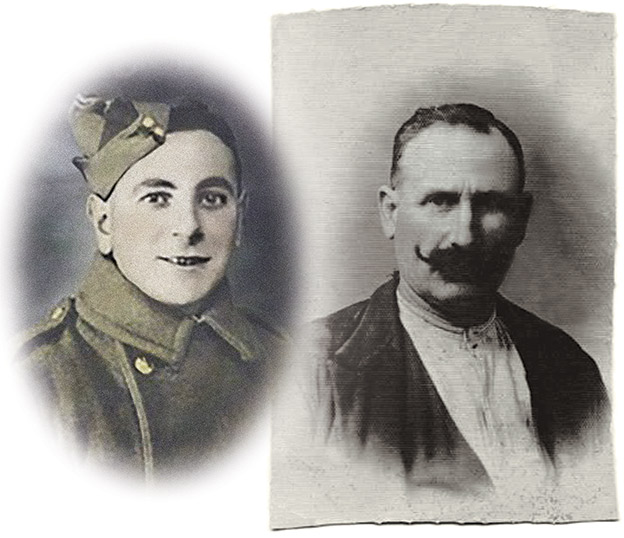
David Garcia and his Italian protector Umberto Capannolo

Last September, at the “Paths to Freedom” (Sentieri di Libertà) event in Servigliano, I had the pleasure of meeting Linda Quigley, daughter of British POW David Garcia, Linda’s daughters Annabel Heath and Miranda Quigley, and Miranda’s husband Roger Bickmore.

Pte. David Garcia, 1/4 Battalion, Essex Regiment, was deployed to North Africa during WWII, and was captured near Mersa Matruh in June 1942.

Unlike most POWs featured on this site, David had not been an internee in PG 59 Servigliano. Rather, he was interned in PG 102 L’Aquila, nestled in the foothills of the Apennine Mountains some 130 kilometers (around 80 miles) south of Servigliano.  

Following the September 1943 Italian Armistice, prisoners of PG 102 left the camp. A War Office document, dated April 1945, in the British National Archives, explains:

“After the Armistice with ITALY had been signed, the Italian Commandant opened the gates of the camp and marched the P/W out into the hills, as it was reported that Germans were approaching. A certain number of escapers were rounded up by German paratroops and taken back to camp, but the majority got safely away.”

David and another escaped prisoner, whom the family believes was named Patrick, made their way to San Giacomo, where they were protected by the family of Umberto Capannolo. 

The exact dates that David and Patrick were with the Capannolos is not known to the family. However, David retained a slip of paper certifying that he had “rendered a statement of his experiences to the British Section, C.S.D.I.C., C.M.F. [Combined Services Detailed Interrogation Centre, Central Mediterranean Forces].” The document is dated 5 July 1944, therefore David may have been on the run in enemy-occupied Italy for as long as 10 months.

On returning home to England, David attempted to contact the Capannolo family in order to let them know he was safely home and to thank them for their kindness.

When the letter was returned to David, he wrote to the British Red Cross asking if they would assist in his contacting the family. 

Continue reading
A VanSlooten-Palmoni Family Reunion

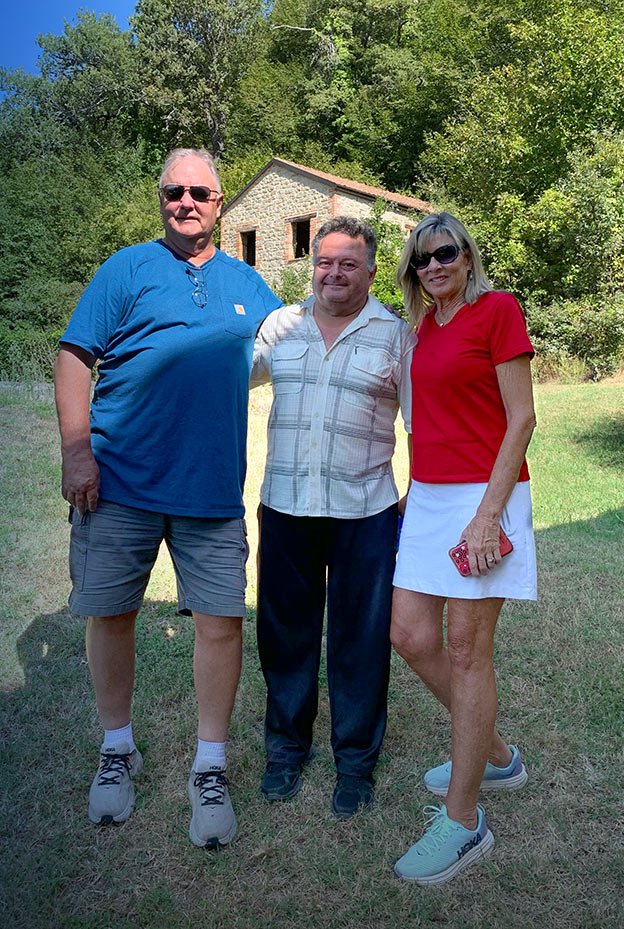
Louis VanSlooten’s son Tom VanSlooten and daughter Karen Miersma embrace Antonello Palmoni

Last September, during the “Paths to Freedom” (Sentieri di Libertà) celebration to honor the 80th anniversary of the Italian Armistice and the breakout of Allied POWs from Italian camps, several attendees had the thrilling experience of meeting descendants of the Italian families who protected their father or grandfather. 

This post is about the meeting of two of escaped POW Louis VanSlooten’s children, Tom VanSlooten and Karen Miersma, and Antonello Palmoni.

Antonello’s grandmother Iginia and grandfather Luigi Palmoni hid and fed Louis and fellow PG 59 escapee Luther Shields. 

Antonello’s father, Marino Palmoni, was a 10-year-old boy when the desperate soldiers emerged from the woods near his family’s home to ask for food.

Read “Martino Palmoni on the Sheltering of the POWs” and “Louis VanSlooten’s Story.”

The old Palmoni home is nestled against a bluff, below the comune of Montefalcone Appennino

Tom VanSlooten was accompanied on this Italian adventure by his wife Carmen, and Karen by her husband Tom Miersma.

Continue reading

Two Pavese Helper Priests

“Many priests in the villages of Pavese helped the Pows,” according to Massimo “Max” Piacentini (a researcher with the Istituto Pavese di storia della Resistenza e dell’età contemporanea) . 

“Don Mario Grugni was a highly-esteemed pastor for many years in Ceranova. But the most important was Don Piero Angelini, pastor of Vairano, about 4 kilometers from Ceranova. Here was the camp of our Pows. Don Piero was an agent of the Ufficio Assistenza Prigionieri Alleati of CLN, and he saved many Pows (I have his memoirs).

“I think Don Piero and Don Mario certainly collaborated with each other to assist and save the local Pows. Also, Don Piero hid Pows in the bell tower and in the attic of his church in Vairano.”

A Don Mario Grugni memorial plaque in Ceranova, Italy. The two photos are of Don Mario Grugni at different ages. 
Continue reading

Dr. Domenico Lunghi—A Safe Harbor for Four Former PG 59 POWs

I’ve recently received a great deal of help and guidance from Massimo “Max” Piacentini, a researcher at the Istituto Pavese per la storia della Resistenza e dell’età contemporanea.

In 1991 Bill Armitt (right) took his wife Hilda back to the scene of his escape, where they met with Dr. Domenico Lunghi (at left)—photo by Hilda Armitt, courtesy Victoria Theatre Archive

Istoreco (istorecopavia.it), founded in 1956, is part of the national network of the Ferruccio Parri Institute. An important leader of the Italian Resistance, Parri understood the importance of preserving the documents of the resistence for posterity. In 1943 he charged his friend Giuseppe Bacciagaluppi with creation of the Ufficio Assistenza prigionieri Alleati of the CLN (Comitato di Liberazione Nazionale, or National Liberation Committee). The organization saved more than 1,500 Allied escaped POWs by guiding them to Switzerland. Documents relating to these saved POW are preserved in Fondo: Bacciagaluppi at the Istituto Parri of Milano. Istoreco of Pavia keeps documents such as the arrest records of POWs in Provincia di Pavia and an archive of oral sources, including interviews with local helpers. 

“My current research,” Max explained, “concerns the Pow camps in the Pavese area and the helpers who offered assistance to the fugitive prisoners after 8 September 1943. In the course of my research, I came across several Pows from camp PG 59 who were transferred in the spring of ’43 to the labor camps of Pavese, in particular to PG 146/23 Landriano.

Continue reading

Long Gone—But Not Forgotten

Peonies in bloom at Rose Hill Cemetery—Bloomington, Indiana

Today is Memorial Day here in the United States, a national holiday for honoring those who lost their lives while serving in the Armed Forces.

On this day, families and others wishing to pay respects to the fallen soldiers visit their graves, sometimes bringing flowers. Originally known as Decoration Day, the time each year for “strewing the graves of Civil War soldiers—Union and Confederate” with flowers was effectively promoted by Mary Anne Williams after the U.S. Civil War. Eventually, the last Monday in May became a Federal holiday.

Each year at this time, I visit one of the oldest cemeteries in my community, Rose Hill Cemetery, where a profusion of peonies bloom just in time for the holiday. These perennials are most concentrated in the oldest part of the cemetery; the largest peony clusters are believed to be well over a century old.

There are many graves in Rose Hill of soldiers from both the First and Second World Wars, as well as those of men and women who served in more recent wars and conflicts. The surnames are very familiar to me, and I reminded that many people I know have had relatives who went to war.

On Camp 59 Survivors, this is an appropriate day to remember three Americans who escaped from P.G. 59 in September 1943, but who did not return home.

Each was killed by Germans or fascists while traveling through enemy-occupied Italy.

Continue reading

A Pause for Reflection

Martin Luther King Jr., 1964—Image courtesy of the U.S. Library of Congress

Every year on the third Monday in January, in the United States we celebrate a national holiday honoring the life and legacy of Dr. Martin Luther King Jr. 

Beginning in 1955, Dr. King was one of the most prominent human rights leaders in America, heading a movement to advance equal treatment of people of color through nonviolent resistance and civil disobedience. As a Baptist minister, he was inspired by his Christian beliefs, as well as the nonviolent activism of Mahatma Gandhi.

Dr. King knew the personal risks he faced, but in an atmosphere of ever-present hatred and threats, he remained steadfast. He was planning a national occupation of Washington, D.C., to be called the Poor People’s Campaign, when he was assassinated on April 4, 1968.

A few of the many heroes of Italian compassionate resistance: Letizia Galiè in Del Gobbo, the Zagnoli family, Giovina Fioravanti, Iginia and Luigi Palmoni, and Sebastiano “Bastiano” Crescenzi

Italian Heroic Resistance

During the Second World War, not dozens, not hundreds, but thousands of Italian citizens—many of them poor farmers and laborers—risked their lives to practice the type of compassion resistance and civil disobedience Dr. King was later to embrace through their feeding and sheltering of escaped POWs who appeared at their doorsteps. 

In a preface to Monte San Martino Trust founder J. Keith Killby’s memoir, In Combat, Unarmed, Giuseppe Millozzi writes of the courageous humanity of these Italians:

“They reached out despite this October 9, 1943 proclamation of Mussolini: ‘Anyone who helps escaped prisoners of war or any enemy by assisting them to escape or by offering them hiding places will be punished by death.’ An evangelical doctrine states, ‘There is no greater love than this: to give up your life for your friends.’ In light of the actions of these Italian peasants, this doctrine might be rephrased to read, ‘There is no greater love than this: to give up your life for your enemies.’ Even though fascist propaganda painted a gloomy picture of the Allied soldiers, these uneducated, simple, and poor farmers were capable of immense courage when they were confronted by these young men. Thanks to their alacrity and kindness, many escapees were saved from deportation. Their selfless actions helped to counterbalance the shame of Italy.”

Today, I remember these remarkable people, just as I pause to remember Dr. King.

An Anniversary

Martin Luther King Jr. Day has a further personal significance for me.

It was on the Martin Luther King Jr. holiday in 2008 that I began camp59survivors.com. The website is 15 years old today! 

To date there are nearly 500 posts on the site. Through my research, I’ve made dozens of wonderful new friends—former servicemen interned in P.G. 59, descendants of the POWs and of Italian helpers, relatives of agents active in the I.S.9 rescues, researchers, and archivists.

I’ve found that in spite of the fact 80 years have passed since the escaped POWs were on the run, there is no shortage of interest in this subject. Whereas in the beginning I was being contacted by children, nieces, and nephews of POWs, increasingly I am hearing from grandchildren and great-grandchildren.

My own interest in the POW stories is as keen as ever, and I’m looking forward to the next 15 years.

Glauco Cesaretti—Recognized for Heroic Action

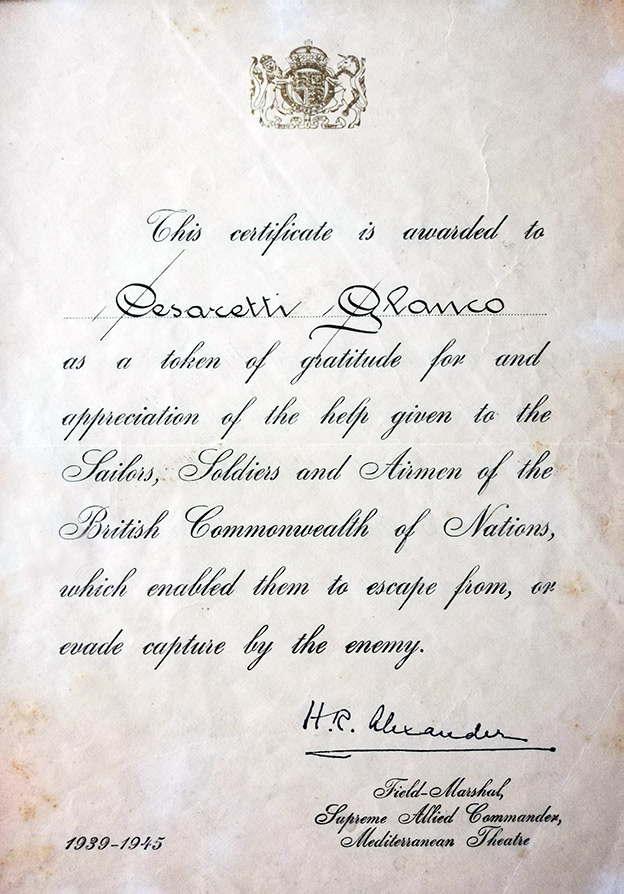
From a contact in Rimini, Italy, I’ve received word that a framed Alexander Certificate awarded to Glauco Cesaretti has come to light. 

In an attempt to learn who Glauco Cesaretti was and why he was recognized by Field-Marshal Alexander, the person who discovered the certificate found a reference to him in a book, Faetano 1944 Victoria Cross (2008, Giunta di Castello di Faetano, publisher). 

In fact, the Alexander Certificate itself appears in the book, where Glauco Cesaretti is credited with hiding two Scotsmen from the Germans. 

Contributor Daniele Cesaretti, in a chapter entitled “Other Battles in San Marino,” describes the September 1944 battle where Glauco Cesaretti fought:

“At noon the forward Cameron troops enter Borgo and house-to-house fighting develops. In the confused fight two Scotsmen are cornered in a house in which Marino Militiaman Glauco Cesaretti is present and who swiftly hides them in the basement, fooling the Germans. Later Pte Cesaretti will be awarded by Allied Officers a certificate signed by General Alexander.” (Cameron Highlanders were among the units fighting that day.)

Continue reading

Alfred Hackett, Royal Artillery

Alfred Hackett in Egypt, 1940 

Recently Nigel Hackett wrote to me, “My father, Alfred Hackett (Gunner, 31st Field Regiment, Royal Artillery), was a prisoner of war at P.G. 59 Servigliano from late January/early February 1942 to June 1942. 

“Dad was captured in a desert battle in December 1941 and was taken to Servigliano via the military hospital at Caserta and the transit camp at Capua.

“He was moved to P.G. 29 Veano from which he escaped in September 1943 at the time of the Italian Armistice.

“He made it back to the British lines at Termoli in October 1943 with the help of an Italian family, two Italian deserters, plus special forces taking part in Operation SIMCOL.

“I am a member of the Escape Lines Memorial Society (ELMS) and a supporter of Monte San Martino Trust (MSMT), and I have visited Servigliano a couple of times with ELMS.

“Dad—who was born in 1916 and died in 2002—had dictated his story to Roger Stanton, now Director of ELMS, when my father was a member of the Army Escape Club. I discovered more details at the Paradata Archive at Duxford about Operation SIMCOL some years ago.

Continue reading

The Departure of Heroes

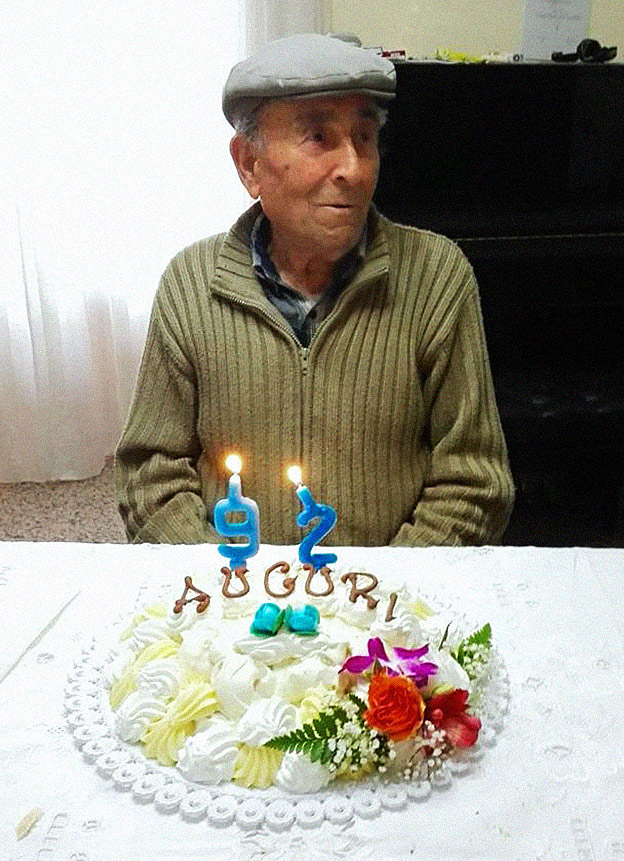
Antonio Del Gobbo on his ninety-second birthday
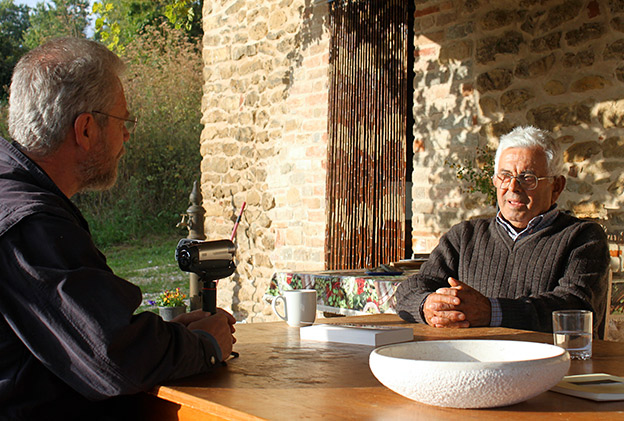
Marino Palmoni is interviewed by Italian historian Filippo Ieranò (left) and Ian McCarthy (not shown), 2010

My father, American Sgt. Armie Hill, was a prisoner of war in P.G. 59 Servigliano during the Second World War.

He escaped from the camp in September 1943, shortly after Italy signed the armistice with the Allies. Although the Italian government had capitulated, much of Italy was still held by the Germans. Escapees from prison camps across central and northern Italy found themselves on the run in enemy-occupied territory—and were at the mercy of local Italians for protection.

The Italians themselves were divided between fascists, who cooperated with the Germans, and partisans, who fought for liberation of their country. Rural laborers and farmers, the contadini, were faced with an ethical dilemma when ragged POWs turned up at their doorsteps asking for food, shelter, or directions. 

Continue reading

Antonio Zagnoli, The Airmen’s Guide

“This photo was taken at Poggio di Casola on September 26, 1941. From left, standing, are Ireneo (brother of my grandpa), my grandma Felicita, and my grandpa Sante; from left, sitting, are cousin Vittorio, my aunt Ada, my uncle Umberto, and my father Antonio” —Marco Zagnoli

Marco Zagnoli recently wrote to me from Italy about his family’s support for Allied airmen in 1943–44. 

“My father told me that he—at the age of sixteen—helped British airmen who were evaders or escaped from prison camps to pass the lines and reach the Allied troops,” Marco said.

“Also, my grandfather provided help, hiding the airmen at our family farm called Poggio di Casola, Castel di Casio village, near Porretta Terme (Bologna). 

“On the British military maps of the area—to which my father could get a look—our farm was marked as ‘a family that helps British troops,’ or something similar.” 

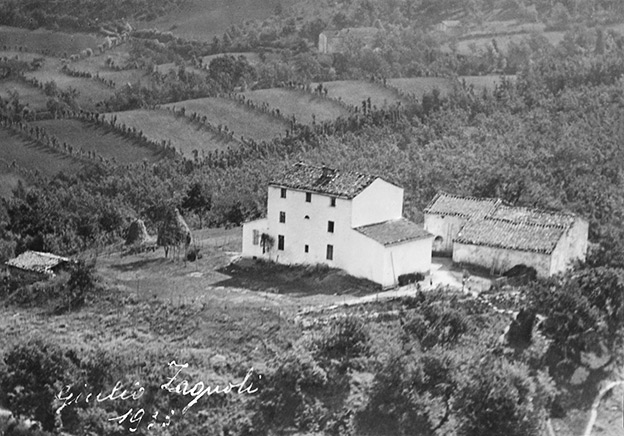
Aerial view of Poggio di Casola, 1933

The airmen, Marco explained, turned up individually at the farm over time. 

Continue reading