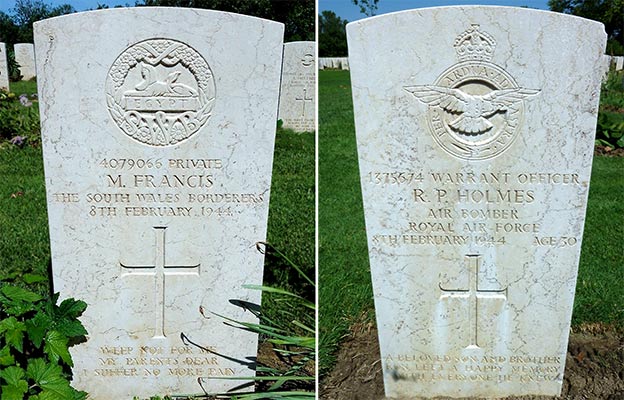
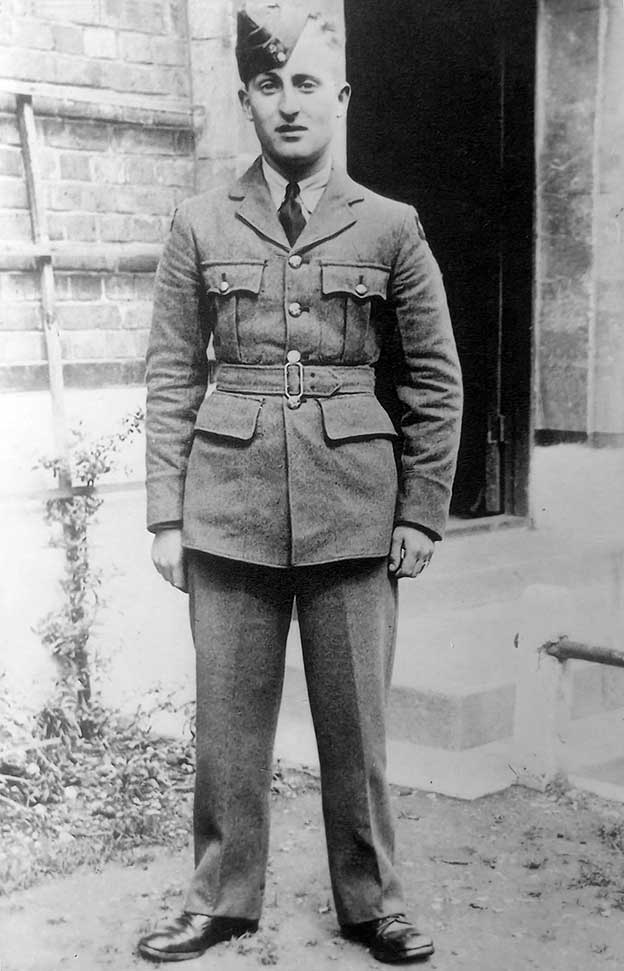
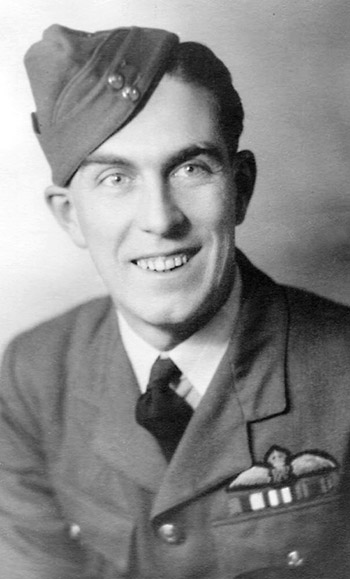
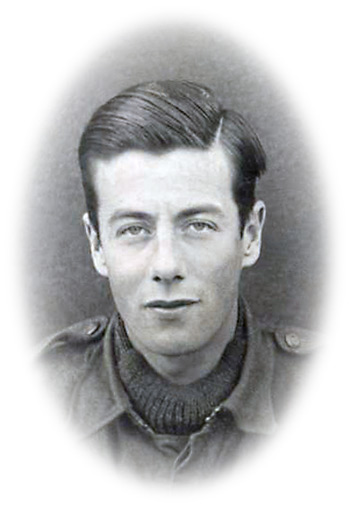
The plane’s navigator, Sgt. Ronald Percy Holmes (1375674), was shot by fascists after escaping from PG 59. James shared with me several statements from the investigation into the crash, DV416 AIR 81/11245, on the shooting of Ronald Holmes and Morgan Francis.
Rear Gunner Sgt. Robert Charles Davis—image courtesy James DavisSecond Pilot Warrant Officer Stuart Marshall Cross—image courtesy the Canadian Letters & Images Project
Occasionally I post a query on this site that goes unaddressed for months or years, and then suddenly, out of the blue, the mystery is addressed. This happened to me last week.
In 2015 I had published a post titled “Italian Helpers—Two Queries.” My friends Anne Copley and Giordano Viozzi were searching for information on Ronald P. Holmes, who had been sheltered by Oreste Belleggia of Piane di Falerone.
At the time I couldn’t help.
However, last week I received an email from James Davis:
“My grandfather’s Wellington Bomber ran out of fuel and landed in Sicily, with at least some of the crew ending up in PG 59.”
It turns out Ronald P. Holmes was the navigator on this downed Wellington Bomber.
“I’m slowly working through archives to find out more of his story,” James explained. “I’m organizing my notes at fettle.org.uk/DV416/.
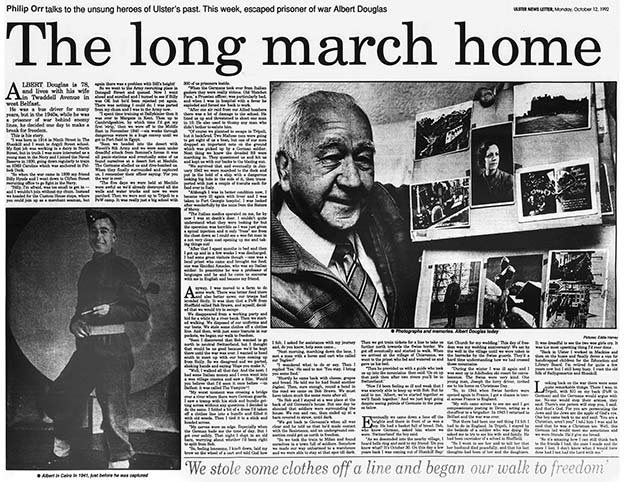
Last September, I was pleased to receive a newspaper clipping from Richard Minshull regarding POW Albert “Paddy” Douglas, about whom I’ve written several posts.
Albert Douglas was Richard’s wife‘s grandfather.
The clipping, published in 1992 in Belfast, Northern Ireland, had been overlooked when Richard sent me a wealth of other clippings, documents, and photos several years ago.
The long march home
Philip Orr talks to the unsung heroes of Ulster’s past. This week, escaped prisoner of war Albert Douglas
Ulster News Letter Monday, October 12, 1992
Albert Douglas is 78, and lives with his wife in Twaddell Avenue in west Belfast.
He was a bus driver for many years, but in the 1940s, while he was a prisoner of war behind enemy lines, he decided one day to make a break for freedom.
This is his story.
“I was born in 1914 in Ninth Street in The Shankill and I went to Argyll Street school. My first job was working in a dairy in North Street, but in truth I was more interested as a young man in the Navy and I joined the Naval Reserve in 1930, going down regularly to train on HMS Caroline which was anchored in Pollock Dock.
“So when the war came in 1939 my friend Billy Hynds and I went down to Clifton Street recruiting office to go fight in the Navy.
“Billy, I’m afraid, was too small to get in and I wouldn’t join without my chum. Instead we headed for the Custom House steps, where you could join up as a merchant seaman, but again there was a problem with Bill’s height!
“So we went to the Army recruiting place in Donegall Street and queued. Now I went ahead and enrolled and I turned to see if Billy was OK but he’d been rejected yet again. There was nothing I could do; I was parted from my chum and I was in the Army now.
“I spent time training in Ballykinler then it was over to Margate in Kent. Then up to Cambridgeshire, by which time I got my first ‘stripe,’ then we were off to the Middle East in November 1940—six weeks through dangerous waters in a huge convoy until we got to Port Said in Egypt.
“Soon we headed into the desert with Wavell’s 8th Army and we were soon under dreadful attack from Rommel’s forces: it was all panic-stations and eventually some of us found ourselves at a desert Fort in Mechile. The Germans shelled us and dive-bombed us. When they finally surrounded and captured us, I remember their officer saying: ‘For you the war is over.’
E. R. H. Silverman, accompanied by Private A. Kuhn (South Africa), Sergeant D. Almon (Royal Canadian Air Force), and Sergeant R. Rognon (Free French Infantry), stayed in Servigliano area and the southern provinces of Macerata and Ascoli-Piceno until middle of May 1944. They then joined a party of 10, which became 14, and was sent south with a series of Italian guides arranged by an organization.
They were-captured by Germans in the Maiella mountain range and taken north on foot.
They escaped on 13 June 1944 with Sergeant W. Dickson at Giulianova and hid until the Germans moved off. The escapees were sheltered by an Italian for two days, until the arrival of British and Polish forces on 16 June 1944.
Their Italian helper was Aloisi Greatano of Giulianova, Teramo (Abruzzo)
The “Alphabetical Lists”—WO 392 in The National Archives, UK—are compilations of WWII prisoners of war from all branches of British Forces, including other nationals under British command, held in Germany or German-occupied territory, Italy, and Japan or Japanese-occupied territory.
A publication date of August 1943 given for WO 392/21, a subseries listing Imperial POWs who were reported by Italian or Red Cross sources as being prisoners in Italian hands.
The Italian WO 392/21 is comprised of:
Section 1: British Army. Section 2: Australian Army. Section 3: Canadian Army. Section 4: New Zealand Army. Section 5: South African Army. Section 6: Indian Army. Section 7: Naval Forces and Merchant Seamen. Section 8: Air Forces.
In 2015—16, I shared on this site POWs from the WO 392/21 subseries listed as being interned in PG 59. However, at that time I overlooked Section 8: Air Forces. I am now correcting that oversight by adding the airmen of the RAF now.
The three surviving crew members of the downed Blenheim Z7800 bomber (left to right, pilot Sgt. Allan John Lee, navigator Sgt. Richard Haggett, and wireless/air gunner Sgt. Ambrose John Comeau—image courtesy Acqui Museum/Associazione Mediterraneo
I wrote a post in August 2018 titled “Sergeant Allan Lee Downed in Greece,” concerning an Allied aircraft, Blenheim Z7800 (Squadron 107, Royal Air Force), which was downed at Kefalonia Island, west of Greece, on 13 December 1941.
The bomber had been on an operation against Argostoli Harbor.
Most of the crew were killed. Three crew members survived and were captured:
The pilot, Sgt. Allan John Lee, RAFVR (Royal Air Force Volunteer Reserve), was interned in PG 59 Servigliano; navigator Sgt. Richard Haggett, RAFVR, first interned in PG 59, was ultimately interned in Stalag VII-A Moosburg; and wireless/air gunner Sgt. Ambrose John Comeau, RCAF (Royal Canadian Air Force), first interned in PG 52, was ultimately interned in Stalag VIII-B/344 Lamsdorf.
Details for the 2018 post were provided by Greek researcher Thanos Antonelos.
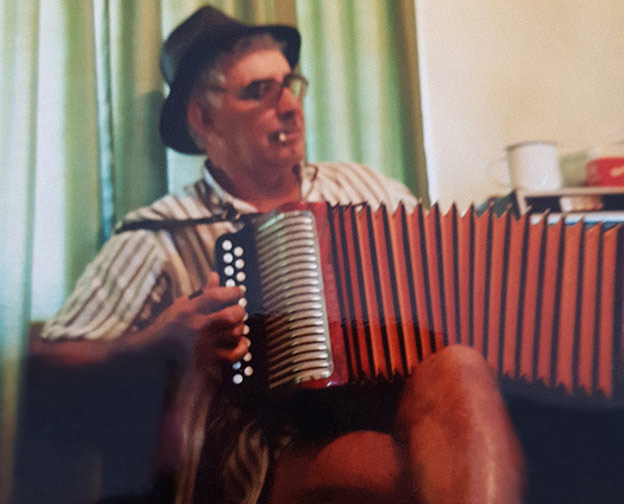
Jimmy Feehan in the early 1980s, at ease with his accordion—image courtesy of Pamela Robinson
If you type “Feehan” in the search box on this website you’ll see that references to Australian infantryman James “Jimmy” Feehan have occurred in a number of posts. For years has Jimmy struck me as a particular interesting fellow, so I’m devoting this post exclusively to him.
Jimmy enlisted on 18 June 1941 and served in the 2/32 Infantry Battalion of the Australian 9th Division, which saw action in North Africa in 1942. Jimmy’s military record notes he was reported missing in action 17 July and officially confirmed a POW on 22 October 1942.
The Australian War Memorial website has this description of the conflict at El Alamein where Jimmy was captured:
The war in North Africa had become critical for the British forces. In July 1942 Germans and Italians had reached El Alamein in Egypt, about seventy miles from Alexandra. The 9th Division was consequently rushed to the El Alamein area and held the northern sector for almost four months as the British Eighth Army was reinforced for an offensive under a new commander.
The division’s orders for the first attack were issued on 7 July. Moving inland from the coast, the 2/32nd and 2/43rd Battalions (comprising the 24th Brigade) would attack along the ridgeline from Trig 22 and approach Ruin Ridge. The 2/32nd would lead the attack, advancing from Trig 22 to the Qattara Track. The 2/43rd would then proceed towards Ruin Ridge.
The attack began on 17 July at 2.30 am. The 2/32nd captured the Trig 22 and linked with the 2/43rd but the Germans resisted fiercely and counter-attacked with tanks. The 2/32nd suffered heavily: nearly half its number were either killed or wounded and nearly 200 became prisoners of war. The fighting continued for several days.
Welsh POW Ronald McCurdy’s daughters Rona Crane and Jeannie Hendra made a physical and emotional journey early this summer that they had long anticipated.
With the help of Janet Kinrade Dethick and Professor Giuseppe Zucca, their adventure led them on a search for the internment camp where their father labored and from which he escaped, as well as to places where he hid while he was on the run.
Janet recounts the days they spent together in the following essay.
Gunner Ronald Edmund McCurdy
A Strange Coincidence
Janet Kinrade Dethick, July 2025
Several years ago, as a result of a contact I made through the WW2Talk forum, I got to know Professor Giuseppe Zucca, whose book about prisoners of war in Lomellina—the rice-growing area to the south west of Milan in Lombardy—I subsequently translated. It tells the story of how his mother, Giovanna Freddi, had helped three escaped South African prisoners of war to reach neutral Switzerland after the declaration of the Armistice on 8 September 1943.
Prof. Zucca’s second book on this theme, I Giusti di Lomellina, (The Righteous of Lomellina) which examines the role local people had played in hiding and helping the escaped prisoners, came out late in 2022, and my husband Enzo and I were invited to its presentation in Vigevano in January 2023. Not only did this visit strengthen the professional link between myself and Prof. Zucca, we have now become firm friends.
Towards the end of 2024 I began helping Penny Hayes, the daughter of Trooper John Richard Shaw, to find out who had assisted her father before he left Lomellina for Switzerland on 14 November 1943. Trooper Shaw had been transferred from PG 59 Servigliano to Lomellina in June 1943. In this case the name Angelo Comelli, cited in Trooper Shaw’s Escape Report, appears in a list held in the Commune of Vigevano of persons who had been awarded the Alexander Certificate. Prof. Zucca had obtained a copy of the list when researching his book, and he soon found Carla Liliana Comelli, granddaughter of Angelo, who is now corresponding with Penny.
In my 2020 post A Haven in Smerillo, I shared a story about the sheltering of two escaped POWs by a remarkable woman, Letizia Galiè in Del Gobbo, a widow with six children.
The story of Letizia Del Gobbo’s heroism came to me from her grandson Marco Ercoli. When Marco contacted me, he recalled that the family simply referred to the two escapees as “Michele” and “Beo.”
Letitia Del Gobbo carrying gathered firewood
Marco recalled that “Beo” had years ago returned to Smerillo with his wife, Nadine. The 1990 homecoming was deeply emotional for both the American couple and everyone in Smerillo—both family and older neighbors. In relaying the story, Marco described the event best as he could from memory—taking a degree of creative liberty to enliven it with recreated conversations and detail.
The only evidence of the visit was a photograph of the American couple with Marco’s uncle Antonio and Antonio’s wife Viola, with a notation on the back: “Nadine and Bill.” That made it clear that the man they called “Beo” was Bill, or William.
“Michele” in English would be Michael, and Marco’s uncle Antonio, who was a teenager when his mother sheltered the POWs, confirmed that “Michele” was American serviceman Michael Rotunno.
Since then, in spite of delving into archives, no further information about Bill and Michael came to light until last March, when I discovered that after the war Letizia had submitted a claim to the Allied Screening Commission requesting compensation for sheltering POWs. From the U.S. National Archives (NARA) I ordered a digital copy of Letizia’s helper claim.
The claim turned out to be a goldmine of information.
Carola Bauducco and her husband Giovanni and their daughter Maria, whom they called Ginetta
In a claim received by the Allied Screen Commission, Italy, on 1 October 1945, Maria Bauducco Di Giovanni (Giovanni’s daughter) of A. Diaz 29, Gassino (Torino) requested compensation for the sheltering of Corporal Ronald Leonard Dix (service number 6022221) and Gunner Robert Dickinson (service number 896957).
The applicant was Maria Concetta Bauducco, who was called Ginetta, or Gina. Ginetta/Maria was one of the daughters living at home when the Bauducco family sheltered Ron and Robert.
The value of the assistance was determined by the commision to be:
Value of food and lodging supplied: 54,270 lire Value of clothing supplied: 6,000 lire Money advanced: — General unspecified assistance (GSA): 730 lire Total: 61,000 lire
As evidence two postcards are included in the claim. Both are addressed to Gent. Signora Bauducco of Via A. Diaz, Gassino, Torino, and they express holidays wishes. The cards are signed Ron and Robert. As the cards are postmarked with the same date and location, we can assume Ron and Robert were together at the time they were sent.
In her claim, Maria noted, in Italian:
“I have received a card dated December 18–19, 1944; the prisoners were led away by my father and entrusted to the partisan Carlo, who to the present day resides in Castelnuovo Don Bosco; I also am acquainted with him. The two English prisoners were brought away owing to the threats of the Germans. Germans occupied my courtyard.”
According to Maria’s claim, food and lodging were provided to Robert and Ron from 10 September 1943 until 18 October 1944. According to the application “complete clothes” were also provided for both Robert and Ron.
An appendix in the claim mentions that both Ron Dix and Robert Dickinson were killed while fighting with the partisans.
Appendix A of the application reads: “Cpr. Dix & Gnr. Dickinson were killed by the Fascists while fighting with the Partisans. They had been staying at a house in GASSINO for 13 months. This is evidently claimant’s house, as no one else has claimed for these two P/W. These details have been given by T/18033 Drv. BROWN E. The postcard Robert sent to Maria reads: “Touti saluti e Buone Feste—Robert” [Best regards and Happy Holidays].The postcard Ron sent reads: “Ricorrendo te feste di invio i miei saluti fini sinceri—Ron” [With the arrival of these holidays I send you my sincere greetings].Tranquil landscapes are featured on the fronts of Robert and Ron’s postcards.
A full index of Italian claimants requesting compensation for assisting escaped Allied POWS or evaders during World War II is available on the U.S. National Archives (NARA) website.