Category Archives: Prisoners—Camp 59

Ronald Bertie Bones—An Album

“A portrait of Bertie from an unknown time,” says Jeremy Bones, “but given he looks young, it could be pre-WW2.”

I received an email last month from Jeremy Bones.

He wrote, “I am currently conducting research into my great-grandfather, Gunner Ronald Bones, who was held as a POW in Camp 59. I have noticed that Robert Dickinson, who wrote “Servigliano Calling,” was also in the camp but, more importantly, was in the same battery as my great-grandfather, 237 Battery of 60th Field Regiment, Royal Artillery.”

Indeed, Ronald Bone’s address is one of 20 recorded in Robert’s journal. As such, it seems likely he and Robert were good friends. See “Robert Dickinson’s Address List.”

“My great-grandfather was born on 21st August 1910 in Grimsby and lived in Lincoln his entire life.” Jeremy said.

“I have a number of photos of him in my possession, and a good few are of him in POW camps. I know some of them are from Stalag VIIIA.

Continue reading

Louis VanSlooten’s Story


Louis VanSlooten before going overseas

I have known Louis VanSlooten’s son Tom VanSlooten since 2008.

Tom was one of the first family members of Camp 59 POWs I met when I began my research into the camp’s history. I met him through email the same month I began this site.

Tom’s dad was living and active then.

At the time, Tom wrote, “My father has been writing his story off and on for many years and has recently started writing again. It has been a difficult task for him. He told me just a week ago when we were at our family cabin in Northern Michigan that he has spent 65 years trying to forget what happened, and now is having in some way to go back and relive it again to write it all down.”

Louis came close to finishing this memoir before he died in 2011. His granddaughter (Tom’s niece) Jessica Lyn VanSlooten edited and completed the story, which I am pleased to share in this post.

The story is full of excellent detail. Of particular interest to me are the attentiveness and lifesaving efforts of the camp medical doctors, Captain J. H. Derek Millar and Adrian Duff. In his research, Giuseppe Millozzi references Dr. Duff as having cut his own arm, collected blood, and then donated it to his patient through a rubber tube. As it turns out, Louis was a witness.

Continue reading

Tom Alman—Back Home in Western Australia

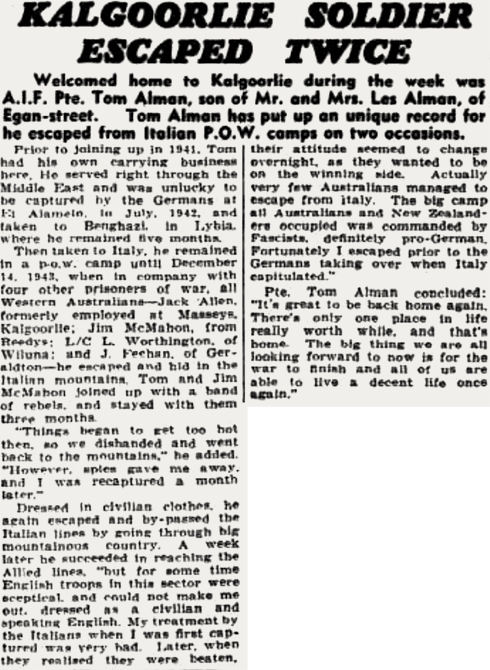
Ray Worthington (son of P.G. 59 escapee Les Worthington) and Linda Veness (daughter of escapee Jim McMahon) discovered and shared this 1944 news article with me this week.

Kalgoorlie Soldier Escaped Twice

Sunday Times (Perth, Western Australia)
Sunday, 24 September 1944

Welcomed home to Kalgoorlie during the week was A.I.F. Pte. Tom Alman, son of Mr. and Mrs. Les Alman, of Egan-street. Tom Alman has put up an unique record for he escaped from Italian P.O.W. camps on two occasions.

Prior to joining up in 1941, Tom had his own carrying business here. He served right though the Middle East and was unlucky to be captured by the Germans at El Alamein, in July, 1942, and taken to Benghazi, Lybia [sic] where he remained five months.

Then taken to Italy, he remained in a p.o.w. camp until December 14, 1943, when in company with four other prisoners of war, all Western Australians—Jack Allen, formerly employed at Masseys, Kalgoorlie; Jim McMahon, from Reedys; L/C L. [Leslie] Worthington, of Wiluna; and J. [Jimmy] Feehan, of Geraldton—he escaped and hid in the Italian mountains. Tom and Jim McMahon joined up with a band of rebels, and stayed with them three months.

Continue reading

Charles H. Ebright

Charles Herbert Ebright

On January 28, I posted on this site a list of 51 escapees who were helped by Domenico Mancini, an Italian. (See “Domenico Mancini—A Key Italian Assister.”)

According to Allied military records, Domenico Mancini “had helped American and British prisoners in every way possible after their departure from POW camps by giving them food and shelter.”

One name in particular on this list stood out to me—Charles H. Ebright of South Bend, Indiana.

I live in southern Indiana, and South Bend is about 200 miles north of my home.

I searched online for any mention of Charlie, and quickly discovered his obituary on the Palmer Funeral Home—Guisinger Chapel website.

Charlie had passed away just 12 months earlier, in January 2017. Staff at the funeral home kindly put me in touch with Charlie’s niece, Angie Brechtel.

Angie and I exchanged several emails, through which she shared the following memories of Charlie with me:

“I came into Charlie’s family 15 years ago when I married his nephew Craig. Charlie was a fixture then. Everyone said he attached to me because I was a lot like his first love and wife, Viv.

“He did not have children, so we were the only family he had. When he became ill, I stepped in. I saw him several times a week, took care of all his finances, which led to my becoming his power of attorney, healthcare representative, and all that goes with it, for a little over 10 years.

“As his health declined, my visits and responsibilities increased.

Continue reading

To Talk or Not To Talk

pow_instruction_r72

Tomorrow is my father’s birthday. He died in 2000, but had he lived, he would have been 100 years old. He was born on February 9, 1918, to Finnish immigrants in a lumber camp in Michigan’s heavily forested Upper Peninsula.

I’m dedicating this post to his memory.

The document pictured above, issued by the U.S. War Department, entitled “Amended Instructions Concerning Publicity in Connection with Escaped Prisoners of War, to Include Evaders of Capture in Enemy or Enemy-Occupied Territory and Internees in Neutral Countries,” is dated August 6, 1943.

The document stresses the need for secrecy about information relating to the POW experience, and it lays down guidelines.

It states, “Information about your escape or your evasion from capture would be useful to the enemy and a danger to your friends. It is therefore SECRET.”

Former prisoners, on their repatriation, were required to sign the form.

The poor condition of this copy suggests my dad carried it folded in his pocket or wallet for some time after his return to freedom.

The form instructs servicemen to not disclose, except to certain military personnel, the following information:

(1) The names of those who helped you.
(2) The method by which you escaped for evaded.
(3) The route you followed.
(4) Any other facts concerning your experience.

“You must be particularly on your guard with persons representing the press,” it says, and “give no account of your experiences in books, newspapers, periodicals, or in broadcasts or in lectures.”

Continue reading

British Captives Drank Champagne

The following two newspaper articles were provided by Vanda Jessopp, daughter of Stanley Thomas Dunn, a POW was interned with Jimmy Peters in Camp 59. (See “Stanley Thomas Dunn.”)

The Germans Got Merely Rice-Stew
Their British Captives Drank Champagne

After being held in an Italian camp for two years Private J. Peters, R.A.M.C. has arrived back at his Halchard-road (Upper Halloway) home after travelling through Turkey, Egypt and South Africa. He said to-day:

“The Germans made us work 17 hours a day for seven days a week in a working party in Tripoli, but as it was on a food dump we enjoyed it. When the Jerries were lining up for rice stew we were lying in the shade drinking sherry and champagne and eating 7 lb. tins of ham. It was nothing to eat a whole tin of pears at a time.”

He is to marry Miss Joan Lines, Falkland-road, Honsey.

Caption for two photos:
Pte. James Peters and Miss Joan Lines.

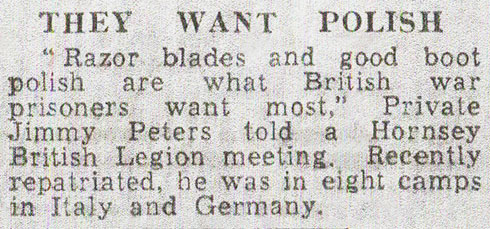
They Want Polish

“Razor blades and good boot polish are what British war prisoners want most,” Private Jimmy Peters told a Hornsey British Legion meeting. Recently repatriated, he was in eight camps in Italy and Germany.

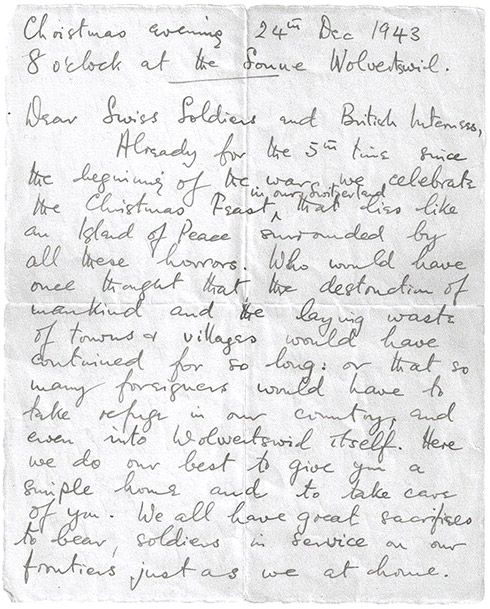
An Address in Switzerland—Christmas 1943

The following address from among Stanley Thomas Dunn’s papers from the war appears to be remarks given before a Christmas evening dinner at the Sonne Wolfertswil—the Sonne Restaurant—in Flawil, a municipality in the canton of St. Gallen, Switzerland.

See “Stanley Thomas Dunn” for more details.

A Christmas Address

Christmas Evening 24th Dec 1943 8 o’clock at the Sonne Wolvertswid.

Dear Swiss Soldiers and British Internees,

Already for the 5th time since the beginning of the war we celebrate the Christmas Feast in our Switzerland that lies like an Island of Peace surrounded by all these horrors. Who would have once thought that the destruction of mankind and the laying waste of towns & villages would have continued for so long; or that so many foreigners would have to take refuge in our country, and even into Wolvertswid itself. Here we do our best to give you a simple home and to take care of you. We all have great sacrifices to bear, soldiers in service on our frontiers just as we have at home.

Your thoughts will naturally be at home with your dear ones; your fathers, mothers & sweethearts and children which we quite understand. When will they see you again and embrace you with the desire “For no more war in all the world.” So let us celebrate Christmas in my family circle simply & modestly. This little celebration will bring us nearer to one another until the star of peace shines brighter and you will be at your own fireside. We hope and pray that this desire will bring the reality “Peace be unto men of good will”.

So only take courage brothers; tomorrow cares and troubles will be swept away and the sun will shine again on our native land. Above all we thank you especially for your excellent behavior and chivalry.

We wish you luck and a very Merry Christmas.

from Loser Hofstetter his family and children.

Continue reading

Stanley Thomas Dunn

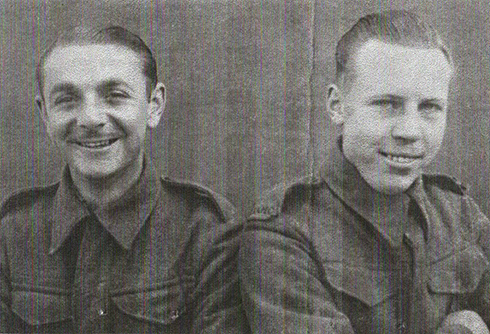
At left, Stanley Thomas Dunn, 5th Battalion Royal Tank Regiment; at right, James (Jimmy) Peters, Royal Army Medical Corps. Photo taken in Camp 59, Servigliano.

My friend Anne Copley met Vanda Jessopp and her husband Peter last November at the 2017 Fontanellato–Monte San Martino Trust Luncheon in London. They have since exchanged information about Vanda’s father, Stanley Dunn, that they are allowing me to share here.

Stanley Thomas Dunn (Trooper 7908395, 5th Battalion, Royal Tank Regiment), was captured in North Africa on April 8, 1941.

He was born November 6, 1919. He died February 22, 2003.

Here is the apparent chronology of his internments:

From Africa, Stanley was transported to Sicily (where the POWs built a road). From Sicily he was sent to Servigliano (P.G. 59), then Fontanellato (P.G. 49), and finally Sforzesca (P.G. 146/18). He escaped from Sforzesca and in time was able to make his way to Switzerland, where he lived in Camp d’Eoades in Arosa, Switzerland, until his repatriation.

It’s somewhat of a mystery why Stanley would have been sent from Servigliano, which was an “other ranks” camp to Fontanellato, which was an officers’ camp before being transferred to Sforzesca.

After his escape in Italy, Stanley was helped by Eric Newby’s wife-to-be Wanda Skof.

British travel writer Eric Newby, who during the Second World War served in the Black Watch and Special Boat Section, was captured in August 1942. He escaped from Fontanellato POW camp after the Italian Armistice and was befriended by Wanda Skof, a Slovenian woman living with her family nearby. Eric married Wanda after the war.

Continue reading

Douglas Allum’s Camp 59 Prisoner List

I’ve exchanged several notes with Bruce Allum throughout 2017. Bruce’s father, Douglas Walter Allum, Service Number 2585112, Royal Signals (2nd Middlesex Yeomanry) was captured in Libya on December 29, 1941.

Douglas was in P.G. 66 Capua (February 2–March 10, 1942), P.G. 59 Servigliano (March 11, 1942–June 2, 1943) and P.G. 146/18 Sforzesca (June 3–September 10, 1943), before escaping and making his way to Switzerland on November 17, 1943.

He passed away on November 6, 2014.

Bruce sent me a two-page prisoner list kept by his father. A note at the bottom of the list indicates “All at Campo P.G. 59.” It contains details on rank, bed, section, and hut.

On the list, there are check marks after four names; a different kind of mark precedes 12 names. There is no indication what these marks signify.

Continue reading

American Escapers from P.G. 59

The “Scheda Personale P.G.” Italian personal identification card for my father, Sgt. Armie S. Hill. Greg Bradsher describes these prisoner of war cards, now held at the U.S. National Archives, in his research below.

Last month, I received an excellent paper written by historian Greg Bradsher of Silver Spring, Maryland.

He has generously allowed me to share his research on this site:

Stories of American Escapers from Prisoner of War Camp 59, Servigliano

Greg Bradsher, Ph.D.

At the time of the Italian Armistice on September 8, 1943, there were almost 80,000 Allied prisoners of war in Italian prisoner of war camps. Among these prisoners of war were 1,310 Americans; many were soldiers captured in North Africa and airmen shot down over Italy. (1)

Most of the American prisoners of war were confined at Camp 59, at Servigliano. This camp, 15 miles north of Ascoli, in the foothills of the Apennines, held perhaps as many as 3,000 prisoners, mostly Allied enlisted personnel. Although the camp was well-guarded and thorough searches were frequent, numerous tunneling projects were continually in progress. There were quite a few escapes, but most of the prisoners were recaptured. (2)

When the Allied prisoners of war learned of the Armistice, most were in a quandary as to what action to take. Under orders received earlier in the summer, most remained in their camps under the mistaken impression Allied forces would soon liberate them. Italian camp authorities also faced their own quandaries. Without clear orders as to what to do, many simply opened the gates to allow the prisoners to leave their camps. During the first days after the Armistice, perhaps as many as 50,000 prisoners remained in their camps and quickly became prisoners of the Germans. Another 30,000 left their camps. Some 16,000 were recaptured and 4,000 found safety in Switzerland. The remaining 10,000 found safety in hiding with the help of Italians, and many found their way back to Allied lines.

Continue reading