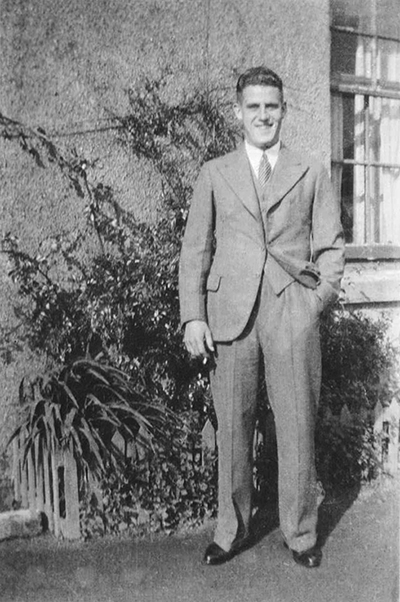
Arthur T. Sayler
“My father was an American who escaped from Camp 59 when the Italians surrendered,” Susie Wickman wrote to me from her home in Colorado last November.
“He lived in a cave with help from the Italian people, until he was approached by an Italian man who offered to take him and his partner back behind Allied lines. I am trying to find information about this man who helped my dad and “Buck” Vanous. [See “Elwyn “Buck” Vanous—P.G. 59 Escapee.”]
“I recall my dad said this man approached them and told them his story.
“He had been living in America, when he was overheard to say on the phone, ‘I’ve got the package’ during the time of the Lindbergh kidnapping. He didn’t have anything to do with that, but he was deported. He told my dad that he loved America and was helping the Allies all he could so he could get back to America.
“He asked my dad to sign something like a petition at the time, but my dad was suspicious and did not. I don’t know if he was a member of the Italian resistance, or what.
“I would like to thank this man, or his family, as well as to accurately capture the story. If anyone has any knowledge of him, would they let me know?
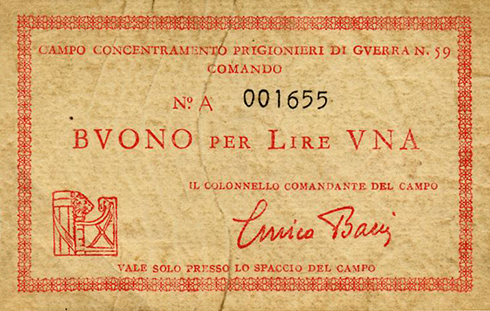
“I have my father’s POW disability statement where he mentions Camp 59 by name.
“We know the name of the family in Italy that helped him—the Catalano family. The Catalanos were from Le Piane, Abbateggio [Pescara]. They had twin boys who eventually emigrated to America, and my dad was friends with them his whole life.
“I am still in touch with one of them, Romolo Catalano.”
Arthur Sayler’s Story
The following account of Arthur’s experience is derived from the disability application Arthur filed after the war.
ARTHUR T. SAYLER
Peoria, Arizona
Army Serial Number 37025925
On April 11, 1941, at age 23, Arthur Sayler of Wishek, North Dakota, was inducted into the U.S. Army at Ft. Snelling, Minnesota. He was assigned to Infantry Company A, 135th Infantry First Battalion, 34th Infantry Division.
From there, he was sent to Camp Claiborne, Louisiana, where the Louisiana Maneuvers of the Red and Blue Armies were conducted.
Continue reading →