Category Archives: Prisoners—Camp 59

Captain J. H. Derek Millar

J. H. Derek Millar grew up in Scotland. He qualified in 1937 from Edinburgh University and had been working in hospital medicine when the war broke out and he volunteered for service.

He was posted to go overseas in 1941. He served in North Africa and was captured in Egypt and was sent to Camp 59.

As one of two medical officers in the camp, he was confronted by primative hygienic conditions, poor nutrition and insufficient food in general, harsh climate, pests and parasites, and lack of medicine and tools for carrying out routine care.

On September 9th, the day the Italian Armistice was announced in the camp, Sergeant Major Hegerty, who had been commanding officer at Camp 59 for one year, relinquished his duties. Captain Millar volunteered to take over command of the camp.

It was in this commanding role that Captain Millar—just five days later—negotiated with the commandant, Colonel Bacci, for release of the prisoners.

Continue reading

Carnival Time

The photos in this post are from Maggie Clarke, daughter of Camp 59 British prisoner Denis Crooks.

Denis kept a suitcase—a veritable treasure trove—of letters, newspaper clipping, and photos related to his POW experience.

Maggie explains, “We didn’t find his suitcase full of these letters until after he died nine years ago. We also have some photos which he took of camp life, although as he said, he would have been shot if he had been caught! He must have got to a point where he didn’t care.”

She continues, that the photos “aren’t of brilliant quality as he somehow had them developed in camp! I seem to remember he mentioned bribing one of the guards! Mind you, by reading of some of the inventions he and Bob made, they probably made their own dark-room!”

Bob, of course, is Denis’ close friend and fellow prisoner Robert Dickinson.

Continue reading

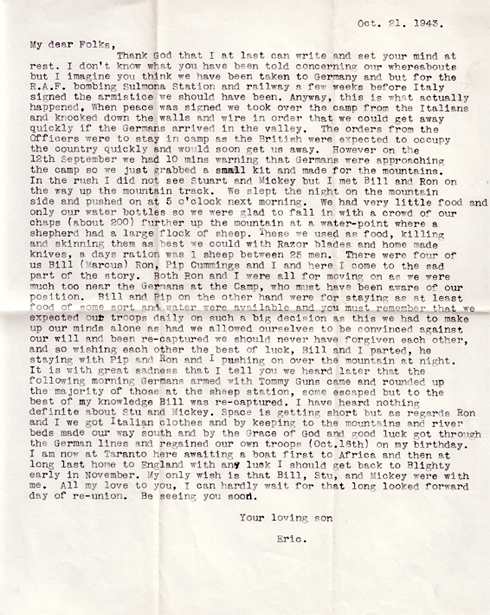
A Letter from Eric

The following letter is from Maggie Clarke, daughter of former Camp 59 prisoner Denis Crooks.

Maggie writes that this letter, “…is a bit of a mystery to us. It was included in with Dad’s letters, but is from someone called Eric who addressed the letter to ‘My dear Folks’ and signed it ‘Your loving son, Eric’. The letter is typed, which I would think is quite unusual but it looks quite old.

“It’s quite a sad story and I would love to find out more, but no idea where to start. As you will see, the letter is dated October 1943 which is when Dad was moved to Stalag IVG in Germany. I’m looking through the letters again to see if I can find any reference to any of the men mentioned, but no luck so far.”

Although the description of the post-armistice camp evacuation matches accounts from other prisoners, the date Eric gives of the escape is the night of September 12, whereas the actual date of the escape from Camp 59 was September 14. It may be that he simply got the date wrong. That Ron and Eric made it to the Allied lines in a little more than one month is impressive.

Continue reading

A Southward Migration

This undated newspaper photo was clipped and saved by British former prisoner-of-war Denis Crooks.

The source, the Evening Standard, is evidently the London Evening Standard.

The caption reads:

“‘Welcome Home’ Sign in Italy

“So many Allied officers and men are escaping through the enemy lines to the Eighth Army that directional signs have been put up for them. One of the signs in the village of Vinchiaturo.”

[The stenciled sign in the photo reads “ALLIED EX POW REPORT HERE.”]

Two Transfer of Personnel Documents

Document No. 1—November 3, 1943

The following “transfer of personnel” document—my father Sergeant Armie Hill’s “ticket home” after reunion with the Allied forces following his escape—was framed and proudly displayed on our living room wall for many years when I was a child.

Armie and his escape companion Ben Farley made it to the Allied lines in 31 days, having traveled an estimated 300 miles on foot through the mountains in order to evade recapture. They escaped on September 14 and arrived at the British Eighth Army line on October 15.

These eight men were the first prisoners to turn up, and Armie later said, “They didn’t know what to do with us.”

All eight escapees listed in this document escaped from Camp 59 in Servigliano.

Continue reading

A Visit to the Palmoni Home

On a sunny morning late last September, Marino Palmoni and his son Antonello took a group of us to see the area of Montefalcone Appennino where, during World War II, the Palmoni family sheltered escaped prisoners of war.

Along for this tour were: Anne Bewicke-Copley and David Runciman (who own a home in Montefalcone), Aat van Rijn (from the Netherlands, now a resident of Montefalcone), Steve Dickinson (visiting from England), and Mark Randolph and I (visiting from the United States).

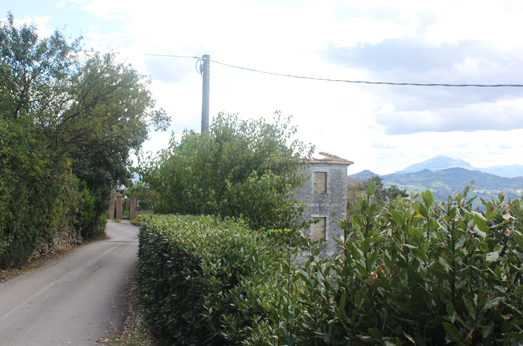
The road to the Palmoni home—Casa Palmoni—in Montefalcone Appennino, Italy.

Casa Palmoni.

Casa Palmoni and the Marziali Property

This is the house where the Palmoni family lived for over 100 years. There were over 20 people living in this house during the war: Mario’s grandparents—Iginia and Luigi Palmoni—Luigi’s four brothers and their wives, and all their children.

They were contadini—sharecroppers working on the property of the rich Marziali family. The Palmonis didn’t own the house.

Marino remembers—as a boy—taking food to the prisoners who were hiding in the woods above his home. His family looked after four of the prisoners who stayed with them in the house—two English soldiers and two Americans (Louis VanSlooten and Luther Shields).

Continue reading

Northward Bound

This article about Allied prisoners of war was clipped and saved by ex-POW Denis Crooks. Denis’ daughter Maggie Clarke kindly shared it for this site.

Unfortunately, we do not know which newspaper the article is from or the date it was published, although the reference to the fall of Mussolini (July 1943) is helpful in dating it.

PRISONERS SENT TO GERMANY

“Hundreds of Names”

Some hundreds of names have recently been received of prisoners who have arrived in Germany from Italy. Sir James Grigg, the War Minister, said in Parliament today.

It seemed clear that large numbers of such notifications would be received in due course, but he did not know how many.

Sir James, who was replying to Wing Commander Hulbert (Con. Stockport), said there had always been some movement to Germany of prisoners captured in North Africa and more recently in Sicily.

In some cases they were held for a time in transit camps in Italy [and] 2400 prisoners were transferred from Italian camps other than transit camps shortly before the fall of Mussolini.

Still at Large

“A number of British prisoners of war have escaped from Italy to Switzerland and others have reached the Allied lines in the south.” he added. “The next of kin of these prisoners are being informed as soon as names are received.

“Some prisoners may still be at large elsewhere in the country. The protecting Power is doing what is possible to obtain information about our prisoners and to safeguard their interests.

“It is extremely important not to say anything which interferes with the prospects of the final escape of those still at large.”

Mystery Photo

This photograph was one of several that we believe Denis Crooks took while away during the war.

Denis’ daughter, Maggie Clarke, has shared several photos he took in Camp 59 with me—which I will share here in upcoming posts.

I first assumed this photo was taken within the camp. It appears to be the inside of a storage tent, with bundles of blankets or clothing and a few mess kit items atop wooden stools.

On closer examination, there appears to be at least one rifle propped against the center post. An unattended rifle in a prison camp storage tent seems unlikely. Did Denis take this in North Africa before he was captured?

At any rate, there is something beautiful—and a bit haunting—about this intriguing image.

Denis Crooks—First Letter Home

The following letter was the first one received by Denis Crook’s parents after his capture. Thanks to Maggie Clarke for sharing this letter and the notifications in the previous post.

257879H Sigmn. [Signalman] D. Crooks
Prisoner of War

My Dear Mother and Dad,

I expect by the time you get this letter you will have heard that we are “in the soup”—and thick soup at that! But there’s absolutely no need to worry as I am quite fit and well and so far the life isn’t too bad. We are getting enough food and water and we still have blanket and greatcoat for night-time, so we aren’t badly off. So don’t worry at all as I’m quite OK.

There’s one thing though, and that is the question of underclothes, etc. I lost practically everything when we surrendered and I could do with plenty of shirts, pants, vests, socks, etc. Also of course anything in the way of eats!! I don’t know how long it will take for letters and parcels to reach here from England, but you could send unperishable food, especially of the “filling” variety! Anyway, I think you know my stomach sufficiently well to guess what it needs!! Also any washing gear.

Continue reading

News—Denis Crooks Now Prisoner

In this clipping (circa July 1941) from an unidentified newspaper, Denis Crooks is identified as one of three British servicemen found to be a prisoner of war in Italy.

Thanks to Denis’ daughter, Maggie Clarke, for sharing this item.

REPORTED MISSING—NOW PRISONER.

A letter, postmarked “Tripoli,” as been received by Mr. and Mrs. P. R. Crooks, of 141, Parkanauer Avenue, Thorpe Bay, from their only son Denis, a former pupil of the Southend High School for Boys, who was reported missing while serving with a Yeomanry Regiment in April. “He told us that he was quite all right and that we were not to worry about him,” Mrs. Crooks told our representative. Denis, who is 21 years of age, was an Executive Officer in H.M. Customs and Excise before he joined up.