Category Archives: Prisoners—Camp 59

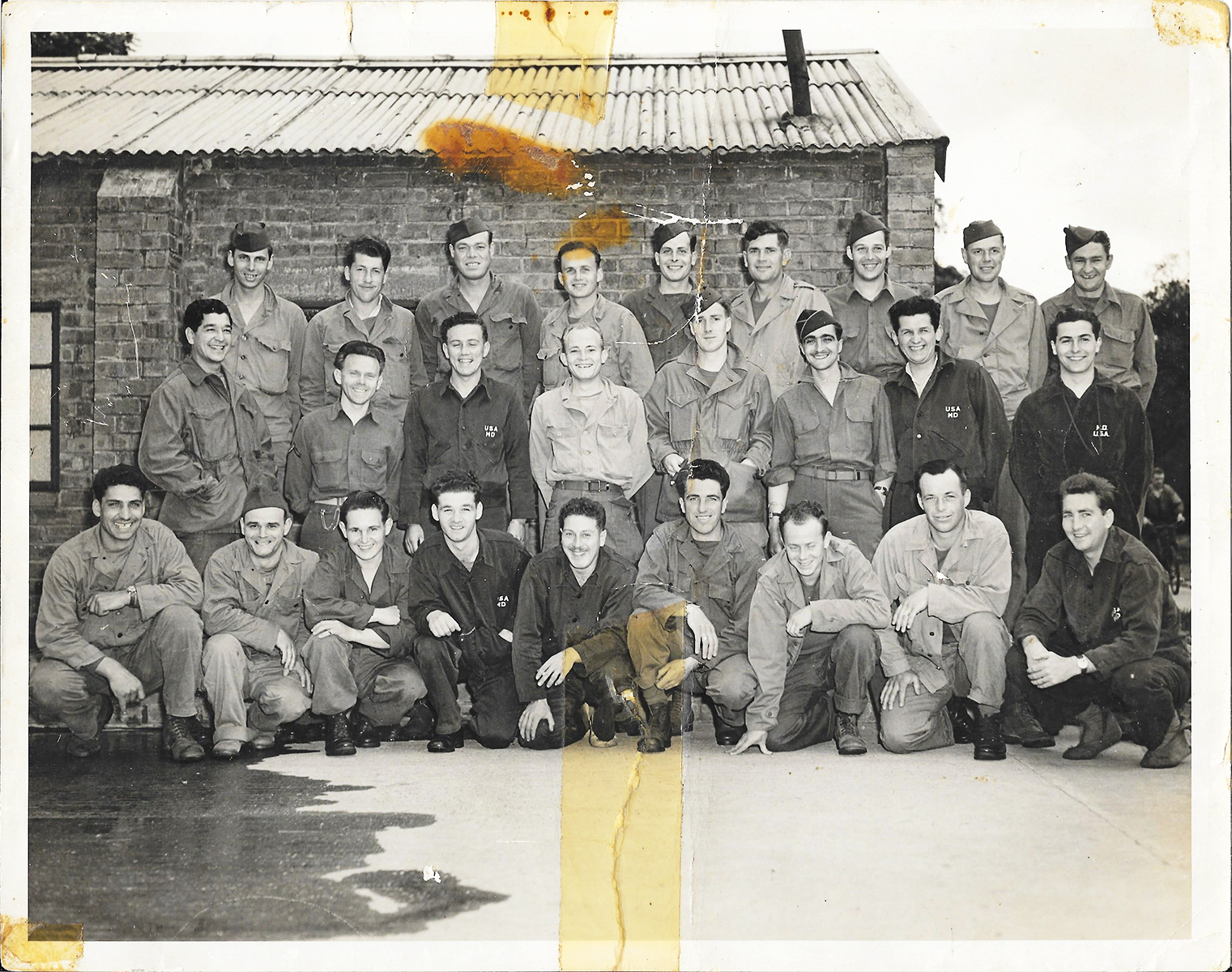
George Payne, U.S. Army Medic

george-payne-3

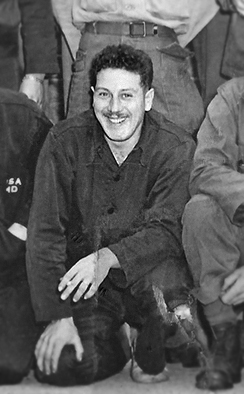
Private First Class George A. Payne

I received an e-mail on May 27 from Julie Payne Williams. Julie wrote she began an archive of the WW II experiences of her father, George Payne, in spring 2003. He passed away in December 2003.

George Payne was a prisoner in Camp 59.

Julie sent me a transcript of an interview she did with her father, photos of him, and documents pertaining to his capture and internment as a POW.

Julie asked whether I might be able to provide information on the Italian civilians who helped her father, the Tirabassi family.

“The Tirabassi family lived in Comunanza,” Julie wrote. “Dad could only remember the name of the father (Francesco, called Paco) and the oldest daughter, Maria. Paco had a wife and a younger daughter also. Maria was around 18—only a year younger than my dad—and a younger (blonde) daughter was around 11.

“Dad always wondered which members of the family, if any, survived the war. He carried around a lot of guilt his entire life from not knowing if they survived or, if they didn’t, if they were killed for helping him.

Continue reading

Raimondo Illuminati on Sidney Seymour Smith

raimondo-illuminati_r72

Raimondo Illuminati at the site of the Sidney Seymour Smith memorial plaque.

Tenna Valley Freedom Trail Walk activities last month included the installation, on May 10, of a plaque in memory of British soldier Sidney Seymour Smith on the road outside the village of Montelparo where Sidney was shot to death. Sidney was known to the Italians as “Giorgio.”

See “Sidney Seymour Smith—A Mystery Solved” and “Sidney Seymour Smith—the Interviews.”

Just prior to the unveiling of the plaque, Raimondo Illuminati, who as a boy knew Sidney, spoke about his memory of him at the Montelparo town hall.

I am grateful to Anne Copley for her translation of the speech from Italian into English. Anne’s comments are in brackets.

Raimondo Illuminati’s Speech

“8th September 1943; church bells were ringing in all the villages, the Armistice had been declared between Badoglio’s Italy and the Anglo-American troops. In our district, at Servigliano, there was a concentration camp; the gates were opened and the prisoners were free. It seemed it was over, the war which had not touched us, which had taken place far from our peaceful lives. But it ended up in our houses, with the immediate occupation by the Germans, endorsed by the Salo Republic. The prisoners, once free, took refuge in our countryside, welcomed with love into our homes. And indeed our own soldiers were prisoners in their lands.

“One of these prisoners was called, or at least he gave himself the name GIORGIO. He was an English soldier. He took refuge in the contrada Santa Maria di Montelparo with the family “Ndunucciu” [Italian peasant families had a real name and then a nickname—it seems likely this was the nickname for the Mazzoni family], adjacent to the Tirabassi elementary school. I was seven years old and went to the primary class, I remember Giorgio because sometimes he came to our school when the master was away, and he read us books and stories. Giorgio was “a boy” [I’m not sure how to translate ragazzo, which literally means “boy” but here seems to have a deeper significance], about thirty-six years old, tall, slender, blond with blue eyes. He was always smiling and he was very dear to us, we always behaved well and kept quiet whilst he was reading to us. But one day the brutality of war took him away. One day in March he received a visit from three individuals—“friends” they called themselves, but they were two Germans and a local Fascist and they slaughtered him, unloading into him forty machine-gun bullets. This unhappy event happened north of the contrada Santa Maria and right next to the house of Paolo Traini (Cucurre). I passed that way the next morning and saw signs of his blood and fragments of his body on the edge of the road. He was accompanied to the cemetery by a large cortege, and by all us schoolboys to give him a final farewell.”

Upcoming Italian Freedom Trail Walk

monte-san-martino_r72

A wreath-laying ceremony in Monte San Martino, Italy, during the Freedom Trail Walk in September 2013.

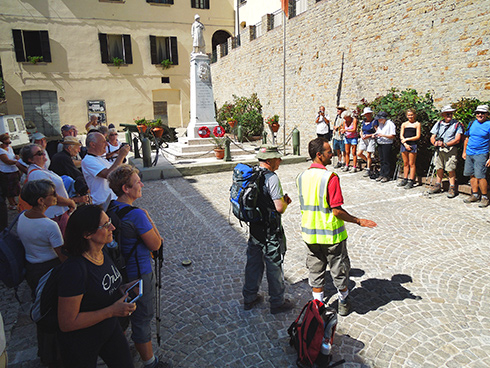
A Tenna Valley Freedom Trail Walk sponsored by WW2 Escape Lines Memorial Society and Monte San Martino Trust is scheduled for May 7–12. The annual walks, begun in 2001, retrace routes taken by Allied escapers and evaders caught in enemy territory in Italy during World War II.

The last Freedom Trail walk was held just seven months ago, to commemorate the 70th anniversary of the September 1943 Italian armistice and the subsequent escape of prisoners from camps across central and northern Italy.

The walks are dedicated to the people of the Italian countryside, the contadini, who, at great risk to themselves and their families, provided shelter, food, clothing, and medical assistance to the young Allied servicemen.

This year’s walk will cover approximately 80 kilometers and include visits to the villages of Monte San Martino, Massa Fermana, Montappone, Montelparo, Montalto delle Marche, Monte Urano, Fermo, and Porto San Georgio.

freedom-walkers_r72

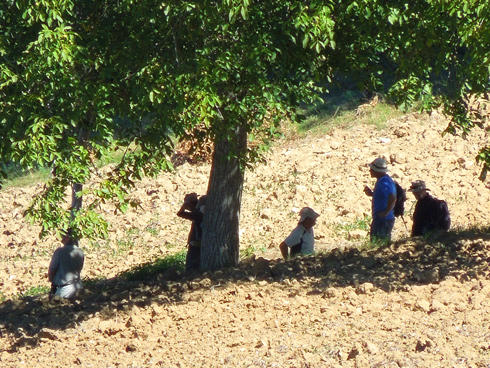
A shady rest during the Freedom Trail Walk last September.

freedom_trail_g72

Program cover for the first Freedom Trail Walk, 2001.

National Archives Report on Leslie “Jack” Young

I received from my friend Brian Sims this morning Jack Young’s official repatriation papers, which Brian had copied during one of his research sessions at the British National Archives.

Here are details from the four-page report:

Leslie John Young
Service number 7901430
Trooper, 4th Battalion, Royal Tank Regiment

Date of interrogation: August 10, 1944

Date and place of capture: June 17, 1941, Sidi Omar

Date and place of final escape: September 9, 1943, Sforzesca Pavia

Date of arrival in Switzerland: October 27, 1943

Brief circumstances of capture: put out of action by heavy artillery firing at point-blank range, evacuated tank and were then surrounded by enemy tanks.

Where and when imprisoned, and how employed:

Tripoli German working camp, July 1941–January 1942, employed loading convoys, camouflaging dumps

59 Servigliano, February 1942–June 1943

146/18 Sforzesca, June 1943–September 1943, employed in farming

Continue reading

Photos from St. Gallen, Switzerland

lj-young-5_r72

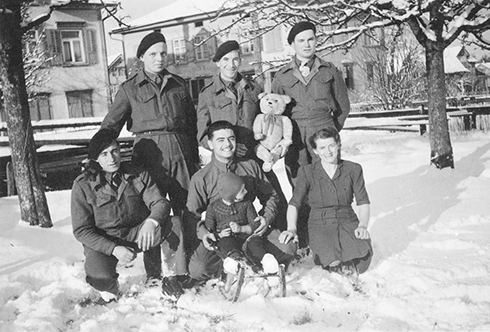
A note on the back of this photo reads, “Switzerland New Year 1944.” Jack Young is in the middle, kneeling on the snow with the child.

Trooper Leslie John “Jack” Young, at one time a prisoner at Camp 59 in Servigliano, escaped to Switzerland in October 1943. Read “Leslie ‘Jack’ Young Home from Switzerland.”

Jack’s daughter, Lyn Jones, wrote to me this week, “I managed to scan in some photos from Switzerland, the first one says New Year 1944.”

Many of others say just 1944. Jack is in most of the photographs.

“He seems to have acquired a saucy striped tie which he is wearing in a couple of the pics,” Lyn said.

“Wouldn’t it be great if someone else recognises their own father on one of the pictures?

Continue reading

Leslie “Jack” Young Home from Switzerland

lj-young-news_r72

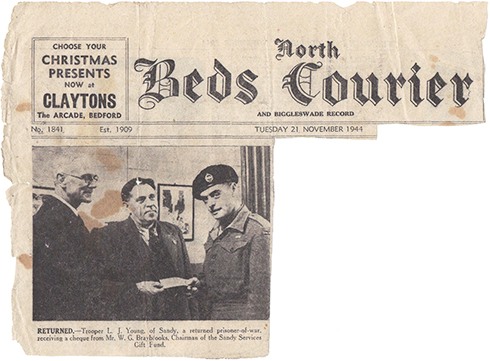
This photo of Leslie “Jack” Young appeared on the front page of the North Beds Courier to mark the trooper’s return from Switzerland where had been confined since escaping from Italy in October 1943. The caption reads:

“Returned.—Trooper L. J. Young, of Sandy, a returned prisoner-of-war, receiving a cheque from Mr. W. G. Braybrooks, Chairman of the Sandy Services Gift Fund.”

lj-young-4_r72

This studio portrait appears to be of Jack Young with members of his tank crew before their service in Africa. Jack is seated at right. Note the Royal Tank Regiment badges on the men’s black berets.

I heard this past week from Lyn Jones, who e-mailed me from the UK.

She said, “I am writing to tell you about my father Leslie John (Jack) Young (7901430), who was a prisoner at Camp PG59 in Italy. He was in the 4th Royal Tank regiment and was taken prisoner by the Germans on 17 June 1941 near Sidi Omar. After working for the Germans in Tripoli he was sent by boat to Sicily in 1942 and later to the camp near Servigliano.

“I have written accounts from newspaper articles written about my father on repatriation, of some of the things that happened there.

Continue reading

Fyrtle Myrtle Story Included in New Book

salerno-1943 r72

On the morning of Friday, July 16, 1943 a formation of B-24 bombers left Berka, Libya, on a mission to destroy the airport facilities at Bari, Italy. The planes belonged to the 513th Bomb Squadron of the 376th Heavy Bombardment Group of the United States Air Force.

On the return flight from their mission the group encountered Italian Royal Air Force and German fighters. The Fyrtle Myrtle was shot down. Only three of the airmen were able to exit the plane before it crashed. Two of them, Cyrus F. Johnson Jr. and Edward T. Dzierzynski, were later interned in Camp 59 at Servigliano.

fyrtle-myrtle_r72

Aircrew of the Fyrtle Myrtle

In 2012, the Salerno Air Finders, a group of volunteers from the Italian organization Salerno 1943, explored the crash site of the Fyrtle Myrtle and published a report of their findings on the Salerno 1943 website. That report is now one of 25 investigations included in a newly published volume by Matteo Pierro entitled Salerno 1943: Gli aviatori, le storie, i ritrovamenti dell’Operazione Avalanche (Salerno 1943: The aviators, the stories, the findings of Operation Avalanche).

Continue reading

A Belated Bronze Star for Joe Mandese

This is the second article about Joe Mandese that Joe’s grandson Bobby Cannon shared with me.

The article is followed by an interview that Bobby’s mother, Bernadette Cannon, conducted with Joe in 1993.

mandese-bronze_r72

World War II Escapee Honored
Bronze Star for ex-POW

By Don Stancavish
Staff Writer
Bergen Record
Circa 1998

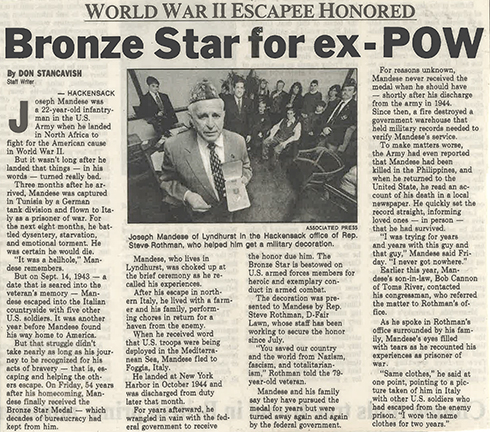
Caption: Joseph Mandese of Lyndhurst in the Hackensack office of Rep. Steve Rothman, who helped him get a military decoration.

HACKENSACK [New Jersey]—Joseph Mandese was a 22-year-old infantryman in the U.S. Army when he landed in North Africa to fight for the American cause in World War II.

But it wasn’t long after he landed that things—in his words—turned really bad.

Three months after he arrived, Mandese was captured in Tunisia by a German tank division and flown to Italy as a prisoner of war. For the next eight months, he battled dysentery, starvation, and emotional torment. He was certain he would die.

“It was a hellhole,” Mandese remembers.

But on Sept. 14, 1943—a date that is seared into the veteran’s memory—Mandese escaped into the Italian countryside with five other U.S. soldiers. [Joe actually escaped with four other men; he was the fifth escapee in the group.] It was another year before Mandese found his way home to America.

Continue reading

Joe Mandese—The Burden of Remembrance

Last month Bobby Cannon commented on “Felice “Phil” Vacca, Part 2—Camp 59 and Escape.”

“This is an amazing story.” he wrote. “My grandfather is Joe Mandese. He is alive and well at age 94. Mario, Jim, and Tony [Vacca] visited their house in the ’60s in Union City, NJ. My grandfather now resides in Lyndhurst, NJ with his wife of 68 years. My whole family thanks you for this story and we can add some additional details if you are interested.”

I wrote that I was very interested, and Bobby then sent two newspaper clippings, photos, and a short interview his mother, Bernadette Cannon, did with Joe 20 years ago.

Here is the first article:

mandese-memory_r72

In memory of lost war heroes
Lyndhurst holds 24-hour POW vigil

By C. Rae Jung
Managing Editor

October 2002
South Bergenite (New Jersey)

Caption: The burden of remembrance—Commissioner Tom Graffam, a Vietnam War veteran, delivers a speech at a vigil honoring American POW/MIAs, below. Those who came back, such as Joe Mandese of Lyndhurst, above, often have to carry the memories of war alone in pain. Staff photos/Jaimie Winters & C. Rae Jung

LYNDHURST—The table was set for one, but the chair remained empty. The glass on the table was put upside down; it stayed that way for 24 hours. And local veterans stood guard into the wee hours, in memory of those who did not come home.

Continue reading

Next-of-Kin Parcels—Packed with Care

repack_r72

This illustration of next-of-kin parcel repackers working out of the repacking center at Finsbury Circus in London appeared in a cheerful article published in the September 1942 edition of The Prisoner of War journal. The Prisoner of War was the official journal of the Prisoners of War Department of the Red Cross and St. John War Organisation (St. James Palace, London). The journal was provided free to next-of-kin.

Al Rosenblum, son of former Camp 59 prisoner Staff Sergeant Albert Rosenblum, sent me the materials for this post some time ago. But perhaps there is no better time to share this information than during this “season of giving.”

repack-parcel_r72

I Repack Your Parcel

The Prisoner of War
September 1942

THE DAY’S WORK
Described by an examiner at the Next-of-kin Packing Centre at Finsbury Circus.

I work in the packing department of the Next-of-Kin Packing Centre at Finsbury circus, where parcels from next-of-kin are checked and repacked before being sent on their long journey to the prisoners of war. There are 120 of us in the large packing room where I work.

My job is to examine the parcels as they arrive, and I like to think that it is the most important job of all.

Continue reading