Category Archives: Prisoners—Camp 59

Theatre of War Recaptured

hands-up-4-12-95_r72

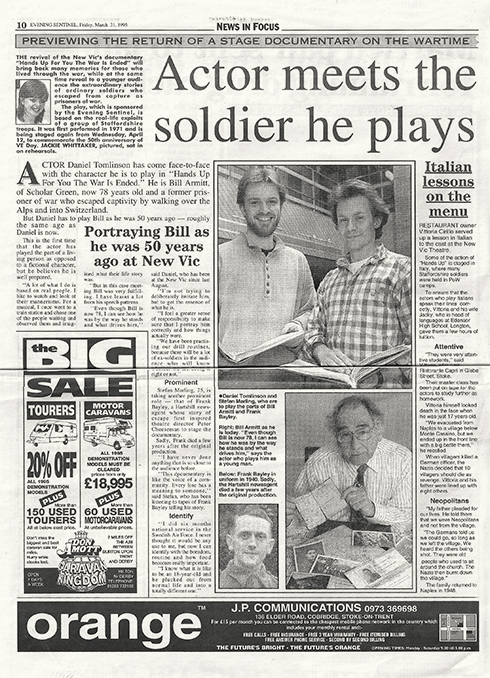
This is the last of three news articles from the Evening Sentinel (Stoke-on-Trent, England) covering a 1995 revival of the New Vic Theatre’s 1971 original musical documentary, Hands Up! For You the War Is Ended.

See also “Hands Up—For You the War Is Ended!,” “More on the Camp 59 Theatre Subjects,” “Prisoners of Experience,” and “Revived Play ‘the Voice of a Community’.”

Captions for newspaper photos.

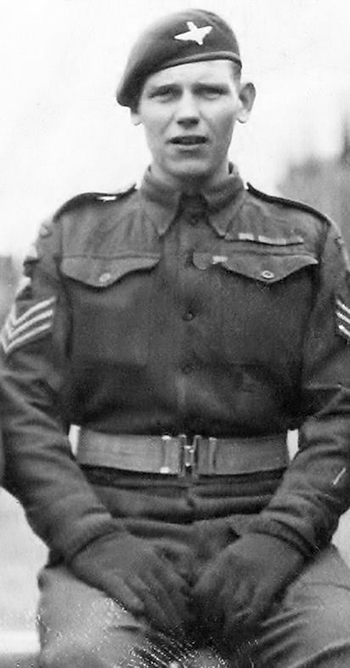
Bill Armitt of Scholar Green in captured by Rommel at Fort Mechili in North Africa (top image), and Laura Beckford and Nicola Wainwright as the fortune teller and Gladys Bayley (above left) Neil Hulse, photographer

Jack ‘Jock’ Attrill (above right)

Continue reading

Revived Play “the Voice of a Community”

hands-up-3-31-95_r72

This is the second of three news articles from the Evening Sentinel (Stoke-on-Trent, England) covering a 1995 revival of the New Vic Theatre’s 1971 original musical documentary, Hands Up! For You the War Is Ended.

See also “Hands Up—For You the War Is Ended!,” “More on the Camp 59 Theatre Subjects,” and “Prisoners of Experience.”

Captions of newspaper photos:

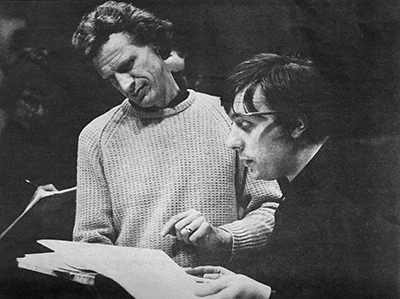
Daniel Tomlinson and Stefan Marling, who are to play the parts of Bill Armitt and Frank Bayley.

Bill Armitt as he is today. “Even though Bill is now 78, I can see how he was by the way he stands and what drives him,” says the actor who plays him as a young man.

Frank Bayley in uniform in 1940. Sadly, the Hartshill newsagent died a few years after the original production.

Continue reading

Prisoners of Experiences

hands-up-3-23-95_r72

A recent post on this site was dedicated to a 1971 theatrical production of the Victoria Theatre (Stoke-on-Trent, England) entitled Hands Up! For You the War Is Ended.

The musical documentary was based on the real-life experiences of several Staffordshire WW II ex-POWs.

Nigel Armitt’s father, Bill Armitt, was one of those veterans, and my access to the playbill for the production was courtesy of Nigel.

Nigel has since brought to my attention that in 1995 the theatre, now called the New Vic, staged a revival of the play to commemorate the 50th anniversary of VE Day. Nigel sent three news clippings, from March and April 1995, which revisit the former troops’ stories and cover the play itself.

Here is the first of the three articles:

real life exploits of the brave PoWs who won their freedom

News In Focus
Evening Sentinel [Stoke-on-Trent, Staffordshire, England]
March 23, 1995

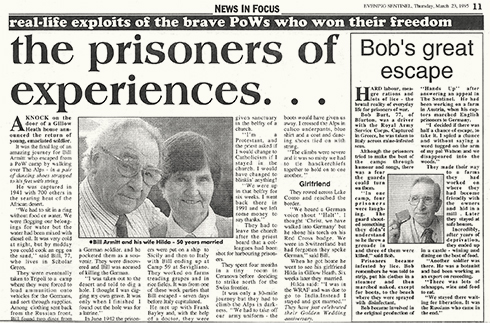
the prisoners of experiences…

A KNOCK on the door of a Gillow Heath house announced the return of a young, emaciated soldier.

It was the final leg of an amazing journey for Bill Armitt who escaped from a PoW camp by walking over the Alps – in a pair of dancing shoes strapped to his feet with string.

Continue reading

More on the Camp 59 Theatre Subjects

This post offers details on several of the men whose war experiences were the inspiration for the Victoria Theatre 1971 musical documentary “Hands Up—For You the War Is Ended!”

I am grateful to researcher Brian Sims for access to repatriation records for four of these men, who were transferred together from PG 59 to PG 146/22 Vairano in the summer of 1943. The British National Archives records provide the men’s imprisonment timelines and details on their escape to Switzerland.

According to the Victoria Theatre playbill, “The prisoners who took ship from North Africa were taken to various prisoner of war camps. Frank Bayley, Bill Armitt, Tug Wilson, and Jack Ford went to PG 59, (Campo Prigioneri etc) south of Ancona near the east coast, and there they stayed.”

Perhaps it was an oversight that Jock Attrill and Jock Hamilton were not mentioned in this list of transferees from North Africa, as the program later mentions their departure from PG 59:

“Sometime in 1943 volunteers were called for from the POWs in PG 59 to join working parties in the north of Italy. Bill Armitt, Jock Attrill, Frank Bayley and Jock Hamilton were amongst those who went. They were transferred to PG 146 at Laclirago some 15 miles south of Milan on the Lombardy plain and in sight of the Alps.”

When the men later escaped from PG 146, Italian Domenico Lunghi was involved in protecting all four. They later arrived in Switzerland on the same date, April 1, 1944, so it is reasonable to conclude they made the cross-border journey together.

Eric “Tug” Wilson and Jack Ford seem not to have transferred from PG 59 to PG 146 with the others. It is possible that they were transferred later, or they may have remained in Camp 59 until the time of the camp-wide outbreak on September 14, 1943. At any rate, Jack ended up in Germany according to the playbill.

Continue reading

Hands Up—For You the War Is Ended!

armitt-bayley_r72

Frank Bayley and Bill Armitt (at right), with Simon Coady and Colin Starkey, the actors who played them in Hands Up—For You the War Is Ended!

On Tuesday, May 18, 1971 an unusual theatrical production premiered at the Victoria Theatre in Stoke-on-Trent, England. Termed a “musical documentary,” the work was the brainchild of the theatre’s artistic director Peter Cheeseman.

A commentary in Peter Cheeseman’s obituary in The Guardian sheds light on the importance of this and similar works performed at the Victoria Theatre:

“Of the more than 140 productions that Peter directed, it was the 11 musical documentaries voicing the verbatim stories and concerns of the local community that brought the Victoria theatre recognition. From The Jolly Potters (about the history of the Potteries) in 1964 to Fight for Shelton Bar! in 1974 (part of a campaign to save the local steelworks), they were researched by members of the company. Subjects ranged from the English civil war in The Staffordshire Rebels (1965) and local railways in The Knotty (1966) to the audience’s second world war memories in Hands Up! For You the War Is Ended (1971).”

The play was funded by a grant from the Arts Council of Great Britain through its program for the promotion of new drama.

Continue reading

John Richard Shaw—Escapee to Switzerland

john-shaw-2_r72

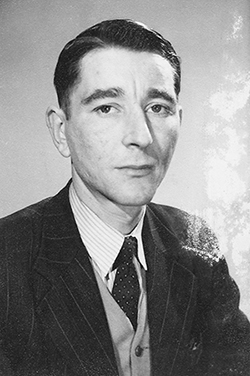
John Richard Shaw, circa 1950s.

I received a note from Penny Hayes (nee Shaw) last month. She wrote to share information about her father, John Shaw, who was a prisoner in Camp 59 from March 11, 1942 to April 1, 1943.

Penny wrote, “I have a photograph of my aunt with her charges (she was a childrens’ nurse) sent to my father with the following on the back:

TPR J R Shaw 7889463
POW 1634
PG 59 PM 3300
Italy

“My father, John Richard Shaw, sadly died in 1964 when I was 15.

“There is no record of him on your site so I take it you were not aware of his having been a prisoner.

“Unfortunately, although I knew he had been a prisoner it was never discussed. However, I was aware that he escaped. I have no idea how he returned to the UK. If you have any information or could point me in any direction where I might find more details I would be most grateful.

Continue reading

News Feature—Four Camp 59 Prisoners

four-bulletin_r72

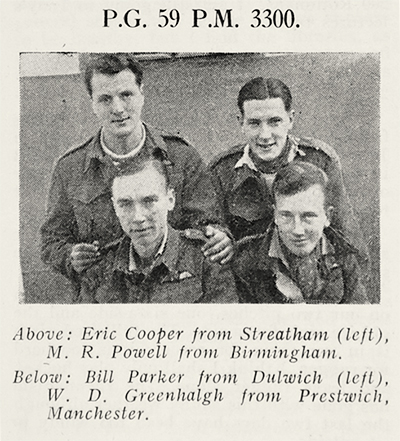
This photograph from the British Prisoners of War Relatives’ Association News Sheet, June 1943 issue, identifies British prisoners Eric Cooper (Streatham), M. R. Powell (Birmingham), Bill Parker (Dulwich), and W. D. Greenhalgh (Prestwich, Manchester) as prisoners in Camp 59.

This News Sheet was brought to my attention by Brian Sims, who accessed a copy of it in the British National Archives.

bulletin-nameplate_r72

There is possible mention of three of these prisoners on the site currently:

John L. Turner of the Royal Canadian Air Force mentions a Royal Air Force pilot by the name of Eric Cooper in “John Leon Turner—Survival in Italy“:

“A friend in hiding 6 miles away, in another farmhouse, R.A.F. Pilot Eric Cooper, was in the same shoe destitute condition, so Turner, wearing borrowed native footgear, sloughed through mud to get his pal’s shoes fixed also.”

Camp 59 escapee British Lance-Sergeant Robert Henry Collins mentions the whereabouts of Royal Air Force Sergeants Parker and Greenhalgh in his repatriation report (in “Details on Remaining 10 British Escapees”).

Parker and Greenhalgh are listed in a section of the report entitled “late news of whereabouts of escapers”:

Sgt. Parker, RAF—last seen on September 17 near Amandaley
Sgt. Greenhalgh, RAF—ditto

Sergeant Collins does not say whether the sergeants were escapees from Camp 59 or another camp.

A Prisoner’s Son Visits Servigliano

landscape_r72

The stunning Italian countryside near Servigliano.

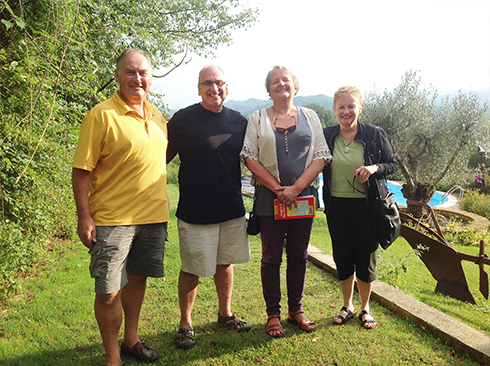
Ed Cronin and his wife Susan of Fitchburg, Massachusetts, visited Servigliano in September in order to see the site of Camp 59, where Ed’s father, Clarence “Tom” Cronin, was a prisoner of war during WW II. (See “A Son’s Memories of Tom Cronin.”

Ed and Susan were guests of Anne Copley and David Runciman, who own a home in Montefalcone, not far from Servigliano.

foursome_r72

Left to right: David, Ed, Anne, and Susan heading for adventure.

I asked Ed to send me photos and to share some of his impressions of the visit for this site.

“The first thing that I was struck by was how isolated the camp was.” Ed told me. “It was way up in the mountain region. Even today, there is only one road that I know of that goes up the mountain and it is narrow and slow going. I can only imagine what it was like during the war era—probably little more than cart roads.

“I would think that being so far away could be very disheartening and challenging for a prisoner who wanted to escape. There must have been a tremendous contrast in weather from the hot summer season to the winter mountain weather. I can see why the local villagers played such a part in the survival of many who did escape.”

Continue reading

Cypriot Prisoners in Camp 59

In a 1976 interview I conducted with my father (American Sergeant Armie Hill, see “Recollection of Camps 98 and 59“), he spoke briefly of Cypriots in Camp 59 during the time he was interned there:

“This was a camp of mostly British men. There were some Americans and some ‘Cyps’—guys from Cyprus.”

It was a rare referral in a first-person account to Cypriots in the camp.

Red Cross reports, written following visits to the camp by inspectors, contain information on the Cypriot prisoners. As the last report I have access to is June 12, 1943, I can’t speculate on how many Cypriots were still in the camp at the time of the breakout on September 14, 1943.

International Red Cross Reports

Report of March 20, 1942—Cypriots are listed as present in the camp, however this report contains no numerical breakdown of the prisoners according to nationality

May 1, 1942 — 43 Cypriots of a total prison population of 1,931

June 3, 1942 — 43 Cypriots (4 noncommissioned officers and 36 men) of a total prison population of 1,927

July 10, 1942 — 43 Cypriots (1 noncommissioned officer and 42 men) of a total prison population of 1,850

September 11, 1942 – 43 Cypriots (1 noncommissioned officer and 42 men) of a total prison population of 1,859

November 16, 1942 — 41 Cypriots of a total prison population of 1,872

December 16, 1942 — 41 Cypriots (1 noncommissioned officers and 40 men) of a total prison population of 1,999

June 12, 1943 — 46 Cypriots (1 noncommissioned officers and 45 men) of a total prison population of 1,328

Continue reading

Liberated Comrades-in-Arms

peter-grillo-pows_r150

Peter Grillo’s son Roy believes this photograph of 26 cheerful servicemen was taken shortly after their liberation from German captors on March 25, 1945. Click on the photo to enlarge it.

Roy writes, “I had been looking for this for a while, but now I am trying to recollect where it was taken. If memory serves me correctly this is the group of POW’s in my dad’s building that were taken to the Army Medical Hospital for recuperation after getting free from the compound. I hope others might find themselves in this image.

“My father is bottom center with moustache and big smile.”

After his capture at Kasserine Pass, Peter Grillo was held on Sicily and then in Camp 59. The U.S. National Archives WW II POW database indicates he was repatriated from Stalag 2B Hammerstein. I assume the other men in the photo were also freed from Stalag 2B.

peter-grillo-crop_r72

Peter Grillo

See also and “Peter Grillo—Surgery ‘Sans Anesthetic’” and “Peter Grillo—Captive.”