Author Archives: Dennis Hill

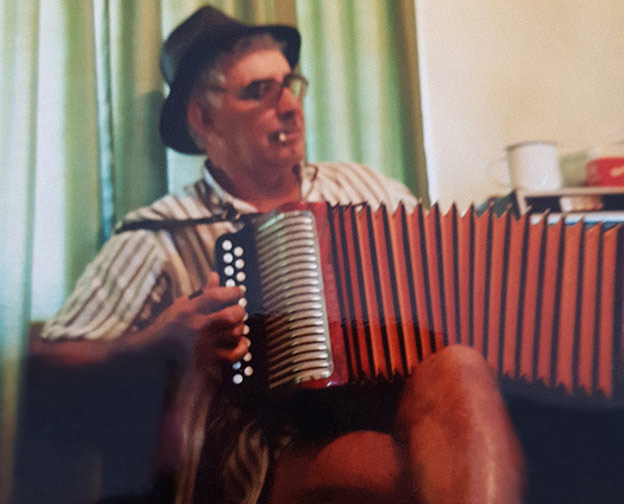
Jimmy Feehan—Soldier and Father

Jimmy Feehan in the early 1980s, at ease with his accordion—image courtesy of Pamela Robinson

If you type “Feehan” in the search box on this website you’ll see that references to Australian infantryman James “Jimmy” Feehan have occurred in a number of posts. For years has Jimmy struck me as a particular interesting fellow, so I’m devoting this post exclusively to him.

Jimmy enlisted on 18 June 1941 and served in the 2/32 Infantry Battalion of the Australian 9th Division, which saw action in North Africa in 1942. Jimmy’s military record notes he was reported missing in action 17 July and officially confirmed a POW on 22 October 1942.

The Australian War Memorial website has this description of the conflict at El Alamein where Jimmy was captured:

The war in North Africa had become critical for the British forces. In July 1942 Germans and Italians had reached El Alamein in Egypt, about seventy miles from Alexandra. The 9th Division was consequently rushed to the El Alamein area and held the northern sector for almost four months as the British Eighth Army was reinforced for an offensive under a new commander. 

The division’s orders for the first attack were issued on 7 July. Moving inland from the coast, the 2/32nd and 2/43rd Battalions (comprising the 24th Brigade) would attack along the ridgeline from Trig 22 and approach Ruin Ridge. The 2/32nd would lead the attack, advancing from Trig 22 to the Qattara Track. The 2/43rd would then proceed towards Ruin Ridge. 

The attack began on 17 July at 2.30 am. The 2/32nd captured the Trig 22 and linked with the 2/43rd but the Germans resisted fiercely and counter-attacked with tanks. The 2/32nd suffered heavily: nearly half its number were either killed or wounded and nearly 200 became prisoners of war. The fighting continued for several days.

Continue reading

A Guest in Two Rectories

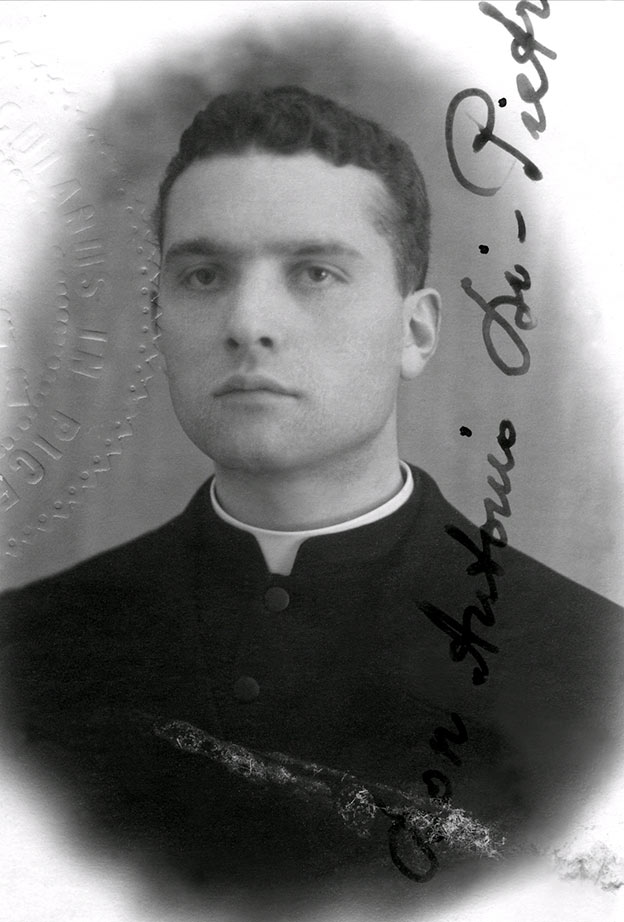
Don Antonio Di Pietro

By way of my friends Gian Paolo Ferretti and Antonio Ferretti I’ve learned of a British officer who was sheltered in the comune of Roccafluvione in late 1943.

The officer, Major Patrick Clayton, was the guest of two Catholic priests: Don Antonio Di Pietro, who served the parish in Osoli, and Don Giuseppe “Don Peppe” Ciabattoni, who served the parish in Marsia, both within the comune of Roccafluvione.

The road distance from the Roccafluvione villages (frazioni) of Osoli and Marsia is 6.8 kilometers (about 4 miles)—Google Maps

Antonio Ferretti had previously shared segments of Don Peppe’s chronicon diary, in which the priest briefly mentions Patrick Clayton. (See “Don Giuseppe Ciabattoni—A Hero of Faith.”)

Now Antonio has accessed the chronicon of Don Antonio Di Pietro, which is housed in the Archivio Diocesano.

Paolo notes that Osoli has two churches—one dedicated to San Martino and the other to San Giovanni. Both are outside of the village, and San Martino was chosen as the church of the parish because it is nearer to Osoli.

Today Osoli is under the parish of Marsia.

Continue reading

Antonio Ferretti—“A Bird of Passage”

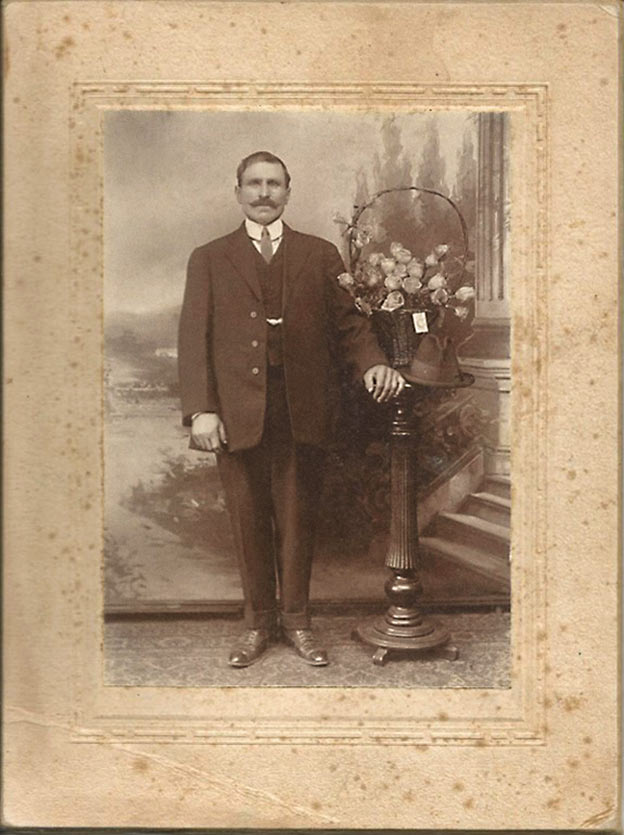
Formal portrait of Antonio Ferretti taken in America
An address stamped on the back of the image notes the photograph was taken by Fotografia Artistica Italiana in Pittsburgh, Pennsylvania. The photographic studio apparently catered to Italian immigrants.

Growing up in American, I’ve been aware all my life of the many contributions Italian immigrants have made to the fabric of American culture. However, until recently I was not familiar with Italian seasonal migrant labor in the early 20th century. These “birds of passage” found temporary employment in the U.S. in order to provide for their families in Italy, eventually returning to their homeland.

Migrant workers often worked alongside permanent Italian immigrants in booming U.S. industries such as mining and steel production.

Italian Migrants

Historian Joan L. Saverino, in her publication “‘Domani Ci Zappa’: Italian Immigration and Ethnicity in Pennsylvania,” writes: “[Most Italian immigrants to America] were contadini, a word variously translated as farmers, farm hands, or peasants. Even an expression used by Italian immigrants to indicate work the next day, ‘Domani ci zappa (Tomorrow, it’s work)’ suggests that these immigrants formerly made a living as farm laborers or lived closely connected to the agricultural cycle. The use of the verb ‘zappare,’ is translated literally ‘to hoe.’”

Continue reading

A Journey of Discovery—Tracking Ronald McCurdy

Welsh POW Ronald McCurdy’s daughters Rona Crane and Jeannie Hendra made a physical and emotional journey early this summer that they had long anticipated.

With the help of Janet Kinrade Dethick and Professor Giuseppe Zucca, their adventure led them on a search for the internment camp where their father labored and from which he escaped, as well as to places where he hid while he was on the run.

Finally, they followed his passage through the Alps to safety in neutral Switzerland. (Read “Ronald McCurdy—Escaped to Switzerland.”)

Janet recounts the days they spent together in the following essay.

Gunner Ronald Edmund McCurdy

A Strange Coincidence

Janet Kinrade Dethick, July 2025

Several years ago, as a result of a contact I made through the WW2Talk forum, I got to know Professor Giuseppe Zucca, whose book about prisoners of war in Lomellina—the rice-growing area to the south west of Milan in Lombardy—I subsequently translated. It tells the story of how his mother, Giovanna Freddi, had helped three escaped South African prisoners of war to reach neutral Switzerland after the declaration of the Armistice on 8 September 1943.

Prof. Zucca’s second book on this theme, I Giusti di Lomellina, (The Righteous of Lomellina) which examines the role local people had played in hiding and helping the escaped prisoners, came out late in 2022, and my husband Enzo and I were invited to its presentation in Vigevano in January 2023. Not only did this visit strengthen the professional link between myself and Prof. Zucca, we have now become firm friends.  

Towards the end of 2024 I began helping Penny Hayes, the daughter of Trooper John Richard Shaw, to find out who had assisted her father before he left Lomellina for Switzerland on 14 November 1943. Trooper Shaw had been transferred from PG 59 Servigliano to Lomellina in June 1943.  In this case the name Angelo Comelli, cited in Trooper Shaw’s Escape Report, appears in a list held in the Commune of Vigevano of persons who had been awarded the Alexander Certificate. Prof. Zucca had obtained a copy of the list when researching his book, and he soon found Carla Liliana Comelli, granddaughter of Angelo, who is now corresponding with Penny. 

Continue reading

Falciano Today

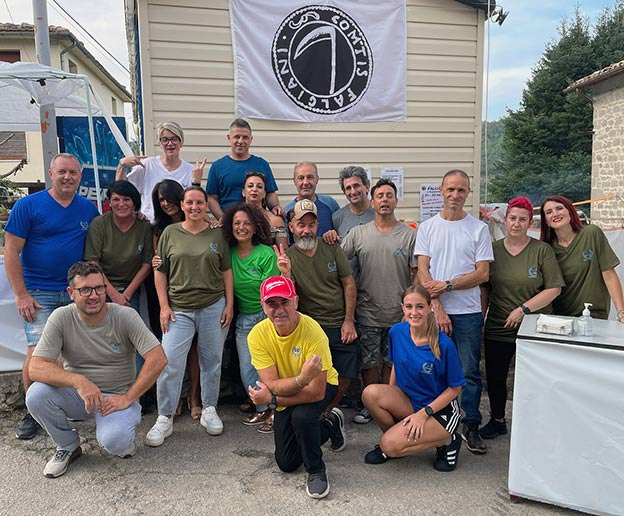
Members of Le Ville sul Tufo

Le Ville sul Tufo

A group of community volunteers based in Falciano, who call themselves Le Ville sul Tufo, is dedicated to preserving local landmarks and sharing the history of their area with visitors.

The association is comprised of residents of Falciano—the Falcianesi—along with former residents and descendants of Falcianesi, and their spouses/companions. Today only 15 people live in the small cluster of homes known as new Falciano. Old Falciano, shattered by an earthquake, has been entirely abandoned.

A core group of Le Ville sul Tufo gathers periodically for work sessions that include tidying historical sites, repair work, and path clearing. Group member Gian Paolo Ferretti says, “When we organize walks, conferences, or parties, other members and friends also participate.”

“The name Le Ville sul Tufo,” Paolo explains, “refers to a group of seven small villages that in the past were called ville, for example Villa Falgiano [a former spelling of Falciano]; ‘sul tufo’ references the rock from which the villages are built, which is commonly called tufo—even if it is not actually tufo [a type of pyroclastic, or volcanic, rock], but another kind of rock—arenaria [sandstone].

“We don’t have the means and the strength to repair buildings, but we reopen old paths and organize cultural events.”

Continue reading

A Visit to Falciano

I have written about the sheltering in Falciano of escaped prisoners of war from Camp 59 in 1943–44, but I have not had the pleasure of seeing the village in person.

When Gian Paolo Ferretti—great-grandson of Antonio Ferretti, who helped to protect the escapees—invited my friend Anne Copley to Falciano for a tour, I was excited for her, but wishing I could join them.

So I was delighted when, a few days later, Anne sent me notes on her visit and a slideshow of some 20 images she took while there.

“Paolo pointed out that in the ’40s there was no road to the village, just footpaths and mule tracks,” Anne explained. ”It would have been pretty safe as a hiding place, as it would have taken the Germans an hour to reach Falciano from Aquasante Terme. The two spies in the village would have only been able to deliver information that would have been out-of-date by the time they got down into the valley.

“At its height there were over 100 people living up in Falciano. All the now heavily-wooded land would then have been cultivated—everywhere terraced for growing crops. The locals mostly owned their land, rather than working it as sharecroppers. It’s a very different landscape to where I live in Montefalcone—very steep hills and nowhere available as actual fields. 

“There are lots of little waterfalls and fonte, where a stone trough was carved out to capture the water. And there are amazing rock formations making grottos where produce was stored and animals kept—and where the escapers were sheltered, with villagers bringing them food on a rota system. Each overhanging rock was fashioned (carved by hand) so that a lip prevented the rain running down inside and ruining the stuff stored there. Since they were taxed according to the number of animals they had, a few were hidden away in these grottoes!

Continue reading

The Insatiable Curiosity of Janet Kinrade Dethick

I’d like to take a moment to give a shout-out to researcher Janet Kinrade Dethick for her excellent autobiography, An Insatiable Curiosity: A Personal Journey through Wartime Italy, which was published last December.

Janet’s foray into researching and writing about WWII in Italy began over a quarter century ago.

She was managing holiday properties in Umbria when she had what she calls a “chance encounter” in 1999 with octogenarian Jack Doyle, who had been an Australian pilot during WWII. Jack wanted to rent a villa near Lake Trasimeno, where he had been on special assignment in 1944 when he was injured by a bomb blast. 

“My encounter with Jack Doyle changed my life,” Janet explains, “as listening to his experiences led me to investigate what happened during World War Two in the area around Lake Trasimeno.”

Her first book, The Trasimene Line, June–July 1944, was published in 2002. The insatiable curiosity rooted in her meeting with Jack has led Janet to delve ever more deeply into researching and writing about Italy during WWII. Most of her research concerns POW camps in Italy, escaped prisoners of war on the run following camp breakouts, and the Italians who protected the escapees. She has also written about the Italian resistance, isolated wartime events, and war crimes committed during WWII.

A current list of books by Janet on goodreads.com numbers an impressive 22 distinct titles. That’s nearly a title a year during the course of her research career.

Additionally, Janet’s own website has a list of her eight websites dedicated to prisoners of war, war cemeteries, and POW camps. She has also authored several websites on WWII written in Italian, and she has a YouTube presence.

Continue reading

Picturing Ron Dix

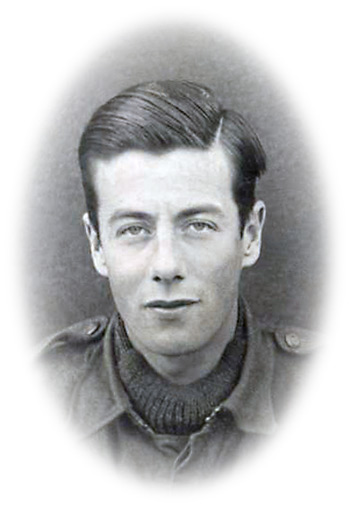
Ron Dix before deployment

Ron Dix and Robert Dickinson were prisoners of war together in Italy. After their escape from PG 112/4 Turin they were sheltered by the Bauducco family in Gassino for 13 months.

They left the Bauducco home to fight with the Italian Aldo Brosio partisan brigade. Ron was killed while fighting with the brigade in December 1944; Robert lost his life in a fight in March 1945.

Last week, Robert’s nephew Steve sent me pictures of Ron he received from Ron’s niece, Gina Siddons, who lives in Ellesmere Port, UK.

Until now the sole photograph I had seen of Ron was a headshot accompanying a 1999 article in the Newport News (Essex, England). In the article, written by Ron’s sister Dorothy (see “News of Ron Dix Comes to Light”), we have an intimate glimpse into Ron’s early years—the life of a boy and young man who was joyful, active, and popular in his school and community.

Gina’s five snapshots are a perfect complement to Dorothy’s story.

As Steve writes, they show us “Ron Dix in civvy life before the war … probably taken in the Safron Waldon area,” where the Dix family lived.

Ron with his sister Dorothy, Gina’s mother, in a Morgan—a British classic 3-wheeler
Continue reading

Italian Soldier Giovanni Di Valentino Rests in England

Giovanni Di Valentino rests in Brookwood Military Cemetery, Surrey, England. Image courtesy Find a Grave.

In July 2020, I wrote a post titled “Seeking John Jarrett’s Italian Father,” which concerns an Italian POW who was interned on a farm in East Sussex during WWII.

Last month, I received a message from Patricia Jones, who had come across the post while doing an online search. She wrote, “I live in Mountfield in East Sussex and look after Mountfield’s archive, whilst also researching local topics. During lockdown I researched all the names on our War Memorial and wrote biographies of them all.

“I’m currently putting together an exhibition/display for Mountfield’s VE Day celebrations on 10th May, which was why I was checking for any more information about the Prisoners of War here and came across the Jarrett story this afternoon.

Continue reading

A Pilgrimage to Roccafinadamo

Last November Willman King’s daughter Rena Buhr met Donato Giancola. As an escaped POW in Italy during WWII, Willman was protected by Donato’s family. Gian Paolo Ferretti (left) arranged their meeting.
Willman King

More than a decade ago I wrote five posts about American prisoner of war Willman King on this site. 

Willman, from Detroit Lakes, Minnesota, was inducted into the service in October 1941. After training in the U.S., he was sent overseas. He participated in the November 1942 Allied invasion of North Africa, and the following month was captured in Tunisia. He was interned in PG 59, from which he escaped in September 1943. Like many other escapees, Willman was cared for by local Italians. 

Willman’s son Joseph was my contact when I wrote those five posts. Confident that Joseph and I had exhausted all the material there was to share about Willman, I didn’t expect to hear further from Willman’s family. So I was surprised in September to hear from Rena Buhr, one of Willman’s daughters.

”I am preparing to visit Italy in early November,” Rena wrote. ”I would love to have any insight into a visit to Camp 59—what to expect and amount of time to explore.” We began an exchange of emails. She used the word “pilgrimage” to describe the trip.

Continue reading