A Warning to German Officers and Men

The following letter from General H. R. Alexander to commanders and men of the German army is from the British National Archives.

Unfortunately, it is undated. However, as the last of the atrocities listed in it allegedly occurred on October 2, 1944, it is apparent the letter was written sometime after that date and before the end of the war in Europe.

My access to the document is courtesy of British researcher Brian Sims.

Here is the full text of the letter:

WARNING to German officers and men

By General Sir H. R. Alexander, Commander-in-Chief, Allied Armies in Italy.

1. Reports of atrocities – killings of hostages, mass reprisals against innocent civilians, torturings and the like – committed by German troops in Northern Italy are becoming daily more frequent.

2. I therefore call the attention to all German officers and men in Northern Italy, who otherwise might give or carry out orders to commit such atrocities, to the following:

3. The fact that in, for example, a certain village Italian patriots – whether or not wearing uniforms, arm-bands or other recognizable insignia – may have attacked German soldiers is not, according to the Jus Gentium or any other Legal or moral code, a justification for collective reprisals upon the population of the village, nor for the killing or persons without due legal trial and conviction.

Continue reading

Memorial to Rome Escape Line’s Sam Derry

derry-article-1

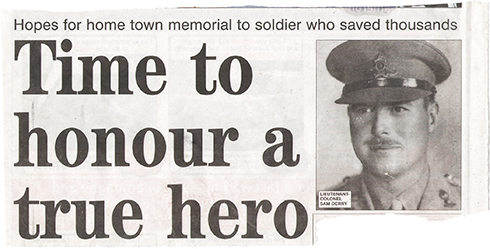
Recently my friend Brian Sims sent me an article that was published last year in the Newark Advertiser, which serves the UK’s Newark-on-Trent area.

The article describes a local interest in the establishment of a lasting memorial to Newark-born Lieutenant-Colonel Sam Derry, who, with Irish priest Hugh O’Flaherty, ran the escaped-POW rescue effort known as the Rome Escape Line out of the Vatican.

The Rome Escape Line rescue efforts were run independently of the I.S.9 rescue efforts, which were mainly conducted along the Adriatic coastline of Italy and east of the Apeninnine Mountains.

The following paragraph from the official I.S.9 history (see “I.S.9 History—Operations in Italy, Part 3“) in the British National Archives, confirms the minimal contact that existed between these two organizations:

“By far the most interesting outcome of our entry into ROME was gaining contact with the Escape Organization which had existed during the German occupation under the direction of Major S.I. DERRY (now Lt-Col. S.I. DERRY, DSO, MC, GS01, G-2 (P/W), AFHQ). This particular organization was easily the largest non-I.S.9 unit engaged in the care and maintenance and possible escape of E & Es. Although we were well aware of the existence of this organization, and had made successful attempts to gain contact during the German occupation, it was unfortunate that we were unable to encourage a closer connection in the early days. We sent an Italian officer courier into ROME and he returned with a reasonably accurate description of the situation, and had personally contacted Father O’FLAHERTY of the Vatican. We sent him back almost immediately, in an attempt to connect ourselves more closely with Major DERRY. Unfortunately, our courier was unable to obtain an interview with Major DERRY and was very naturally treated with suspicion. It was not until the final entry into the city and our contact with Major DERRY that we both realised the pity in that real contact was not established between I.S.9 and the Rome Escape Organization during the German occupation.”

Although the Newark Advertiser article mentions various possibilities for the memorial, Brian more recently told me the actual memorial will be a large painted portrait of Sam Derry, to be hung in the Newark Town Hall.

A dedication ceremony is being planned for this fall.

Continue reading

I.S.9 Italian Agents, Part 4

This is the fourth part in a series of posts concerning Italians who served as agents for I.S.9 (Intelligence School 9 of the Central Mediterranean Force).

I.S.9′s chief mission was support and rescue of escaped POWs and evaders (E&Es) stranded in enemy territory. I.S.9 was a division of M.I.9 (British Directorate of Military Intelligence Section 9), a department of the War Office during WW II.

I am grateful to researcher Brian Sims for providing access to his collection of I.S.9 files from the British National Archives for this series.

stasolla-antonio_r72

Antonio Stasolla

Born January 28, 1920 at Santeramo (Bari Province).

Antonio was a bricklayer at Castellaneta. He was called up to serve in the Army on March 12, 1940. He served in the infantry and joined the parachutists.

He held a parachutist’s Tessera di Riconoscimento (identity card).

He served in Italy, Croatia (for two months), and Sicily. At Armistice, he was in Calabria with the Nembo Division of the Italian Army. He volunteered for A Force service, and joined N Section at Palese in the capacity of para-guide on December 11, 1943.

He was issued a false Carta d’Identita for Foggia in the name Antonio Stasi, muratore.

He ceased to be employed on May 15, 1945 because of lack of work due to conclusion of hostilities. He was paid off by Field Headquarters and sent to Bari on May 16, and then to proceed to Taranto for four weeks leave. Thereafter he was to report to the Italian authorities.

Continue reading

I.S.9 Italian Agents, Part 3

This is the third part in a series of posts concerning Italians who served as agents for I.S.9 (Intelligence School 9 of the Central Mediterranean Force).

I.S.9′s chief mission was support and rescue of escaped POWs and evaders (E&Es) stranded in enemy territory. I.S.9 was a division of M.I.9 (British Directorate of Military Intelligence Section 9), a department of the War Office during WW II.

Thanks to researcher Brian Sims for access to his archives of I.S.9 files from the British National Archives.

petrucci-ernesto_r72

Ernesto Petrucci

Born on February 27, 1915 in San Marcello.

Ernesto was a woodcutter at Abetone. He was called to the Italian Army in 1938, but left the army in 1939 because of a knee injury. He joined “Gino Bozzi” Brigade (a unit, apparently operating in the Apennines of Pistoia, of the “Garibaldi” partisan brigades)—Ospedale—in May 1944.

Ernesto had intimate knowledge of the region from Modena to Pistoia. He spoke French. He held a true identity card for Abetone.

He was employed by Captain B. G. McGibbon-Lewis, No. 5 Field Section, as an agent/guide on January 10, 1945. His name during employment was Didon. No false identification was issued to him.

He ceased to be employed on April 27, 1945 because his services were no longer required due to the Allied advance. After being paid off, he returned to his home.

Continue reading

I.S.9 Italian Agents, Part 2

This is the second part in a series of posts concerning Italians who served as agents for I.S.9 (Intelligence School 9 of the Central Mediterranean Force).

I.S.9’s chief mission was support and rescue of escaped POWs and evaders (E&Es) stranded in enemy territory in Italy and elsewhere in Europe. I.S.9 was a division of M.I.9 (British Directorate of Military Intelligence Section 9), a department of the War Office during WW II.

Thanks to researcher Brian Sims for access to his archives of I.S.9 files from the British National Archives.

marcus-Giovanbattista_r72

Giovanbattista Marcus

Born in Azzano Decimo (Udine province) on March 12, 1920.

Giovanbattista was raised in Azzano, where he worked on his uncle’s farm. He was called up to serve in 1940 in the 17th sector of the Guardia Frontiera (border guard). He transferred to the Italian Army parachutists in 1941, but did not serve outside Italy. He was in Calabria with Nembo division of the Paracadutisti at the time of the Armistice.

Giovanbattista volunteered for special service from the Italian Army in December 1943.

He knew the whole area of Veneto fairly well and Udine area very well. He served in the province of Vercelli for about a year.

His employment with N Section, Advance Headquarters of A Force began on December 7, 1943. He served as an agent/guide who whose name during employment was Battista.

He was issued the following false document: Carta d’Identita – Comune de Spilimbergo, Marcus G. Battista, agricoltore

His employment with I.S.9 ceased on October 31, 1944, and was returned to his regiment in Bari on November 2.

Continue reading

Liberated Comrades-in-Arms

peter-grillo-pows_r150

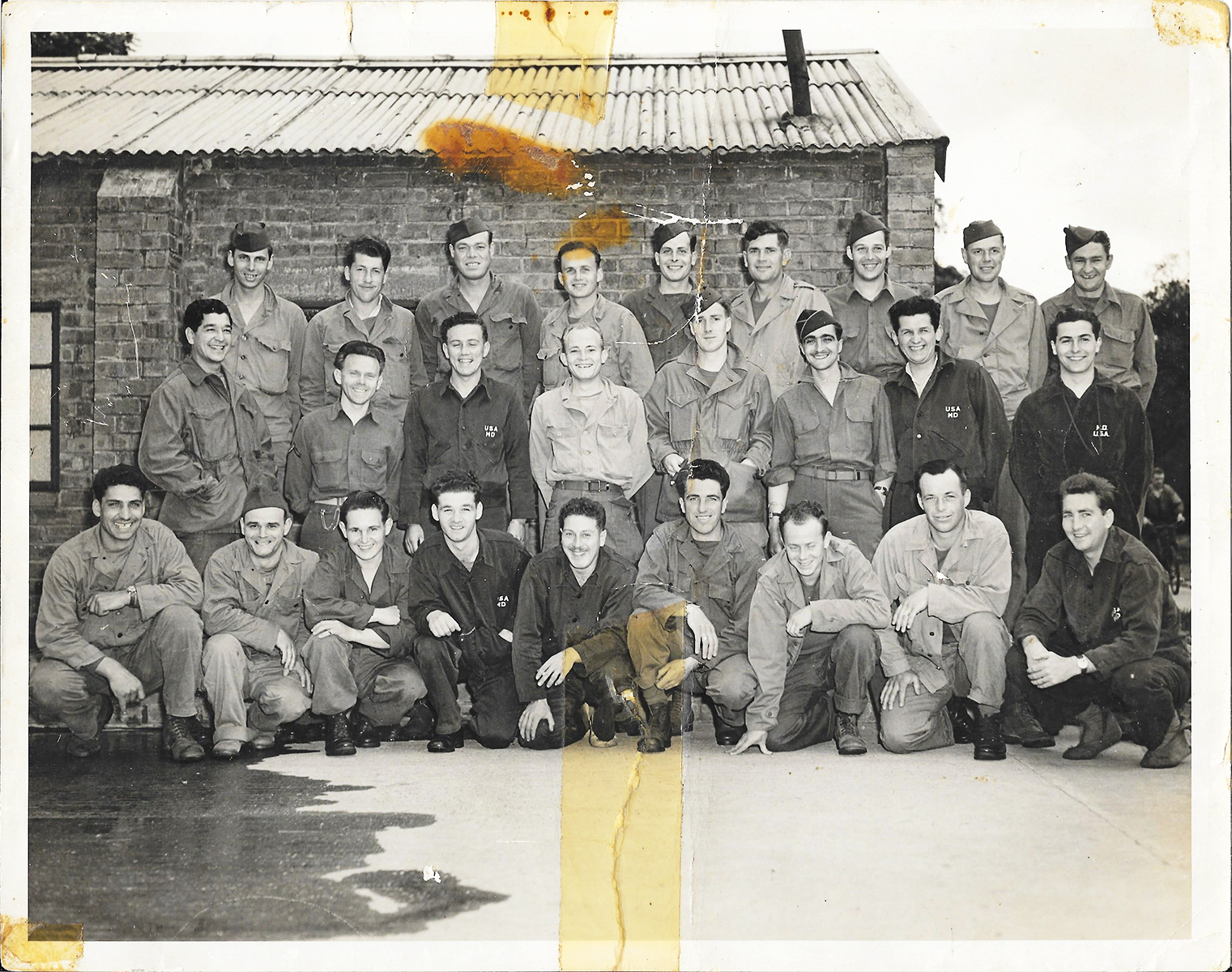
Peter Grillo’s son Roy believes this photograph of 26 cheerful servicemen was taken shortly after their liberation from German captors on March 25, 1945. Click on the photo to enlarge it.

Roy writes, “I had been looking for this for a while, but now I am trying to recollect where it was taken. If memory serves me correctly this is the group of POW’s in my dad’s building that were taken to the Army Medical Hospital for recuperation after getting free from the compound. I hope others might find themselves in this image.

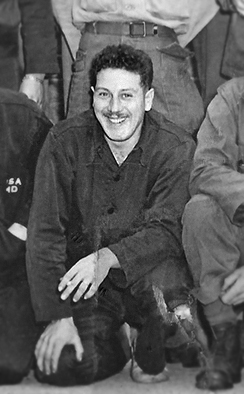
“My father is bottom center with moustache and big smile.”

After his capture at Kasserine Pass, Peter Grillo was held on Sicily and then in Camp 59. The U.S. National Archives WW II POW database indicates he was repatriated from Stalag 2B Hammerstein. I assume the other men in the photo were also freed from Stalag 2B.

peter-grillo-crop_r72

Peter Grillo

See also and “Peter Grillo—Surgery ‘Sans Anesthetic’” and “Peter Grillo—Captive.”

Patrick F. Shea—a Tribute

pat-shea-left2_r72

Patrick F. Shea, Jr. (left) with a fellow sergeant.

I heard from David Shea, Staff Sergeant Patrick F. Shea, Jr.’s youngest brother, last month.

Pat died at the age of 19 when the B-24 bomber he served on, the Fyrtle Myrtle, was shot down over Pietragalla, Italy on July 16, 1943. See “B-24 Bomber Fyrtle Myrtle Discovered.”

David sent me a packet of photos, letters, and other documents to scan, which I am sharing here. I am pleased to offer this post as a tribute to Pat.

Here are comments from David:

“My brother, S/Sgt. Patrick F. Shea, Jr. was born on March 15, 1924 in Lowell, Massachusetts. He and my dad shared the same birthday.

“My dad, mom, Pat, and Charlie lived in Billerica, Massachusetts, and later moved to Boston. Then the family moved to Easton, Massachusetts.

“Pat and I were very close. Even though there was a six-year age difference, he used to carry me around on his shoulders almost wherever he went.

“In Easton, we lived about six miles from the nearest town and had 50 acres of land. There were no houses within a mile. It was a great place for hunting and fishing. When it came to hunting, I thought I was a fair shot but Pat could hit more from the hip than I could from my shoulder.

Continue reading

I.S.9 Italian Agents, Part 1

This is the first of what will be a series of posts concerning Italians who served as agents for I.S.9 (Intelligence School 9 of the Central Mediterranean Force).

The chief task of I.S.9 was support and rescue of escaped POWs and evaders (E&Es) stranded in enemy territory in Italy and elsewhere in Europe. I.S.9 was a division of M.I.9 (British Directorate of Military Intelligence Section 9), a department of the War Office during WW II.

I am grateful to researcher Brian Sims for allowing me access to his documentation of I.S.9 files from the British National Archives.

liverani-emidio_r72

Emidio Liverani

Born in Faenza on October 14, 1920.

Before the war, Emidio worked with his father in agriculture. In 1941 he was called up for service in the Italian Army and served in the Italian-Yugoslav frontier. In September 1943 he returned home, and in November he joined the partisans in Romagna.

In October 1944 Emidio joined I.S.9 No. 5 Field Section. The name he used while working for I.S.9 was Antonio Fadolfi.

He was employed by Captain B. G. McGibbon-Lewis in the capacity of guide from October 9 to December 22, 1944. At that time he was paid off and given a pass to return home.

Continue reading

George Payne, U.S. Army Medic

george-payne-3

Private First Class George A. Payne

I received an e-mail on May 27 from Julie Payne Williams. Julie wrote she began an archive of the WW II experiences of her father, George Payne, in spring 2003. He passed away in December 2003.

George Payne was a prisoner in Camp 59.

Julie sent me a transcript of an interview she did with her father, photos of him, and documents pertaining to his capture and internment as a POW.

Julie asked whether I might be able to provide information on the Italian civilians who helped her father, the Tirabassi family.

“The Tirabassi family lived in Comunanza,” Julie wrote. “Dad could only remember the name of the father (Francesco, called Paco) and the oldest daughter, Maria. Paco had a wife and a younger daughter also. Maria was around 18—only a year younger than my dad—and a younger (blonde) daughter was around 11.

“Dad always wondered which members of the family, if any, survived the war. He carried around a lot of guilt his entire life from not knowing if they survived or, if they didn’t, if they were killed for helping him.

Continue reading

Raimondo Illuminati on Sidney Seymour Smith

raimondo-illuminati_r72

Raimondo Illuminati at the site of the Sidney Seymour Smith memorial plaque.

Tenna Valley Freedom Trail Walk activities last month included the installation, on May 10, of a plaque in memory of British soldier Sidney Seymour Smith on the road outside the village of Montelparo where Sidney was shot to death. Sidney was known to the Italians as “Giorgio.”

See “Sidney Seymour Smith—A Mystery Solved” and “Sidney Seymour Smith—the Interviews.”

Just prior to the unveiling of the plaque, Raimondo Illuminati, who as a boy knew Sidney, spoke about his memory of him at the Montelparo town hall.

I am grateful to Anne Copley for her translation of the speech from Italian into English. Anne’s comments are in brackets.

Raimondo Illuminati’s Speech

“8th September 1943; church bells were ringing in all the villages, the Armistice had been declared between Badoglio’s Italy and the Anglo-American troops. In our district, at Servigliano, there was a concentration camp; the gates were opened and the prisoners were free. It seemed it was over, the war which had not touched us, which had taken place far from our peaceful lives. But it ended up in our houses, with the immediate occupation by the Germans, endorsed by the Salo Republic. The prisoners, once free, took refuge in our countryside, welcomed with love into our homes. And indeed our own soldiers were prisoners in their lands.

“One of these prisoners was called, or at least he gave himself the name GIORGIO. He was an English soldier. He took refuge in the contrada Santa Maria di Montelparo with the family “Ndunucciu” [Italian peasant families had a real name and then a nickname—it seems likely this was the nickname for the Mazzoni family], adjacent to the Tirabassi elementary school. I was seven years old and went to the primary class, I remember Giorgio because sometimes he came to our school when the master was away, and he read us books and stories. Giorgio was “a boy” [I’m not sure how to translate ragazzo, which literally means “boy” but here seems to have a deeper significance], about thirty-six years old, tall, slender, blond with blue eyes. He was always smiling and he was very dear to us, we always behaved well and kept quiet whilst he was reading to us. But one day the brutality of war took him away. One day in March he received a visit from three individuals—“friends” they called themselves, but they were two Germans and a local Fascist and they slaughtered him, unloading into him forty machine-gun bullets. This unhappy event happened north of the contrada Santa Maria and right next to the house of Paolo Traini (Cucurre). I passed that way the next morning and saw signs of his blood and fragments of his body on the edge of the road. He was accompanied to the cemetery by a large cortege, and by all us schoolboys to give him a final farewell.”