
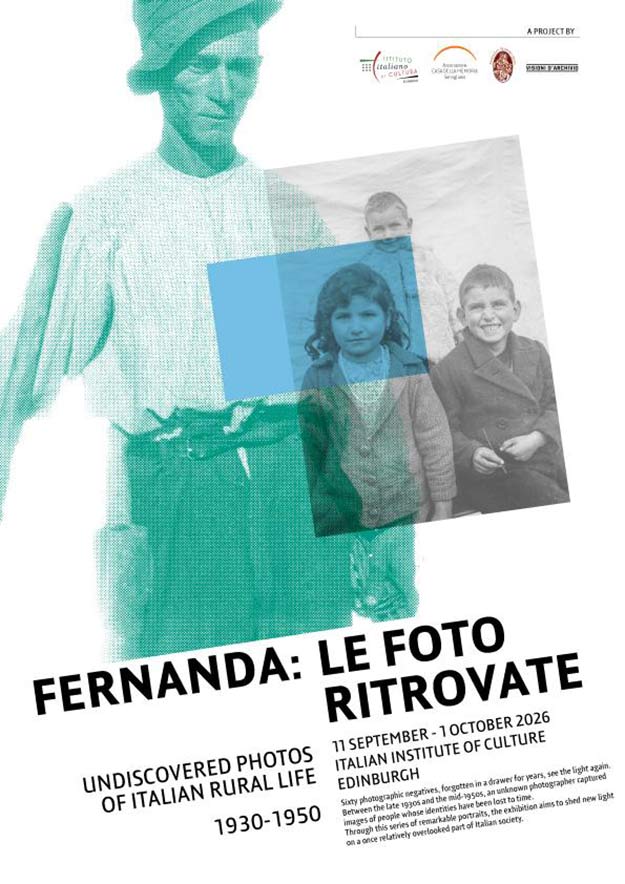
“Fernanda: Le Foto Ritrovate”—Rare images of Italian rural life
A remarkable group of photographs of rural Italians is on exhibit this month at the Italian Cultural Institute in Edinburgh, Scotland.
Fernanda: Le Foto Ritrovate brings together photographs taken in the southern Marche between the late 1930s and the mid-1950s—images that offer a rare glimpse into the lives of the contadini, the impoverished sharecroppers who formed the backbone of rural society in this part of Italy.
The exhibition is organized by Casa della Memoria and the Monte San Martino Trust, in collaboration with the Italian Cultural Institute of Edinburgh.
For those of us interested in the story of Allied prisoners of war who escaped from Italian POW camps after the Armistice of September 1943, the exhibition has particular significance. These are the very kinds of people among whom thousands of escapees found refuge. The rural families who sheltered them risked imprisonment, beatings, or death by hiding the fugitives, feeding them, and sharing what little they possessed.
In most photographs of rural Italy, these stalwart people appear simply as figures in the landscape. However, in these images they are the focus.
This collection has been exhibited at other venues in Italy and Britain. In Edinburgh, it will be on display through October 1.
Forgotten in a drawer
The story behind the photographs is almost as remarkable as the images themselves.
After the death of his aunt Fernanda Millevolte, filmmaker Giordano Viozzi was clearing out her house when he discovered a collection of black-and-white negatives that had remained untouched in a drawer for many years.
Giordano printed the negatives and attempted to learn about the people in the pictures. The photographer is unknown, but research and local efforts to identify the subjects have succeeded in matching names to many of the previously unknown faces.
Much remains to be discovered, but the process of identification is worthwhile. Every name recovered transforms an anonymous face into a person with a family, a home, and a story.
Continue reading
