I.S.9 Progress Reports for November 4–21, 1943

ROBB-Nov.-4-13-1943-r72

First page of the progress report issued on November 13, 1943

The transcription and notes in this post are by Dr. Luigi Donfrancesco, nephew of I.S.9 agent Andrea Scattini. Access to the two progress reports (from the British National Archives) was courtesy of researcher Brian Sims.

Following the September 8, 1943 Armistice, German Divisions promptly invaded Italy and took control of the military situation. In October 1943, from among the many who did not want to collaborate with the Germans, six Italian patriots reached the Allied lines of the 8th Army in just-liberated TERMOLI (Campobasso, Molise).

They were immediately enrolled as agents in the “A” FORCE (I.S.9, or Intelligence School 9, called “A” Force on that front) and assigned to the No. 5 FIELD SECTION, operating in the east along the Adriatic coast.

The six men formed group “RATBERRY SECTION A” of No. 5 FIELD SECTION, under the command of Intelligence Captain Andrew ROBB, who was from New Zealand.

The six original “RATBERRY” agents, often referred to as “the RATBERRY Boys,” were:

1) Hugh/Ugo – Uguccione RANIERI – age 37 – (born 1906 in Florence). Lieutenant, Italian Army; Count of Sorbello – Bourbon del Monte; from Perugia. As he was the eldest, highest in military rank, and was perfectly Italian-English bilingual, he served as the head of the group.

2) “Don” Domenico ORLANDINI, age 30 (born 1913 in Poiano di Villa Minozzo, Reggio Emilia). A Catholic priest; cover name “Carlo.”

3) Ermanno FINOCCHI – age unknown – (“Marina Velica”? – Navy Sailing?); from Grottammare, Ascoli Piceno. Nephew of “Colonel Dolfi” (Gustavo Dolfi, Captain of the Merchant Navy and chief partisan of San Benedetto del Tronto).

4) Andrea SCATTINI – age 26 – (born 1917 in Marina San Vito, Chieti, Abruzzo). Student in Medicine and Surgery. Soldier in the Medical Corps of Italian Army at Celio Military Hospital, Rome.

5) Fausto SIMONETTI – age 23 – (born 1920 in Palmiano di Venarotta, Ascoli Piceno). Student in Medicine and Surgery. Soldier (perhaps in the Medical Corps) of Italian Air Force.

6) “GUIDO” (surname unknown). From TERMOLI, Fausto SIMONETTI and GUIDO were landed at CUPRA MARITTIMA (Ascoli Piceno, Marche) on October 22, 1943.
Continue reading

I.S.9 Situation Report—November 3–4, 1943

SITREP_Nov _3-4_1943

SITREP [Situation Report] for November 3–4, 1943

Two years ago my friend researcher Brian Sims sent me a series of I.S.9 rescue operation diaries and situation reports from 1943–44 that he had copied in the British National Archives.

These documents give a detailed day-to-day (in some cases hour-to-hour) account of I.S.9 rescues of escaped POWs and evaders.

Recently, I shared these reports with Dr. Luigi DONFRANCESCO, nephew of I.S.9 agent Andrea Scattini.

He has transcribed the reports and added clarifications and additional information. Here is the first of a series of these document transcriptions that I will add to this site over the next several weeks.

I am grateful to Luigi for his careful attention to these documents.

NOV. 3

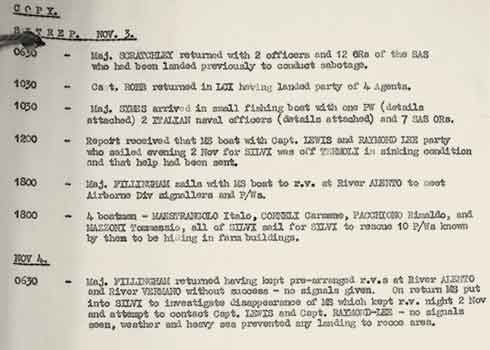
0630 – Maj. SCRATCHLEY returned with 2 officers and 12 ORs [other ranks] of the SAS [Special Air Service] who had been landed previously to conduct sabotage.

1030 – Capt. ROBB returned in LCI [Landing Craft Infantry] having landed party of 4 Agents.

[Note from Luigi Donfrancesco. The four agents were: Uguccione RANIERI di Sorbello; Catholic Priest “Don” Domenico ORLANDINI (cover name “Carlo”); Ermanno FINOCCHI; and Andrea SCATTINI. From TERMOLI, they were landed at CUPRA MARITTIMA in the night of November 2, 1943. In her Diaries (published by Alessandro Perini) “Babka” says they arrived at 2:30 a.m. on November 3 at “Villa Boccabianca” (property of Count Zeno Vinci, Babka’s husband, and base of the “RATBERRY LINE – RAT LINE”), joining there Agent Fausto SIMONETTI, who was previously landed with “GUIDO” on October 22 and who had been waiting for them since October 29].

1030 – Maj. SYMES arrived in small fishing boat with one PW [prisoner of war] – (details attached), 2 ITALIAN naval officers (details attached) and 7 SAS [Special Air Service] ORs [other ranks].

1200 – Report received that MS boat [moto-silurante, or MAS (motoscafo armato silurante), torpedo motorboat] with [U.S. Army Air Force] Capt. [Richard W. B.] LEWIS and [French-British] Capt. RAYMOND LEE [COURAUD, commander of the “French Squad” of 2nd Special Air Service] party who sailed evening 2 Nov for SILVI was off TERMOLI in sinking condition and that help had been sent.

1800 – Maj. [John Francis] FILLINGHAM sails with MS to r.v. (rendezvous, appointment, or encounter] at River ALENTO [south of River PESCARA, just north of FRANCAVILLA] to meet Airborne Div [Division] signalers and P/Ws (Prisoners of War).

[Note in the entry below apparent misspelling of Italian names. Suggested corrections are in brackets.]

1800 – 4 boatmen – MAESTRANGOLO [probably MASTRANGELO] Italo, CORNELI Carmene [Carmine], PACCHIONO [the correct spelling could be PACCHIANO, PACCHIONE, or PACCHIONI] Rimaldo [Rinaldo] and MAZZONI Tommassio [Tommaso], all of SILVI, sail for SILVI to rescue 10 P/Ws [prisoners of war] known by them to be hiding in farm buildings.

NOV. 4

0630 – Maj. FILLINGHAM returned having kept pre-arranged r.v.s. [rendezvous] at River ALENTO and River VERMANO without success – no signals given. On return [of] MS put into SILVI to investigate disappearance of MS which kept r.v. [rendezvous] night 2 Nov. and attempt to contact Capt. LEWIS and Capt. RAYMOND-LEE – no signals seen, weather and heavy sea preventing any landing to recce [reconnaissance] area.

The Alphabetical List—British Soldiers G–J

alphabetical-list-sm-r72

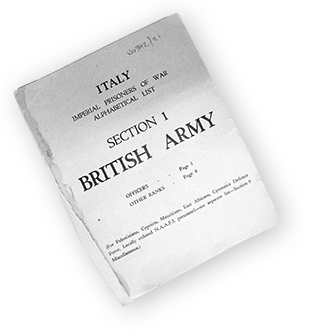
In “The Alphabetical List—British Soldiers A–B” and “The Alphabetical List—British Soldiers C–F” I explained how in 2013 researcher Brian Sims gave me access to a booklet entitled Italy: Imperial Prisoners of War Alphabetical List, Section 1, British Army.

The Alphabetical List contains the names of thousands of British prisoners of war interned in Italian camps, apparently compiled in 1942 or the spring of 1943.

Below is a list of soldiers G–J who were documented as P.G. 59 internees.

A key to acronyms and abbreviations follows the list.

Page 50
Galbraith, A. G. – L/Cpl. – 7012422 – R.U. Rif. – R.O. No. 17
Gale, E. H. – Pte. – 319191 – A.C.C. – R.O. No. 41
Galpin, F. A. – Dvr. – T/217760 – R.A.S.C. – R.O. No. 29
Game, B. C. – Pte. – 7519476 – R.A.M.C. – R.O. No. 30
Gardiner, R. E. – Pte. – 6299294 – Buffs – R.O. No. 23
Gardner, E. F. – L/Cpl. – 6283794 – Buffs – R.O. No. 23
Gardner, F. A. – Rfn. – 6912865 – R. Bde. – R.O. No. 24

Page 51
Gargett, E. – Sjt. – 7357206 – R.A.M.C. – R.O. No. 30
Garraway, J. – Gnr. – 4276657 – R.A. – R.O. No. 6
Gauld, K. – Tpr. – 319448 – R.A.C. – R.O. No. 3
Geeson, V. C. – Tpr. – 7888195 – R.A.C. – R.O. No. 3
Gibson, A. – Gdsm. – 2569934 – S.G. – R.O. No. 13
Gibson, R. – C.Q.M.S. – 2695323 – S.G. – R.O. No. 13

Page 52
Gibson, K. R. – L/Cpl. – 7900168 – R.A.C. – R.O. No. 3
Giesen, S. R. – Rfn. – 6915311 – R. Bde. – R.O. No. 24
Gileney, R. – Tpr. – 7907190 – R.A.C. – R.O. No. 3
Gilfillan, J. – Gdsm. – 2696710 – S.G. – R.O. No. 13
Gill, F. T. – Gdsm. – 2653419 – C. G. – R.O. No. 12
Gilmore, T. – Pte. – 7518529 – R.A.M.C. – R.O. No. 30
Gledhill, P. – Pte. – 4615488 – A.A.C. – R.O. No. 45
Gleed, P.H. – Rfn. – 6896952 – K.R.R.C. – R.O. No. 24
Glynn, R. W. – Pte. – 2937936 – Cam. H. – R.O. No. 16

Continue reading

Gunner J. Boyd’s Spoon

duospoons-j-boyd_r72

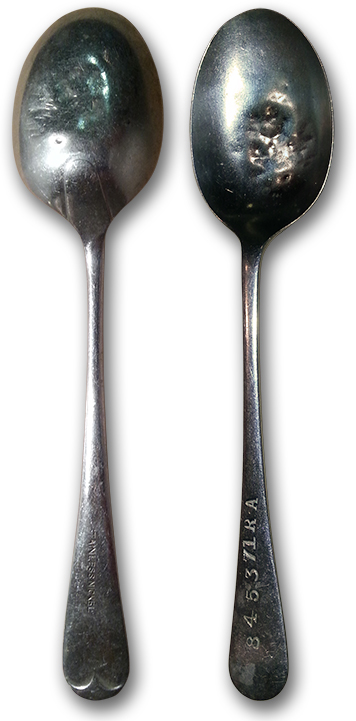
The back and front of J. Boyd’s military-issue spoon

Recently I received a surprise note from Geoff Sidlow, who lives in the U.K.

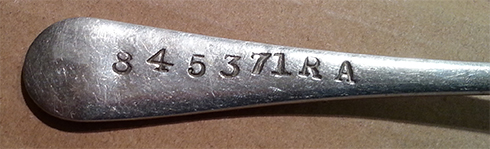
Geoff wrote, “I have come across a spoon on a car boot sale. The spoon has a number on it, 845371 RA.

“I have found the name J Boyd Gnr [in “The Alphabetical List—British Soldiers A–B“], but nothing else.

“All I can find out is that he was in camp 59 in Italy. I was wondering if you could point me in the direction to find any other details. I am really interested in these guys.”

I wrote back to explain I don’t have additional information on J. Boyd.

My late friend Brian Sims provided me with a number of P.G. 59 POWs’ repatriation reports, but unfortunately J. Boyd’s is not among them.

The inside and back of the spoon’s bowl show considerable wear and deformity, as if it had been used as a tool of sorts.

Did this spoon accompany British Gunner J. Boyd in combat, capture, and camp internment, finally to return home to England?

If you have further background about J. Boyd, I would very much like to hear from you. Please email hill@iu.edu.

spoonhandle-j-boyd-r72

J. Boyd’s service number and “RA” for Royal Artillery stamped onto the front of the spoon

A Letter of Tribute to Andrea Scattini

uguccione-scattini_r72

In a letter written after the death of Andrea Scattini, Uguccione Ranieri di Sorbello (Bourbon del Monte) pays tribute to his comrade’s heroism and strength of character.

Following a transcript in Italian—immediately below—is the text of the letter translated into English by Luigi Donfrancesco, Andrea’s nephew.

21 marzo 1946. Nel dopoguerra il Tenente Uguccione Ranieri (di Sorbello) Bourbon Del Monte, al quale nel frattempo è stata conferita la Medaglia d’Argento, dal suo domicilio di Roma in Via Due Macelli 31, indirizza alla Commissione per il Riconoscimento della Qualifica di Partigiano di Ancona una relazione nella quale descrive l’opera del suo collaboratore Andrea Scattini durante la guerra di liberazione:

“E’ mio dovere segnalare a codesta Commissione l’opera di un mio collaboratore, Andrea SCATTINI, morto l’8 marzo 1944 nella guerra di liberazione.

L’8 settembre 1943, fuggito dai Tedeschi a Cento (Ferrara) dove prestavo servizio, riuscii a raggiungere Termoli, allora appena liberata, dove – previo assenso del nostro Comando di Stato Maggiore – presi servizio in un Comando inglese i cui compiti, di natura riservata, si svolgevano dietro le linee in territorio nemico.

Continue reading

The Alphabetical List—British Soldiers C–F

alphabetical-list-sm-r72

In “The Alphabetical List—British Soldiers A–B” I explained how in 2013 researcher Brian Sims gave me access to a booklet entitled Italy: Imperial Prisoners of War Alphabetical List, Section 1, British Army.

The Alphabetical List contains the names of thousands of British prisoners of war interned in Italian camps, apparently compiled in 1942 or the spring of 1943.

Below is a list of soldiers C–F who were documented as P.G. 59 internees.

A key to acronyms and abbreviations follows the list.

Page 26
Cade, J. W. – Gnr. – 1433324 – R.A. – R.O. No. 6
Cahill, P. – Tpr. – 3597294 – R.A.C. – R.O. No. 3
Cairns, G. F. – Tpr. 7887665 – R.A.C. – R.O. No. 3
Calder, R. – Drv. – T/17143 – R.A.S.C. – R.O. No. 29
Caldwell, G. – Gnr. – 1438906 – R.A. – R.O. No. 6
Cameron. N. W. – Cpl. – T/128221 – R.A.S.C. – R.O. No. 29
Cammack, H. M. – Gnr. – 1504725 – R.A. – R.O. No. 5

Continue reading

The Alphabetical List—British Soldiers A–B

alphabetical-list-r72

In July 2013 my friend Brian Sims sent me a set of photographs of a remarkable document he had uncovered in the British National Archives.

One hundred thirty-eight pages in length, Italy: Imperial Prisoners of War Alphabetical List, Section 1, British Army, contains the names of thousands of British prisoners of war, along with their ranks, service numbers, and the military units to which they belonged.

The booklet is divided into sections for officers and “other ranks.”

Because officers were not typically interned at P.G. 59, only three are listed.

These officers provided healthcare to the internees: Captain T. R. Hodgson, Royal Army Dental Corps (serving as the camp’s dentist); Captain J. H. D. Millar, Royal Army Medical Corps (the chief medical officer for the camp); and A. R. Duff Royal Army Medical Corps (also a camp medical officer).

I am unsure of why Brigadier S. William, Royal Artillery, was present in the camp.

Sergeant Major T. W. Hegarty was P.G. 59 camp leader before Captain Millar assumed that role on September 9, 1943 due to Hegarty’s sudden incapacity. Hegarty, R.S.M. (Regimental Sergeant Major—a non-commissioned rank), Royal Armoured Corps, is listed among other ranks in this document.

This post contains the names of the officers and names A–B of other ranks—147 men in all.

I will share the rest of the British P.G. 59 internees’ names in future posts.

Continue reading

Honor Recommended for Mario Mottes

mottes-silver-medal-1-r72

First page of a letter from Major Luigi Stipa recommending that I.S.9 agent Mario Mottes be posthumously awarded the Italian Silver Medal of Military Valor (Medaglia d’Argento al Valore Militare)

In January 1944, Sergeant Mario Mottes was wounded in the area of Montalto Marche during a parachute drop, when his parachute opened too late to prevent a violent landing.

He continued on his mission, and two months later, on March 10, 1944, he was arrested by the Germans and shot with three escaped Allied prisoners of war.

Major Luigi Stipa proposed the Italian Silver Medal of Military Valor (Medaglia d’Argento al Valore Militare) be awarded to Mario. His letter of recommendation details Mario’s valiant service.

Access to this document from the “Stipa Papers” came through Dr. Luigino Nespeca of Offida. Luigi Donfrancesco translated the Silver Medal nomination into English:

REPORT ATTACHED TO PROPOSAL OF SILVER MEDAL “TO MILITARY BRAVERY, IN MEMORIUM” to Sergeant Radio-Telegrapher Paratrooper of the Army Mario MOTTES

Name: MOTTES Mario
Born: Belgium, November 18, 1919
Degree: Sergeant R.T. Paratrooper
Unit: Royal Army, Battalion Paratroopers
Enrolled in force on January 17, 1944
Residence: PERGINE VALSUGANA (TRENTO)
Shot at MONTALTO (MARCHE) on March 10, 1944

Continue reading

Ermanno Finocchi to “Carlo” Orlandini

orlandini-finocchi-let-r72

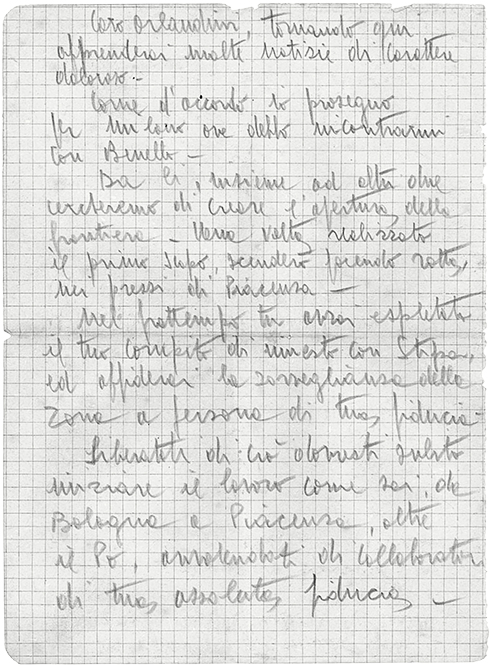
First page of a two-page letter from Ermanno Finocchi to Don Domenico “Carlo” Orlandini

Last week, Luigi Donfrancesco sent me an English translation he made of a letter I.S.9 agent Ermanno Finocchi sent to fellow agent Don Domenico Orlandini, whose agent name was “Carlo.”

“I found it interesting, as it shows details of Plan MILKY WAY and the way agents operated in setting up Rat-lines (Ratberry lines),” Luigi explained.

Here are introductory notes from Luigi in Italian and English, followed by the letter in both languages:

Nota. Scritto a matita su carta di quaderno a quadretti. E’ fra le “carte Stipa”, gentilmente fornite dal Dr. Luigino Nespeca di Offida nell’Agosto 2015.

Non c’è data, ma è stato scritto subito prima della partenza di Ermanno Finocchi per Milano (il 15 Marzo 1944 in camion, riferisce “Babka” nei suoi Diari). Quindi le “molte notizie di carattere doloroso” sono:

  • l’uccisione di Andrea Scattini a Force (8 marzo);
  • la cattura di Fausto Simonetti a Palmiano (9 marzo);
  • l’attacco alla banda partigiana “Paolini” a Rovetino e Rotella (9 marzo) e conseguente smantellamento della banda stessa;
  • l’attacco ed eliminazione della base “Rat-line” di Porchia (10 marzo), con ferimento e cattura di Diego Vecchiarelli e arresto di altri collaboratori;
  • l’uccisione nei pressi di Montalto Marche del Sergente Paracadutista Mario Mootis (sopravvissuto alla battaglia di El Alamein) e dei 3 prigionieri di guerra britannici che erano con lui (11 marzo).
Continue reading

Andrea Scattini—Youthful I.S.9 Agent

Scattini-Spoltore-1944_r72

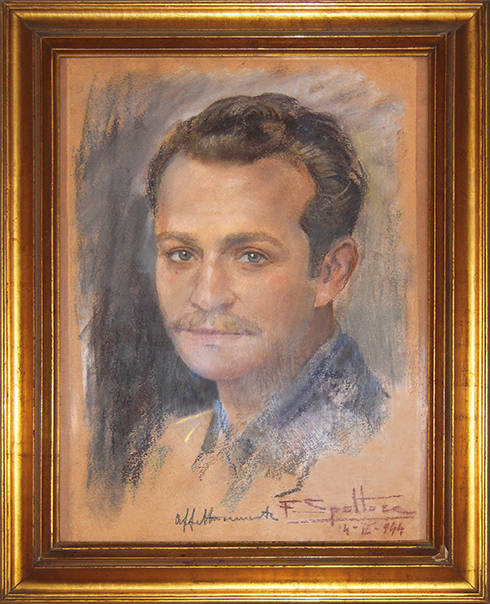
Portrait of Andrea Scattini by Federico Spoltore, Lanciano, February 14, 1944

As a young man and a medical student, Andrea Scattini was enrolled in the Medical Corps of the Italian Army and assigned to the Celio Military Hospital, Rome, according to his nephew Luigi Donfrancesco.

In September 1943, after Italy signed the Armistice, Andrea was captured by Germans outside the hospital. He and several other young men were slated for transport to Germany when Andrea escaped.

He returned to his home in San Vito Chietino Marina, on the Adriatic coast.

In October 1943, in Termoli, Andrea offered his services to the Allies and was enrolled as an agent under Captain Andrew Robb, No. 5 Field Section, “A” Force (I.S.9). He was among the first small group of six Italians to be employed in that capacity (the others being Uguccione Ranieri di Sorbello, Don Domenico Orlandini, Ermanno Finocchi, Fausto Simonetti, and “Guido”—full name unknown).

Andrea’s mission was to organize escape “Rat-lines” and to guide former POWs to safety over land and along the Adriatic coastline.

This was named Plan RATBERRY Section “A”, No. 5 Field Section, and Andrea and the other agents of his group were often referred to as “the Ratberry boys.”

Luigi is trying to acquire documents with details of Andrea’s missions and activities as an “A” Force/I.S.9 agent in the Marche and Abruzzo regions.

In a No. 5 Field Section progress report from Lanciano, Captain Robb states that on December 21, 1943, Andrea arrived at the Allied lines of the New Zealand Division, taking with him ex-POW Lance Corporal “Spiro.”

In the same report, Captain Robb states Andrea is “one of the original planners of MILKY WAY.”

“MILKY WAY” was a plan to extend RATBERRY in other directions, north and possibly east, to take prisoners to Switzerland and/or Yugoslavia.

On March 8, 1944, at age 26, Andrea was killed in the village of Force—the victim of an apparent ambush.

Continue reading