Category Archives: Prisoners—Camp 59

Ernest Debenham—Downed after Convoy Strike

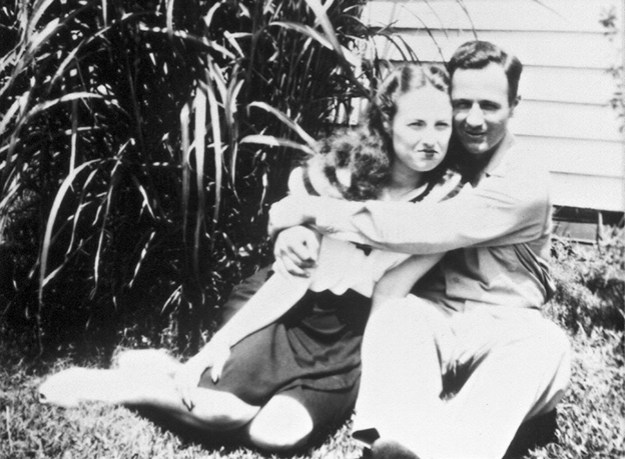
Flight Serjeant Ernest Debenham’s daughter Lesley shared this “photo on his wedding day to my mum, Ethel Mary Debenham (née Hoyle), who he had met through scouting before the war.

Lesley Woollacott (née Debenham) wrote late last month, “I have been looking for information about my father, W/O Ernest Debenham RAF 996601, who died in 1979. I know that he was a POW at Camp 59 Servigliano and somehow escaped. He was interrogated on return to the UK at 3 P W Transit camp on 22 January 1944.

“Unfortunately, my dad didn’t talk much about his wartime experiences. He was shot down in the Mediterranean (I think he would have been navigator/gunner) flying out of Malta and walked out across the wing of his plane to be taken prisoner of war.

“I understand that he escaped by just walking out of the camp, probably with another person, and they just kept walking. He could count to 20 in Italian and ask for a box of matches, and said they somehow passed German soldiers. He was assisted by an Italian family I believe, but I’ve no idea how he got back to the UK.

Continue reading

Serjeant Joseph Groves—Fallen in Pito, Italy

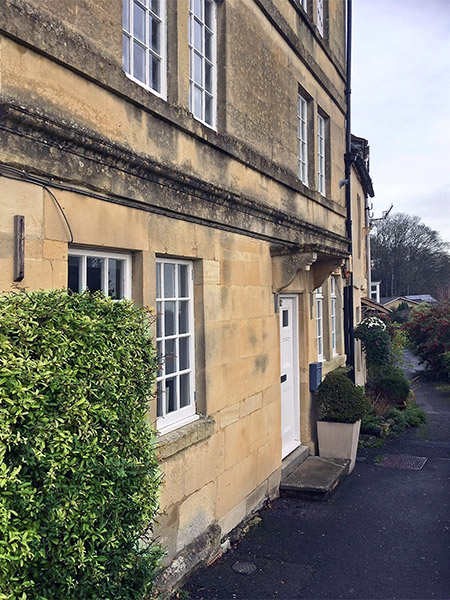
12 Tory, Bradford-on-Avon, Wiltshire, UK—the home of Joseph and Phyllis May Groves. The photo is courtesy of Jonathan Falconer, who comments, “I suspect he only lived there briefly after they married in June 1940 and before his regiment was posted overseas the following month to Egypt. Even so, he is commemorated on Bradford-on-Avon’s war memorial in the town centre.”

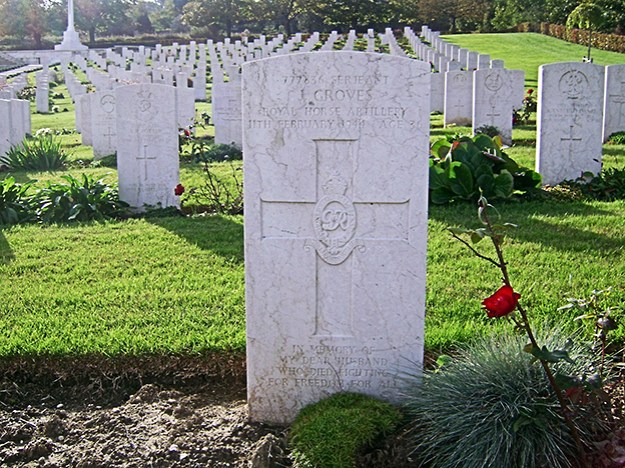
The Grave of Joseph Groves in Ancona War Cemetery.

The inscription on the marker reads:

777836 SERJEANT
J GROVES

11TH FEBRUARY 1944 – AGE 36

[The crest of the Royal Horse Artillery is carved within a cross]

IN MEMORY OF MY DEAR HUSBAND WHO DIED FIGHTING FOR FREEDOM FOR ALL

Sjt. Joseph Groves was captured in North Africa, interned in PG 59, and was killed in Italy four months after his escape from the camp. Some records, including the marker at Ancona War Cemetery, indicate he died on February 11, 1944. In fact, he was killed by soldiers of the German Brandenburg Regiment on March 11, 1944, during a surprise ambush at Pito, Italy.

Continue reading

Luther Vaughn’s Daughters Forge A Friendship with the Cesari Family

Luther and Anna Vaughn

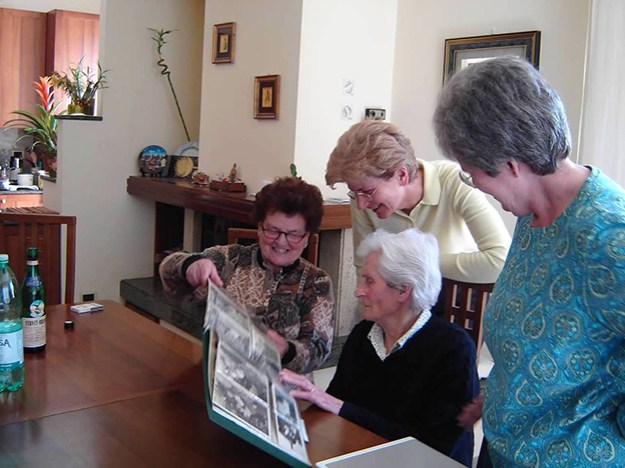
Adele, Loredana, and Francesca share old family photos with Judy Ingersoll during Judy and Victoria’s 2006 visit in Italy.

In January 2007, when I first set out to research the story of Camp 59, I made contact with Ian McCarthy of Associazione Casa della Memoria—the memorial association of Camp 59 in Servigliano, Italy.

Ian provided historical background about the camp, and he put me in touch with Judy Ingersoll and Victoria Vaughn, two daughters of American serviceman Luther C. Vaughn. Like my father, Luther had been a POW in Camp 59.

Victoria and Judy had recently been to Italy to see the camp and meet members of the Italian family that hid and fed Luther after his escape from P.G. 59.

On March 8, Victoria wrote, “How thrilling to hear from you! It is like hearing from a long-lost brother, as our fathers were brothers in arms.

“Dad was in the 1st Armored Division, 27th Field Artillery. He was a staff sergeant on a half-track. He deployed out of Fort Knox, Kentucky. His name was Luther Claude Vaughn, and I think his nicknames were “Ark,” “L.C.,” and who knows what else. He was captured at Tabourba, Tunisia, on December 6, 1942.

“On our visit to Servigliano, we met one family member who was living when Dad was there, as well as the descendants who were the warmest and most wonderful people.

“In 1943, Luigi and Lucia Cesari had three children: Renzo, Francesca, and Elena. Their son Pacifico had died in the war.

“Renzo married Adele, and their sons are Claudio and Pierluigi. Claudio is married to Laura, and Matteo is their son. Pierluigi is married to Enrica, and their daughter is Genny.

“Loredana is Francesca’s daughter.

“It was fascinating that everywhere we went in the area, people who heard our story recalled a GI who was with their families for some period of time. The Italians really seemed to embrace our POWs who escaped from Camp 59.

Continue reading

The Adventure of a Lifetime

This article was published one year ago in the Murray Ledger & Times (Murray, Kentucky). Victoria Vaughn has offered a few corrections, which are in brackets throughout the article.
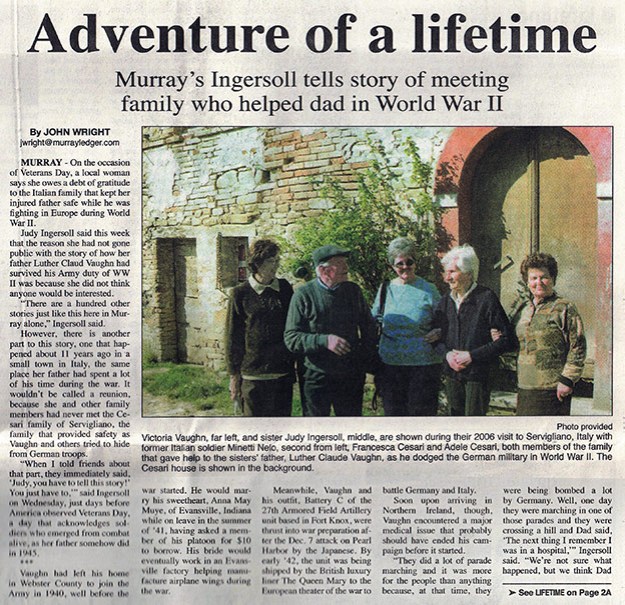
Victoria Vaughn, far left, and sister Judy Ingersol, middle, are shown during their 2006 visit to Servigliano, Italy with former Italian soldier Minetti Nello, second from left, Francesca Cesari and Adele Cesari, both members of the family that gave help to the sisters’ father, Luther Claude Vaughn, as he dodged the German military in World War II. The Cesari house is shown in the background.

Adventure of a lifetime

Murray’s Ingersoll tells story of meeting family who helped dad in World War II

By JOHN WRIGHT
Murray Ledger & Times
Saturday/Sunday, November 11-12, 2017

MURRAY – On the occasion of Veterans Day, a local woman says she owes a debt of gratitude to the Italian family that kept her injured father safe while he was fighting in Europe during World War II.

Judy Ingersoll said this week that the reason she had not gone public with the story of how her father Luther Claude Vaughn had survived his Army duty of WW II was because she did not think anyone would be interested.

“There are a hundred stories just like this here in Murray alone,” Ingersoll said.

However, there is another part to this story, one that happened about 11 years ago in a small town in Italy, the same place her father had spent a lot of his time during the war. It wouldn’t be called a reunion, because she and other family members had never met the Cesari family of Servigliano, the family that provided safety as Vaughn and others tried to hide from German troops.

“When I told friends about that part, they immediately said, ‘Judy, you have to tell this story! You just have to,’” said Ingersoll on Wednesday, just days before America observed Veterans Day, a day that acknowledges soldiers who emerged from combat alive, as her father somehow did in 1945.

Vaughn had left his home in Webster County to join the Army in 1940, well before the war started. He would marry his sweetheart, Anna May Muye, of Evansville, Indiana while on leave in the summer of ’41, having asked a member of his platoon for $10 to borrow. His bride would eventually work in an Evansville factory helping manufacture airplane wings during the war.

[Judy explains, “My mother, Anna May Muye was actually from Clay, Kentucky, also but was living in Evansville, Indiana, working first as a hospital aid to help pay off her father’s medical bills and later ‘Rosie the Riveter’ working on the wing of an airplane. (My mom is still alive and living in Florida).]

Meanwhile, Vaughn and his outfit, Battery C of the 27th Armored Field Artillery unit based in Fort Knox, were thrust into war preparation after the Dec. 7 attack on Pearl Harbor by the Japanese. By early ’42, the unit was being shipped by the British luxury liner The Queen Mary to the European theatre of the way to battle Germany and Italy.

Continue reading

Jimmy Feehan—Enlistment

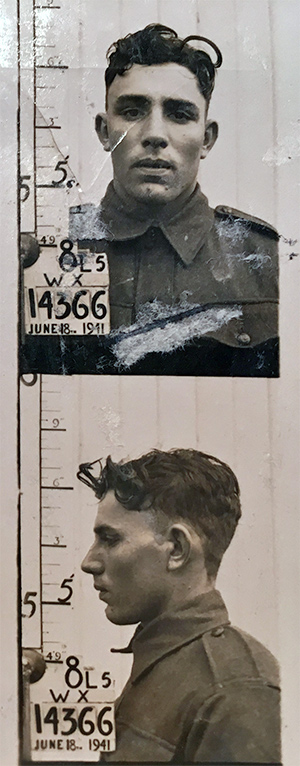
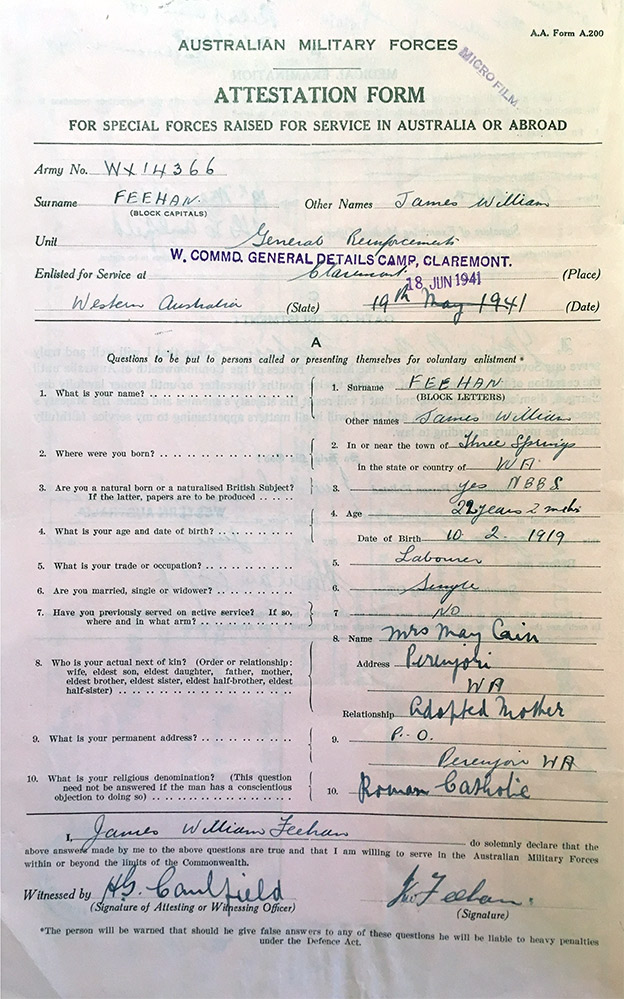
Jimmy Feehan enlisted in the Australian Special Forces on June 18, 1941, at the age of 22.

Front and side photos of him taken on that day are in his service records at the National Archives of Australia.

Katrina Kittel kindly shared copies of these records with me.

James William Feehan WX14364 was born in Three Springs, Western Australia, on February 10, 1919. His trade is listed as laborer and he was single when he enlisted.

Next of kin listed was Mrs. May Cain of Perenjori, Western Australia—his adopted mother.

Jimmy was one of nine Australians to escape from P.G. 59 in September 1943. The others were: John “Jack” Albert Allen, Thomas David Alman, Arthur George Bell (sometimes known as A. G. Jux), Lawrence Mortimer “Lawrie” Butler, Vaughan Lawrence Carter, Robert Edward Albert Edwards, Ronald James “Jimmy” McMahon, and Leslie Worthington.

See also “Jimmy Feehan and Thomas Penman,” “>Tom Alman—Back Home in Western Australia,” and “Tom Kelly—Escapee from P.G. 59.”

Also, use “Categories” on the home page to search for other “ANZAC Prisoners” posts.

Remembering Keith Killby


Keith (on left) with his father; Keith in his Special Air Service uniform


Keith with Letitia Blake

J. Keith Killby
June 15, 1916–September 7, 2018

Keith Killby, a former prisoner of war and founder of Monte San Martino Trust, died yesterday at his home in London.

About 10 years ago, I first learned of the Trust.

At the same time, I discovered Keith Killby had been interned at P.G. 59 and escaped though the same hole battered through the camp wall that my father passed through on the night of September 14, 1943.

In planning a trip to the UK in 2012, I reached out to Trust secretary and trustee Letitia Blake. Might she arrange for me to meet Keith?

A few weeks later, on our first day in London, Letitia met my partner Mark and me at the Swiss Cottage tube station and together we walked several blocks to the quiet street where Keith lived.

Continue reading

Memories of Manuel Serrano

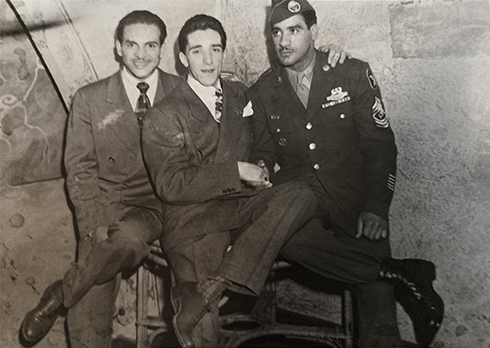
Manuel Serrano in an undated photo. Courtesy of Marie Galarza-Ruiz.

Manuel and friends. Courtesy of Marie Galarza-Ruiz.

One of the most interesting Camp 59 POWs by far is Manuel Serrano—a young paratrooper of Puerto Rican descent from New York City’s Brooklyn borough.

Even during the war, Manuel gained recognition as a tough, colorful character when his exploits behind enemy lines in Italy were profiled in Yank magazine. See “The Partisan from Brooklyn.”

I was so pleased to hear recently from Marie Galarza-Ruiz, who shed further light on, and a glimpse into a tender side of, this enigmatic character.

Marie wrote, “Manuel Serrano was a very close friend of my parents, Ignacio and Maria Galarza, and our family.

“I can’t tell you how surprised I was to find the clipping of him on your site. I have the same clipping in a scrapbook I keep of him to this day. He was such a special man and I absolutely adored him. His military service record is incredible and a testament to his strength and courage.

“He also led a very interesting life after leaving the military. He had small parts in a few Hollywood movies and lived most of his life in Europe, where he married his wife Adrienne in France.”

“He had a small part in the Valachi Papers and a larger role in Land of the Pharaohs, starring Joan Collins. He played her personal guard. He looked terrific in an Egyptian costume.

Continue reading

Manuel Serrano—The Partisan from Brooklyn

In 1999–2001, Italian historian Filippo Ieranò conducted a number of interviews with Italians of the Marche.

The collection was published as Antigone nella Valle del Tenna, or “Antigone in the Tenna Valley” in 2002 by Consiglio Regionale delle Marche. The stories highlight the reception of fleeing Allied POWs and Jews after 8th September 1943 in the Tenna Valley—examples of nonviolent resistance against Nazi-Fascists.”

Filippo included a memoir by Manuel Serrano in this volume:

Il partigiano di Brooklin
The Partisan from Brooklyn

[…] Erano passati due mesi dalla tragedia di Pearl Harbor, quando mi arruolai volontario nel corpo dei paracadutisti e fui mandato al corso di addestramento di Fort Benning, nello Stato della Giorgia. Dopo qualche mese fummo inviati in Inghilterra per un po’ di tempo e poi partecipammo all’invasione del Nord Africa.

[…] Two months had passed since the tragedy of Pearl Harbor, when I volunteered for the paratroopers and was sent to the training course at Fort Benning, Georgia. After a few months, we were sent to England for a while and then we participated in the invasion of North Africa.

La nostra prima missione era di far saltare un ponte, ma il 27 dicembre 1942 fummo catturati e condotti a Tunisi, dove ci caricarono su una nave italiana di nome ‘Zeno,’ destinazione Palermo.

Our first mission was to blow up a bridge, but on December 27, 1942, we were captured and taken to Tunis, where they took us on an Italian ship called the Zeno, destined for Palermo.

[…] Dopo due ore, arrivammo col treno a Servigliano provenienti da Porto S. Giorgio. La gente sembrava più cordiale, ci offriva anche del pane, nonostante la contrarietà dei carabinieri presenti.

[…] After two hours, we arrived by train in Servigliano. Coming from Porto S. Giorgio, people seemed more cordial there—they even offered us bread, despite the opposition of the carabinieri present.

Continue reading

Ron Streatfield—“Granddad”

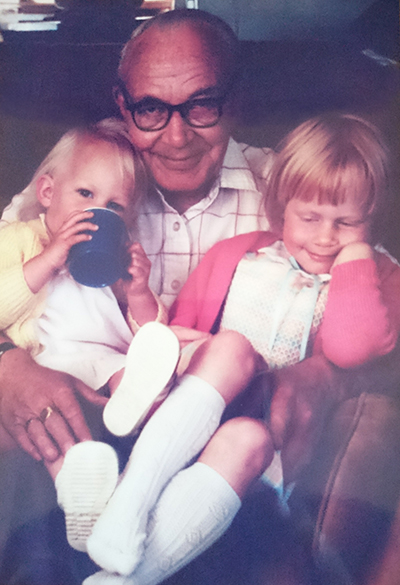
This week, Tracy Streatfield sent me additional photos of her grandfather, Ron Streatfield. The photo above, she explains, “is likely to have been taken not long before his passing—in either 1985 or 1986, as my sister Heather (left) only looks 2–3 years of age and she was born in 1983.” Tracy is on the right.

Ron died in December 1986.

Above—Ron with his Royal Signals training squad. Printed on the photo is “71 SQUAD NO 2 COY 1st O.T.B. R. SIGNALS 1945 INST L/CL ADAMS.” Ron is seated fourth from the left—see an enlarged detail of Ron below.

This is one of several group photos Tracy sent me.

Read also “Ronald Streatfield in Switzerland.”

Ronald Streatfield in Switzerland

Ronald Arthur Streatfield

The photos in this post were sent to me by Tracy Jayne Streatfield, whose grandfather, Ronald Arthur Streatfield, was a prisoner in Camp 59.

“Ron married Sylvia Shrubb and they had two children—Nigel and Jane,” she wrote. “I am Nigel’s eldest daughter.

“My granddad was in the Queen’s Royal West Surrey Regiment. He was born 30th December 1919, and died 4th December 1986.

“Along with some fellow prisoners of war, he ended up in Switzerland before returning home.

“Most of the pictures are from Switzerland, as you will see.”

Continue reading