Category Archives: Prisoners—Camp 59

Willman King—Enlistment to Capture

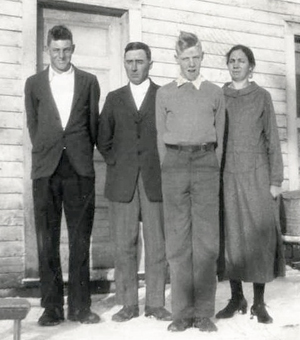
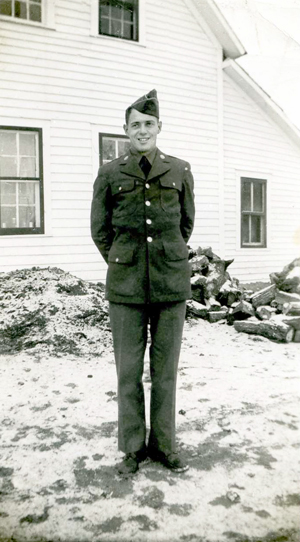
Willman King, late fall 1945. The photo was taken in front of the farm home where he worked before WW II.

“The man with my dad and string of fish is Carl Eidensheink,” says Joe King. “He was a farmer my dad worked for as a hired man.” Circa 1938–39.

I received an email from Joseph M. King in January of this year. Joe wrote:

“I am sending information that I believe will add one more man to your list of Camp 59 survivors. He is my father, Willman I. King (Pvt. 37093828). He was born in 1919 and he died in 1980.

“Sometime in the late 1970’s, when I was home for a short visit, I did a mini-interview with Dad one evening at the dinning table. I was only about 30 years old, so I had very limited life experience to ask the in-depth questions I would ask today. But at least I got a small sketch of the chain of events from dad’s enlistment in the Army to his capture in North Africa. I say enlist because that is what his friend Johnnie Eidensheink told me Dad did.

Continue reading

Willman King—A 1979 Interview

Click on the image above for access to a file that can be enlarged for better viewing.

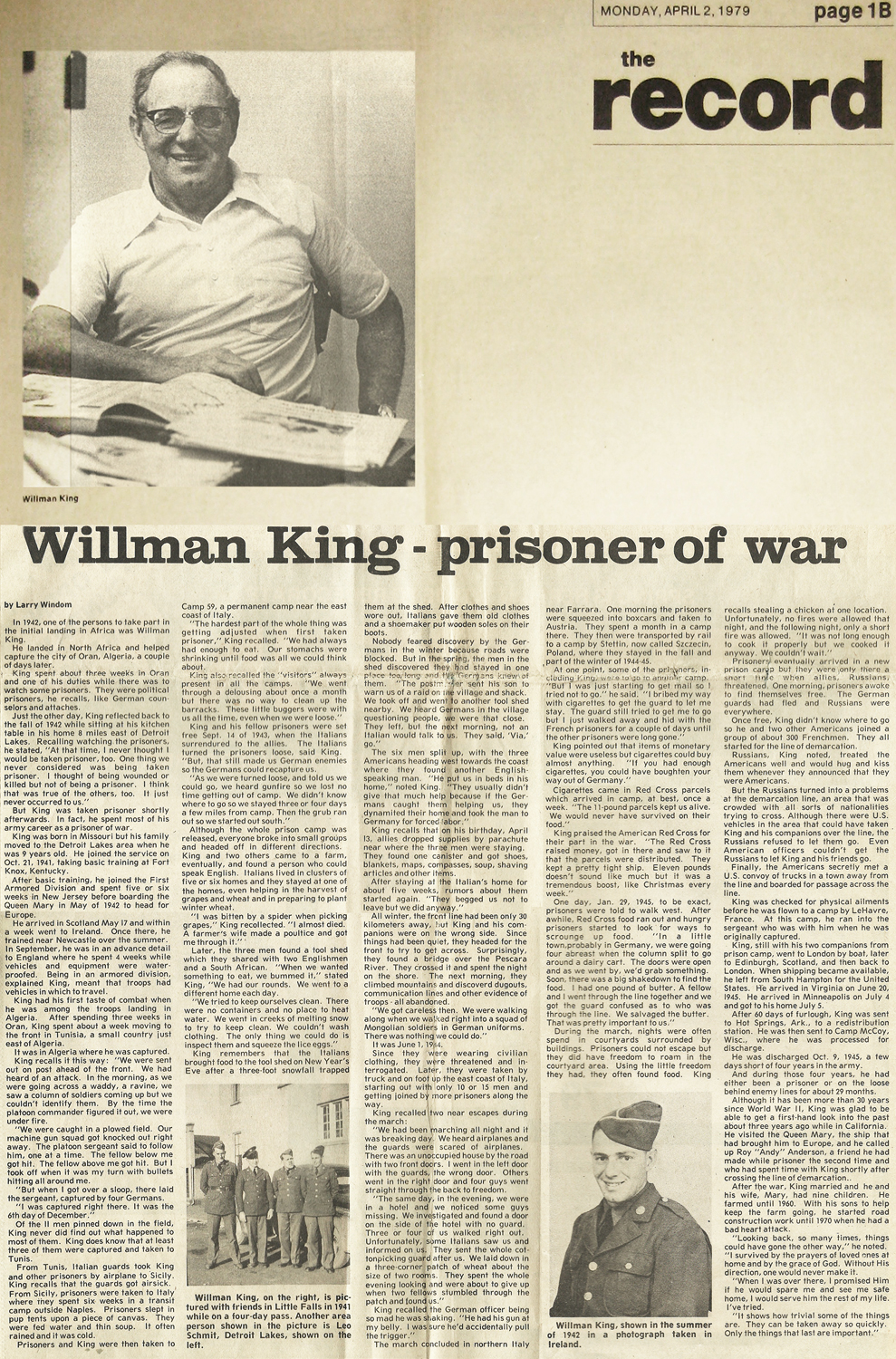
Willman King—prisoner of war

The Record
Monday, April 2, 1979

[The Becker County Record serves Becker County and Detroit Lakes, Minnesota.]

By Larry Windom

In 1942, one of the persons to take part in the initial landing in Africa was Willman King.

He landed in North Africa and helped capture the city of Oran, Algeria, a couple of days later.

King spent about three weeks in Oran and one of his duties while there was to watch some prisoners. They were political prisoners, he recalls, like German counselors and attaches.

Just the other day, King reflected back to the fall of 1942 while sitting at his kitchen table in his home 8 miles east of Detroit Lakes. Recalling watching the prisoners, he stated, “At that time, I never thought that I would be taken prisoner, too. One thing we never considered was being taken prisoner. I think that was true of the others, too. It just never occurred to us.”

But King was taken prisoner shortly afterwards. In fact, he spent most of his army career as a prisoner of war.

Continue reading

Additional Camp 59 Prisoners

Since the recent New Names for the Prisoner List post, Robert Newton sent a few more names for the master Prisoner List.

These servicemen are:

Willard J. Bergstrom—From Traverse City, Michigan, “Bill” Bergstrom was formerly of the 1st Armored Regiment. He was interned at Camp 59 and escaped with Paul Alsin and John S. Skulborstad.

Alphonse Buttacavoli

James Edward Kavana—Escaped from Camp 59, was recaptured by the Germans, and escaped again.

William J. “Kivvy” Kivlehan

Leslie O. Parker

Robert D. Power

Kenneth G. “Bull” Seldon—Escaped from Camp 59 but was recaptured and sent to Germany.

Regarding servicemen from other countries who were interned at the camp, Robert wrote:

“There were Canadians in the area for sure. Raymond Cox told me that.

“Ferree Grossman also said there was a Welshman with my uncle [Corporal Robert Alvey Newton].”

In going though his research resources, Robert found he had two copies of the 1991 membership directory of the national American Ex-Prisoners of War (AXPOW) organization. He generously sent his extra copy to me.

The directory lists home addresses and all of the camps where each member was held. This listing of all camps for each serviceman is especially valuable because the National Archives Records of World War II Prisoners of War lists only the last camp where each man was interned.

As I find time to go though the full AXPOW directory, which contains thousands of names, additional names for the master Prisoner List are sure to surface.

Many thanks to Robert for his generosity.

New Names for the Prisoner List

Late last month Robert Newton of Hillsboro, Oregon, provided me with a list of many POWs who, until now, have not been included on the master Camp 59 Prisoner List.

Robert’s uncle, Corporal Robert A. Newton, was a prisoner in Camp 59, (this site has several posts concerning him), and Robert has conducted years of research into WWII POWs. In fact, I found among my own father’s papers after he passed away in April 2000, letters Robert had sent to him in 1992!

Robert explained, “I either corresponded with these vets or their family members, or met them personally, or heard about them from other escapees. For example, Ken Lightbody told me that he spent nine months on the run with J. B. Tackett.

“Most of my contacts were 20 years ago, so most have since left the stage.

“As you noted, the official records are ambiguous and simply state that a POW returned to allied control. I have enjoyed trying to find out as much as possible to advance the history of these brave men.

Continue reading

James Osborn in Italian and German Camps

Above: Jim Osborn in 1945, at the time of his marriage to Betty Ephgrave.
Note that the crest on his cap seems to be that of the Royal Artillery, and the ribbon bar above his left pocket flap bears a number 8. I believe it is the Africa Star 8th Army bar.

I received an email from John Osborn, who lives in Derby, England, on January 12.

John wrote, “I am trying to trace the movements of a relative of mine who I have just discovered was a POW held at Camp 59 and who is not on your list. My uncle, James Frederick Osborn was a Gunner in the Royal Artillery of the British Army.

“My uncle Jim was born in Luton, Bedfordshire, on 26 July 1920. He was one of three sons of Frederick and Hilda Osborn. His brother Les was about a year younger and my dad, Ray, was three years his junior. At the outbreak of World War 2 the family was living in Welwyn Garden City, Hertfordshire, England, UK.

“The three brothers all volunteered before they were drafted, as their conscription age approached. Jim went into the Army, Les into the Royal Air Force, and my dad went into the Royal Navy.

“I have always known that Jim had been a POW from early on in the war and I have some vague memory that I was once told that he was captured in North Africa rather than France.

“My cousin Christine, Jim’s daughter, sent me photocopy of a POW postcard from Jim to Betty Ephgrave, who was at the time his fianceé. They married in 1945 on Jim’s return home.”

The return address on the card is Osborn, James Fredirick, Gunner 1602265, Camp PG No 59, PM 3300 ITALIA.

John continued, “Jim ended the war in Stalag VI-B at Mühlberg in Germany.

“Christine told me that at some time during his captivity, possibly at the end of the war, or possibly before he was transferred from Camp 59, Jim was involved in a breakout.

“During the breakout he lost what personal papers he had. These were found by a German soldier. Some years after the war (about 1948-49) this German returned the papers to Jim. From then on they sent each other Christmas cards and visited each other!”

Albert Rosenblum with the Virgili Family

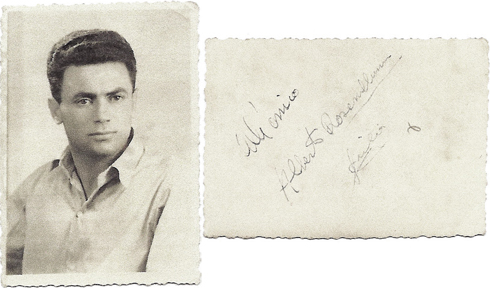
Above: Duilio Virgili

Alle amico [To a friend]
Alberto Rosenblum
Duilio

Last June, Alan Rosenblum sent me a detailed account of the protection his father, Sergeant Albert Rosenblum, was given by the Virgili family of Ortezzano, Italy, after his escape from Camp 59 in 1943.

Al also sent scans of a few old photographs and an envelope from a letter sent by Duilio Virgili to his father after the war (the letter has since been lost).

I forwarded Al’s account and the photos to Italian researcher Filippo Ieranò in Servigliano, Italy, explaining that Al was interested in making contact with the Virgili family.

In September, Filippo replied: “It was not easy, but eventually I managed to get in touch with Rita Virgili, the sister of Duilio Virgili of Ortezzano.”

Filippo explained, “Mrs. Virgili recalls that Albert and several other American prisoners came to their house during the war. She currently lives in Rome, and would be very glad to establish a relationship with Alan Rosenblum.”

Continue reading

Mrs. Dickinson to Mrs. Crooks—Letters

The following two letters were sent from Robert Dickinson’s stepmother to Denis Crooks’ mother when the two sons were overseas during the war.

Robert’s mother—also the mother of his brothers James and William—died young. Robert’s father, Leslie Dickinson, married again—to Nellie, the author of these two touching letters.

Leslie and Nellie had a son together, Len Dickinson. Letters and cards Robert sent while in service to his little brother Len are posted elsewhere on this site.

Thanks to Denis’ daughter, Maggie Clarke, for sharing this material.

Continue reading

Robert and Denis—“Best of Chums”

Pictured above are Robert Dickinson (left) and Denis Crooks.

The 12 letters in this post were sent to me by Maggie Clarke, Denis Crook’s daughter.

Ten of the letters were among those Denis sent to his parents while he was interned at Camp 59–Servigliano. The final two were written in Camp 53–Sforzacosta. The letters are a testament to the deep friendship between Denis and fellow prisoner Robert Dickinson, who is mentioned in each of the letters.

Denis also is frequently mentioned in the log of daily events in Robert’s prison camp journal, “Servigliano Calling.”

The two men were, as Denis put it, “best of chums” from January 1942 to May 1943. When Robert was transferred from Camp 53, it would be the last time the two men would see each other, as Robert did not return from the war.

In addition to reports of what Denis and Robert were up to, the letters provide a wealth of information about daily life in camp—invention and refinement of the “blowers” the men used to warm food, the concoctions that they created from Red Cross parcel contents (see also “Robert Dickinson’s ‘Campo 59 Cookery'”), and details of a camp-sponsored “grand carnival” (see also “Carnival Time”).

(No. 11) April 12th. [1942]

Dear Mother and Dad,
I received another two letters last week—no. 50 dated 4th. Feb. and letter-card dated 30th. Oct. and then today I had a letter-card (no. 3) dated 1st. of March, so I was very pleased. After I had written my last letter on Easter Sunday we received another Red-Cross food parcel, one between two. I and my friend Bob were very lucky, we had an apple pudding (tinned of course) and with it we each ate a pound of jam which we had bought at the canteen; we get paid here and can buy cheese and jam at the canteen. Gee! was it good!!! Amongst other things we had ½ lb. oatmeal, so on Monday the cookhouse made porridge for those who had oatmeal, and that was jolly good too. I hope these parcels come fairly regularly now. [missing text] had an extra 8 o’clock service last Sunday morn… [missing text] that. There were over 100 chaps there. The padre has [text missing] evening services every evening at 7:30 for about 10 minutes. I hope you are receiving my letters every week now, we write regularly every Sunday. Please thank everybody for their greetings, and for being so good to you at home, it must have been very worrying for you. Remember me to Michael and Joan Field, and also to Elsa and through her to Ron Gilbert. Yes, I do smoke a little, it helps to pass the time, so I’d love to get some cigarettes. We have an Italian issue every week, and also 50 English with each parcel. Glad your back is O.K. Dad, keep it up! Lot of love and kisses from Denis xxxxxxx

Continue reading

Kind Strangers—Relays from Radio Rome

World War II Radio Heroes: Letters of Compassion, published in 2007 by psychologist Lisa Spahr and Austin Camacho, tells the story of shortwave radio listeners who collected and relayed information broadcast from enemy territory about newly-captured POWs to their families in the U.S.

An entry about Letters of Compassion on Wikipedia has this to say about the effort:

“During World War II, short messages from prisoners of war were often read by studio announcers at stations in Germany, Japan, and other Axis powers countries. A number of shortwave listeners copied the prisoner names and addresses and notified families by mail or telephone, and the practice became known as ‘Prisoner of War relay’ or ‘POW monitoring’. Although the Allied government provided similar services, the families usually heard from shortwave listeners first, sometimes as many as 100 at a time.

“Many wartime listeners were ordinary citizens who discovered they were able access the shortwave bands; a feature included on many premium consumer radios of the era. Times and radio frequencies of the news from Rome, Berlin and Tokyo were published daily on the radio page of The New York Times. Others were dedicated shortwave listeners or DXers who maintained an ongoing interest in long-distance radio listening as a hobby. Still others were licensed amateur radio operators who were, as a group, banned from transmitting due to wartime restrictions, but often kept their listening gear in operation.”

In May 1943, Sergeant Albert Rosenblum’s family received a host of these cards from shortwave listeners around the U.S. The writers reported they had heard Albert’s name and his home address broadcast from Rome.

In addition to the news conveyed, concern and encouragement these strangers expressed must have been a great comfort to the Rosenblums.

For Albert Rosenblum’s full story, read the following post:
A Family in Service.


Helen Barrett
317 Burnet Park Dr.
Syracuse, N.Y. [New York]

Mr. Horace Rosenblum
Route 1
Box 48
Swan Lake, N.Y.

May 8, 1943

Dear Mr. Rosenblum,

Last evening I was listening to my short-wave radio and tuned in on a news broadcast from a station in Italy. The news was in English, and among other information, were the names, addresses, etc. of American soldiers who are “Italian prisoners”. Your son’s name was among those given:

Albert Rosenblum
#6701591

Perhaps you already have this information, but as a fellow American with a young brother in the war I feel it is my duty, really, to send this news on to you.

Hoping you will be hearing good news of your son very soon, I remain—

Sincerely yours,
(Miss) Helen Barrett

Continue reading