Category Archives: Prisoners—Camp 59

The Alphabetical List—British Soldiers C–F

alphabetical-list-sm-r72

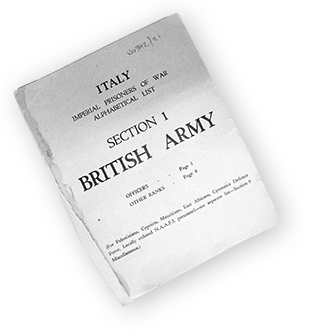
In “The Alphabetical List—British Soldiers A–B” I explained how in 2013 researcher Brian Sims gave me access to a booklet entitled Italy: Imperial Prisoners of War Alphabetical List, Section 1, British Army.

The Alphabetical List contains the names of thousands of British prisoners of war interned in Italian camps, apparently compiled in 1942 or the spring of 1943.

Below is a list of soldiers C–F who were documented as P.G. 59 internees.

A key to acronyms and abbreviations follows the list.

Page 26
Cade, J. W. – Gnr. – 1433324 – R.A. – R.O. No. 6
Cahill, P. – Tpr. – 3597294 – R.A.C. – R.O. No. 3
Cairns, G. F. – Tpr. 7887665 – R.A.C. – R.O. No. 3
Calder, R. – Drv. – T/17143 – R.A.S.C. – R.O. No. 29
Caldwell, G. – Gnr. – 1438906 – R.A. – R.O. No. 6
Cameron. N. W. – Cpl. – T/128221 – R.A.S.C. – R.O. No. 29
Cammack, H. M. – Gnr. – 1504725 – R.A. – R.O. No. 5

Continue reading

The Alphabetical List—British Soldiers A–B

alphabetical-list-r72

In July 2013 my friend Brian Sims sent me a set of photographs of a remarkable document he had uncovered in the British National Archives.

One hundred thirty-eight pages in length, Italy: Imperial Prisoners of War Alphabetical List, Section 1, British Army, contains the names of thousands of British prisoners of war, along with their ranks, service numbers, and the military units to which they belonged.

The booklet is divided into sections for officers and “other ranks.”

Because officers were not typically interned at P.G. 59, only three are listed.

These officers provided healthcare to the internees: Captain T. R. Hodgson, Royal Army Dental Corps (serving as the camp’s dentist); Captain J. H. D. Millar, Royal Army Medical Corps (the chief medical officer for the camp); and A. R. Duff Royal Army Medical Corps (also a camp medical officer).

I am unsure of why Brigadier S. William, Royal Artillery, was present in the camp.

Sergeant Major T. W. Hegarty was P.G. 59 camp leader before Captain Millar assumed that role on September 9, 1943 due to Hegarty’s sudden incapacity. Hegarty, R.S.M. (Regimental Sergeant Major—a non-commissioned rank), Royal Armoured Corps, is listed among other ranks in this document.

This post contains the names of the officers and names A–B of other ranks—147 men in all.

I will share the rest of the British P.G. 59 internees’ names in future posts.

Continue reading

Carl Leroy Good—Captured by the Enemy

aceves-cover_r72

carl-duo_r72

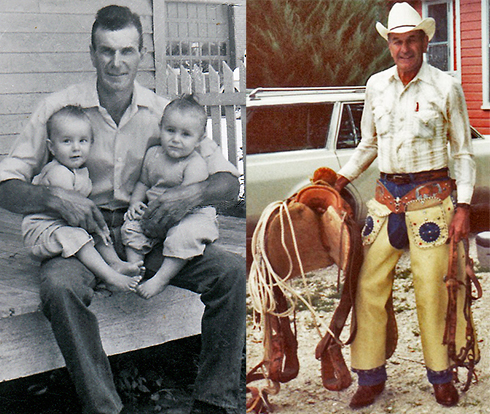
At left, Carl with twins Ron and Don, the last-born of his and his wife Nadine’s six children; right, Carl at home on the family farm

I first heard from Crystal Aceves in February 2010, when she wrote, “My grandfather was part of Operation Torch, subtask operation Brushwood. He made it through the amphibious landing and went on to Sicily, where he captured on July 17, 1943.”

Carl was transferred through several camps, the last of which was P.G. 59 in Servigliano.

He kept an account of his war experiences, in which he described the Camp 59 breakout:

“It was on the 8th of September we heard the allies were in Italy and Italy had packed in. What a day! We were free! That’s what we thought. We were held for six more days. We grew very impatient and started to smell a mouse, were they going to turn us loose, today, tomorrow, so we made plans of our own. We’d go on our own. Soon the Germans would come in and take us on to Germany. On the night of the 14th of September we went out under fire through a hole in the wall that had been chiseled by some of the prisoners.”

Continue reading

Brian Sims—A Tribute

arboretum-tree_r72

Brian Sims oversaw the dedication of this memorial plaque and a commemorative tree planted in the National Memorial Arboretum several years ago.

My first connection with researcher Brian Sims was on June 2, 2013.

In an earlier post on this site I had speculated on the presence of New Zealanders in PG 59, to which Brian responded with this short note:

“There were a very small number of New Zealanders in PG 59—2 in March 1942—3 in May 1942—and only one up to December 1942. None are recorded for 1943.

“The information comes from my database of Red Cross reports copied in the UK National Archives. —Brian Sims”

Thus began a rich two-year correspondence with Brian during which he introduced me to or shed additional light on many aspects the POW experience including:

  • The SS Brandenburg Division operations in Italy
  • I.S.9 rescue operations along the Adriatic coast
  • Recommendations put forward by British and American officers for honors and awards to Italian helpers
  • British Special Investigation Branch (SIB) inquiries into the murder of escaped prisoners
  • POW escapes into Switzerland
  • Sam Derry, Monsignor Hugh O’Flaherty, and the Rome Rescue Organization

Brian’s research into the POW situation in Italy went back 23 years, to the time of his retirement from a career in mining. What began as a quest for information on his father—a British POW who drowned when an Italian ship on which he was being transported was sunk in the Mediterranean—quickly became a calling to learn all that he could about Allied POWs in Italy, and to make that information available to others.

Continue reading

On the Trail of L/Sgt John Henry Jewell

john-jewell_r72

Lance Sergeant John Henry Jewell, Service Number 5495162, of the Royal Hampshire Regiment

I received a note a few days ago from Jackie Keenan of the village of Whittlesford in Cambridge, England.

She and her sister, Margaret, have been attempting to trace the details of their father’s wartime experience.

“Our father, John Henry Jewell, was taken prisoner in North Africa on 3rd December 1942,” Jackie explained.

“I have been through [accounts of] other prisoners taken in the same battle, on the same day, from the same regiment and it would appear that they were taken to Camp 98 in Sicily on 5th December where they stayed until being moved on 31st December to Camp 66 at Capua. On 2nd March 1943 they were moved on again to Servigliano where they remained until 14th September 1943.

“After the POWs escaped from Servigliano, my father was reported missing until being traced as a prisoner in Stalag 7 in Moosburg.” His prisoner number there was 130605.

Continue reading

Story of Joseph E. Pojawis Shared

pojawis-ID-detail-r72

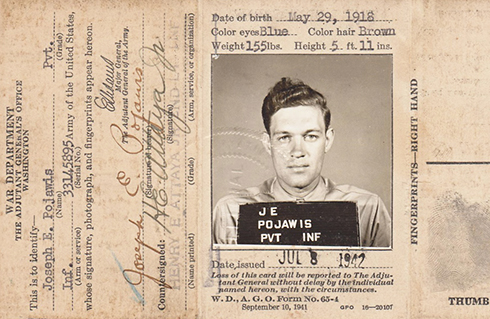
Detail of Joe Pojawis’ military identification card, issued in July 1942 before his overseas departure

I received a note this past week from Wally McCollum of Maryland.

Wally has a family connection to American soldier Joseph Pojawis, who was interned at PG 59 January 23–September 14, 1943. In his note, Wally related how he and his wife discovered new information about Joe’s combat and POW experiences just one week ago (over the U.S. Memorial Day weekend):

“This past weekend at a family reunion I came into possession of a diary kept by my wife’s uncle Pvt. Joseph E. Pojawis, who served in a light mortar squad, Company A, 18th Infantry Regiment, 1st Infantry Division. He was captured on December 23, 1942 in the Battle of Tunisia. He was first taken to a POW camp in Sicily, but was transferred to Camp 59 in late January 1943. In addition to the diary I have ten letters he wrote while at the camp. He was among the mass escapees in September 1943. He eluded capture for several months, but was unable to get through the German lines to freedom. He linked up with Allied forces and was sent to the USA, where he was discharged in poor health in December 1944.

Continue reading

P.G. 59 Prisoner Arthur Page

I am pleased to have added today a new name, British Sergeant Arthur Page, to the master Prisoner List on this site. Information on Arthur was sent to me by researcher Janet Kinrade Dethick.

She wrote:

“I have just come across the translation into Italian of part of a book by Sergeant Arthur Page, 5501857, captured near Tunis on 3 December 1942, who after a period in a camp in Sicily and then PG 66 at Capua was sent to Servigliano. He escaped at the Armistice, was recaptured and put on a train for Germany.

“He escaped from the train and, passing through (or near to) Bologna, Florence and Città di Castello, he arrived in Nocera Umbra, where he met a young man who took him up into the hills where he was sheltered firstly by the family of Attilio Tulli at Verchiano and then by the Spuntarelli family at Croce di Rocca Franca.

“When the worst of the winter ’43–44 was past, he and a fellow escaper, South African Piet van Rensburg, left for the Allied lines. They met the Allied troops not far from Servigliano.”

Janet said the original English version of Arthur’s book is entitled A Walk in Wartime Italy. It was published in 1995 by Airforce Publishing Services, P.O. Box 236, Swindon, Wilts. UK.

Soldiers of the Strange Night

soldiers-covers_r72

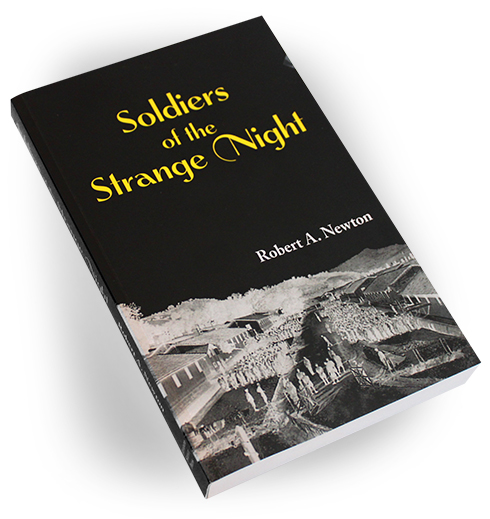
For author Robert A. Newton, publication earlier this year of a 360-page book entitled Soldiers of the Strange Night marked the culmination of many years of dedicated research.

Robert’s experience was a personal journey of first coming to understand, and now sharing, the full life story of his father’s brother—and Robert’s own namesake—U.S. Army Corporal Robert Alvey Newton, who was called Alvey by his family and friends.

Robert took the title of his book from a quote by Pulitzer Prize–winning American journalist and roving war correspondent Ernest Taylor “Ernie” Pyle (who, like Alvey, was born and raised in Indiana and attended Indiana University):

“Everything in this world had stopped except war and we are all men of a new profession out in a strange night caring for each other.”—Ernie Pyle, Brave Men

One way to understand war is to study it in terms of politics, power, strategy, and battles won or lost. Another way, which was Ernie Pyle’s way and Robert Newton’s approach as well, is to see it on a deeply personal level—of men serving together as brothers and caring for each other, while acting in a savage, tumultuous theatre.

This spirit of compassion and bravery was characteristic also of the Italians who sheltered Allied escapers—in the case of Robert and fellow escapee Martin Majeski, the Viozzi family, who are profiled in the book.

Continue reading

Tom Lockett—Two Months To Freedom

tom-lockett_r72

Sergeant Tom Lockett, posing while an ammunitions instructor for his parachute regiment

I heard this week from Robert Maddocks, the chairman of the Penkridge (Staffordshire, England) local history group. He explained that he was contacting me on behalf of Josie Shemwell, daughter of Frederick Thomas Lockett, a sergeant with the 2nd Battalion, Parachute Regiment.

Tom Lockett was captured in North Africa on December 2, 1942 and he escaped from P.G. 59 in September 1943.

Tom’s repatriation record is given on “Detailed Accounts of 14 British Escapees.” After escaping, Tom was sheltered and fed by the family of farmer Francesco Vallorani of Montefalcone, Italy from September 20 to November 14.

Continue reading

Hands Up Interviews Preserved for Posterity

dawson-cheeseman_r72

Actor Stanley Dawson (left), who played the role of General Archibald Wavell in Hands Up! For You the War Is Ended discusses a scene with artistic director Peter Cheeseman

I sent a note to the New Vic Theatre after publishing my initial post about their 1971 production of Hands Up! For You The War Is Ended.” I was interested in what had become of the interview tapes made during creation of the play.

A warm response came from Romy Cheesemen, who was married to creative director Peter Cheeseman. Since his death in 2010, she has been acting as honorary archivist of the Victoria Theatre Archive held at Staffordshire University’s Thompson Library (Special Collections).

She wrote, “Peter would be so gratified to know that his documentary work with local people still has resonance today. He always believed that people’s personal stories and experiences were important and that a theatre subsidised by its own community should find ways of valuing local people and celebrating their stories. Having lived through the war as a boy, Hands Up was Peter’s favourite of the 11 documentaries that his company created. For him it was an unforgettable experience meeting and talking with those ex-POWs and their families, and one that he valued all his life.”

Continue reading