Category Archives: Italian Helpers

I.S.9 Italian Agents, Part 5

This is the fifth part in a series of posts concerning Italians who served as agents for I.S.9 (Intelligence School 9 of the Central Mediterranean Force).

I.S.9′s chief mission was support and rescue of escaped POWs and evaders (E&Es) stranded in enemy territory. I.S.9 was a division of M.I.9 (British Directorate of Military Intelligence Section 9), a department of the War Office during WW II.

I am grateful to researcher Brian Sims for allowing me access to his collection of British National Archives I.S.9 files.

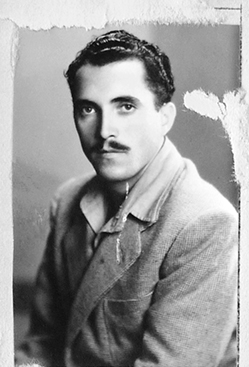
terrizzano-ezio_r72

Ezio Terrizzano

Born November 2, 1913 at San Bartolomeo del Cervo, Imperia Province. Ezio was a lieutenant in the Italian army (artillery) in Libya until April 1942, and thereafter he served in Italy until the armistice. He spoke French and English fairly well. (He could make himself understood).

Ezio was attached for duty with I.S.9 by the Italian High Command. He was employed by Field Section No. 1 in the capacity of liaison discipline at the Bari headquarters.

He ceased to be employed on May 22, 1945, as his services were no longer required due to conclusion of hostilities. He proceeded to Milan on May 23 for 21 day’s leave, after which he was to report to the Italian authorities.

Continue reading

I.S.9 Italian Agents, Part 4

This is the fourth part in a series of posts concerning Italians who served as agents for I.S.9 (Intelligence School 9 of the Central Mediterranean Force).

I.S.9′s chief mission was support and rescue of escaped POWs and evaders (E&Es) stranded in enemy territory. I.S.9 was a division of M.I.9 (British Directorate of Military Intelligence Section 9), a department of the War Office during WW II.

I am grateful to researcher Brian Sims for providing access to his collection of I.S.9 files from the British National Archives for this series.

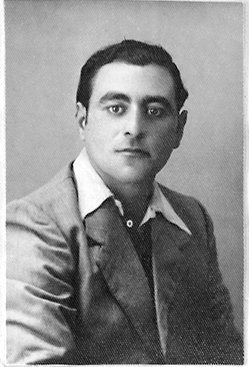
stasolla-antonio_r72

Antonio Stasolla

Born January 28, 1920 at Santeramo (Bari Province).

Antonio was a bricklayer at Castellaneta. He was called up to serve in the Army on March 12, 1940. He served in the infantry and joined the parachutists.

He held a parachutist’s Tessera di Riconoscimento (identity card).

He served in Italy, Croatia (for two months), and Sicily. At Armistice, he was in Calabria with the Nembo Division of the Italian Army. He volunteered for A Force service, and joined N Section at Palese in the capacity of para-guide on December 11, 1943.

He was issued a false Carta d’Identita for Foggia in the name Antonio Stasi, muratore.

He ceased to be employed on May 15, 1945 because of lack of work due to conclusion of hostilities. He was paid off by Field Headquarters and sent to Bari on May 16, and then to proceed to Taranto for four weeks leave. Thereafter he was to report to the Italian authorities.

Continue reading

I.S.9 Italian Agents, Part 3

This is the third part in a series of posts concerning Italians who served as agents for I.S.9 (Intelligence School 9 of the Central Mediterranean Force).

I.S.9′s chief mission was support and rescue of escaped POWs and evaders (E&Es) stranded in enemy territory. I.S.9 was a division of M.I.9 (British Directorate of Military Intelligence Section 9), a department of the War Office during WW II.

Thanks to researcher Brian Sims for access to his archives of I.S.9 files from the British National Archives.

petrucci-ernesto_r72

Ernesto Petrucci

Born on February 27, 1915 in San Marcello.

Ernesto was a woodcutter at Abetone. He was called to the Italian Army in 1938, but left the army in 1939 because of a knee injury. He joined “Gino Bozzi” Brigade (a unit, apparently operating in the Apennines of Pistoia, of the “Garibaldi” partisan brigades)—Ospedale—in May 1944.

Ernesto had intimate knowledge of the region from Modena to Pistoia. He spoke French. He held a true identity card for Abetone.

He was employed by Captain B. G. McGibbon-Lewis, No. 5 Field Section, as an agent/guide on January 10, 1945. His name during employment was Didon. No false identification was issued to him.

He ceased to be employed on April 27, 1945 because his services were no longer required due to the Allied advance. After being paid off, he returned to his home.

Continue reading

I.S.9 Italian Agents, Part 2

This is the second part in a series of posts concerning Italians who served as agents for I.S.9 (Intelligence School 9 of the Central Mediterranean Force).

I.S.9’s chief mission was support and rescue of escaped POWs and evaders (E&Es) stranded in enemy territory in Italy and elsewhere in Europe. I.S.9 was a division of M.I.9 (British Directorate of Military Intelligence Section 9), a department of the War Office during WW II.

Thanks to researcher Brian Sims for access to his archives of I.S.9 files from the British National Archives.

marcus-Giovanbattista_r72

Giovanbattista Marcus

Born in Azzano Decimo (Udine province) on March 12, 1920.

Giovanbattista was raised in Azzano, where he worked on his uncle’s farm. He was called up to serve in 1940 in the 17th sector of the Guardia Frontiera (border guard). He transferred to the Italian Army parachutists in 1941, but did not serve outside Italy. He was in Calabria with Nembo division of the Paracadutisti at the time of the Armistice.

Giovanbattista volunteered for special service from the Italian Army in December 1943.

He knew the whole area of Veneto fairly well and Udine area very well. He served in the province of Vercelli for about a year.

His employment with N Section, Advance Headquarters of A Force began on December 7, 1943. He served as an agent/guide who whose name during employment was Battista.

He was issued the following false document: Carta d’Identita – Comune de Spilimbergo, Marcus G. Battista, agricoltore

His employment with I.S.9 ceased on October 31, 1944, and was returned to his regiment in Bari on November 2.

Continue reading

I.S.9 Italian Agents, Part 1

This is the first of what will be a series of posts concerning Italians who served as agents for I.S.9 (Intelligence School 9 of the Central Mediterranean Force).

The chief task of I.S.9 was support and rescue of escaped POWs and evaders (E&Es) stranded in enemy territory in Italy and elsewhere in Europe. I.S.9 was a division of M.I.9 (British Directorate of Military Intelligence Section 9), a department of the War Office during WW II.

I am grateful to researcher Brian Sims for allowing me access to his documentation of I.S.9 files from the British National Archives.

liverani-emidio_r72

Emidio Liverani

Born in Faenza on October 14, 1920.

Before the war, Emidio worked with his father in agriculture. In 1941 he was called up for service in the Italian Army and served in the Italian-Yugoslav frontier. In September 1943 he returned home, and in November he joined the partisans in Romagna.

In October 1944 Emidio joined I.S.9 No. 5 Field Section. The name he used while working for I.S.9 was Antonio Fadolfi.

He was employed by Captain B. G. McGibbon-Lewis in the capacity of guide from October 9 to December 22, 1944. At that time he was paid off and given a pass to return home.

Continue reading

Raimondo Illuminati on Sidney Seymour Smith

raimondo-illuminati_r72

Raimondo Illuminati at the site of the Sidney Seymour Smith memorial plaque.

Tenna Valley Freedom Trail Walk activities last month included the installation, on May 10, of a plaque in memory of British soldier Sidney Seymour Smith on the road outside the village of Montelparo where Sidney was shot to death. Sidney was known to the Italians as “Giorgio.”

See “Sidney Seymour Smith—A Mystery Solved” and “Sidney Seymour Smith—the Interviews.”

Just prior to the unveiling of the plaque, Raimondo Illuminati, who as a boy knew Sidney, spoke about his memory of him at the Montelparo town hall.

I am grateful to Anne Copley for her translation of the speech from Italian into English. Anne’s comments are in brackets.

Raimondo Illuminati’s Speech

“8th September 1943; church bells were ringing in all the villages, the Armistice had been declared between Badoglio’s Italy and the Anglo-American troops. In our district, at Servigliano, there was a concentration camp; the gates were opened and the prisoners were free. It seemed it was over, the war which had not touched us, which had taken place far from our peaceful lives. But it ended up in our houses, with the immediate occupation by the Germans, endorsed by the Salo Republic. The prisoners, once free, took refuge in our countryside, welcomed with love into our homes. And indeed our own soldiers were prisoners in their lands.

“One of these prisoners was called, or at least he gave himself the name GIORGIO. He was an English soldier. He took refuge in the contrada Santa Maria di Montelparo with the family “Ndunucciu” [Italian peasant families had a real name and then a nickname—it seems likely this was the nickname for the Mazzoni family], adjacent to the Tirabassi elementary school. I was seven years old and went to the primary class, I remember Giorgio because sometimes he came to our school when the master was away, and he read us books and stories. Giorgio was “a boy” [I’m not sure how to translate ragazzo, which literally means “boy” but here seems to have a deeper significance], about thirty-six years old, tall, slender, blond with blue eyes. He was always smiling and he was very dear to us, we always behaved well and kept quiet whilst he was reading to us. But one day the brutality of war took him away. One day in March he received a visit from three individuals—“friends” they called themselves, but they were two Germans and a local Fascist and they slaughtered him, unloading into him forty machine-gun bullets. This unhappy event happened north of the contrada Santa Maria and right next to the house of Paolo Traini (Cucurre). I passed that way the next morning and saw signs of his blood and fragments of his body on the edge of the road. He was accompanied to the cemetery by a large cortege, and by all us schoolboys to give him a final farewell.”

Upcoming Italian Freedom Trail Walk

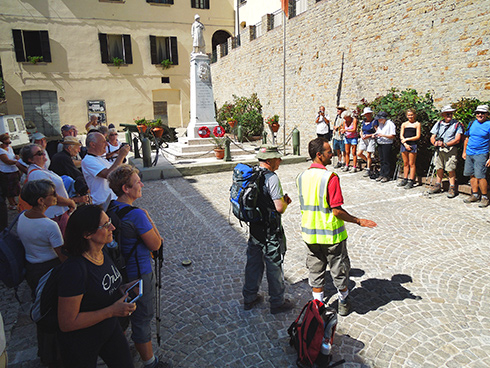
monte-san-martino_r72

A wreath-laying ceremony in Monte San Martino, Italy, during the Freedom Trail Walk in September 2013.

A Tenna Valley Freedom Trail Walk sponsored by WW2 Escape Lines Memorial Society and Monte San Martino Trust is scheduled for May 7–12. The annual walks, begun in 2001, retrace routes taken by Allied escapers and evaders caught in enemy territory in Italy during World War II.

The last Freedom Trail walk was held just seven months ago, to commemorate the 70th anniversary of the September 1943 Italian armistice and the subsequent escape of prisoners from camps across central and northern Italy.

The walks are dedicated to the people of the Italian countryside, the contadini, who, at great risk to themselves and their families, provided shelter, food, clothing, and medical assistance to the young Allied servicemen.

This year’s walk will cover approximately 80 kilometers and include visits to the villages of Monte San Martino, Massa Fermana, Montappone, Montelparo, Montalto delle Marche, Monte Urano, Fermo, and Porto San Georgio.

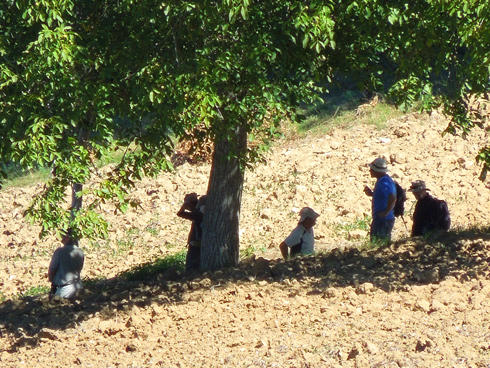
freedom-walkers_r72

A shady rest during the Freedom Trail Walk last September.

freedom_trail_g72

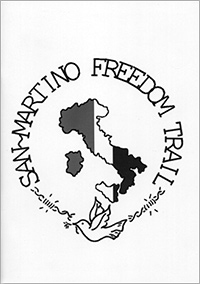
Program cover for the first Freedom Trail Walk, 2001.

Fyrtle Myrtle Story Included in New Book

salerno-1943 r72

On the morning of Friday, July 16, 1943 a formation of B-24 bombers left Berka, Libya, on a mission to destroy the airport facilities at Bari, Italy. The planes belonged to the 513th Bomb Squadron of the 376th Heavy Bombardment Group of the United States Air Force.

On the return flight from their mission the group encountered Italian Royal Air Force and German fighters. The Fyrtle Myrtle was shot down. Only three of the airmen were able to exit the plane before it crashed. Two of them, Cyrus F. Johnson Jr. and Edward T. Dzierzynski, were later interned in Camp 59 at Servigliano.

fyrtle-myrtle_r72

Aircrew of the Fyrtle Myrtle

In 2012, the Salerno Air Finders, a group of volunteers from the Italian organization Salerno 1943, explored the crash site of the Fyrtle Myrtle and published a report of their findings on the Salerno 1943 website. That report is now one of 25 investigations included in a newly published volume by Matteo Pierro entitled Salerno 1943: Gli aviatori, le storie, i ritrovamenti dell’Operazione Avalanche (Salerno 1943: The aviators, the stories, the findings of Operation Avalanche).

Continue reading

“A Symbol of the True Italy”

handful-flour_r72

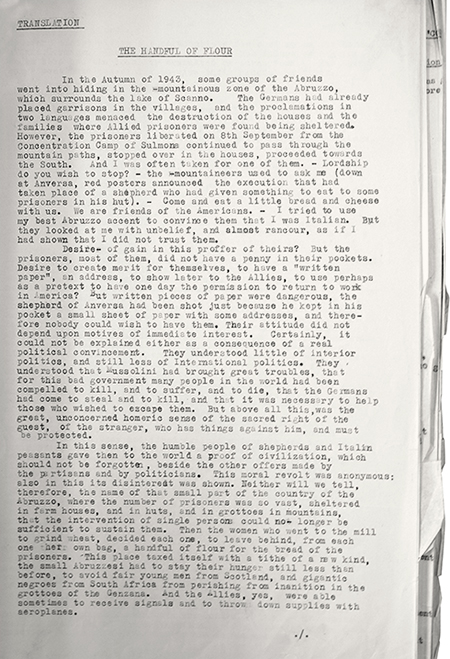
First page of Guido Calogero’s essay

Researcher Brian Sims discovered the following essay, entitled “The Handful of Flour,” among the files of the Allied Screening Commission (Italy) in the British National Archives at Kew.

The task of the Allied Screening Commission was to investigate and acknowledge Italians who helped escaped Allied prisoners-of-war.

The purpose of this essay among the commission’s files is not entirely clear to me. Although it includes information about a particular Italian “helper,” Nunziata, the essay doesn’t seem to be intended as justification for a specific recognition or compensation. Rather, it seems a broader appeal to the commission to exercise fairness and generosity in their task.

Brian wrote, “What ‘Handful of Flour’ tells me is that the peasants gave what they really couldn’t afford to, while such people as businessmen gave several thousand Lire without too much ill effect on their everyday life.”

The sacrifice is best measured not in what was given, but rather in “the cost to those who gave.”

Translation in areas of the essay seems a bit awkward, but the sentiment of Calogero’s message rings clear.

Guido Calogero was an Italian philosopher and essayist.

Read a Wikipedia biography of Calogero in Italian, or translated into English.

The Handful of Flour

In the Autumn of 1943, some groups of friends went into hiding in the mountainous zone of the Abruzzo, which surrounds the lake of Scanno. The Germans had already placed garrisons in the villages, and the proclamations in two languages menaced the destruction of the houses and the families where Allied prisoners were found being sheltered. However, the prisoners liberated on 8th September from the Concentration Camp of Sulmona continued to pass through the mountain paths, stopped over in the houses, proceeded towards the South. And I was often taken for one of them. “Lordship do you wish to stop?” the mountaineers used to ask me (down at Anversa red posters announced the execution that had taken place of a shepherd who had given something to eat to come prisoners in his hut). “Come and eat a little bread and cheese with us. We are friends of the Americans.” I tried to use my best Abruzzo accent to convince them that I was Italian. But they looked at me with unbelief, and almost rancor, as if I had shown that I did not trust them.

Continue reading

Lost Airmen Remembered in Pietragalla

ceremony-1a_r300

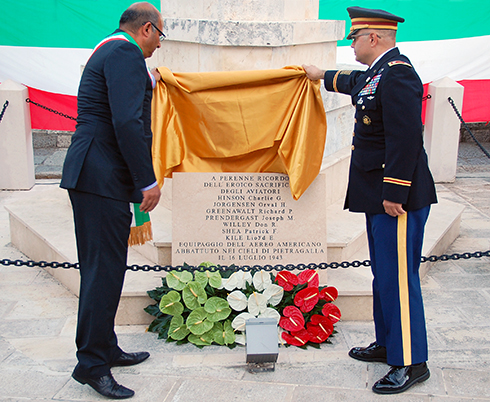
On August 4, Pietragalla Mayor Rocco Iacovera and Lieutenant Colonel Robert Ruffolo, representing the United States Embassy in Rome, unveiled a marble tablet honoring the seven airmen who died when the B-24 Bomber known as the Fyrtle Myrtle was shot down over Pietragalla in 1943.

ceremony-2_r72

Michele Potenza, who witnessed the crash of the Fyrtle Myrtle as a boy, speaks at the ceremony.

On July 16, 1943, a formation of three B-24 bombers left the Allied airbase in Berka, near Benghazi, Libya on a mission to damage or destroy the Axis airport at Bari. The fliers belonged to the 513th Bomb Squadron of the 376th Heavy Bombardment Group of the United States Air Force.

On their return, the first of the three planes, the Fyrtle Myrtle, was shot down over Pietragalla. The other two bombers were shot down soon after—near Altamura and Tricarico.

In 2012, the Salerno Air Finders, a group of volunteers from the Italian organization Salerno 1943, explored the crash site of the Fyrtle Myrtle and published a report of their findings on the Salerno 1943 website.

Then, last summer, a tablet was installed in Pietragallo comemmorating the men who lost their lives in the crash.

For the announcement of the ceremony, see “B-24 Bomber Crash Commemorated.”

The research and archaeological investigation into the crash of the Fyrtle Myrtle was first covered on this website through “B-24 Bomber Fyrtle Myrtle Discovered.”

Below is a transcript of the message Michele Potenza delivered at the ceremony.

It is presented in Italian, with translation of each section into English alternating throughout.

Continue reading