Author Archives: Dennis Hill

Armie’s Italian Angels

Armie_Address_r72

After escape from Camp 59 on September 14, 1943, Armie Hill and Ben Farley traveled south together and reached the British 8th Army, near Termoli, on October 15.

During this month-long journey the soldiers were assisted by a number of Italians.

In his two recorded accounts of the escape, Armie describes the help they received from the Bianchini family.

Two Bianchini addresses are recorded in his address book:

Bianchini Angela
Caserine N118
Roccafluvione
Ascoli Piceno

Bianchini Angelo
Porta Romana N18
Ascoli Piceno

Armie explained that the Bianchinis “…owned a place in the city, but this [the home in Roccafluvione] was out in the country—kind of like a hiding place or like a resort.” By contrast, Porta Romana is one of the six historical quarters of the city of Ascoli Piceno.

A woman who marries in Italy does not take her husband’s surname, but keeps her own family name. Therefore, Angelo Bianchini would likely have been Angela’s brother, cousin, or some other blood relative.

The addresses of two other Italian families are recorded in Armie’s address book.

Continue reading

The Survival Tale of John O. Everett

Lupi_family_r72
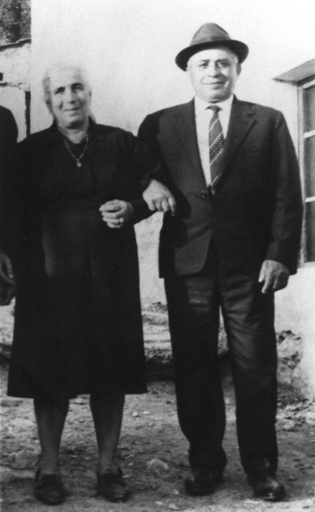
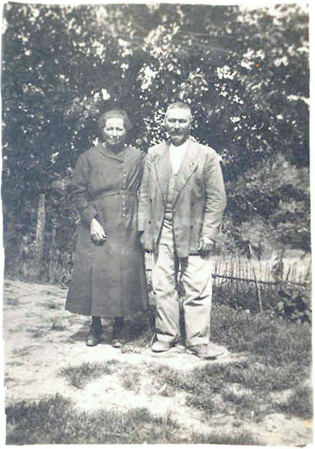
Nazareno Lupi and his wife, whose family hid John Everett and Willis Largent for over nine months. John received this picture after the war from the Lupi family.

JEverett_etal_r72
John Everett (with arms crossed) and two comrades.

Two weeks ago I received these photographs and the following story from John O. Everett, Jr.

He wrote, “Dad’s story is in the form of a submission he and I made to TNT years ago when they were focusing on soldiers’ stories one Memorial Day weekend. I had sat down with my Dad several times to obtain the timeline and other details for the story, and it was completed and submitted a year before he died. Although TNT did not include his story during the broadcast, I am so glad that I documented his experience so that I can provide the details to you.”

John O. Everett, Sr. passed away in 1995.

It’s a pleasure to share his story, and it’s my hope that the gratitude he wished to send to the Lupi family by way of the TNT broadcast will find it’s way to them somehow through this site.

John Everett and Willis Largent were both interned in Hut 4–Section 11—the section of men Armie Hill was assigned when he was transferred to the camp.

Here is John’s tale, which he named “The Unsung WWII Heroes of Italy: A POW’s Story.”

The Unsung WWII Heroes of Italy:
A POW’s Story

“What the hell part of the world are you from?”

I still remember this question asked of three scruffy American soldiers in June, 1944 by an officer in the South African Army near Foggia, Italy. The rags that served as our clothing were part U.S. Army issue, part Italian farmer, and our boots had more holes than leather. And yet we were happy, we were safe, and we owed our lives to an Italian family that hid four prisoners of war from the Germans for over nine months.

The history books tell us that Italy was our enemy during World War II. But you will never convince a number of POWs who owe their lives to the courage and generosity of several poor Italian families who shared when they had nothing to give.

World War II began for me when I was drafted in early 1942. I had originally volunteered for service in 1941, but was turned down due a problem with my legs. Like so many other health problems, mine was “reevaluated” when the fighting got hot and heavy in 1942.
Continue reading

Marino Palmoni on the Sheltering of the POWs

I nonni Iginia e Luigi_g150

Marino’s parents, Iginia and Luigi Palmoni (Marino genitori, Iginia e Luigi Palmoni)

This recollection of the experiences of Marino Palmoni during the long winter of 1943–44 was provided by his son Antonello Palmoni. Antonello interviewed his father for this story in May 2009.

marino_r100

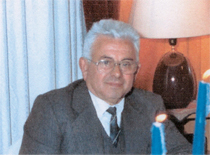
Marino Palmoni

The story is presented here in Italian and translated into English.

First, the English translation (Tradotto in inglese):

In September 1943, my grandfather Luigi, my father Marino (10 years old), and my uncle Gino (5 years old) were plowing the field near the woods beneath the cliff, when out of the woods came a man. Although he did not speak Italian, we understood from his gestures that he was hungry.

Grandfather asked my father to return home and bring something to eat, so Marino did and returned with bread and cheese. Our family was poor and large; there were more of us at home.

Continue reading

Remembering Robert Dickinson

milan-steve_r150

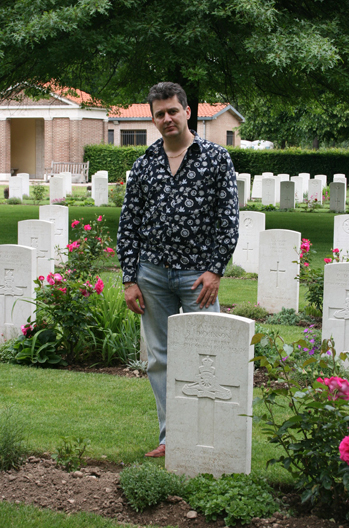
Steve Dickinson at the grave of his uncle, Robert Dickinson, in Milan War Cemetery. May 2009.

After escaping from prison camp, Robert Dickinson was sheltered by a family in Gassino (a small town near Turin in northern Italy).

Steve Dickinson, Robert’s nephew, believes he was hidden by a family with the surname of Bauducco at a farmhouse on Via Armando Diaz in Gassino. (A loose page in Robert’s diary, “Servigliano Calling,” bears the address of “Bauducco, Via A. Diaz, Gassino.”)

While in Gassino, Robert fought with the Italian Partisans against the German forces. He was killed in action on March 3, 1945. Initially, he was laid to rest by his Partisan comrades in Viali Cemetery in the town of Asti. After the war Robert’s body was moved to the Milan War Cemetery.

Steve Dickinson first visited Robert’s grave in August 1992. This month he made a return visit to the cemetery.

He also traveled to Gassino. In advance of his trip, Steve created “request for information” leaflets, translated by an Italian friend into Italian, for distribution in Gassino.

On returning to his home in the UK, Steve wrote:

“Spent some time in the village where Robert was hidden and left some of the fliers in various places. Several shops including the pharmacy said they would put them in their windows. Also left many in post boxes on Via Armando Diaz. Doubt I’ll get a reply but given the visit I had to try.

“Following this I visited Robert’s grave in Milan. I was greatly pleased to see that the cemetery was as well kept as when I had previously visited. In fact, probably better as the roses were in full bloom. As with my previous visit it was a moving experience. I probably spent an hour walking around the cemetery taking photos and reading/observing the graves. I found 5 graves buried all together, these being the crew of a plane shot down over Italy. Also found another grave of one of the Lincolnshire’s due to the Lincolnshire’s emblem (The Sphinx) on his gravestone.”

milan_064_r150

Robert Dickinson’s Address List

dickinson_diary_angle_2001

addresses_r300

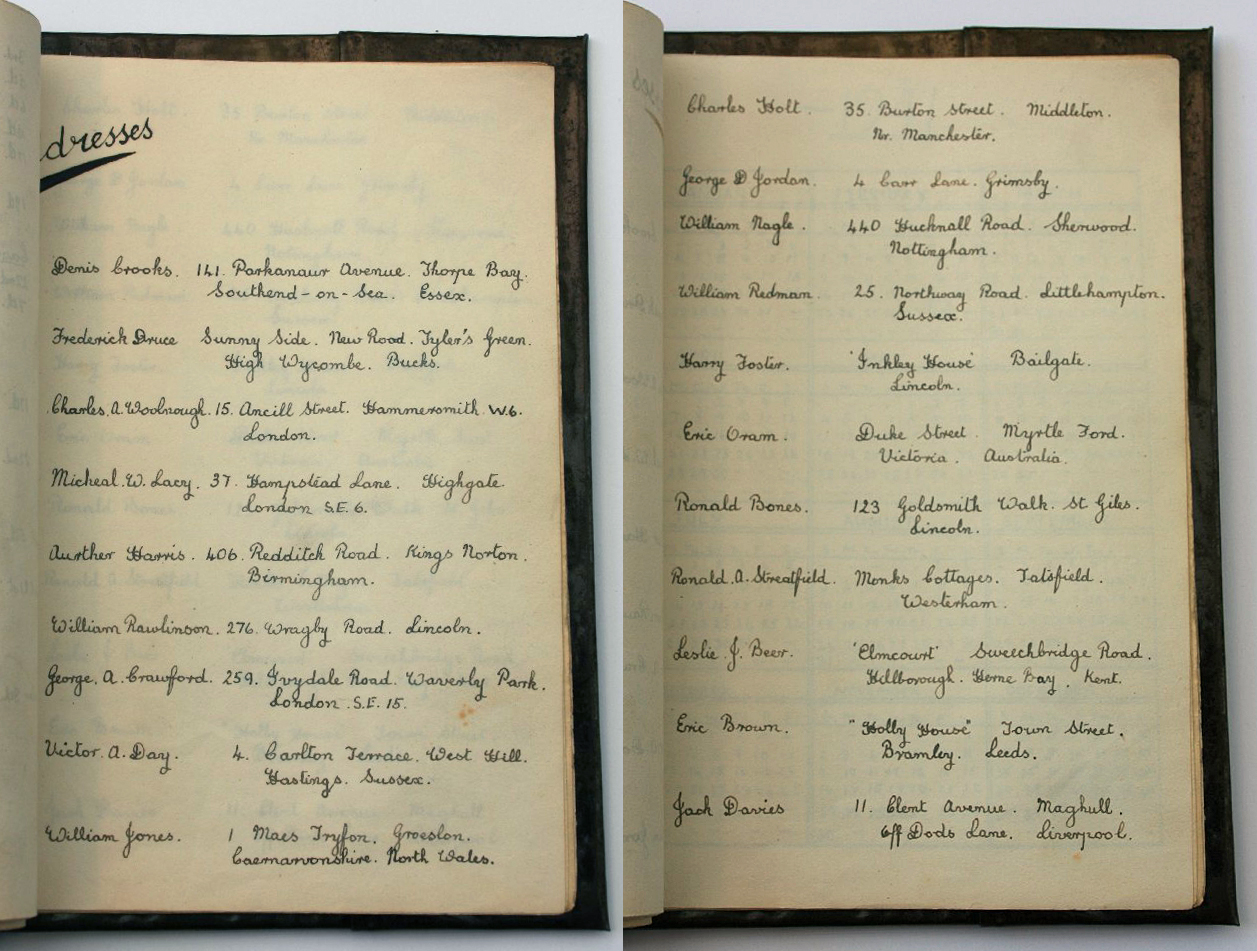
Two pages of Robert Dickinson’s journal, “Servigliano Calling,” contain names and addresses of 20 fellow prisoners. These are listed here:

Denis Crooks

141. Parkanaur Avenue. Thorpe Bay.

Southend-on-Sea. Essex.

Frederick Druce
Sunny Side. New Road. Tyler’s Green.
High Wycombe. Bucks.

Charles A. Woolnough
15. Ancill Street. Hammersmith. W.6.
London

Micheal W. Lacy
37. Hampstead Lane. Highgate.
London S.E.6.

Continue reading

The “Servigliano Calling” Poets

Robert Dickinson’s journal, “Servigliano Calling,” contains 34 poems. The ten identified poets whose works appear in the journal are: 

C.A. Hollis, J.R. Cromley, Corporal D. Nevitt, Denis Crooks, G.A. Crawford, C.G. Hooper-Rogers, Alec. Forman (A. Forman), Bombardier P.G. Whapples, Harry Stewart (H. Stewart), and F. Chiltern. 

One poem, The Alphabet, is simply attributed to “a South African.”

Only the addresses of two of the poets are recorded in the journal. They are:

Denis Crooks
141. Parkanaur Avenue. Thorpe Bay.
Southend-on-Sea. Essex.

George A. Crawford
259. Ivydale Road. Waverly Park.
London. S.E. 15.

Continue reading

Neil Torssell on Life in Camp

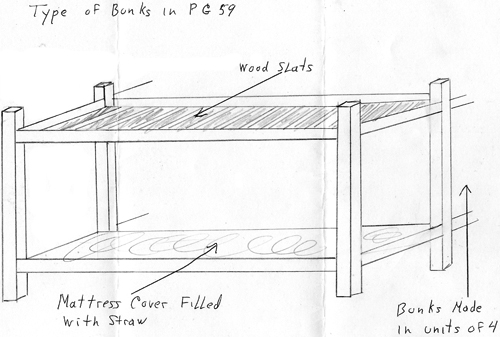
torssell_beds_g200

This diagram of the bunk bed construction in the huts of Camp 59 was drawn by Neil Torssell.

The following interview between former Camp 59 prisoner Neil Torssell and Dennis Hill was recorded on October 30, 2008. The interviewer’s questions and comments are in italic.

When we talked before, you told me about your years in the service from start to finish. And when you wrote to me in the past you described being in the camp, but you didn’t say a lot about what daily life was like there.

I made a list of things I would like to ask you about today.

When my dad was in the camp, he was in Hut 4, Section 11. You had mentioned to me there were big barracks that had bunk beds. You sent me a drawing of the bed construction. Does the organization of hut and section number sound familiar to you?

I don’t remember anything like that. Was he in the building where they were digging the tunnel?

No, I don’t believe so, but he said he had heard about the digging of a tunnel.

That wasn’t known about until the Italians had practically quit. It was only then we found out about it, because there were just a few of them [the prisoners] involved in digging.

In the hut that you were in—or barracks—did the Italians come in at night to make sure that nothing was going on, or when you went to sleep at night were you left alone until morning?

Well, they patrolled the barracks all night. They patrolled periodically. I don’t know if there was any particular schedule. We didn’t pay attention to them. As far as how far apart the patrols were—if there were as many on the outside as the inside—I couldn’t tell you that.

Continue reading

The Kane Brothers—Looking Back

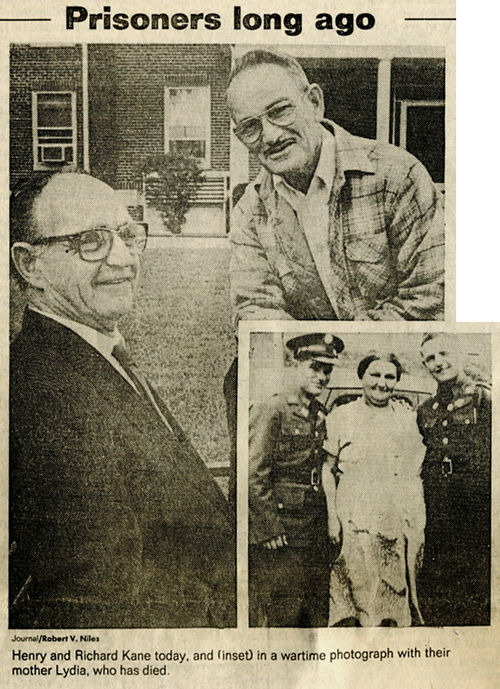
hank-dick_article1-crop_r1501

Brothers who knew of the hell of war

By Mercedes M. Cardona
Journal staff

[September 18, 1987, Poughkeepsie Journal, Poughkeepsie, New York] 

Richard and Henry Kane wanted to see the world when they joined the Army.

But they spent most of their service time in prisoner of war camps in Italy and Germany.

For almost 2½ years during World War II, the Orange County brothers were held captive in the same prison camps. Today, national POW-MIA Day, they will join others at the Veterans Administration Medical Center in Castle Point for ceremonies honoring POWs and those missing in action.

They know first-hand why POWs are recognized. Richard Kane’s feet were frozen while he was a POW. He once was lined up with others and was about to be shot when someone returned a loaf of bread that sparked the guards’ fury.

When they returned home, the brothers felt as if they were beginning new lives. Even hearing children speak English was a wonder.

Continue reading

Henry and Richard Kane are POWs

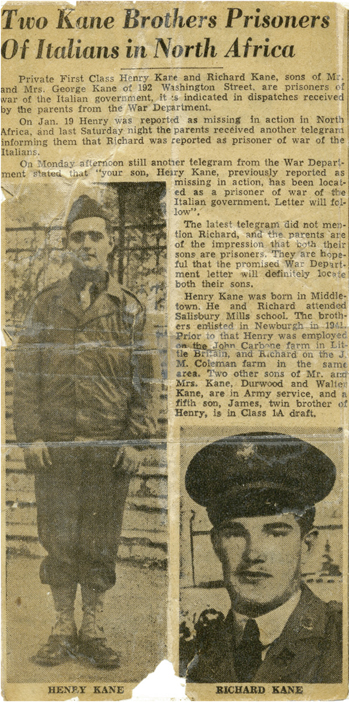
kanebros_-1943_r150

Two Kane Brothers Prisoners of Italians
in North Africa

Newspaper article, early 1943, perhaps from the Newburgh News

Private First Class Henry Kane and Richard Kane, sons of Mr. and Mrs. George Kane of 192 Washington Street, are prisoners of war of the Italian government, as is indicated in dispatches received by the parents from the War Department.

On Jan. 19 Henry was reported as missing in action in North Africa, and last Saturday night the parents received another telegram informing them that Richard was reported as prisoner of war of the Italians.

On Monday afternoon still another telegram from the War Department stated that “your son, Henry Kane, previously reported as missing in action, has been located as a prisoner of war of the Italian government. Letter will follow”.

The latest telegram did not mention Richard, and the parents are of the impression that both their sons are prisoners. They are hopeful that the promised War Department letter will definitely locate both their sons.

Henry Kane was born in Middletown. He and Richard attended Salisbury Mills school. The brothers enlisted in Newburgh in 1941. Prior to that Henry was employed on the John Carbone farm in Little Britain, and Richard on the J. M. Coleman farm in the same area. Two other sons of Mr. and Mrs. Kane, Durwood and Walter Kane, are in Army service, and a fifth son, James, twin brother of Henry, is in Class 1A draft.

War Claims Compensation

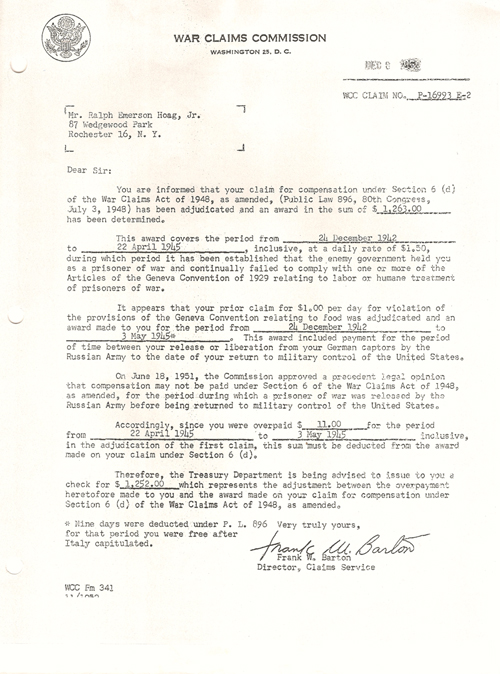
warclaim_hoag_r150

Monetary compensation was offered to ex-POWs of World War II through the War Claims Act of 1948 passed by the United States Congress.

Ralph Hoag was compensated for the 28 month period he was held prisoner.

This letter from the War Claims Commission, dated December 8, 1952 (or possibly 1953), offers a detailed account of his compensation.

The award covers the period from December 24, 1942 to May 3, 1945—from his capture in North Africa to reunion with the Allied forces. However, Ralph was not paid for the nine days between his escape from Camp 59 and recapture by the Germans.

Also, Ralph explained to me that he got “no pay for wandering around Germany from April 23 to May 5 [while] trying to get across the Elbe River.” The Russians had liberated the prisoners of Stalag 3-A on April 22.

In other words, compensation was for the actual number of days Ralph Hoag was held prisoner.