Author Archives: Dennis Hill

“Servigliano Calling” Poem #15

This poem of longing for England is one of three poems in “Servigliano Calling” by Denis Crooks of Southend-on-Sea, Essex.

England

This place of heat and sun and sand!
When shall that day return
That I shall no more tread this land,
But that for which I yearn!
O England mine—my home, my love,
When shall I see thee more?
Thy pleasant fields, white clouds above,
And sea-encircled shore.

“Servigliano Calling” Poem #14

“Memories of Home” is one of three poems by Bombardier P.G. Whapples recorded in Robert Dickinson’s journal.

Memories of Home

Imagine a cool, new forest dell
Your turn at the lane, then at the well,
Into nature’s own store,
The earth as a floor,
Where nothing has changed ten decades or more.
Amongst stately trees,
In a clean healthy breeze,
Mingling with song the humming of bees.

A myriad of colours stretch into the deep,
Of a forest, or listen! The bleating of sheep,
That have wandered astray,
In the heat of the day,
Unknown to the shepherd, asleep in the hay.
Then a dog’s heavy bark,
Or the song of a lark,
Comes through the twilight, before the dark.

While musing of this, ’tis a fine English day,
Where my friends are all happy—and I far away,
In a country way up in the hills, very cold,
In the land where Vesuvius bursts, we are told,
In a cold prison-camp, just over the foam,
From England, and you, and all that is home.

Bonne Année—Christmas 1942


Armie Hill landed in Vichy-controlled French North Africa on November 8, 1942 during “Operation Torch,” the Allied invasion.

The following month he sent this holiday card to his family. The French Bonne Année is a wish for “A Happy New Year.” The card pictures a snow-covered village framed by holly and mistletoe and a Christmas herb (possibly rue). In one corner is a horseshoe—symbol of good luck.

On the back Armie wrote:

Wishing you a happy Christmas.
Loads of Love
Armie

The following February Armie was captured at Kasserine Pass. He spent most of the year in captivity.

Happily, the Christmas of 1943 found him celebrating Christmas at home in Phelps, Wisconsin on furlough. Many soldiers who escaped from Camp 59—those who were not killed or recaptured—spent Christmas 1943 hiding in the Italian countryside.

Simmons’ Address Book—the Italians

papal_cal_italians_r72

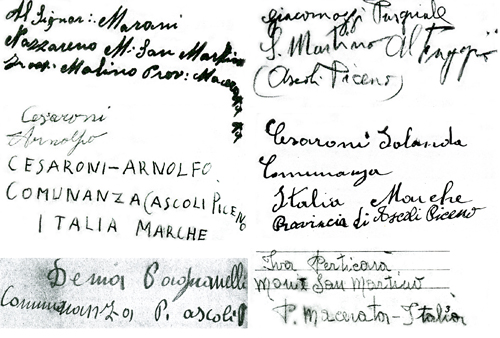
Charles Simmons’ calendar and address book contains the names and addresses of six Italian families. They presumably provided assistance to Simmons after his escape from Camp 59.

The names are:

Il Signor: Maroni (or Moroni) Nazzareno
M San Martino
____ Molino Prov Macerata

Molino is a small place near to Monte San Martino, and the word before it could be “frazione” which means “fraction,” a denotation that it is a part of the commune of Monte San Martino.

Cesaroni-Arnolfo
Comunanza (Ascoli Piceno)
Italia Marche
(Note that the Italians always put the surname before the first name. So the name in this case if Arnolfo Cesaroni.)

Dema Paopranelli
Comunanza P. Ascoli

Giacomozzi Pasquale
S. Martino al Faggio
(Ascoli Piceno)

If “al Faggio” is the correct place name here (the handwriting is difficult to decipher), there is a San Martino al Faggio in the right area. It’s a frazione of Smerillo—on the hill facing Monte San Martino.

Cesoroni Iolanda
Comunanza
Italia Marche
Provincia di Ascoli Piceno

Iva Perticara
Monte San Martino
P. Macerata-Italia

The P stands for Provincia. There were four provinces at the time in Marche. From north to south: Pesaro; Ancona; Macerata; Ascoli Piceno. (Another, Fermo, has been added recently.)

So these places are all on either side of the county borders of Macerata and Ascoli Piceno.

Many thanks to Anne Copley of Oxford, UK, for her help in reading and interpreting these addresses!

Joe Maly in Italy

montefalcone_frnt_r72
montefalcone_s2_r72

Al Maly provided this photograph of his father, Joe Maly, taken when Joe was in Italy and while he was being sheltered by the Papiri family of Montefalcone.

To the best of my knowledge the writing on the back of the photo reads:

Montefalcone li 25-6-1944 (A. Piceno)

Mio dovere come patriota, lasciarvi a tutti il ricordo
Famiglia Papiri, Nello Papiri

The first line indicates the village name (Montefalcone Appennino), the date (June 25, 1944), and the province the village was a part of at the time (Ascoli Piceno). Montefalcone is today a part of the newly-formed Province of Fermo.

The next two lines translate as “My duty as a patriot,” plus something along the lines of “I’ll leave you all this record [or keepsake].”

And it is signed,
“Papiri Family, Nello Papiri”

According to Al, the first man standing on the left is a son in the Papiri family. Next to the son is Joe Maly, and beside Joe is James Guillary. The other three men in the photo were also escaped POWs. Joe and “Gilly” were both housed in Hut 4–Section 11 of Camp 59.

Al told me his dad “was one of the men who made it out through the hole in the wall and in his group one of the men was shot. They could not go back for him as they were under fire. He never talked much about the war, only little indirect statements when I was young and a little more detail as I got older and more close to him.”

After the escape, Joe fought with the Italian resistance. He eventually made it to the Polish lines.

Joe passed away in January 2000.

Charles Simmons’ Calendar and Address Book

Earlier this year, I received from Trish Harper photocopies of a calendar booket her father was given when he was interned at Camp 59. Charles Kenneth Simmons used the printed calendar pages to mark off the days as they passed, and he used blank spaces to record notes about activities in the camp and rumors of war that reached the prisoners.

Simmons used the pages marked for “MEMORANDUM” to list names and addresses of fellow servicemen.

Altogether he recorded addresses of:

61 American servicemen
Four English servicemen
Two Scottish servicemen
One Australian serviceman
Six Italian families

I will post all of the addresses on this site as I transcribe them and confirm their accuracy as best I can (the handwriting is not always clear).

Interestingly, the summer 2008 online newsletter of the UK National Ex-Prisoner of War Association contains an article about two prisoners (Maurice Newey and David John Jenkins) from Italian Camp 54 at Fara in Sabrina who had been given copies of the same calendar book.

According to the newsletter, the calendar, entitled “Christmas 1942,” was a gift of Pope Pius XII. The booklet is composed of 48 pages plus a cardboard cover. Pages 26-48 contain hymns and Christmas carols. The booklet also contains quotations of papal encouragement and a prayer by Cardinal John Henry Newman (“Lead, kindly Light, amid the encircling gloom”).

William George Wales

British serviceman William George Wales served in the Royal Sussex Regiment, 1st Buffs. He was captured in North Africa on December 15, 1941 and sent to the prison camp in Servigliano.

From Italy he was transferred to Germany, where he was interned at Stalag 7-A Moosburg, Stalag 11-A Altengrabow, Stalag 11-B Fallingbostel, and Commando 1011 Wolfenbüttel.

William was liberated on April 23, 1945.

Later in life he was consulted during the making of the film “Von Ryan’s Express.” He died in 1980.

Kane Brothers Recall the War—Article, Part II

Kane_Jacksonville_g150
This photo of Henry (at left) and Richard Kane was taken on the boardwalk in Jacksonville, FL while the brothers were on a pass during training. Henry’s son George commented, “Ironic that the photo depicts exactly what was to come several months later.” 

Memories of WW II Continue For Kane Brothers

December 23, 1986, The Sentinel, New Windsor, New York

Editors note: This is part two of a two-part feature. The first part appeared in the December 18 issue of The Sentinel.

by Linda Fehrs

Henry and Richard Kane are brothers who did many things together including joining the army in World War II. After fighting many battles, mostly in northern Africa they were captured together by the Axis powers and spent well over two years in prisoner of war camps in Europe.

After being transferred from camp to camp they had ended up in Palermo, staying there for about a year. They spent their time reading and playing games. The Red Cross sent them packages regularly, but life in the camp was not of the highest quality. The place was rampant with bedbugs and the men had body lice. The meals were sparse and the conditions less than pleasant to say the least.

One of the goals of captured soldiers in time of war is to escape. And this was what Henry and Richard Kane, along with other American soldiers, did. They managed to blow a hole in the wall of their camp and escape through some tunnels they had been digging.

Continue reading