Author Archives: Dennis Hill

Prisoners of Experiences

hands-up-3-23-95_r72

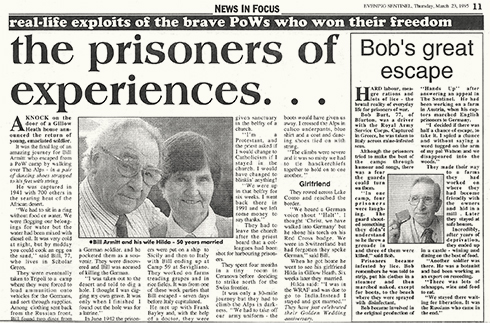
A recent post on this site was dedicated to a 1971 theatrical production of the Victoria Theatre (Stoke-on-Trent, England) entitled Hands Up! For You the War Is Ended.

The musical documentary was based on the real-life experiences of several Staffordshire WW II ex-POWs.

Nigel Armitt’s father, Bill Armitt, was one of those veterans, and my access to the playbill for the production was courtesy of Nigel.

Nigel has since brought to my attention that in 1995 the theatre, now called the New Vic, staged a revival of the play to commemorate the 50th anniversary of VE Day. Nigel sent three news clippings, from March and April 1995, which revisit the former troops’ stories and cover the play itself.

Here is the first of the three articles:

real life exploits of the brave PoWs who won their freedom

News In Focus
Evening Sentinel [Stoke-on-Trent, Staffordshire, England]
March 23, 1995

the prisoners of experiences…

A KNOCK on the door of a Gillow Heath house announced the return of a young, emaciated soldier.

It was the final leg of an amazing journey for Bill Armitt who escaped from a PoW camp by walking over the Alps – in a pair of dancing shoes strapped to his feet with string.

Continue reading

Interview with Gino Antognozzi

Gino-Antognozzi-24anni_r72

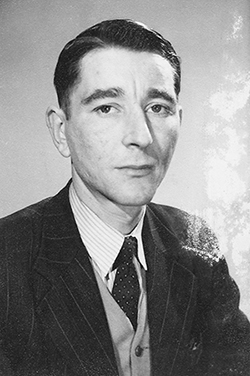
Gino Antognozzi at age 24, July 27, 1950

Introduction

The transcript of an interview with Gino Antognozzi that makes up this post is courtesy of Gino’s nephew Alfredo. The interview comes to me by way of Anne Copley, who translated the transcript from Italian into English.

Last summer Anne located the family of Sydney Harold Swingler, known to Gino’s family only as “Antonio” when they sheltered him during the war, and put the two families in contact with each other.

See “Swingler and Antognozzi Familes United.”

Gino Antognozzi lives with his wife Annunziata in Montelparo, a small town about 30 km. from the city of Fermo. He is 89 years old today.

Last summer, on being shown a photograph of Sydney Swingler, Gino immediately recognized him, saying: “It’s him, it’s Antonio.”

“Why Antonio didn’t write a letter, a postcard?” he asked. “I thought he had been killed in war, and he could not go back to England.”

Continue reading

More on the Camp 59 Theatre Subjects

This post offers details on several of the men whose war experiences were the inspiration for the Victoria Theatre 1971 musical documentary “Hands Up—For You the War Is Ended!”

I am grateful to researcher Brian Sims for access to repatriation records for four of these men, who were transferred together from PG 59 to PG 146/22 Vairano in the summer of 1943. The British National Archives records provide the men’s imprisonment timelines and details on their escape to Switzerland.

According to the Victoria Theatre playbill, “The prisoners who took ship from North Africa were taken to various prisoner of war camps. Frank Bayley, Bill Armitt, Tug Wilson, and Jack Ford went to PG 59, (Campo Prigioneri etc) south of Ancona near the east coast, and there they stayed.”

Perhaps it was an oversight that Jock Attrill and Jock Hamilton were not mentioned in this list of transferees from North Africa, as the program later mentions their departure from PG 59:

“Sometime in 1943 volunteers were called for from the POWs in PG 59 to join working parties in the north of Italy. Bill Armitt, Jock Attrill, Frank Bayley and Jock Hamilton were amongst those who went. They were transferred to PG 146 at Laclirago some 15 miles south of Milan on the Lombardy plain and in sight of the Alps.”

When the men later escaped from PG 146, Italian Domenico Lunghi was involved in protecting all four. They later arrived in Switzerland on the same date, April 1, 1944, so it is reasonable to conclude they made the cross-border journey together.

Eric “Tug” Wilson and Jack Ford seem not to have transferred from PG 59 to PG 146 with the others. It is possible that they were transferred later, or they may have remained in Camp 59 until the time of the camp-wide outbreak on September 14, 1943. At any rate, Jack ended up in Germany according to the playbill.

Continue reading

Hands Up—For You the War Is Ended!

armitt-bayley_r72

Frank Bayley and Bill Armitt (at right), with Simon Coady and Colin Starkey, the actors who played them in Hands Up—For You the War Is Ended!

On Tuesday, May 18, 1971 an unusual theatrical production premiered at the Victoria Theatre in Stoke-on-Trent, England. Termed a “musical documentary,” the work was the brainchild of the theatre’s artistic director Peter Cheeseman.

A commentary in Peter Cheeseman’s obituary in The Guardian sheds light on the importance of this and similar works performed at the Victoria Theatre:

“Of the more than 140 productions that Peter directed, it was the 11 musical documentaries voicing the verbatim stories and concerns of the local community that brought the Victoria theatre recognition. From The Jolly Potters (about the history of the Potteries) in 1964 to Fight for Shelton Bar! in 1974 (part of a campaign to save the local steelworks), they were researched by members of the company. Subjects ranged from the English civil war in The Staffordshire Rebels (1965) and local railways in The Knotty (1966) to the audience’s second world war memories in Hands Up! For You the War Is Ended (1971).”

The play was funded by a grant from the Arts Council of Great Britain through its program for the promotion of new drama.

Continue reading

John Richard Shaw—Escapee to Switzerland

john-shaw-2_r72

John Richard Shaw, circa 1950s.

I received a note from Penny Hayes (nee Shaw) last month. She wrote to share information about her father, John Shaw, who was a prisoner in Camp 59 from March 11, 1942 to April 1, 1943.

Penny wrote, “I have a photograph of my aunt with her charges (she was a childrens’ nurse) sent to my father with the following on the back:

TPR J R Shaw 7889463
POW 1634
PG 59 PM 3300
Italy

“My father, John Richard Shaw, sadly died in 1964 when I was 15.

“There is no record of him on your site so I take it you were not aware of his having been a prisoner.

“Unfortunately, although I knew he had been a prisoner it was never discussed. However, I was aware that he escaped. I have no idea how he returned to the UK. If you have any information or could point me in any direction where I might find more details I would be most grateful.

Continue reading

Lost Airman Dewey Gossett

salerno-1943_r72

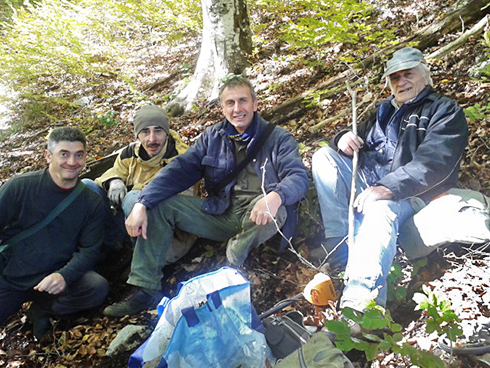
Salerno 1943 researchers Daniele Gioiello, Luigi Fortunato, Italo Cappetta, and Aniello Sansone in the field

After 71 years, the remains of American airman Dewey L. Gossett may yet come home to a proper burial.

Researchers from the Italian research association known as Salerno 1943, in collaboration with the Protezione Civile (civil defence) of the city of Acerno, Italy, have identified remains that may be those of an American aviator whose A-36 bomber crashed on Mount Accellica on September 27th, 1943.

Continue reading

News Feature—Four Camp 59 Prisoners

four-bulletin_r72

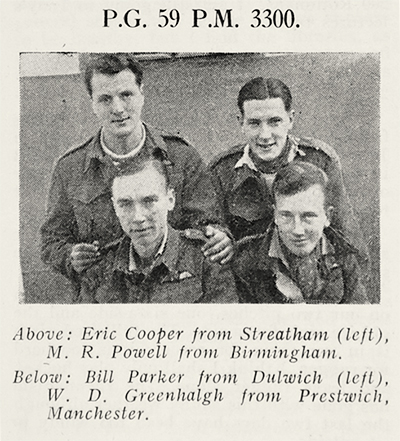
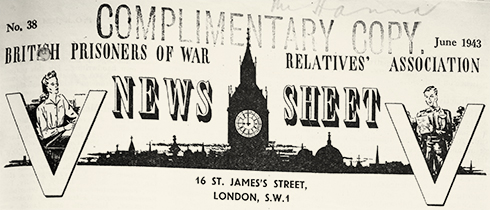
This photograph from the British Prisoners of War Relatives’ Association News Sheet, June 1943 issue, identifies British prisoners Eric Cooper (Streatham), M. R. Powell (Birmingham), Bill Parker (Dulwich), and W. D. Greenhalgh (Prestwich, Manchester) as prisoners in Camp 59.

This News Sheet was brought to my attention by Brian Sims, who accessed a copy of it in the British National Archives.

bulletin-nameplate_r72

There is possible mention of three of these prisoners on the site currently:

John L. Turner of the Royal Canadian Air Force mentions a Royal Air Force pilot by the name of Eric Cooper in “John Leon Turner—Survival in Italy“:

“A friend in hiding 6 miles away, in another farmhouse, R.A.F. Pilot Eric Cooper, was in the same shoe destitute condition, so Turner, wearing borrowed native footgear, sloughed through mud to get his pal’s shoes fixed also.”

Camp 59 escapee British Lance-Sergeant Robert Henry Collins mentions the whereabouts of Royal Air Force Sergeants Parker and Greenhalgh in his repatriation report (in “Details on Remaining 10 British Escapees”).

Parker and Greenhalgh are listed in a section of the report entitled “late news of whereabouts of escapers”:

Sgt. Parker, RAF—last seen on September 17 near Amandaley
Sgt. Greenhalgh, RAF—ditto

Sergeant Collins does not say whether the sergeants were escapees from Camp 59 or another camp.

More Advice to Escapers and Evaders

aids-escape-detail

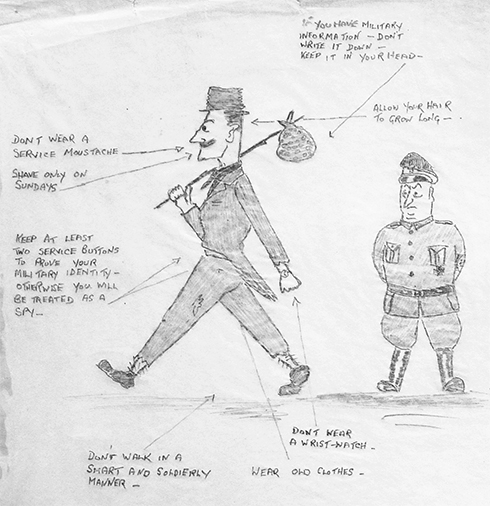
A detail of a cartoon entitled “Aids to Escape.” See two such cartoons at the end of this post. The originals are archived with A Force bulletins at the British National Archives. I cannot say whether they were ever reproduced for general distribution.

The following two A Force bulletins address ways in which Allied escapers and evaders in Italy might avoid confrontation. Bulletin No. 7 specifically addresses “force-landed airman,” while Bulletin No. 8 mentions escapers from Italian camps and seems to address escapers and those evading capture alike.

Keep in mind that this document was written in the months before the capitulation of Italy and the subsequent general escape/release of prisoners from Italian prison camps into enemy-occupied territory. By late September, central and northern Italy was flush with escaped POWs.

See also “Official Advice to Escapers and Evaders.”

Thanks to researcher Brian Sims for access to these documents.

Bulletin No. 7

ADVANCE HEADQUARTERS “A” FORCE,
c/o Force Headquarters,
A.P.O. 512 – U.S. Army

22nd. July, 1943.

SUGGESTIONS FOR ITALY

Now that the invasion of the “Axis Fortress” has begun it is, perhaps, worthwhile to take advantage of certain well known characteristics of the Italian people. It is not known what percentage of rural Italians are pro-Fascist but it is safe to assume that many who are luke warm on the subject are giving it very serious thought these days. The knowledge that Italy has lost the war must be filtering through in spite of Axis propaganda.

Continue reading

Official Advice to Escapers and Evaders

“…one thing is essential, namely a stout heart.”

A bulletin of tips for escapers and evaders (E&Es) behind enemy lines in Italy was issued from the “N” Section unit of “A” Force C.M.F. (Central Mediterranean Force) in February 1944.

This “most secret” document was evidently intended for agents involved in directly assisting E&Es behind the lines. Agents were to read the document and later use the information in coaching E&Es one-on-one in how to avoid capture and find their way to freedom.

The following three paragraphs from the “I.S.9 History—Organization” post will help to clarify the organization of “A” Force as it evolved during the war.

“In order not to confuse the reader more than is necessary it is explained that M.I.9 [British Directorate of Military Intelligence Section 9] work in the Mediterranean Theatre of Operations first started early in 1941 and was carried out by ‘A’ Force, commanded by Lt-Col [lieutenant-colonel] (later Brigadier) D.W. CLARKE, CBE. A few months later, ‘N’ Section was set up in Cairo as a separate Section of ‘A’ Force and Major (later Lieut-Col) A.C. SIMONDS, OBE, placed in charge of all M.I.9 duties in the Mediterranean Command.

“On the 1st November 1943 ‘N’ Section ‘A’ Force was divided into EAST and WEST, Lt-Col. A.C. SIMONDS being placed in charge of ‘N’ Section ‘A’ Force (EAST) and S/Ldr [Squadron Leader] (later W/Cdr [wing commander]) E.A. DENNIS, OBE, placed in charge of ‘N’ Section ‘A’ Force (WEST).

“On the 20th August 1944 responsibility for M.I.9 work in the Mediterranean Theatre passed from ‘A’ Force and became the responsibility of G-2 (P/W) AFHQ. ‘N’ Section ‘A’ Force title was changed and became I.S.9 [Intelligence School 9], the initials (ME) and (CMF) indicating (East) and (West) respectively.”

Therefore, “N” Section is essentially synonymous with I.S.9.

I am most grateful to researcher Brian Sims for sharing access to this bulletin from the British National Archives, as well as I.S.9 documents that give the bulletin fuller context.

There is the bulletin in its entirety:

MOST SECRET
OFFICER ONLY

‘N’ SECTION
Adv. H.Q. “A” Force
c/o No. 2 District H.Q.
C.M.F.

10th February, 1944.

BULLETIN NO. 21

The following are a few hints to Escapers and Evaders in Italy. They are the suggestions of an “A” Force Officer who, out of less than five months service in Italy spent more than three of them behind enemy lines. They are comments by an officer who spent many months with “A” Force patrols operating behind Rommel’s lines in the Western Desert and at one time he escaped from Tortorette Prison Camp after having been taken prisoner.

Continue reading

American Red Cross—Information for Families

During WW II, the British and American Red Cross societies recognized that families who received notification of their sons’ capture would be in need comfort.

In times of war, that comfort was best provided by straightforward information on the conditions in prison camps.

The following items from the August and October American Red Cross bulletins sent to families provide just that sort of information about Camp 59.

Thanks to Al Rosenblum for sharing these bulletins with me for the site.

Prisoners of War Bulletin—American Red Cross

August 1943

ced-cross_r72

Illustration: Bales and cases of clothing sent by the American Red Cross for prisoners of war are stored in bonded warehouses of the International Red Cross Committee awaiting rail transport from Switzerland to Axis camps.

Prisoner of War Camps in Italy—No. 59
By Frank Abbott

One of the largest prisoner of war camps in Italy is No. 59, situated near the ancient town of Ascoli Piceno, which before the war had a population of some 25,000. Ascoli Piceno lies in the valley of the river Tronto in mountainous country about 90 miles northeast of Rome in the direction of the Adriatic coast. Mountain peaks rising over 3,000 feet are visible to the north, west, and south of Camp No. 59. For many years before the war the Ascoli Piceno region was a popular one for tourists from other countries.

The latest information available, based on March of this year, shows that there were nearly 2,000 prisoners of war in Camp No. 59—mostly British, but including 445 Americans, of whom 77 were noncoms and 368 privates. All the prisoners had been captured in the North African campaign and had only recently arrived at Camp No. 59. The camp leader, at the time of the visit, was Sgt. Major Hegarty (British). Besides Camp No. 59, there is also a military hospital for American prisoners of war at Ascoli Piceno.

Continue reading