

Today is Memorial Day here in the United States, a national holiday for honoring those who lost their lives while serving in the Armed Forces.
On this day, families and others wishing to pay respects to the fallen soldiers visit their graves, sometimes bringing flowers. Originally known as Decoration Day, the time each year for “strewing the graves of Civil War soldiers—Union and Confederate” with flowers was effectively promoted by Mary Anne Williams after the U.S. Civil War. Eventually, the last Monday in May became a Federal holiday.
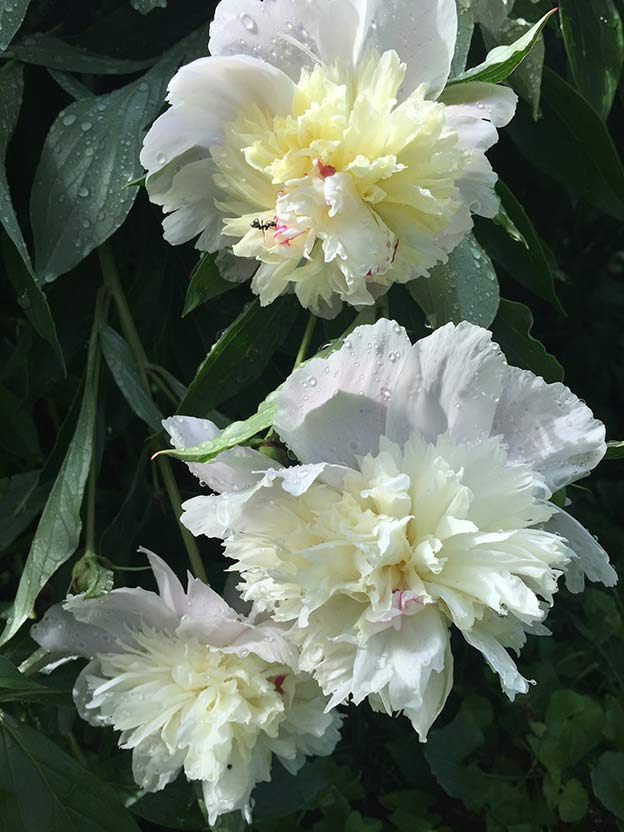
Each year at this time, I visit one of the oldest cemeteries in my community, Rose Hill Cemetery, where a profusion of peonies bloom just in time for the holiday. These perennials are most concentrated in the oldest part of the cemetery; the largest peony clusters are believed to be well over a century old.
There are many graves in Rose Hill of soldiers from both the First and Second World Wars, as well as those of men and women who served in more recent wars and conflicts. The surnames are very familiar to me, and I reminded that many people I know have had relatives who went to war.
On Camp 59 Survivors, this is an appropriate day to remember three Americans who escaped from P.G. 59 in September 1943, but who did not return home.
Each was killed by Germans or fascists while traveling through enemy-occupied Italy.
The stories of Travis Fowler (Sylvester, Georgia), Robert Alvey Newton (Logansport, Indiana), and Martin Majeski (Anderson, South Carolina)—have been told through posts here. (Read “Travis Fowler—Nearly Home,” “The Story of Robert Alvey Newton,” and “Cesare Viozzi on Sheltering Robert A. Newton.”)
In addition to recognizing the Americans, I’d like to take a moment to remember Laurence Sydney Barker, who was from Canada—our “neighbor to the north.”
Although Memorial Day is an American holiday, Canada has two equivalent days: Canada Day, celebrated on July 1 in the provinces of Newfoundland and Labrador, and Remembrance Day, which falls on November 11.
In 2012, I corresponded with Laurence Barker’s nephew, Michael Laurence Barker.
Although at the time Michael had no evidence Laurence had been interned in Camp 59, the close proximity of the camp to Pito—the village where Laurence had been killed—led him to believe Laurence might very well have escaped from P.G 59. Pito is only 60 kilometers (37 miles) south of Servigliano.
In Pito, Laurence was tracked down by the Nazis. The pursuers set fire to a barn in order to flush out hiding escapees. Laurence and six others were killed by gunfire as they ran out; only one prisoner escaped.
Read “Laurence Barker—Died for His Country.”
Just this morning, in searching online for information about Laurence, I discovered a trove of his service documents on the website of the Library and Archives Canada.
Luckily, one of the documents confirms Laurence’s internment in P.G. 59.

Aside from Laurence and the three soldiers from the U.S., there were many others—from Great Britain and Commonwealth countries—who had passed through P.G. 59 who were also killed before the war’s end.
We remember and honor them all with a moment of reflection.

 Camp 59 Survivors
Dennis,
Thank you so much for your continued work to keep alive the memory and the service of those soldiers in Camp 59!
See you in Italy!
Steve Thomas ________________________________