Mark Your Calendar for September 2023

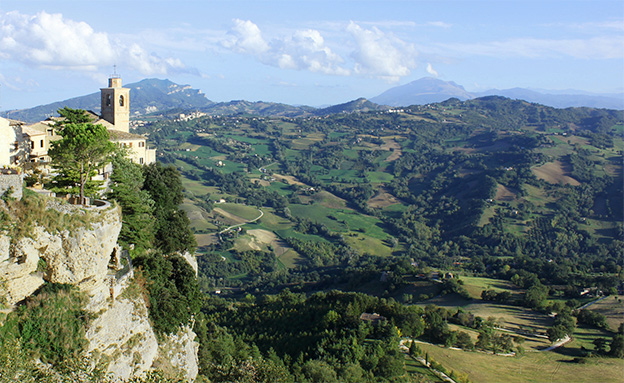
View from the hilltop village of Santa Vittoria in Matenano, 9 km (5 miles) south of Servigliano. Escaped POWs crisscrossed this landscape in September 1943.

Organizers at London-based Monte San Martino Trust are now making plans for an eightieth anniversary celebration of the Allied Forces’ armistice with Italy, the event that triggered the escape of Allied POWs from Italian camps in September 1943.

The September 2023 anniversary activities will be based at the site of P.G. 59 in Servigliano.

Servigliano is nestled in the beautiful Le Marche region of Italy, located in central Italy between the Apennine Mountains and the Adriatic Sea. The main event of the celebration will be a six-day Freedom Trail walk, on September 6–11, co-hosted by the Trust and the WW2 Escape Lines Memorial Society, also of the UK.

The Trust has posted on their website information about the area, links to several area hotels and restaurants, and a brief history of P.G. 59.

The Trust’s founder, J. Keith Killby, escaped from P.G. 59, which in 2021 was designated an Italian National Memorial.

Casa della Memoria (the House of Remembrance association) in Servigliano will be supporting the anniversary activities. The group is active in preserving the history of P.G. 59. Their Remembrance Museum, housed in the renovated railroad station adjacent to the camp grounds, is a hub for educational activity—including classroom activities, tours of the camp, and historical research.

The Freedom Trail walk will take hikers through Tenna Valley terrain crossed by escaped soldiers, visiting historical landmarks and meeting with families of Italians who assisted the escapees. Historians on the tour will serve as guides and answer questions.

For more information on the activities of Monte San Martino Trust, visit msmtrust.org.uk.

Queries about the anniversary events can be sent to the Trust at info@msmtrust.org.uk.

More on the Escaped Prisoners at Fontanaluccia

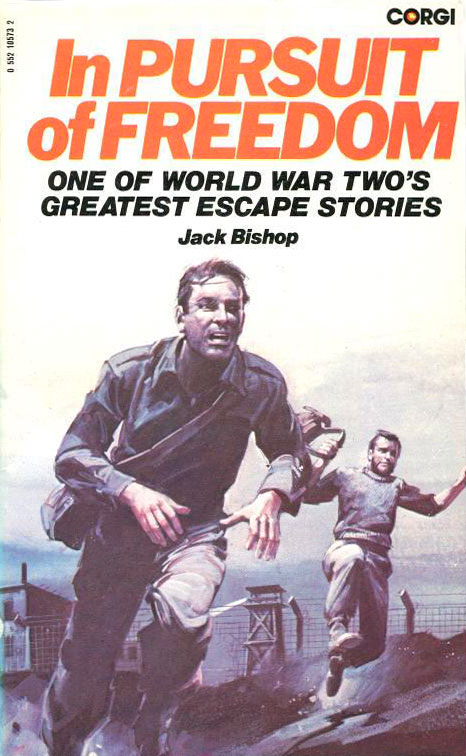
In Pursuit of Freedom, published by Corgi Books

Yesterday my friend and fellow researcher Anne Copley shared information related to a post I wrote in 2017. See “Escaped Prisoners and Airman at Fontanaluccia.”

“One of the names there is W. J. Bishop,” Anne wrote. “This is Jack Bishop who wrote a book, In Pursuit of Freedom, about his wartime experiences. (He was one of the first to end up on Italian soil as a PoW—captured when his submarine was rammed on 31 July 1940.) 

“Jack has a whole chapter on the convent at Fontanaluccia (which clearly acted as a sort of hospital as well), and in particular a Sister Maria who gave him a rosary. He was with someone he only ever calls ‘The Corporal’, who must be the R. D. Smith who turned up on the same day in October. Jack talks about him having a bad leg. He was eventually betrayed and recaptured. I haven’t been able to trace him post-war. 

“Jack was an OR (enlisted man) but, although he didn’t much fancy being someone’s servant, he volunteered to be a batman in an officers’ camp, knowing the conditions would be better. Thus he ended up in Fontanellato. He actually escaped on his own initiative a day or two before the mass breakout organised by the Camp Commandant and the Senior British Officer Hugo de Burgh. 

“He met up with ‘The Corporal’ later, after those he had escaped with decided to stay on with an Italian family.”

Many thanks to Anne for sharing this new information.

Travis Fowler—A Family Connection

Private Travis L. Fowler, U.S. Army Infantry

It’s Memorial Day weekend here in the United States—an appropriate time to remember a particular soldier who lost his life in World War II. 

For his family, details of Private Travis Fowler’s death have remained unclear for decades.

As a prisoner-of-war who had escaped—very likely from P.G. 59—in late 1943, Travis had evaded capture in Italy for months. Then, while attempting to cross the Allied lines, he was shot by a German sentry. He died 78 years ago this month. See “Travis Fowler—Nearly Home.”

When I wrote about Travis in January 2021, I had not been in contact with anyone from Travis’ family. 

Four days ago, I received a note from his nephew, Jeff Fowler.

Jeff wrote, “Travis Fowler was my uncle. I am the son of Jessie D. Fowler. Until recently I did not know that Travis was a POW; today, thanks to you, I learned even more.”

Some information known to older relatives in the Fowler family may not have been passed down. 

Continue reading

Reginald Skinner in Switzerland

Escaped Allied POWs bask in the beauty of their Swiss harbor

Many Allied soldiers who escaped from prison camps in northern Italy in the fall of 1943 made their way safely to neutral Switzerland.

Reginald Skinner was among them.

Reginald’s granddaughter Hannah Angell doesn’t know in which Swiss community he found shelter. Other POWs represented on this site found refuge in Alpine resort villages such as Adelboden, Arosa, and St. Gallen.

Reginald kept the following photographs as reminders of his time spent Switzerland.

(See also “Reginald Skinner—P.G. 59 and Beyond.”)

Reginald Skinner—Notebook Poetry

A poem from Reginald Skinner’s prison camp notebook

Reginald Skinner’s prison camp notebook contains seven full-length poems. (See “Reginald Skinner—P.G. 59 and Beyond.”)

The poems are:
Reflections of a P.O.W.
Appreciation
The Fireside Fusiliers
The Mirage
Evening
The Long Range Desert Group
A Father’s Story to His Son

Reginald did not record the authors of the poems, but some of the poems appear with attributions in other prisoner’s notebooks, most notably Robert Dickinson’s “Servigliano Calling.”

“Reflections on a P.O.W.” is in G. Norman Davison’s diary, and the same poem also appears in “Servigliano Calling” with the shortened title “Reflections.” See “Camp 59 Poets.”

In addition, “The Mirage” and “The Fireside Fusiliers” are in “Servigliano Calling.” All three poems are credited there to Cpl. D. Nevitt. (See “The ‘Servigliano Calling’ Poets,” “‘Servigliano Calling’ Camp Poem #8,” and “‘Servigliano Calling’ Camp Poem #10.”)

Of course, it’s entirely possible Reginald wrote some of the poems in his notebook himself.

Continue reading

Reginald Skinner—P.G. 59 and Beyond

A spread from Reginald Skinner’s notebook

On the inside cover of his POW notebook, Reginald Skinner recorded his name, rank and company, as well as his bed and hut assignment in P.G. 59:

R.E.J. SKINNER. PTE.
6097228 BUFFS
BED. NO 1019 9 HUT.
CAMPO 59. PM. 3300
ITALIA.

Reginald Skinner of the Buffs

Recently Hannah Angell wrote to me from the UK. 

“My daughter has been doing a school project on WW2,” she explained. “My grandfather was a prisoner of war in Italy. After doing a little research, I believe he was a POW in Servigliano. I have attached some pictures of a pocket notebook from his time there and a picture of him. His name was Reginald Skinner. 

“My grandfather passed away eight years ago and he was a man of few words. He never shared any stories from his time in the war. All he told us was he was a POW in Italy and escaped to Switzerland. 

“The only memory he ever shared with me was when he had a toothache an Italian soldier took him away and they ripped the tooth out of his mouth! 

“He was in North Africa before Italy. I’ve found records with dates of capture and when he was interviewed in Switzerland.”

Continue reading

The Departure of Heroes

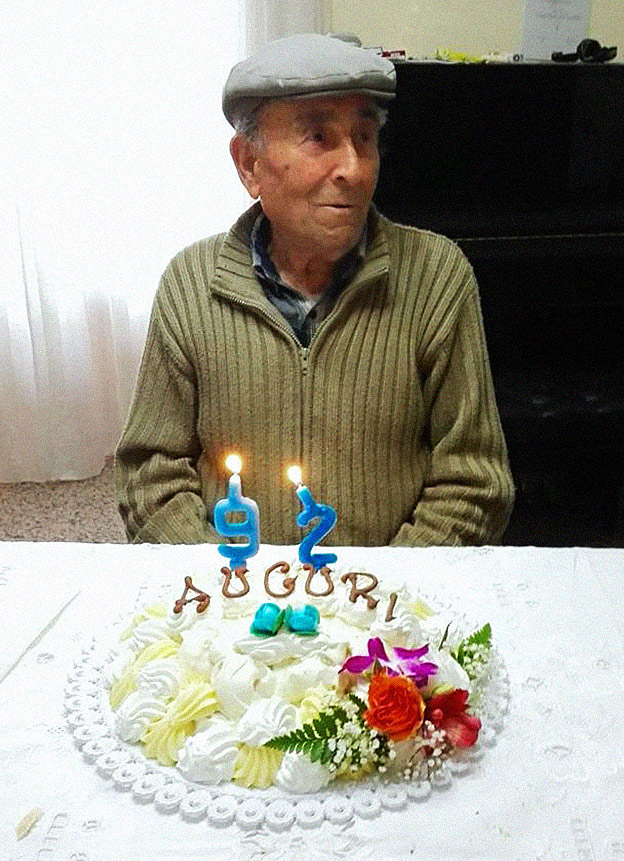
Antonio Del Gobbo on his ninety-second birthday
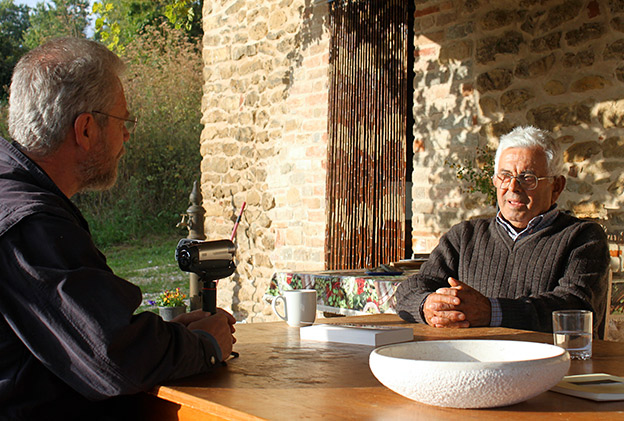
Marino Palmoni is interviewed by Italian historian Filippo Ieranò (left) and Ian McCarthy (not shown), 2010

My father, American Sgt. Armie Hill, was a prisoner of war in P.G. 59 Servigliano during the Second World War.

He escaped from the camp in September 1943, shortly after Italy signed the armistice with the Allies. Although the Italian government had capitulated, much of Italy was still held by the Germans. Escapees from prison camps across central and northern Italy found themselves on the run in enemy-occupied territory—and were at the mercy of local Italians for protection.

The Italians themselves were divided between fascists, who cooperated with the Germans, and partisans, who fought for liberation of their country. Rural laborers and farmers, the contadini, were faced with an ethical dilemma when ragged POWs turned up at their doorsteps asking for food, shelter, or directions. 

Continue reading

Antonio Zagnoli, The Airmen’s Guide

“This photo was taken at Poggio di Casola on September 26, 1941. From left, standing, are Ireneo (brother of my grandpa), my grandma Felicita, and my grandpa Sante; from left, sitting, are cousin Vittorio, my aunt Ada, my uncle Umberto, and my father Antonio” —Marco Zagnoli

Marco Zagnoli recently wrote to me from Italy about his family’s support for Allied airmen in 1943–44. 

“My father told me that he—at the age of sixteen—helped British airmen who were evaders or escaped from prison camps to pass the lines and reach the Allied troops,” Marco said.

“Also, my grandfather provided help, hiding the airmen at our family farm called Poggio di Casola, Castel di Casio village, near Porretta Terme (Bologna). 

“On the British military maps of the area—to which my father could get a look—our farm was marked as ‘a family that helps British troops,’ or something similar.” 

Aerial view of Poggio di Casola, 1933

The airmen, Marco explained, turned up individually at the farm over time. 

Continue reading

A Reflection on Heroism and Humility

Antonio and Domenica Cavaciuti

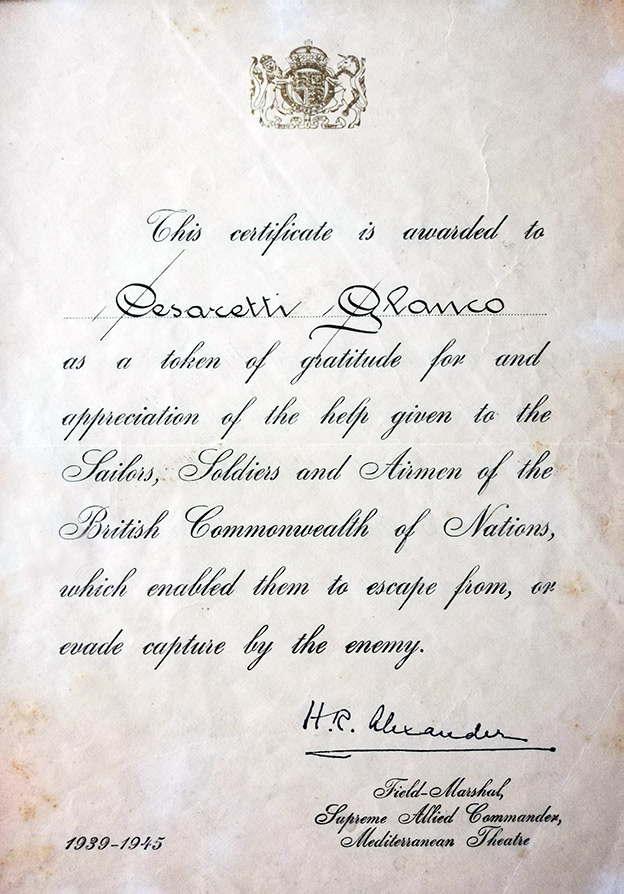
“There is a certificate of gratitude hanging in my grandmother’s house in London that was awarded to my great-grandfather, Antonio Cavaciuti,” Sophia Boeri wrote to me last month. 

“I recently began to enquire about the history of this certificate to my family. My grandfather passed away before I was born and so I was never able to ask him directly about the certificate. My family don’t know too much about the story behind it—all that they’ve been able to tell me is that my great-grandfather helped to protect British soldiers during World War II and that his actions were deemed to be very courageous, especially considering that he had nine young children. 

“I began to search for more information on the internet and came across your website, so was hoping that you will be able to provide me with more information about the actions of people like my great-grandfather.”

I told Sophia I would like to share their great-grandparents’ story and asked if she would send me a few photos.

Sophia wrote again a couple of weeks later. “Sorry about the delay in responding to you,” she said. “It took a while to sort through many boxes of family photos!

“I have attached a picture of my great-grandfather’s Alexander certificate, a photo of Antonio and Domenica, a clearer photo of Antonio and a photo of all their children together.

Continue reading

William McBeth “On the Run”

Photo of William McBeth's family
William McBeth with his family, circa 1965. Granddaughter Kirsty McBeth says, “He’s the gentleman on the right and my dad [Donald McBeth] is the young lad with the tie. He married my dad’s mum, who was separated and already had an older daughter, who is the other lady in this picture with her husband and her son and daughter.”

William Harkins McBeth was never a prisoner in P.G. 59.

In fact, he was captured by the Germans in Italy on 3 October 1943, one month to the day after Italy signed the armistice with the Allies. By the time William was captured, POW camps across Italy had dissolved—the captives having fled into the countryside or been transported to Germany.

William’s granddaughter Kirsty McBeth is in the process of piecing together her grandfather’s wartime story. She shared with me some of the documents she’s gathered so far. 

They’re quite interesting, and I’m eager to share his story on this site.

William was born 1 February 1915.

“My grandfather lived in Glasgow and moved through to Edinburgh when my dad was around four,” Kirsty wrote. “His family had a carter business in Glasgow which was basically transporting coal. I think my grandad was a driver.”

William had just turned 25 when he enlisted in the Army in February 1940. Early in the war he was in North Africa, serving with 1 SAS (the Special Air Service—a special forces unit of the British Army) and the SRS (Special Raiding Squadron).

An SAS researcher whom Kirsty contacted wrote to her, “Whilst a member of ‘A’ Section 3 Troop he was involved in three operations. One of these was in the Desert but I am unable to pin it down to which one. The other two were at Capo Morro di Porco and Augusta in Sicily. His final action with the SRS was in Termoli in Italy on Operation Devon where he was captured on 3 October 1943.”

Continue reading