Category Archives: Prisoners—Camp 59

News of Claude McLaughlin

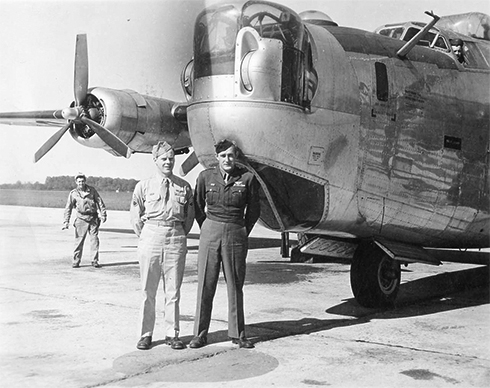
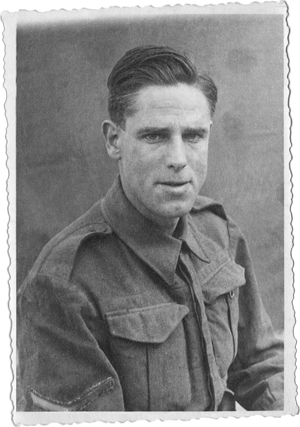
Photo of Claude McLaughlin (on left) with another crewmember.

Two months ago I received an e-mail from Claudia McLaughlin-Wood of Toronto, Canada. She wrote:

“I have discovered the Camp 59 website and am quite certain that my father, U.S. Army Air Force S/Sgt. Claude H. McLaughlin, was a prisoner there in 1943. He was in the 32nd squadron of the 301st Airborne Division flying in a B-17 bomber that was shot down over Gabes, Tunisia on February 4, 1943. From there he was sent to a prison hospital somewhere near Naples, then to a prison camp near Naples before being transferred to Camp 59.

“I have a newspaper account from his hometown in Iron Mountain, Michigan that states he was in Camp 59 in northern Italy. I’m not sure how long he was there but I know that he escaped and was hiding with an Italian peasant family for nine months before crossing enemy lines and meeting British forces on June 19, 1944. I note from your website that there was a massive escape in September 1943, but in his account he just said, ‘some of us managed to escape.’ He was with an English sergeant and a South African sergeant while hiding in the mountains. I assume the area is the Tenna Valley. In trying to figure out the dates it looks as though he would have escaped in October 1943. I am wondering if you have any information about escapes subsequent to September 1943.

“He was the only one of his crew that was in the camp because he was injured. The rest of his crew was sent to Germany for the duration of the war.

Continue reading

Maurice French—Prisoner from New Zealand

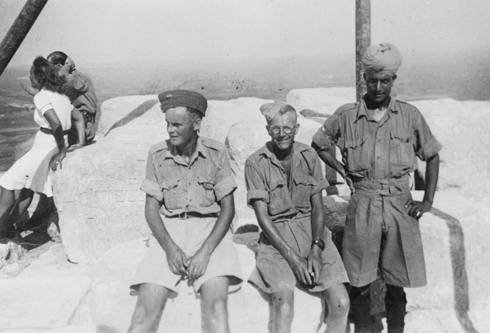
Above: Maurice French (at center) on top of the Pyramid at Giza. (This photo from the online Cenotaph Database (Auckland War Memorial Museum) was provided to the database by Maurice French).

I received a note on July 9 from Miriam McDonald. “I came across your website looking for more information on my grandfather’s experience in the war,” she explained.

“His name was Maurice Ernest French (known by his army friends as ‘Snow’), a New Zealander in the 27th machine gun battalion 2NZEF.”

Miriam wondered if I knew of her grandfather and if I had any record of his time spent in Camp 59.

I had never heard of Maurice French. In fact, this is the first evidence any New Zealanders in the camp I had come upon.

Part of the difficulty in documenting New Zealanders was the fact they are not listed separately in WW II prison records from that time.

Giuseppe Millozzi, in Allied Prisoners of War in the Region of the Marche and Prison Camp at Servigliano, notes that the Italian military authority list of internees did not distinguish between British and other nationalities (the general breakdown listed only British, Americans, and French). Irish, Canadians, Cypriots, New Zealanders, Australians, Poles, South Africans, Palestinians, Maltese, Rhodesians, and Norwegians, he explains, were included in the British total.

New Zealand WWII veteran and historian Ken Fenton told me he was unaware of any New Zealanders who were interned at Camp 59, although his main research concerns the Italian camps where most New Zealanders were held.

Ken goes on to explain:

“I have also looked at the only known and Official War Office Roll of NZ POWs held in Italian camps, a roll prepared between April and June 1943. It lists each POW by camp of imprisonment. There is not one NZ POW listed as being at PG 59, in fact PG 59 is not mentioned anywhere in the document.

“There is a faint possibility that some NZ POWs may have passed through PG 59 at some stage prior to the preparation of the Roll and ended up at PG 57 as most NZ POWs did. In these circumstances, if there were few involved, PG 59 might have escaped mention in the official history, but I am inclined to doubt it.”

And yet here we have the Cenotaph Database record indicating Maurice French’s presence in Camp 59. Perhaps additional information will surface over time about Maurice French and any other New Zealanders who either passed through Camp 59 or who were present at the time of the breakout in September 1943.

For now, here is a biography of Maurice French, based on the information available on the Cenotaph Database:

Maurice Ernest French

Private Maurice Ernest “Snow” French
Serial No. 36248
27 (Machine Gun) Battalion
Second New Zealand Expeditionary Force (2NZEF)

Maurice Ernest French was born in Hamilton, New Zealand on November 9, 1918.

His record in the Cenotaph Database lists his mother, Mrs. Ella Sarah French, (24 Paterson Street, Sandringham, Auckland, New Zealand) as his next-of-kin during the war.

Maurice enlisted the day he turned 21—November 9, 1939. He was single at the time he served.

He received military training in Trentham and Palmerston North, both in New Zealand.

His ship, the Nieuw Amsterdam, left Wellington, New Zealand on February 1, 1941 for Port Tewfik, Egypt.

In North Africa, Maurice served in the Western Desert, Minqar Qaim, and El Alamein campaigns.

His “action prior to capture” is given in the database as front line soldier. He was captured at Ruweisat Ridge, El Alamein—according to the database—in May or June, 1942.

Maurice was interned in Campo 42 (Italy), Campo 59 (Italy), and Campo in Bay of Venice (Italy). He was free for 7 months before being recaptured and sent to Germany, where he spent another year as a POW in German camps.

In Germany, he was held in Stalag VIIA Moosburg (Germany), Stalag IVB Muhlberg (Germany), and Stalag Esdenmein.

Following his release, he was returned to England in March 1945. He was discharged from service in October 1945.

He later married and had four children.

He received the following awards: 1939–1945 Star, Africa Star and 8th Army Clasp, New Zealand War Service Medal, War Medal 1939–1945, and the International P.O.W. Medal.

Maurice’s postwar occupations listed on the database are “carpenter per rehab” and zookeeper.

A category of “wounds and diseases” in the database lists these injuries: prolapsed invertebral disc, hammertoes (2 and 3 on left foot), and sensory neural deafness.

The database also indicates that Maurice was admitted to New Zealand General Hospital at Sweet Water Canal, Egypt.

The Cenotaph record was prepared with Maurice French in 1999.

Maurice French is No. WW2 3 in the New Zealand Nominal Roll. (The Nominal Roll is a list of all soldiers who embarked for active service overseas.)

Packages Sent from Home

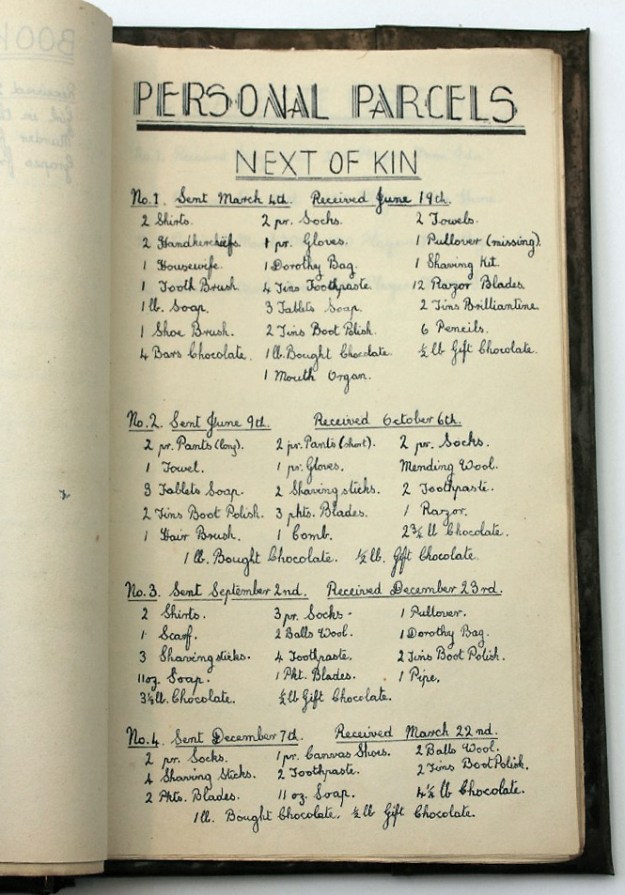
A page in Robert Dickinson’s journal,”Servigliano Calling,” is dedicated to “next-of-kin” parcels received.

Relatives of Allied prisoners were allowed to send one package four times a year to their loved ones. How this process was conducted in Canada was described in an Ottawa Citizen article about the services of the Canadian Red Cross Enquiry Bureau on April 26, 1944:

“There are 6,365 [Canadian] prisoners and internees on record whose next-of-kin are issued quarterly labels for personal parcels by the Department of National War Services….

“As soon as a man is officially declared a prisoner of war, another pamphlet is sent [by the Red Cross Enquiry Bureau] advising the next-of-kin what to do about parcels and enclosing the latest postal regulations.

“The bureau also receives reports from the supplementing committee of the Red Cross by which it is enabled to keep in touch with the next-of-kin who have difficulty in making up their quarterly parcels. One of the duties of the Red Cross is to see that the parcels are up to their full weight and it is through these reports that the liaison officers of the Red Cross branches are able to offer help to those in need of it.”

Continue reading

Red Cross Parcels

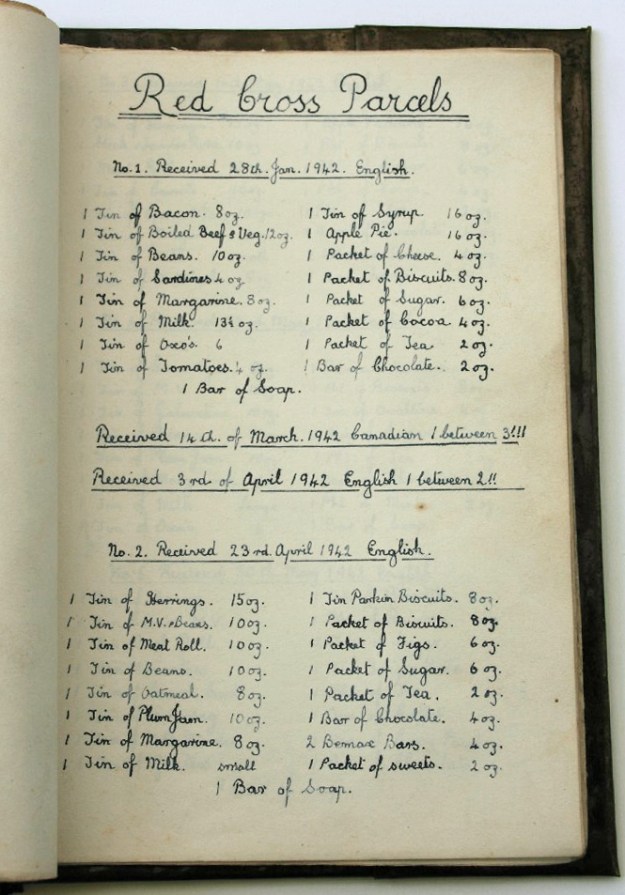
Red Cross Parcels distributed in Axis camps during the war were essential to the Allied POWs’ survival.

Robert Dickinson describes the eagerly awaited parcels in his diary; it’s clear that interruptions in parcel distribution were times of anguish.

Italian historian Giuseppe Millozzi, in his dissertation, Allied Prisoners of War in the Region of the Marche and Prison Camp at Servigliano, notes the following:

“English, Canadian and also New Zealand Red Cross sent to POWs various parcels some that contained clothes, tobacco and other necessities but the most important ones were food parcels that helped POWs to survive with the meagre Italian rations. Parcels coming from Canada and New Zealand were the richest as in those countries there was no food rationing such as in England that was under the constant threat of German bombing.

“Food parcels that had reached the camp were not enough for everybody and therefore they were divided among POWs. During the distribution of them, the Italian authorities usually punched food tins to prevent any the POWs from storing them for use in an eventual escape. POWs use tins of food, tobacco etc. as exchange goods; furthermore they recycled all the empty tins as the metal was very useful to construct a great variety of utensils.”

Continue reading

Cigarette Parcels

Robert Dickinson recorded parcels of cigarettes received in his “Servigliano Calling” journal.

His girlfriend Ida was the primary supplier of cigarettes. Others came from his family and from his regiment in Lincoln, England.

Player’s brand tobacco was manufactured by John Player’s tobacco company in Nottingham, England. Higgs Bros. was a tobacconist shop in Lincoln.

Comments below in italic are from Robert’s diary.

CIGARETTE PARCELS

No. 1. Received July 23rd. 200 Players From Ida.

Jul 23rd [1942] First big parcel, just right have got no cigs. 200 Players from Higgs, no senders name.

Continue reading

Robert Dickinson—Books and Readers

BOOK PARCEL

Received 21st. August 1943.

Girl in the Dark.
Murder for Christmas
Grapes from Thorns

The following passages from Robert Dickinson’s diary in “Servigliano Calling” convey the importance of books to the prisoners. The nighttime reading aloud of books in Robert’s hut was welcome escapism—even worth risk of punishment!

1942

Jul 9th

Denis and I bought a Penguin book “Crump Folk going Home” costing 20 Lira. A good investment, have now access to practically all the books in the camp. Reading aloud at night because of the bugs not letting one sleep; starting at 10pm till midnight.

Continue reading

Robert Dickinson—Calculating Nutrition

Two charts:

Daily Ration Scale W.E.F. 22nd. December 1941. (In grammes per head daily 50 grammes = 1¾ oz.}

Daily Ration Scale W.E.F. 13th. March 1942.

This page with two charts from Robert Dickinson’s journal, “Servigliano Calling,” shows Robert’s awareness of basic nutritional needs and his meticulous effort to ensure those needs were met.

The food categories in the first chart (December 22, 1941) are:

Meat, rice or macaroni, oil or fat, tomato, grating cheese, table cheese, vegetable, sugar, coffee subs., biscuit, bread, and wine.

The food categories in the second chart (March 13, 1942) are slightly different. Vegetables listed are in dried form, and the chart lacks biscuit and wine categories.

On March 12, 1942, 
Robert wrote in his diary, “News of drastic cut in rations.” And on the following day he recorded, “Rations cut by more than half!!” The second chart reflects that severe cut.

It’s alarming to see the drop in rations for several categories from one chart to the next. The second chart, for instance, lists a reduction of meat from servings on five days a week to only two, and the portions on those two days are smaller. Rice or macaroni servings and bread are substantially reduced in the second chart. Oil or fat are a little reduced, but quantities of tomatoes, cheese, vegetables, sugar, and coffee are similar in the two charts.

Do the charts reflect what Robert actually consumed in a given week in the camp, or the balance he hoped for, given the scarcity of food in the Camp 59? The reference to “grammes per head” suggestions that he had his “chums” in mind as well as himself.

Stanley Ernest Taylor

This photo of Stanley Taylor was sent to me by his daughter, Barbara Chapman. Written on the back of the photo is this information:

TAYLOR. STANLEY. L/BDR 1555824.
14/45.
P.G. 59. PM. 3300
ITALIA.

MRS. M.A.E. TAYLOR.
81 ASTBURY ROAD. QUEENS ROAD.
PECKHAM, LONDON. S.E. 15.
ENGLAND

I exchanged several e-mails with Barbara Chapman of Worcester, England, last month.

Barbara wrote:

“Please find attached a photograph of my father, Lance Bombadier Stanley Ernest Taylor, 1555827, Royal Artillery, along with the reverse giving his POW details. My Dad died in June 1973, and all I have are photographs which he’d kept of my Mum and some taken in Africa prior to his capture. However, on the back of these photographs, all rather faded, are details of his capture and also a brief diary. I have to admit for a while I thought it was a shopping list, until I looked closely and realised there were dates, etc.

“Dad’s records from the Ministry of Defence state he was a POW in Italian hands from December 29, 1941 to November 2, 1944.”

Continue reading

A Daring Escape through the Alps

I received a note recently from Marco Soggetto, who lives in Northern Italy.

Marco is engaged in a difficult historical search, concerning a small group of Allied soldiers who escaped from Italian camps and tried to reach the Swiss border through Italy’s Aosta Valley, on the Western Alps.

“They climbed the highest mountain chain in the whole of Europe,” he explained, “without being trained or equipped to do so, and as an alpinist I know how difficult this may be.”

One of the prisoners in this group came from Camp 59. He was Charles John P. Bradford, a British rifleman from the Rifle Brigade, 6915262. He was born March 8, 1918 and he died in 1989.

I asked Marco if he would send me detailed information about his research that I could post on the Camp 59 site. This morning he sent me the following note, which tells of his research and also is a request for assistance from anyone who may be able to help him in his quest for information.

If you know anything about any of the soldiers he mentions, please write to me at hilld@iu.edu and I will share the information with Marco.

Dennis Hill
Camp 59 Survivors administrator

Escape through the Alps

Allied soldiers on the run between Piedmont and the Aosta Valley

April 15, 2012

To the kind attention of the public of Camp 59 Survivors website,

Good evening from Biella, a small town in the northwestern part of Italy.

I am writing this short article and request for information on the very kind suggestion of Dennis Hill, webmaster of the nice and impressive website dedicated to deepening the history of Camp 59.

I am a researcher—both for work and in my free time—and I’ve spent my life under the stars of two different and powerful passions: mountaineering and history.

These two great, fascinating interests first captured me in a difficult search between August 2009 and the following Christmas. In a few words, after many years spent on the Western Alps in the beautiful Aosta Valley, I found the wreckage of a legendary plane, which crashed during the Second World War on the Dame di Challand (Ladies of Challand) group at about 2,900 meters above sea level.

Continue reading

Heard over Shortwave

During WW II citizens in their homes across the U.S. listened to shortwave radio broadcasts for information about Allied POWs.

The broadcasts came from behind enemy lines. Faithful listeners recorded what they heard and attempted to relay information about the soldiers to their families.

The following two notes regarding a September 1944 broadcast were sent to Willman King’s father, Emery King.

A September 1944 broadcast would have come over three months after Willman was recaptured by Axis forces on June 1, 1944. (He had escaped from Camp 59 on September 1943 and evaded the enemy for 8 1/2 months).

Savannah, Ga.,
Sept. 11th, 1944.

Mr. Emery King,
Detroit Lakes, Minn.

Dear Sir:-

Heard over Short Wave that Pvt. William King -37093828, is a prisoner of Germany. Part of his message to you was:- “I am well. Love – Bill.” Thought you may not have heard the broad-cast. We listen every night, as my son. St Sgt. Richard M. Osbourne, is missing in action over France since Aug. 13th and we hope to hear good news of him soon.

Respectfully,
Mrs. E. W. Osbourne
7 W. 31st St.,
Savanannah,Ga.

Note: The U.S. National Archives lists Staff Sergeant Richard M. Osbourne of Georgia, Army Air Corps (heavy bomber), was “returned to military control, liberated or repatriated” from Stalag 17B in Austria—Mrs. Osborne was to have her good news in time.

Continue reading