Category Archives: Prisoners—Camp 59

North Africa American Cemetery and Memorial

n_africa_cem_r72

In a quiet 27-acre cemetery in Carthage, Tunisia, rest 2,841 individuals who gave their lives in military service.

Their headstones, set in straight lines, are subdivided by wide paths into nine rectangular plots, with a decorative pool at each of the paths’ intersections.

Along one edge of the burial area, bordering a tree-lined terrace, is a Wall of the Missing, upon which 3,724 names are engraved. Rosettes mark the names of those since recovered and identified.

Most honored in the North Africa American Cemetery and Memorial lost their lives in World War II in military activities ranging from North Africa to the Persian Gulf.

Among the buried soldiers is Phil Vacca’s cousin Battista “Bucky” Linico Jr.

Bucky was like a little brother to Phil. He and Phil had enlisted under the “buddy system” on January 3, 1941. They served together in North Africa, and Phil witnessed Bucky’s death at the battle for St. Cloud on November 10, 1942. Bucky was 21 years old.

Phil was captured the following month at Longstop Hill. He was eventually interned at Camp 59. Phil’s full story will be shared in upcoming posts.

Bucky’s death was announced in the (Lambertville, New Jersey) Beacon:

buck_linico_obit_r72

Reported Killed

Private “Bucky” Linico
As reported in last week’s Beacon, Private Battista Linico, son of Mr. and Mrs. Battista Linico, of 38 Coryell Street, Lambertville, was killed in action in the “Western European area.” Information of his death was given in a telegram received by Mrs. Linico, Jr., of Phillipsburg.

B-24 Bomber Fyrtle Myrtle Discovered

fyr3_crop_r72

Key fragment of the Fyrtle Myrtle recovered by the Salerno Air Finders.

Last Flight of the Fyrtle Myrtle

Research into the crash by the Salerno Air Finders

The Salerno Air Finders is a group of volunteers from the Italian organization Salerno 1943 who are dedicated to investigation of crashes in Campania and neighboring regions of Italy during WW II, and preservation of the memory of the airmen who lost their lives in the line of duty.

Many thanks to Matteo Pierro for allowing me post a translation of the report on the Fyrtle Myrtle from the Salerno 1943 site on the Camp 59 Survivors site.

Here is the report:

Plane: Bomber B-24, No. 44,
The Fyrtle Myrtle (Army Air Force serial number 42-40236)

Nationality: U.S.A.

Date of crash: July 16, 1943

Location: 94 km east from Salerno

Remarks: Identification confirmed

Ordine di local. 19°

On the morning of Friday, July 16, 1943 a formation of B-24 bombers took off from Berka, near Benghazi, Libya. They belonged to the 513th Bomb Squadron of the 376th Heavy Bombardment Group of the United States Air Force.

Among the planes was one called the Fyrtle Myrtle by members of its crew. Unfortunately, this was to be its last mission.

Continue reading

Neil Torssell’s Prisoner List

n_torssell_addr_r72

The above list, typed for me by Camp 59 ex-prisoner Neil Torssell on an old manual typewriter, is a a record of men he knew in the camp.

Thirteen of these men are new to my list of Camp 59 prisoners. They are noted below as “first reference.”

Men who were prisoners of war at Camp 59, Servigliano, Italy, September 1944

Note: Neil must have meant September 1943, the month he and the other prisoners escaped.

Joseph W. Mack
R #1
Nowata, Oklahoma (deceased)
First reference

There is no reference for Joseph W. Mack in the U.S. National Archives database of WW II POWs.

William M. Wilson
Fox Hall Plains
Dover, Delaware
or
2100 19th Street, N.W.
Washington, D.C.
First reference

William M. Wilson
Serial Number—15042897
Sergeant
U.S. Army, Infantry—Armored Force
State of Residence—unlisted
Source: U.S. National Archives, World War II Prisoners of War Data Files, documenting the period December 7, 1941–November 19, 1946 (Returned to Military Control, Liberated or Repatriated from Stalag 3B Furstenberg Brandenburg, Prussia (Also KDOS [USA] #1-5; ARB BTNS 225-255) 52-14)

Continue reading

Twenty-five Years After the Escape

Felice “Phil” Vacca escaped from PG 59 in September 1943, along with fellow American prisoners Peter Calvagno, Edmond Petrelli, Joe Mandese, and Tony Spicola.

I have been in touch recently with Mario and Tony Vacca, two of Phil’s three sons. They’ve sent me a wealth of material that I will divide into separate posts.

This first post concerns Tony’s contact with the Virgili family and his first visit to Camp 59. That visit occurred in 1968, 25 years after Phil and his companions escaped from the camp.

camp_gate_r72

Sergio Virgili at the gate to Camp 59 in Servigliano, 1968

While stationed in Pisa during the 1960s, Tony made contact with members of the Virgili family of Monte San Martino in the Marche—Sergio Virgili, and his sisters Luigia and Elena—who assisted his father during the war.

Tony explains, “It was on my second visit to the Virgili’s that I went to see the prison camp at Servigliano and to take photos for my father, per his request.

“Sergio Virgili guided me to the camp. It was a cloudy, dreary day. As we drove through Servigliano, I got an eerie feeling, as I could hear someone playing ‘Taps’ on the trumpet.

“Sergio took me straight to the main gate of the camp and we parked.

“That’s where I took the picture of Sergio standing at the front gate.

“It was like stepping into a ‘ghost town.’ It was very quiet—just Sergio and me – it was like the world stood frozen in time without occupants. The buildings showed signs of deterioration and were locked to prevent anyone from trying to live in them. As I walked around taking photos, I could not help but wonder what the living conditions would have been like for the prisoners. My father made very little mention of his experiences there.

“The only building that was pointed out to me was the guard shack by the gate. At the time I only speculated which buildings were the barracks.

“There were rectangular stone islands of sorts outside, located between buildings. They looked like some sort of outdoor wash stations.

“We also visited the train station across from the camp, which my father had told me about.

As a matter of fact, I have a small book, Il Campo Di Servigliano, 1915–1955, published by Casa della Memoria, which contains a map of the camp, with building locations, and some photos. The map layout is pretty much as I remember the building positions.”

See note after the photos.

barracks-2_r72

Continue reading

Stanley Taylor—A Photo Album

Stanley_Taylor-portrait_r72

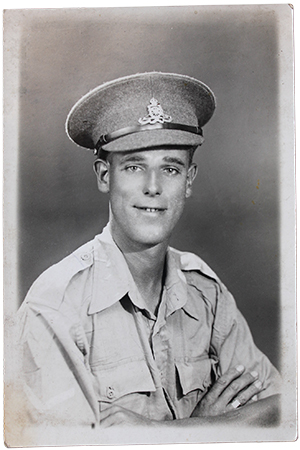
Stanley Ernest Taylor

In June 2012, while my partner and I were traveling in England, I had the pleasure of meeting with Stanley Taylor’s daughter, Barbara Chapman. My first contact with her had been in April. When she heard we would be in the Cotswolds, she wrote back to say, “You’ll be on my doorstep when you are in Cheltenham.”

The day we arrived, Barbara met us at the train station and took us to our hotel, where we enjoyed a visit over afternoon tea. Barbara brought a envelope full of pictures, which I photographed. I am pleased to share them here.

Additional photos are on a previous post, “Stanley Taylor in Switzerland.” Also, read about Stanley on “Stanley Ernest Taylor.”

Continue reading

Peter Grillo—Captive

grillo_letter_r72

I received a note this morning from Roy Grillo, who, in conducting online research about his father, Peter Grillo, discovered his name on Clifford Houben’s Address List of POWs.

Peter’s name and address are also recorded in Charles Simmons’ address book.

Peter passed away in 2002.

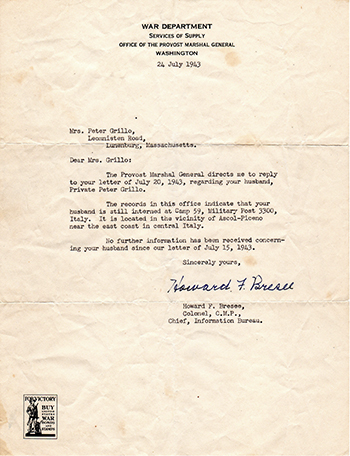
Roy shared a letter with me that was sent by the U.S. War Department to his mother, Virginia E. Grillo, during Peter’s captivity.

Here is the text of that letter:

WAR DEPARTMENT
SERVICES OF SUPPLY
OFFICE OF THE PROVOST MARSHAL GENERAL
WASHINGTON

24 July 1943

Mrs. Peter Grillo,
Leomnister Road,
Lunenburg, Massachusetts.

Dear Mrs. Grillo:

The Provost Marshall General directs me to reply to your letter of July 20, 1943, regarding your husband, Private Peter Grillo.

The records in this office indicate that your husband is still interned at Camp 59, Military Post 3300, Italy. It is located in the vicinity of Ascol-Piceno [Ascoli Piceno] near the east coast in central Italy.

No further information has been received concerning your husband since our letter of July 15, 1943.

Sincerely yours,

Howard F. Bresee
Colonel, C.M.P.,
Bhief, Information Bureau.

“I remember my dad told me once that he and some of the other men ate rat and dog because of very small meals that were made available to them,” Roy said.

“I think the greatest gift my father left me was his talk about death and fear just before I left for Vietnam. It had a profound impact on me when our convoy came under attack (ambush), and it was his words that got me through those tough times.”

roy-grillo_neil_r72

“This photo is one my dad liked,” Roy said. “That is me, age 19, leaning on the machine gun and a very good friend, Neil Naffzinger, who drove this truck.”

Ray Kestner’s “Christmas Book”

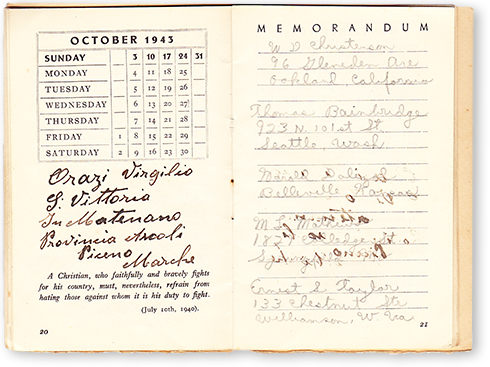
r-kestner_address-page_r72

Ray Kestner’s granddaughter, Jessica Kestner McMahon, calls the little book that Ray brought home from prison camp the “Christmas book.”

Entitled Christmas 1942, the calendar booklets were a gift of Pope Pius XII to the Allied prisoners.

The booklets consist of 48 pages and a cover. They have calendar pages for January–December 1943, as well as a “memorandum” page for each month (pages 2–25); the rest (pages 26–48) is comprised of hymns and Christmas carols.

Camp 59 prisoner Charles Simmons also owned one of these booklets, described in “Charles Simmons’ Calendar and Address Book.”

Most of the addresses throughout Ray’s booklet are penciled in his own very legible handwriting. A few are written in other penmanship—presumably by the prisoners themselves.

Aside from the address of Italian Virgilio Orazi (above) and one Englishman—Bob Johnson of Leeds in West Yorkshire—the names and addresses are those of Americans.

Continue reading

Ray Kestner—Still Behind Enemy Lines

r_kestner-family_r72

Raymond Kestner with family

The letters in this post, saved by Ray Kestner’s sister, are posted here courtesy of Ray’s granddaughter Jessica Kestner McMahon.

In one of his letters, Marshall Wells makes reference to Ray’s wounded arm. Ray had been shot in the left arm before capture and was treated by the Italians.

The sensitive correspondence between strangers in this post calls to my mind the sharing of news concerning Albert Rosenblum’s capture described in “Kind Strangers—Relays from Radio Rome” and the news of Willman King recorded in “Heard over Shortwave.”

For more on Ray Kestner, see “Local News Articles—Raymond Kestner” and “Ray Kestner—Letters and Postcards.

Jan-27_44_1-M-Wells-r72

Continue reading

Willman King’s Addresses

w_king_2-r72 w_king_3-r72 w_king_4-r72 w_king_5-r72

w_king_1a-r72

Above: American soldier Willman King superimposed against a page of his address list.

Like Clifford Houben, Charles Simmons, and many other POWs, Willman King kept a list of men he met while a prisoner.

Like Clifford Houben, Willman recorded his addresses on traced dog tags.

Because there are no notations in this list and because Willman was recaptured after escape from Camp 59 and sent to Germany, we can’t be sure which names and addresses were gathered in Camp 59 and which were collected later.

All the same, it’s good to have this document for future cross reference. Thanks to Willman’s son Joseph King for sharing this list.

R. B. Lipps
410 Ninth St. [street address is unclear]
Marshalltown
Iowa

Ernest Kimbrel
6252 South Spalding
Chicago
Illinois

Eugene Hockenbery
RR #1
Waynesboro
Pennsylvania

Continue reading