Category Archives: Italian Helpers

Sidney Seymour Smith—A Mystery Solved

sidney-smith2_r72

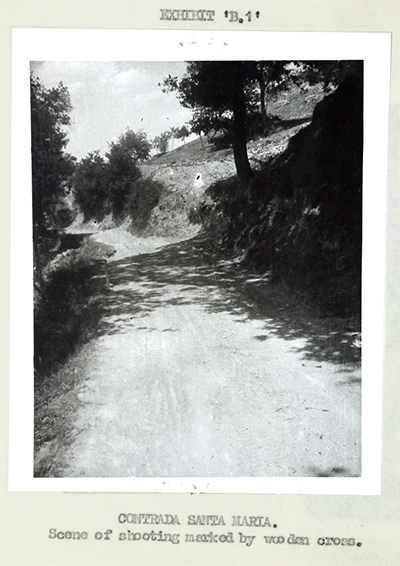
This photograph from the file of inquiry into the death of Signalman Sidney Smith by the Special Investigation Branch (SIB) of the Royal Military Police shows the spot on a road outside the comune of Montelparo, Italy, where the soldier was killed.

cross2_r72

This detail (from the above photograph) shows the wooden cross erected by local Italians in remembrance of Sidney Smith, the man they affectionately knew as “Giorgio.”

The killing of an escaped prisoner of war outside the village of Montelparo is a subject that has come up twice on this site recently. In “Tenna Valley Memorial Walks,” Anne Copley recounted how, two months ago, Freedom Trail walkers visited the spot outside Montelparo where a young British soldier, known to locals only as George—or “Giorgio” in Italian—had been shot by German soldiers.

And in “War Crimes—Sorting through the Accounts,” I questioned whether George Godfrey was the same soldier killed at Montelparo.

But now, thanks to help from British researcher Brian Sims, we have a clear answer to the identify of the soldier and a detailed account of the tragic end to the life of Sidney Smith.

Below is the official summary of an investigation by the Special Investigation Branch (SIB) of the Royal Military Police into the death of Scottish soldier Sidney Seymour Smith, Signalman, Royal Corps of Signals.
Continue reading

Anne Copley in the Italian American Journal

Anne-Copley_r72

Author Anne Copley

Anne Copley’s excellent article on the escaped Allied prisoners and their Italian helpers, Italy’s Courage: The unknown story of WW2 escapees and the Italian peasantry, is now online on the website of the Italian American Journal.

The following description of the author is posted on the IA Journal site:

Anne Copley is a lawyer living and working in Oxford, England. She bought and renovated a house near Montefalcone Appennino in Le Marche region of Italy 10 years ago, and now spends as much time there as possible. She became fascinated by the story of Allied PoWs and their Italian saviours when she found that most of her neighbours’ parents and grandparents were involved. She now takes part in guided “Freedom Trails” in the area, reviving the memories of 70 years ago. She is also involved with the Casa Della Memoria in Servigliano, a museum dedicated to this subject.

Tenna Valley Memorial Walks

trail_tenne_r72

Fording the River Tenna

This post is an account by Anne Copley of the September 5–8 “memorial walks” based out of Camp 59 in Servigliano. The walks were arranged jointly by the Escape Lines Memorial Society (ELMS) and Monte San Martino Trust (MSMT).

Here is Anne’s story:

“A Syrian photojournalist, a very famous Italian photojournalist (being filmed for his own life story), a Canadian woman seeking information about her father, and the CEO of the UK Red Cross mingled with Italian students, retired soldiers, a Jack Russell dog and others with various connections to Italy at the start of three days of walking through the Southern Marche countryside.

“The reason? to commemorate the date on which Italians signed the Armistice and many of the fathers and grandfathers of those taking part escaped singly or en masse from prison camps across Italy.

Continue reading

War Crimes—Sorting through the Accounts

British researcher Brian Sims recently sent me an interesting affidavit from the British National Archives (file WO 311/1336), “In the matter of German war crimes and in the matter of the death of ‘George Godfrey’ in Italy about March, 1944.”

About a week later, Anne Copley mentioned to me that in the commume of Montelparo a British escapee variously called George or David was shot while running from the Germans/Fascists.

I began to wonder if this George or David might be George Godfrey or another fellow named George mentioned in the affidavit, as Montalto delle Marche is very near to Montelparo and Montalto is where the war crimes mentioned in the affidavit occurred.

Here is the full text of the affidavit, given by Forrester Hart:

In the matter of German war crimes and in the matter of the death
of ‘George Godfrey’ in Italy about March, 1944.

I, Forrester HART, with permanent home address in Barnsley Road, Dodworth, New Barnsley, Yorkshire, make oath and say as follows:

(1).
During the War I served with the R.A.S.C. [Royal Army Service Corps] and was serving with that Unit, attached to the Royal Artillery (Medium), in North Africa. My rank was Acting Lance Corporal and my regimental number T/230944. On the 21st June, 1942, I was taken prisoner by the Germans on the fall of Tobruk.

(2).
At the back end of July or the beginning of August, 1942, I, along with the other prisoners, was taken to a transit camp at TARANTO, via Derna and Bengazzi. About a fortnight later I was transferred to No.65 Camp, near Barri, where I was detained approximately 10 or 11 months. In June, 1943, I was taken to MACERATA Camp. About this time the Italians Capitulated.

Continue reading

More on Giovina Fioravanti

After I added the post on Giovina Fioravanti to the Camp 59 Survivors site this week, I heard from Joely Carter. Giovina is her husband’s grandmother. On her blog, iwishiwasalandgirl.wordpress.com, she has shared some personal reminiscences:

“My husband’s grandmother, Bella, has always been larger than life. A typical Italian matriarch, she is fiery and protective, and always wants to feed you! When I first met her around 7 years ago, I was struck by how beautiful and elegant she was, and couldn’t believe it when she told me she was 86! Bella is a term of endearment, her real name being Giovina Fioravanti. Originally, Bella aspired to be an actress however on the outbreak of World War II Bella volunteered her services to her country. Over the years, Bella has shared many stories with me, the most memorable being that during a boat crossing from Albania back to Italy, a Bulgarian man had taken a bullet for her using his body as a shield. When I first went to her house, I was proudly shown a certificate, which was hanging in the dining room. Bella explained that this was for bravery during the War, but never elaborated on what she had done to obtain this. It was always assumed that this was an award given to all Italians who played their part in the War.

Continue reading

A Heroine Recognized

giovina-2_r72

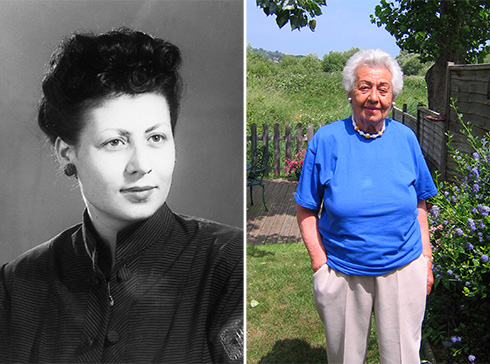
Giovina Fioravanti, circa 1940s, and a more recently photo on the Isle of Wight

I received an e-mail late last month from Isabelle Burberry on the Isle of Wight on the south coast of England.

She wrote, “I am in possession of the Certificate of Gratitude signed by Field-Marshall H.R. Alexander awarded to my Mother, Fioravanti Giovina. My Mother is extremely proud of said Certificate and would show it off to all and sundry even to this day. However, I was completely unaware of the story behind the Certificate until a search on the internet led me to your site.”

“I’m not really sure exactly what it was that my mother did, but presume it was to provide help. I know that she was with the Red Cross, and I seem to remember that she had been in Albania and was travelling back down from the North to the South of Italy to be reunited with her family.”

Giovina’s family lived about an hour south of Rome.

The certificates, signed by Field Marshal Harold Alexander, commander of Allied forces in Italy, were issued to a select group of Italians who had risked their lives to protect escaped British POWs and evaders (soldiers evading capture in enemy territory) during German occupation of their homeland.

Continue reading

A Hiding Place

Bell tower of Chiesa S. Michele in Montelparo, Italy.

Early this month I received an e-mail from Loris Ferretti, son of Onelio Ferretti. Onelio was a young man in the comune of Montelparo, in the Marche region of Italy, during World War II.

“My father told me the Americans [who had escaped from Camp 59] hid with him in a room of a church [Chiesa S. Michele or the Church of Saint Michael] in the village, where in the night my grandmother secretly brought them food, using a ladder that was in that room. My father told me he helped the Americans hide, but he never revealed their names. Then the war ended and they returned to their country. That is all know of this little story.”

Mio padre mi raccontava di Americani nascosti con lui in una stanza di una chiesa in paese, dove la notte di nascosto mia Nonna portava loro da mangiare, aiutandosi con una scala che tenevano in quella stanza. Mio Padre mi raccontava di aver aiutato quei Americani a nascondersi, ma non mi ha mai rivelato i loro nomi. Poi la guerra finì e sono tornati al loro paese.

“The monks walled up (closed) that room to hide the gold, precious objects of the Church. They opened that room about two months ago. That room was used to hide the fugitives of Camp 59. You could not get up there without a ladder.”

I frati avevano murato (chiuso) quella stanza per nascondere l’oro, gli oggetti preziosi della Chiesa. Hanno aperto quella stanza circa due mesi fa. Quella stanza servì per nascondere i fuggiaschi del campo 59, non si poteva salire li sopra senza una scala.

Continue reading

“The Earthquake” Returns to San Benedetto

This clipping from a local San Benedetto Del Tronto (Marche, Italy) newspaper, commemorated the return, after two decades, of a favorite son—Nicola Lagalla, known to locals as “the earthquake.”

Nicola returned to San Benedetto when the hometown soccer team, Samb, was having a spectacular season.

Nicola’s daughter, Marida Parkes, in sending me the clipping, explained:

“When Samb climbed up the soccer ladder—because of their win—the town went berserk… they celebrated for weeks (as you do when you are Italian). Dad and mum flew to Italy for the festivities.

“Dad is fanatical about his soccer and Aussie Rules football. To this day he does not miss a match and will get up at all hours to watch.”

Sanbenedettese, the name for a person who is born in San Benedetto Del Tronto, is also the name of the soccer team—or Samb for short. Red and Blue are the Samb team colors.

Translation of the article:

NICOLA LAGALLA (earthquake)

“Today amongst us, we have chosen an enthusiastic, fanatical pureblooded Sanbenedettese who, from such a distance, has maintained his love not only for his soccer team, Samb, but also that of his hometown.

“He immigrated to Australia 20 years ago. With such distance between them, he missed his family and he has also missed his beloved team—Samb. The only comfort, as the newspaper reported on Tuesday, was that the Red & Blue team was promoted on the football ladder. Upon hearing this, he could not ignore the call to return to his roots and returned to San Benedetto Del Tronto for the festivities.

“He [Nicola] will remain here with us until the beginning of the next season/championship.”

Continue reading

Nicola Lagalla—After the Rescue

Marida describes the photo above: “This is of dad and myself—yes, with a ‘boy coif.’ I was two years old and dad would then have been 29 years old. It was taken at San Benedetto, opposite the port.”

Below right: Nicola Lagalla in recent years.

I asked Mariada Parkes this week if her father, Nicola Lagalla, and his brother Liberato ever returned to San Benedetto del Tronto after their transport of the British POWs down the Adriatic coast. (See “Nicola and Liberato Lagalla—Rescue by Sea” for the full story.)

She replied, “Papà tells me that after he and his brother delivered the POWs to safety, their boats were tied up alongside an American ship in Termoli for approximately one month.

“The boats used to assist the POWs were the San Nicola—built by my nonno [grandfather] and named after my dad—and the Luigi Primo. My nonno purchased the second boat, which had already been named.

“Dad and uncle had no money and no diesel for the boats.

“After a while, the Americans supplied them with diesel so that they could take the boats out fishing. They fished off the shores of Termoli, Molfetta, and Barletta. They sold the fish at the fish markets in these towns and then returned to the ship in Termoli.

“There was a curfew at the time—and so, dad and uncle returned to Termoli every day no later than 5 p.m.

“A little twist—in Barletta, dad met a man who had previously been a POW in Tobruk for two years. This fellow was allowed to help dad as a deck hand.

Continue reading

Nicola and Liberato Lagalla—Rescue by Sea

I was pleased to hear not long ago from Marida Parkes. Her father Nicola Lagalla and his brother Liberato were instrumental in transporting Captain J. H. Derek Millar and dozens of other escaped prisoners down Italy’s Adriatic coast from San Benedetto del Tronto to Termoli.

Marida had read Captain Millar’s autobiography and recognized her father’s role in his escape. Soon after, she interviewed her dad so that she could share the his story with Captain Millar’s son, Lenox.

Nicola now resides in Perth, Western Australia.

Here is his story:

“My brother and I knew nothing of the prisoners until we were approached by Commander Nebbia—my nautical professor—and Mr. Antonio Marchegiani.

“Prior to their approaching us, my brother and I had already decided that we were going to escape [from San Benedetto del Tronto] with our boats within two days. The boats belonged to my nonno [grandfather] Emidio Lagalla.

“They were the only two boats left on the wharf—and due to be sunk by the Germans.

Continue reading