Category Archives: Italian Helpers

“Don Carlo”—The Unknown Hero

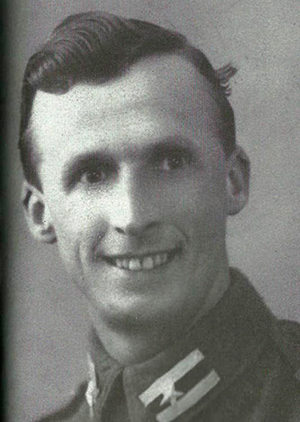
don-domenico-orlandini-1945_r72

I.S.9 agent, partisan leader, and Catholic priest Don Domenico Orlandini “Don Carlo” in the uniform of a military chaplain of the Italian Army, 1945

Several posts on this site concern Italians who, during the war, served as agents for I.S.9 (Intelligence School 9)—also known as “A” Force.

I.S.9′s chief mission was support and rescue of escaped POWs and evaders (E&Es) stranded behind enemy lines. I.S.9 was a division of M.I.9 (British Directorate of Military Intelligence, Section 9), a department of the War Office during WW II.

Last year researcher Brian Sims sent me a series of I.S.9 agent files from the British National Archives. Among the files, Don Domenico Orlandini’s lacks details contained in many of the others—parents, birthplace and residence, educational background, and so on. It does identify him as a priest, and offers this colorful description: “Fair. Medium build. Eyes deep-set. Very active & alert. High-pitched voice. (Smokes, drinks, gambles).”

See “I.S.9 Italian Agents, Part 4.”

Until recently, that was all I knew of Don Domenico. But recently two Italian authors wrote to me with further details.

Continue reading

Parisse Leoni—Italian Protector

I received a note from Michelle Leoni Hazelton of Monongahela, Pennsylvania, this week.

She referenced the name of her great grandfather, Orlando Leoni, in the “Clifford Houben’s Address List” post on this site.

Orlando Leoni’s name appears on one page of the list, and eleven pages later there is a seemingly unrelated reference to two locations:

MONONGHLA, Penn.
R.I. ACQUARTA, IT.

Above these place names is penned “BRO.”

“MONONGHLA, Penn.” is evidently a reference to Monongahela, Pennsylvania, and “ACQUARTA, IT.” seems to reference the Italian comune of Arquata del Tronto.

My guess is that “BRO” is Clifford’s abbreviation for brother. All this was confirmed by what what Michelle shared with me.

In her email, Michelle wrote, “I am the great granddaughter of Orlando Leoni. He was mentioned in Clifford Houben’s list of addresses. There was also another entry ‘R.I. Arquata.’ I believe this may have been his brother, Parisse Leoni, who resided with his wife and roughly eight children in Faete, Arquata del Tronto, Italy.

“Orlando came to America and became a citizen around 1920 but traveled home often to support his family. In America, Orlando resided in Monongahela, Pennsylvania.

“I am trying to learn more about Parisse Leoni and any other relatives that remained in Italy. If you have any further information it would be most appreciated.”

Here is the text of a newspaper article Michelle sent me that describes Parisse’s activities during WW II:

Separated for 50 Years, Brother, Sister Reunited

By Jane Robinson
The Daily Republican (Monongahela, Pennsylvania) – Herald-American (Donora, Pennsylvania) Wednesday, August 19, 1970

“I’m so happy…I thought I’d never see my brother again,” said Mrs. Dominick Varone, now 74, with visible emotion.

After all, fifty years is a long time to wait.

The reunion of brother and sister took place just last week when Mrs. Varone’s brother, Parisse Leoni, 65, arrived in this country from his native Italy. The two had parted in November, 1920, when Mrs. Verone, then Benedetta Leoni, had left Italy for America at the age of 24. Her brother, who accompanied her to the bus but in the confusion never managed to say a final good-bye, was 15 at the time.

She arrived in America in December, sponsored by her brother, Orlando Leo [sic] of RD 1, Bentleyville, and within the next year was married to Dominick Varone. Her brother, Parisse, married too. He has lived and raised his family in the village of Faete, in the same house where he and Benedetta and all the children were born.

Continue reading

Brian Sims—A Tribute

arboretum-tree_r72

Brian Sims oversaw the dedication of this memorial plaque and a commemorative tree planted in the National Memorial Arboretum several years ago.

My first connection with researcher Brian Sims was on June 2, 2013.

In an earlier post on this site I had speculated on the presence of New Zealanders in PG 59, to which Brian responded with this short note:

“There were a very small number of New Zealanders in PG 59—2 in March 1942—3 in May 1942—and only one up to December 1942. None are recorded for 1943.

“The information comes from my database of Red Cross reports copied in the UK National Archives. —Brian Sims”

Thus began a rich two-year correspondence with Brian during which he introduced me to or shed additional light on many aspects the POW experience including:

  • The SS Brandenburg Division operations in Italy
  • I.S.9 rescue operations along the Adriatic coast
  • Recommendations put forward by British and American officers for honors and awards to Italian helpers
  • British Special Investigation Branch (SIB) inquiries into the murder of escaped prisoners
  • POW escapes into Switzerland
  • Sam Derry, Monsignor Hugh O’Flaherty, and the Rome Rescue Organization

Brian’s research into the POW situation in Italy went back 23 years, to the time of his retirement from a career in mining. What began as a quest for information on his father—a British POW who drowned when an Italian ship on which he was being transported was sunk in the Mediterranean—quickly became a calling to learn all that he could about Allied POWs in Italy, and to make that information available to others.

Continue reading

A Rescue Mission Gone Awry

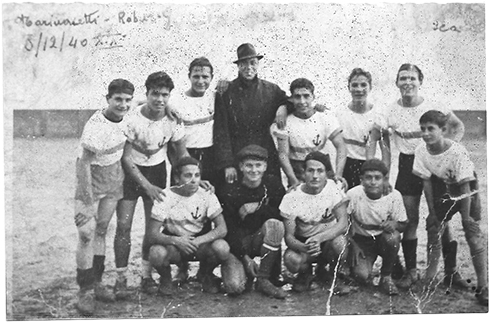
squadra-di-calcio_r72

Giovanni Nebbia with the football team he organized at his Marine School (Scuola di Avviamento Marinaro). The photo was taken in the year they won a championship. December 3, 1940.

In 2005, at a ceremony in Monte Urano, Italy, to honour Ken de Souza—a former POW and author of Escape from Ascoli, which Annelisa Nebbia translated from English into Italian—Annelisa shared an account of a rescue mission her father experienced that nearly ended in tragedy.

Annelisa’s speech is here translated into English:

“Missions to rescue escaping POWs from the Adriactic coast frequently failed due to the Italian captains’ lack of local knowledge, resulting in their being unable to find the exact point of the coastline where escapers were to be picked up.

“Allied Headquarters in Termoli asked Elio Tremaroli—who worked for them and crossed the lines [into enemy-occupied territory] continuously—if he knew somebody who was truly an expert on the Adriatic coast.

Continue reading

“Operazione Nebbia”

nebbia-ANPI-bothsides_r72

Giovanni Nebbia’s partisan identification card, issued in 1950 by the Associazione Nazionale Partigiani d’Italia, or National Association of the Italian Partisans, acknowledges his involvement with the Banda Gran Sasso from September 25, 1943 to June 20, 1944

Captain Giovanni Nebbia’s activity as an I.S.9 “helper” took place along the Adriatic coast of central Italy, including the port towns of Termoli, Manfredonia, and Vieste.

In 1943 Captain Nebbia spearheaded an operation to save the fishing fleet of San Benedetto del Tronto, which was under threat of seizure by the Germans, who were due for arrival in the town the next morning. On completion of the mission, Radio Bari broadcast news of the successful event, today described in Italian history books as ‘Operazione Nebbia.’”

An account of “Operation Nebbia” in Giovanni Nebbia’s own words, translated into English by Annelisa, is below. The original document in Italian is at the end of this post.

To Major R. E. ITALO POSTIGLIONE
Commander 23rd and 24th Patriot Groups
GROTTAMMARE

Having returned home after my departure from San Benedetto del Tronto in the night of 4-5 October 1943, I hasten to give you notice of the mission entrusted to me by you and of subsequent events.

According to the orders that you had given to me, on that date I immediately proceeded with the help of other officers from the groups of patriots to steal the fishing boats/trawlers and minesweepers requisitioned for certain capture by the Germans; such vessels in the port of San Benedetto del Tronto were equipped with local elements, and we launched them for the ports of southern Italy that were already in the hands of the Allies.

Continue reading

Vaccarezza Family—P.G. 52 Escapees Protected

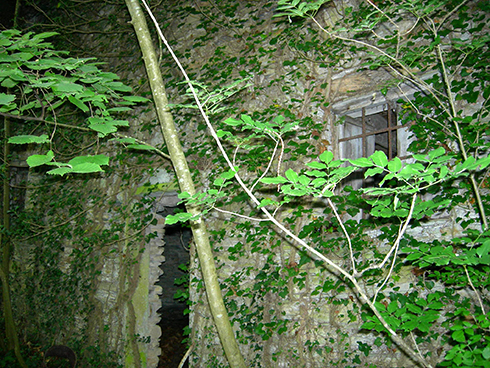
vaccarezza_r72

Farm building on a remote property owned by the Italian couple Gaetano and Maria Vaccarezza, where five escapees from P.G. 52 were sheltered

I received a note last month from Frank Vaccarezza. Frank explained that for a time during the war, his Italian grandparents had sheltered five Allied POWs, all escapees from P.G 52.

Frank who was born in Italy, has lived in the U.S. for most of his life. However, he is in communication with cousins in Italy, who live near his grandparent’s old property. Frank has asked that I post information about his grandparents’ assistance to the soldiers in the hopes of his making connections with the servicemen’s families.

Here is the information Frank sent:

I am trying to locate the families of several British Commonwealth soldiers who escaped during WW2 from P.G. 52 near Chiavari, Italy and hid from the German army in an old stone structure. Chiavari is a town on the Mediterranean Sea coast just about 25 miles south of Genoa. It’s believed these soldiers escaped some time in 1943, but I can’t really be sure of the year.

Continue reading

I.S.9 Captain Uguccione Ranieri di Sorbello

Uguccione-Ranieri-di-Sorbello_r72

Uguccione Ranieri di Sorbello

Many of the stories on this site concerning the protection of escaped POWs describe the brave actions of the contadini, the poor farmers of central Italy.

But people from other strata of Italian society were also involved in the rescue of escapees and evaders. Uguccione Ranieri di Sorbello, the son of R. Ranieri Bourbon del Monte, Marquis of Sorbello, and of Romeyne Robert, an American, is one example of an aristocrat and scholar who lent his expertise and means to the cause of rescuing these stranded soldiers.

A document recommending an award for Uguccione, now in the British National Archives (provided by researcher Brian Sims), has this to say about Uguccione’s service:

“From early November, 1943 until June, 1944 this officer worked behind the lines organising the escape of Allied P/W and showed great personal courage and disregard of danger. On one occasion when the land escape route was disrupted due to enemy vigilance and activity he successfully arranged the evacuation by fishing boat of 27 P/Ws. He was constantly aware of the atrocities committed against P/W by the Germans and Fascists and did all in his power to alleviate the plight of these prisoners. Through the partisans he pursued the originators of these atrocities and saw to it that a number met a proper fate. His energy and extreme loyalty was an inspiration to the many Italian soldiers who worked alongside him.”

In 1945, Uguccione was decorated with a silver medal for valor—and, in 1949, a Ministry of Defense bronze medal—for his rescue and recovery involvement.

I am grateful to Uguccione’s son, Professor Ruggero Ranieri, for allowing me to share on this site the following paper about his father.

The role of Uguccione Ranieri di Sorbello in the operations of the Ratline (Marche and Abruzzi)

1. Sources used

There are two main sources on the history of the Adriatic coast Ratline, which was active between December 1943 and June 1944. One consists of the documents of IS9 itself, which are kept at the NA in Kew Garden. The documentation is fairly vast, but there are two important files covering the key events: Major Fillingham’s report and the Newsletter of IS9 itself, printed every fortnight with news from the various battle fronts, or better from the various Field Section in which A-Force was divided.

Continue reading

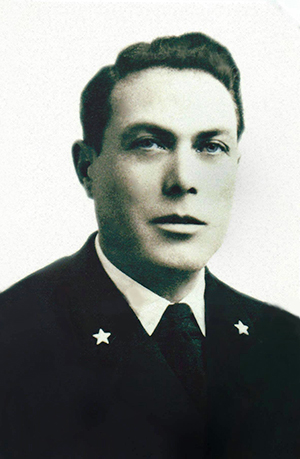
Captain L. C. Giovanni Nebbia

giovanni-nebbia_r72

Captain L.C. Giovanni Nebbia

Over the past several months, I have exchanged a number of e-mails with Annelisa Nebbia, whose father, Captain L.C. Giovanni Nebbia, was involved in the Adriatic coast rescue of Allied POWs during the war.

Annelisa explained, “My father was a sea-captain and his missions were mainly sea missions. His movements as a “helper” took place in the province of Ascoli Piceno and in Southern Italy, precisely in the area including the towns of Termoli, Manfredonia, and Vieste situated along that coast.

“According to his personal diary, I know that he came into contact with the Eighth Army stationed in Italy. In particular, on 5th October 1943 under the command of an American officer of the A.M.G.O.T. [Allied Military Government for Occupied Territories] my father took the fishing-fleet of my town to the Tremiti Islands, because it certainly would have been seized by the Germans who were due to arrive the next morning at 7 a.m. He told the fishermen and owners of the trawlers to bring as much food as they could, as nobody knew how long they would have to stay there. The food would help to ensure their survival.

Continue reading

Interview with Gino Antognozzi

Gino-Antognozzi-24anni_r72

Gino Antognozzi at age 24, July 27, 1950

Introduction

The transcript of an interview with Gino Antognozzi that makes up this post is courtesy of Gino’s nephew Alfredo. The interview comes to me by way of Anne Copley, who translated the transcript from Italian into English.

Last summer Anne located the family of Sydney Harold Swingler, known to Gino’s family only as “Antonio” when they sheltered him during the war, and put the two families in contact with each other.

See “Swingler and Antognozzi Familes United.”

Gino Antognozzi lives with his wife Annunziata in Montelparo, a small town about 30 km. from the city of Fermo. He is 89 years old today.

Last summer, on being shown a photograph of Sydney Swingler, Gino immediately recognized him, saying: “It’s him, it’s Antonio.”

“Why Antonio didn’t write a letter, a postcard?” he asked. “I thought he had been killed in war, and he could not go back to England.”

Continue reading

“Remarkable Gallantry” of Lt. Alberto Orlandi

alberto-orlandi_r72

Alberto Orlandi

On this website, there are several posts concerning Italians who served as agents with Allied I.S.9 operations (Intelligence School 9 of the Central Mediterranean Force) during the Second World War.

The case of Lieutenant Alberto Orlandi warrants special attention. Below is the description of his background from the I.S.9 files. Following that is a letter of recommendation from U.S. Army Air Force Captain R.W.B. Lewis for an American Bronze Star Medal for the Italian.

An I.S.9 response to the request follows his letter.

And, last of all, is the text of an unsigned memo of recommendation for a British decoration of M.B.E. [Member of the Order of the British Empire] for Lieutenant Orlandi. Although this letter does not bear a date, it does refer to the lieutenant’s service through July 1945 (whereas the Captain Lewis’ letter is dated January 1945.

I do not know if Alberti Orlandi in fact received either of these honors.

My thanks to Brian Sims for sharing this material from the British National Archives.

Alberto Orlandi

Lieutenant, Italian Army

Born November 2, 1919 at Citta della Pieve, Perugia Province

Alberto was educated at Citta della Pieve and Siena. He volunteered for service with the Italian Army in 1937 and served three years with the infantry, during which he was stationed on the French front. In 1940 he volunteered as a parachutist, received a course in parachutist training, and performed eleven drops. He served against the partisans in Croatia, and also in Sicily and Southern Italy during Allied invasion. Late in September 1943 he reported for service to Badoglio’s army.

In October 1943 Alberto volunteered for intelligence service and joined I.S.9 at Bari on December 2, 1943. He was employed by Captain R.W.B. Lewis (No. 5 Field Section, I.S.9) on January 12, 1944. He served in the capacity of an Italian staff officer. As he was attached to I.S.9 from the Italian Army, his pay was from the Italian Army.

Continue reading