Category Archives: Italian Helpers

Service in Italy for Three Soldiers

Ancona War Cemetery
Image—Wikimedia Commons

The following graveside rededication service announcement is from the Commonwealth War Graves Commission (CWGC).

A rededication service for three soldiers who were killed in Italy in the Second World War will take place on Tuesday, March 28, 2017 in Ancona War Cemetery, Italy. Private Lionel Brown of the Parachute Regiment and Privates Daniel Hollingsworth and Thomas White of The Buffs (Royal East Kent Regiment) were Prisoners of War and whilst being transported with Sergeant Mario Mottes (an Italian soldier) were shot on March 10, 1944 at Ponte Del Diabolo [Ponte Dragone]. They were originally all buried as unknowns in Montedinove Cemetery. However, the soldiers were later transferred to Ancona War Cemetery and now have individual named headstones.

The service has been organised by the Joint Casualty and Compassionate Centre and will be attended by family of Privates Brown and Hollingsworth. The Parachute and Princess of Wales Regiments will provide support.

Mario Mottes was an I.S.9 agent who was working with Allied forces in the rescue of escaped prisoners when he lost his life. See “Honor Recommended for Mario Mottes.”

Identification of the British soldiers who were shot at Ponte Del Diabolo [Ponte Dragone], as well as work on confirming the identity of Mario Mottes, seems to have been due to the work of Lieutenant Colonel Thomas Huggan, OBE.
Continue reading

Brave Young Fighter Gino Beer

gino-beer-women

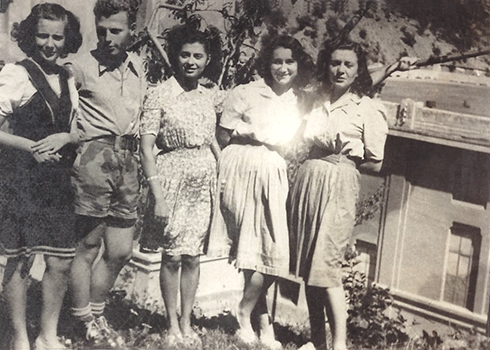
Gino Beer, with some girls at Farneta, near Montefiorino, 1944

I corresponded this week with Italian Michele Becchi concerning Gino Beer, who as a young man served in the fighting group headed by escaped POW Victor Styles. (See “Trooper Victor Styles—P.G. 52 Prisoner.”)

Michele Becchi researches WWII British Liaison Officers in Italy, ex-POWs, and downed pilots trying to reach the Allied lines. He is particularly interested in partisan warfare in his area of Italy, as well as Special Operations Executive (SOE) and Office of Strategic Services (OSS) missions.

Michele knows and has interviewed Gino.

Michele wrote, “Victor Styles was leader of a special ex-POW fighting group working for the ‘TOFFEE’ mission. I’m trying to find the names of other POWs and Italian partisan members of that group. Gino served in the group.

“I meet Gino Beer years ago, when I was researching ‘Operation Tombola,’ an SAS [Special Air Service] operation against a German headquarters not far from my town.

“Gino was an Italian Jew from Genoa; he and his family was persecuted by the Nazis and fascists due to his origin. After a brief spell with the Ligurian partisans, Gino and his family transferred to Modena, in 1944, to avoid death. But the situation worsened, and Gino was forced to join the partisans of the Reggio-Modena mountains.

Continue reading

Update—Search for the Soldier Hidden in Petritoli

Petritoli-Monica-Vitali_r72

The comune of Petritoli in the Italian Marche. Photograph by Monica Vitali (Wikimedia Commons).

There is a new development in the search for information about the escaped POW who was helped in the comune of Petritoli during the war. (See “Escaped Prisoner Sheltered in Petritoli.”)

My earlier post explained that Roberto Lucci is attempting to make contact with the family of an escaped prisoner who was sheltered by his great-grandfather, Luigi Lucci, in 1943–44.

Recently, Roberto was told by elders in Petritoli that William and David were part or all of the first or last names, so the soldier’s last name might have been something like David Williams or William Davidson.

However, since I published the earlier post, a document has surfaced in Petritoli identifying the escapee as “David Grif. prigioniero inglese” (David Grif. English prisoner).

Although the first name was recorded as David, is is conceivable that William was his middle name, or that William was his first name and David his middle name and that he preferred to be called David.

Grif is not a common English name, and the period suggests the name might be abbreviated. The “Alphabetical List” sent to me by Brian Sims, contains 81 soldiers with names beginning with “Grif”—Griffin, Griffith, and Griffiths.

Continue reading

Escaped Prisoner Sheltered in Petritoli

elvira-lucci-r72
Roberto Lucci’s grandmother, Elvira Lucci (center), was 19 years old when her father sheltered a prison camp escapee in their home.

Roberto Lucci is an Italian who is attempting to find the family of an escaped prisoner who was sheltered by his great-grandfather in 1943–44.

Given the close proximity of his family’s village, Petritoli, to Servigliano, Roberto believes the POW likely escaped from P.G. 59.

Roberto wrote (translated here into English from Italian), “I’m a young man from Petritoli, a village 15km from Servigliano.

“I have started to ask some of the elders who have fragmentary recollections of this man [for help]. I know that William and David are the first or last names.”

Roberto explained that the man’s last name might have been something similar to David—such as Davidson, Davison, Davis, or Davies.

Continue reading

Italian Helpers—Two Queries

holmes-hart-addresses_r72

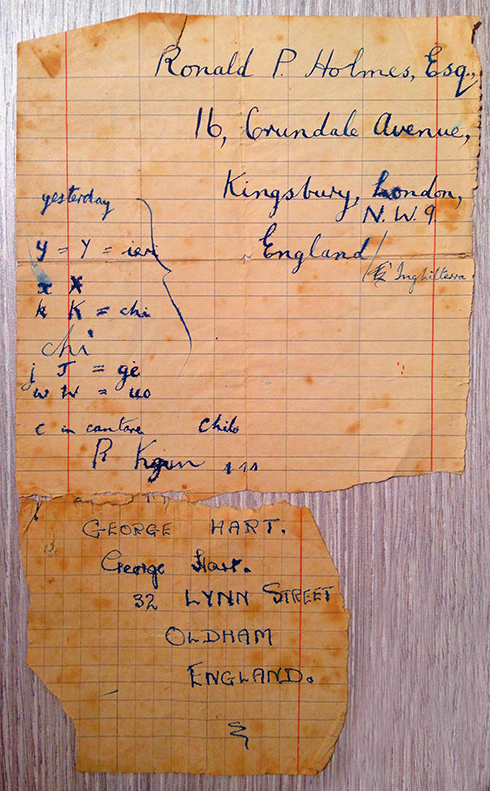
Two chits on which British soldiers recorded their names and addresses

My friend Anne Copley is researching two situations of Italians providing assistance to escaped prisoners of war.

Anne wrote, “Local Italians are producing ancient pieces of paper with names and addresses” that have been kept since the Second World War.

Query One

The first query came to her from Giordiano Viozzi. Giordiano shared three documents:

Two scraps of paper with names and addresses written on them, and an Alexander Certificate issued to Oreste Belleggia for his assistance to escaped POWs.

The addresses on the scraps of paper are:

Ronald P. Holmes, Esq.
16, Crundale Avenue
Kingsbury, London, N.W. 9
England/Inghilterra

(On this paper is also written some simple notes about Italian pronunciation.)

George Hart
32 Lynn Street
Oldham
England

Continue reading

A Letter of Tribute to Andrea Scattini

uguccione-scattini_r72

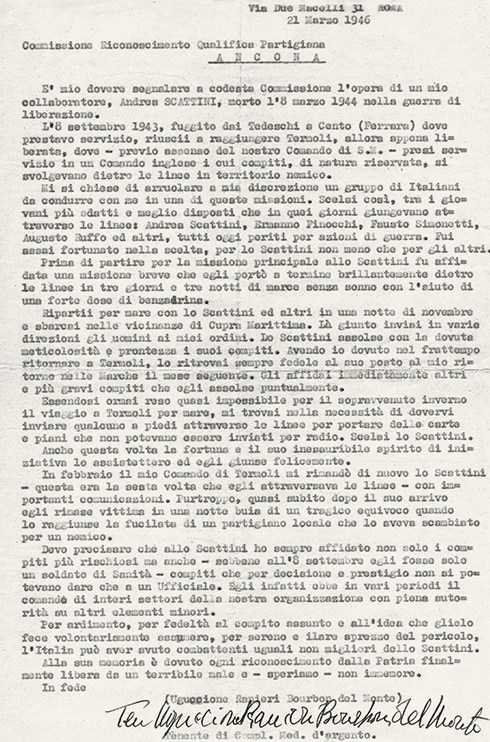
In a letter written after the death of Andrea Scattini, Uguccione Ranieri di Sorbello (Bourbon del Monte) pays tribute to his comrade’s heroism and strength of character.

Following a transcript in Italian—immediately below—is the text of the letter translated into English by Luigi Donfrancesco, Andrea’s nephew.

21 marzo 1946. Nel dopoguerra il Tenente Uguccione Ranieri (di Sorbello) Bourbon Del Monte, al quale nel frattempo è stata conferita la Medaglia d’Argento, dal suo domicilio di Roma in Via Due Macelli 31, indirizza alla Commissione per il Riconoscimento della Qualifica di Partigiano di Ancona una relazione nella quale descrive l’opera del suo collaboratore Andrea Scattini durante la guerra di liberazione:

“E’ mio dovere segnalare a codesta Commissione l’opera di un mio collaboratore, Andrea SCATTINI, morto l’8 marzo 1944 nella guerra di liberazione.

L’8 settembre 1943, fuggito dai Tedeschi a Cento (Ferrara) dove prestavo servizio, riuscii a raggiungere Termoli, allora appena liberata, dove – previo assenso del nostro Comando di Stato Maggiore – presi servizio in un Comando inglese i cui compiti, di natura riservata, si svolgevano dietro le linee in territorio nemico.

Continue reading

Honor Recommended for Mario Mottes

mottes-silver-medal-1-r72

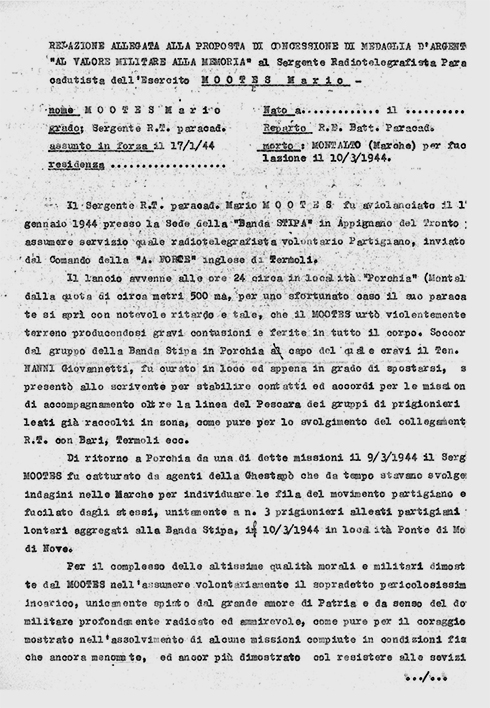
First page of a letter from Major Luigi Stipa recommending that I.S.9 agent Mario Mottes be posthumously awarded the Italian Silver Medal of Military Valor (Medaglia d’Argento al Valore Militare)

In January 1944, Sergeant Mario Mottes was wounded in the area of Montalto Marche during a parachute drop, when his parachute opened too late to prevent a violent landing.

He continued on his mission, and two months later, on March 10, 1944, he was arrested by the Germans and shot with three escaped Allied prisoners of war.

Major Luigi Stipa proposed the Italian Silver Medal of Military Valor (Medaglia d’Argento al Valore Militare) be awarded to Mario. His letter of recommendation details Mario’s valiant service.

Access to this document from the “Stipa Papers” came through Dr. Luigino Nespeca of Offida. Luigi Donfrancesco translated the Silver Medal nomination into English:

REPORT ATTACHED TO PROPOSAL OF SILVER MEDAL “TO MILITARY BRAVERY, IN MEMORIUM” to Sergeant Radio-Telegrapher Paratrooper of the Army Mario MOTTES

Name: MOTTES Mario
Born: Belgium, November 18, 1919
Degree: Sergeant R.T. Paratrooper
Unit: Royal Army, Battalion Paratroopers
Enrolled in force on January 17, 1944
Residence: PERGINE VALSUGANA (TRENTO)
Shot at MONTALTO (MARCHE) on March 10, 1944

Continue reading

Ermanno Finocchi to “Carlo” Orlandini

orlandini-finocchi-let-r72

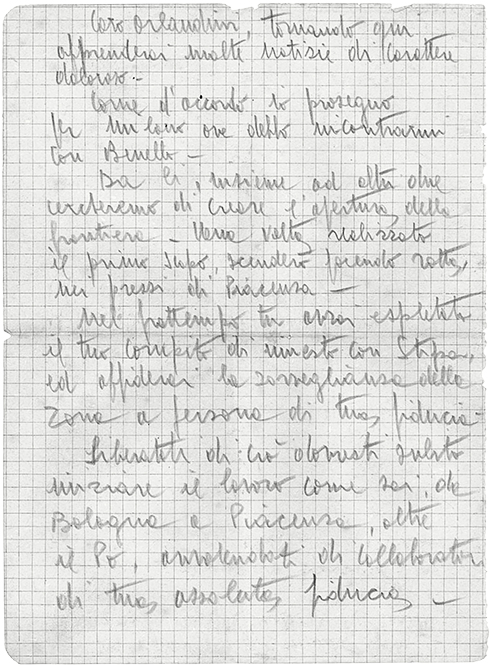
First page of a two-page letter from Ermanno Finocchi to Don Domenico “Carlo” Orlandini

Last week, Luigi Donfrancesco sent me an English translation he made of a letter I.S.9 agent Ermanno Finocchi sent to fellow agent Don Domenico Orlandini, whose agent name was “Carlo.”

“I found it interesting, as it shows details of Plan MILKY WAY and the way agents operated in setting up Rat-lines (Ratberry lines),” Luigi explained.

Here are introductory notes from Luigi in Italian and English, followed by the letter in both languages:

Nota. Scritto a matita su carta di quaderno a quadretti. E’ fra le “carte Stipa”, gentilmente fornite dal Dr. Luigino Nespeca di Offida nell’Agosto 2015.

Non c’è data, ma è stato scritto subito prima della partenza di Ermanno Finocchi per Milano (il 15 Marzo 1944 in camion, riferisce “Babka” nei suoi Diari). Quindi le “molte notizie di carattere doloroso” sono:

  • l’uccisione di Andrea Scattini a Force (8 marzo);
  • la cattura di Fausto Simonetti a Palmiano (9 marzo);
  • l’attacco alla banda partigiana “Paolini” a Rovetino e Rotella (9 marzo) e conseguente smantellamento della banda stessa;
  • l’attacco ed eliminazione della base “Rat-line” di Porchia (10 marzo), con ferimento e cattura di Diego Vecchiarelli e arresto di altri collaboratori;
  • l’uccisione nei pressi di Montalto Marche del Sergente Paracadutista Mario Mootis (sopravvissuto alla battaglia di El Alamein) e dei 3 prigionieri di guerra britannici che erano con lui (11 marzo).

Continue reading

Andrea Scattini—Youthful I.S.9 Agent

Scattini-Spoltore-1944_r72

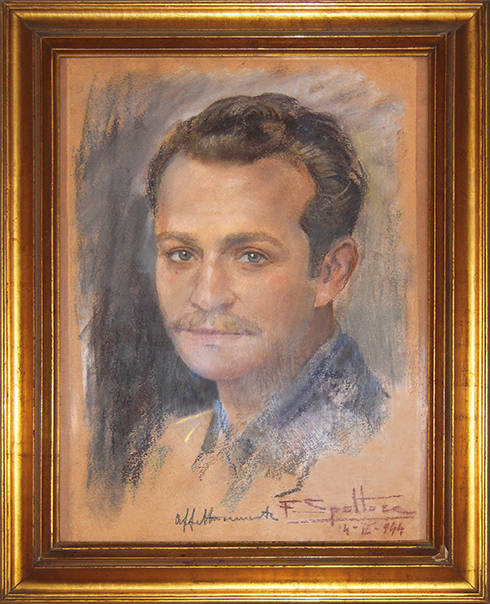
Portrait of Andrea Scattini by Federico Spoltore, Lanciano, February 14, 1944

As a young man and a medical student, Andrea Scattini was enrolled in the Medical Corps of the Italian Army and assigned to the Celio Military Hospital, Rome, according to his nephew Luigi Donfrancesco.

In September 1943, after Italy signed the Armistice, Andrea was captured by Germans outside the hospital. He and several other young men were slated for transport to Germany when Andrea escaped.

He returned to his home in San Vito Chietino Marina, on the Adriatic coast.

In October 1943, in Termoli, Andrea offered his services to the Allies and was enrolled as an agent under Captain Andrew Robb, No. 5 Field Section, “A” Force (I.S.9). He was among the first small group of six Italians to be employed in that capacity (the others being Uguccione Ranieri di Sorbello, Don Domenico Orlandini, Ermanno Finocchi, Fausto Simonetti, and “Guido”—full name unknown).

Andrea’s mission was to organize escape “Rat-lines” and to guide former POWs to safety over land and along the Adriatic coastline.

This was named Plan RATBERRY Section “A”, No. 5 Field Section, and Andrea and the other agents of his group were often referred to as “the Ratberry boys.”

Luigi is trying to acquire documents with details of Andrea’s missions and activities as an “A” Force/I.S.9 agent in the Marche and Abruzzo regions.

In a No. 5 Field Section progress report from Lanciano, Captain Robb states that on December 21, 1943, Andrea arrived at the Allied lines of the New Zealand Division, taking with him ex-POW Lance Corporal “Spiro.”

In the same report, Captain Robb states Andrea is “one of the original planners of MILKY WAY.”

“MILKY WAY” was a plan to extend RATBERRY in other directions, north and possibly east, to take prisoners to Switzerland and/or Yugoslavia.

On March 8, 1944, at age 26, Andrea was killed in the village of Force—the victim of an apparent ambush.

Continue reading

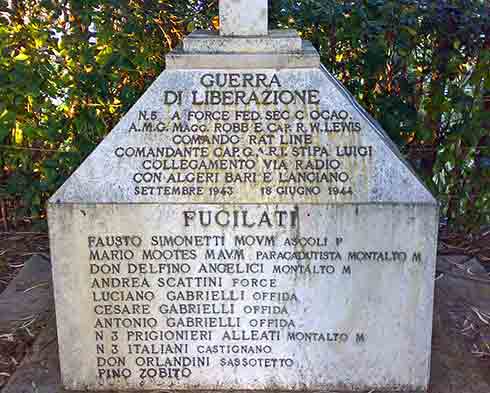
Monument to Valiant Rescuers

war-memorial-r72

I recently exchanged several e-mails with Luigi Donfrancesco, who lives in Rome. His uncle, Andrea Scattini, was an Italian I.S.9 agent during the war.

I.S.9 was a sub-organization of special Allied operations unit “A” Force. I.S.9 formed escape chains to evacuate Allied escapers and evaders (E & Es) from enemy-occupied territory.

Luigi sent me photographs taken by Dr. Luigino Nespeca of a monument at Villa Stipa at Offida (Ascoli Piceno, Italy) that commemorates No. 5 Field Section of I.S.9, which produced the largest number of E & Es of any I.S.9 land unit in Italy.

See “I.S.9 History—Operations in Italy, Part 2” for detailed information on No. 5 Field Section.

Villa Stipa was one of the main bases of I.S.9 “Rat Line” rescues.

“My uncle Andrea Scattini is improperly placed with the shot [executed] patriots, but he should be with the fallen in service instead, because he was never captured,” Luigi clarified.

“Also, Don Domenico Orlandini was never shot nor dead (they erroneously thought so), but survived the war and died later in his sixties.”

Here are the names acknowledged on the memorial:

GUERRA DI LIBERAZIONE [War of Liberation]

N.5 A FORCE FED. SEC C OCAO.
A.M.G. MAGG. ROBB E CAP. R. W. LEWIS [Allied Military Government, Major (maggiore in Italian) A. Robb and U.S. Army Air Force Captain R. W. B. Lewis]
COMANDO RAT LINE
COMANDANTE CAP. G.A.R.I. [Genio Aeronautico Ruolo Ingegneri, Aeronautical Engineer Corps] STIPA LUIGI
COLLEGAMENTO VIA RADIO
CON ALGERI BARI E LANCIANO [wireless connection, Algiers with Bari and Lanciano]
SETTEMBRE 1943—18 GIUGNO 1944 [September 1943 to June 18, 1944]

Continue reading