Author Archives: Dennis Hill

Official Reports on Camp Conditions

During the war, a British publication, The Prisoner of War journal, provided reports on conditions in POW camps to families of prisoners at home.

The journal was published by the Prisoners of War Department of the Red Cross and the St. John War Organization, St. James Palace, London.

Scans of the entire issue of this Prisoner of War publication—along with other issues of the journal from 1942–44—were contributed to the WWII Memories website by Jim Wicketts and his daughter Louise.

The following two items—from the April 1943 (Vol. 1, No. 12) issue of the journal—are reproduced here with permission of the WWII Memories site administrator.

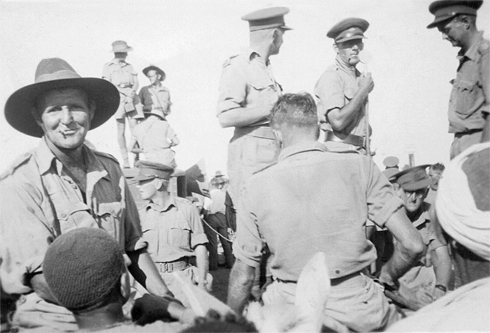
The two on the right are old school pals who met again at Campo P.G. 59.

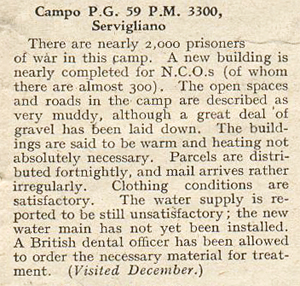
Campo P.G. 59 P.M. 3300, Servigliano

There are nearly 2,000 prisoners of war in this camp. A new building is nearly completed for N.C.O.s [non-commissioned officers] (of whom there are almost 300). The open spaces and roads in the camp are described as very muddy, although a great deal of gravel has been laid down. The buildings are said to be warm and heating not absolutely necessary. Parcels are distributed fortnightly, and mail arrives rather irregularly. Clothing conditions are satisfactory. The water supply is reported to be still unsatisfactory; the new water main has not yet been installed. A British dental officer has been allowed to order the necessary material for treatment. (Visited December.)

Australian and New Zealand “Free Men”

I have just added a link to the blogroll on this site, but lest anyone overlook it, I want to take a moment to recognize its excellence. Its impressive collection of information is the exhaustive work of Australian WW II POW Bill Rudd.

The site, ANZAC POW Freemen in Europe, is devoted to records and history of prisoners-of-war in Europe of ANZAC—the Australian and New Zealand Army Corps.

ANZAC is comprised of the New Zealand Australian Imperial Force (AIF) and the New Zealand Expeditionary Force (NZEF).

When I asked Bill Rudd about the use of his term “Free Men,” he explained:

“When I was asked by the Australian War Museum to extend my Swiss research to all other countries in which Anzac POW either escaped or evaded, but remained behind enemy lines, my first interest was the Anzac POW who had not been captured in Crete. Although technically they had been surrendered to the Germans in Crete, they had not been actually taken POW by them. Literally hundreds were recovered by SOE and MI9 operations and a considerable number came out under their own steam.

“When they eventually re-joined their units, they were never given the status of a POW.

“As a consequence, I had to change my working title to cover such cases and to accomodate the increasing number of airmen, who had crashed behind enemy lines and evaded among the civilian population of the area where that had occurred. Both the peasants of Crete and North Italy took enormous risks in succouring such Allied men. As did those brave patriots manning official escape lines developed throughout Europe.

“So I called all my evaders and escapers surviving behind enemy lines ‘Free Men.’ Many of course carried on their war with local partisan groups.

“My working research parameters was to cover all active escapers and evaders who were NOT sitting in a German prison Camp on VE Day. There were, of course, some exceptions of recaptured POW, but if they had been ‘on the loose’ for at least two months, I included them.”

Continue reading

News of Ira Powers’ Captivity and Escape

Carolyn Abell of Tifton, Georgia, in conducting research for a book she is writing about war veterans from her county who died in wars (World War I to the present), came across two articles from archived issues of her local newspaper, the Tifton Gazette, about Camp 59 POW Ira Powers.

I am grateful to her for sharing this information for this site.

Ira Powers Is Safe After Being Prisoner

Tifton Gazette, July 5, 1944

“Ira Powers of Tifton, technician fourth grade, who had been reported as a prisoner of war since December 12, 1942, has been reported by the War Department as returned to duty since June 21, 1944.

“The communication from Adjutant General Ulio of the War Department was received July 3 by Sam Powers, of Tifton, brother of Ira Powers. It was the first news of him in several months. The communication stated that Powers would undoubtedly communicate with his brother at an early date concerning his welfare and whereabouts.

Continue reading

A Son’s Memories of Tom Cronin

These comments about Clarence T. (Tom) Cronin are from his son, Ed Cronin.

“My father, like many of the survivors of WW II and prisoners of war, never talked much about his experience. What I can tell you about his is that he had full-blown PTSD but in those days it just was not recognized. He was a man with a good heart underneath it all but he had an explosive temper through most of his life. He was typical in that he would jump out of bed in the middle of the night and get under his bed to cover himself from “attack.”

“He was street kid from Brooklyn, New York, who literally grew up on the streets. He worked in the Brooklyn Navy yard for a while before his service in the military. He actually had two stints in the army—one in the ’30s, and then again during WWII. He was a really good boxer when he was in the military.

“I recently made contact with a guy who was in his outfit when they landed at Oran in Algeria. This gentleman tells me that he and my father were in the third regiment (1st Infantry Division, Big Red One) and were actually in the same company but different platoons. He told me that when the troops landed in Oran they landed on three different beaches, and he and my father landed on Arzew beach.

“You asked about my father’s experience when he got out. I can give you bits and pieces of what he told me. Again, I was young and it is hard to grab context but this is my best memory.

“He was captured in North Africa and as I remember he may have been taken to Sicily first. He told me that he was in more than one prison camp and that he had made several escape attempts during his period of confinement.

Continue reading

A Future Home for Casa della Memoria

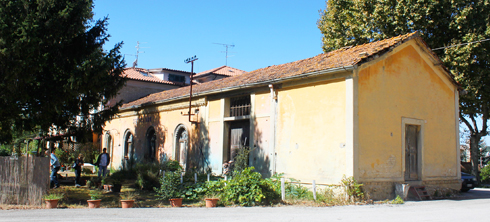
After years of collecting documentary material and recording stories related to the history of Camp 59, an educational center is in sight for members of the Associazione Casa della Memoria (the House of Remembrance) of Servigliano.

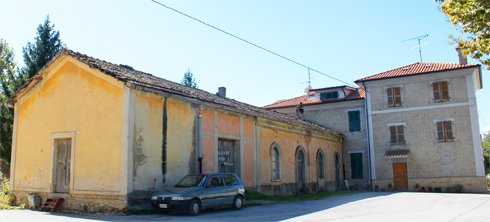
The old train station—through which Allied prisoners were brought to camp—will be renovated. The building has been granted to the association for its educational mission.

The old Servigliano train station viewed from the north.

The front of the station faces the northwestern wall of Camp 59. At one time tracks paralleled that wall of the camp.

Continue reading

Casa della Memoria on Facebook

The Associazione Casa della Memoria (House of Remembrance Association) of Servigliano, Italy, is now on Facebook.

While the focus of the “Survivors of Camp 59” site is on World War II, the camp has a longer history.

According to the Casa della Memoria website, the association’s broader remembrance of the past is defined in this way:

“These events left their mark on the history not just of the small community of Servigliano, but also of the many villages that overlook the Tenna Valley.

“Recovering the memory of all these events involving the Prison Camp is a duty we have to the people who lived through those difficult times, but also to the new generations. The events can be divided into three moments, in relation to the three great dramas of the 20th century:

the First World War;
the Second World War;
the Cold War.

“Each of these moments can be seen as a ‘crisis of values’ in our society, the enslavement of human intelligence and of resources to ideologies that claimed to be absolute, leading to an apocalyptic climax of destruction and death:

the use of the Camp during the First World War was due to nationalism;
the use of the Camp during the Second World War was due to Nazi-Fascism;
the use of the Camp during the Cold War was due to totalitarian socialism.

“Among the various Prison Camps scattered around Italy, the one in Servigliano permits a possibly unique reconstruction of twentieth-century history and its twisted ideologies.”

Robert A. Newton—Further Details

Robert A. Newton of Hillsboro, Oregon, Corporal Robert A. Newton’s nephew (he was named for his uncle when Corporal Newton did not return from the war) had these additional comments concerning his uncle and the interview with Cesare Viozzi (see the previous post):

“The father of the house was Pietro Viozzi.

“My uncle taught himself Italian in the camp. I understand that they held such classes for each other. He wrote home and said that he was learning both Italian and German.

Continue reading

Cesare Viozzi on Sheltering Robert A. Newton

Italian historian Filippo Ieranò conducted a number of interviews with Italians of the Marche region around 1999–2001.

They were published as Antigone nella Valle del Tenna, or “Antigone in the Tenna Valley” by the regional authority of the Marche (Consiglio Regionale delle Marche) in 2002. The title page refers to “The reception of fleeing Allied prisoners and Jews after 8th September 1943 in the valley of the River Tenna, as a form of civil disobedience against the Nazi-Fascists.”

The publication contains a July 2001 interview with Cesare Viozzi of Santa Vittoria in the Italian Marche.

Cesare Viozzi’s family sheltered American POWs Robert Alvey Newton (Logansport, Indiana) and Martin Majeski (Anderson, South Carolina) for nearly six months before the men were discovered by the Germans and executed on March 9, 1944.

Here is the story, in both the original Italian and translated into English by Anne Bewicke-Copley.

Avevano appiccato il fuoco (“They set it on fire”)

Eravamo 28 persone in casa in quel periodo. Abitavamo a metà strada tra Santa Vittoria in Matenano e Ponte Maglio, quattro famiglie insieme, tutti nella stessa abitazione. I prigionieri erano sparsi per le campagne, andavano a cercare aiuto un po’ di qua e un po’ di là. Allora i genitori decisero di prenderne due, si chiamavano Martin e Robert, due americani, e la famiglia aumentò arrivando a 30 persone.

We were 28 people in the house in this period. We lived halfway between Santa Vittoria in Mantenano and Ponte Maglio, four families together, all in the same house. The prisoners were spread out in the countryside, they came to ask help a bit here, a bit there. So my parents decided to take in two, called Martin and Robert, two Americans, and the family grew to 30 people.

Continue reading

In Search of Armie’s Italian Angels

Sergeant Armie S. Hill, circa 1943. I carried this photograph of my father with me to Roccafluvione and to the site of Camp 59, where he was a prisoner.

Strada Caserine winds up a mountainside westward from Roccafluvione. American servicemen Armie Hill and Ben Farley were led up this road by children to a farm where the family of Angela Bianchini offered them protection.

View into a rain-soaked valley from half way up Strada Caserine.

The story of how my father, Armie Hill, and Kentuckian Ben Farley were befriended in the town of Roccafluvione is recorded in an earlier post, “Armie’s Italian Angels.”

Take a moment to review Armie’s account, as it will help you appreciate the adventure described here—a September 2010 journey to Roccafluvione.

I had hoped to meet relatives of the Italians who had sheltered the two men. My friend Anne Bewicke-Copley said the way to get advance word out at Roccafluvione was to contact the town bars—the social hubs of the community.

In early August, I sent letters—translated into Italian—to the four bars in Roccafluvione. I also sent a letter to a city office—to the segreteria of the commune.

Continue reading

A Camp with a View

Before traveling to Italy, I thought I had a good sense of what Camp 59 was like—the layout of the camp, construction of the buildings, and the encompassing brick walls.

Of course, no former POW’s story of how things were in the camp—or even actual photographs I had been sent of Camp 59—could convey so complete a sense of the place as I experienced on walking though the camp for the first time in September.

From within the walls, I could look in all directions, touch the soil, feel the autumn Italian sun on my skin, hear birds and see them flying overhead.

The camp today is a community park called Il Parco della Pace (the Park of Peace), with green lawns, shrubs, trees, and playing fields and courts for soccer, basketball, and other sports.

Continue reading