Author Archives: Dennis Hill

Family Parcels

war_dept_instuctions1943-1-r72

This two-page memo from the U.S. War Department contains instructions for families on how to prepare packages to be sent to prisoners of war and civilian internees overseas.

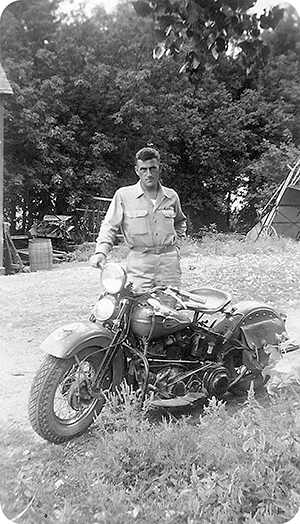
The memo is from Matt Brazil and Bonnie Jacobsen (née Brazil), whose father, Staff Sgt. Matthew P. Brazil, was a POW at Camp 59. Matthew’s family undoubtedly used these guidelines in putting together parcels for him.

The parcels are the American equivalent of what British prisoner Robert Dickinson, in his camp journal, “Servigliano Calling,” called “next of kin” personal parcels.

Here is a transcription of the War Department memo:

WAR DEPARTMENT
Services of Supply
Office of the Provost Marshal General
Washington

March 11, 1943

The Provost Marshal General directs me to inclose a label which may be used within the date stamped thereon for the purpose of sending a prisoner of war or civilian internee parcel. Should you desire to use the label, it is suggested that the following mailing package instructions be strictly followed.

Continue reading

Laurence Barker—Died for His Country

barker_portrait-r72

Sgt. Laurence “Laurie” Sidney Barker, Royal Canadian Air Force

I received a note from Michael Laurence Barker of Calgary, Alberta, Canada, on December 24.

He wrote, “I am the nephew of a Canadian POW who was, I believe, held at Servigliano, at least for part of his time as a POW.

“He escaped from prison camp and travelled with seven others before being discovered in a barn by the Nazis, near Pito. The Nazis set the barn on fire. When the men ran out, all, but for one, were shot. The date was March 11, 1944. The one man who escaped told the sad story to the families of the other seven men. I do not know his name.

“Laurence was buried locally by Pito villagers. Presumably the others were buried there as well.

“Laurence was later re-interred at Ancona War Cemetery.”

Continue reading

Red Cross Parcels

red_cross_package-r72

This list of contents for American Red Cross “Standard Package No. 8” was provided by Matt Brazil and Bonnie Jacobsen (née Brazil).

I am pleased to share it.

The Red Cross document above reads:

Form 1631-P
Feb. 1942

American Red Cross
STANDARD PACKAGE NO. 8
for
PRISONER OF WAR
___
FOOD

CONTENTS

Evaporated Milk, irradiated – 1 – 14 1/2 oz. can
Lunch Biscuit (hard-tack) – 1 – 8 oz. package
Cheese – 1 – 8 oz. package
Instant Cocoa – 1 – 8 oz. tin
Sardines – 1 – 15 oz. tin
Oleomargarine (Vitamin A) – 1 – 1 lb. tin
Corned Beef – 1 – 12 oz. tin
Sweet Chocolate – 2 – 5 1/2 oz. bars
Sugar, Granulated – 1 – 2 oz. package
Powdered orange concentrate (Vitamin C) – 1 – 7 oz. package
Soup (dehydrated) – 1 – 5 oz. package
Prunes – 1 – 16 oz. package
Instant Coffee – 1 – 4 oz. tin
Cigarettes – 2 – 20’s
Smoking Tobacco – 1 – 2 1/4 oz. package

The WW2 US Medical Research Centre website has some interesting details on Red Cross food and medical parcels and first aid kits, including photographs of contents.

Christmas in Captivity

Brazil-xmas-card-r72

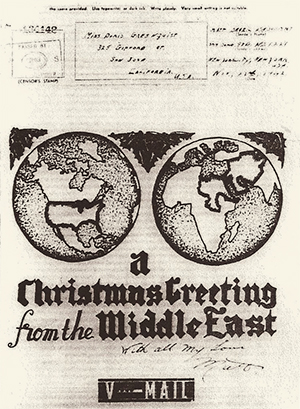
This V-mail Christmas card, dated November 22, 1941, was sent by Matthew Brazil to his sweetheart (and later wife) Doris Greenquist of San Jose, California.

On December 11, Matt’s plane was shot down near Naples while on a bombing run, and he was captured.

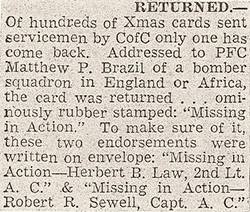
The following San Jose area newspaper articles, document the details of his disappearance and capture, and his mother’s first communications about him.

One of the articles mentions a Christmas card sent by Matt to his mother on the same day time he sent the V-mail card to his girlfriend.

Brazil-returned-r72

RETURNED._
Of hundreds of Xmas cards sent servicemen by CofC [presumable chain of command, the military organization from the individual soldier to President Roosevelt] only one has come back. Addressed to PFC Matthew P. Brazil of a bomber squadron in England or Africa, the cards was returned…ominously rubber stamped: “Missing in Action.” To make sure of it, these two endorsements were written on the envelope: “Missing in Action—Herbert B. Law, 2nd Lt. A. C.” & “Missing in Action—Robert R. Sewell, Capt. A. C.”

Continue reading

Local News Articles—Raymond Kestner

Raymond Kestner

In December 2011, I received a note from Jessica Kestner McMahon.

“I am the granddaughter of Pvt. Raymond Kestner who was interred in Camp 59, she wrote. “I am in the process of scanning his war letters, etc. into my computer. I happened upon your blog and found his name listed in Charles Simmon’s address book from January 2010. I have a similar book from my grandfather.

“My grandfather died in 1986, when I was only 8, so I don’t remember a lot about him. He moved to St. Paul, MN soon after returning from the war, and lived there until he died.

“His sister kept all the letters he wrote, as well as the newspaper clippings about him, which I have. I am currently working on scanning them into the computer. I will send some of those on to you as I get them.

“My grandpa seems to be a pretty laid back guy—he was much more content to wait things out than to try to escape.”

Kestner-Ireland-r72

Is in Ireland

Private Raymond Kestner

Son of Mr. and Mrs. Jos. Kestner, East Main Street, is with U.S. troops in Ireland. He went across some time in May as nearly as his parents could ascertain. The first letter from Ireland arrived in Sleepy Eye [Minnesota] August 5th.

Private Kestner has been In the service about eight months, was first at Fort Knox, Kentucky, and then at Fort Dix, New Jersey. He is serving in the armored division.

Continue reading

Axis Camps in Europe

pow_camps_europe-r72

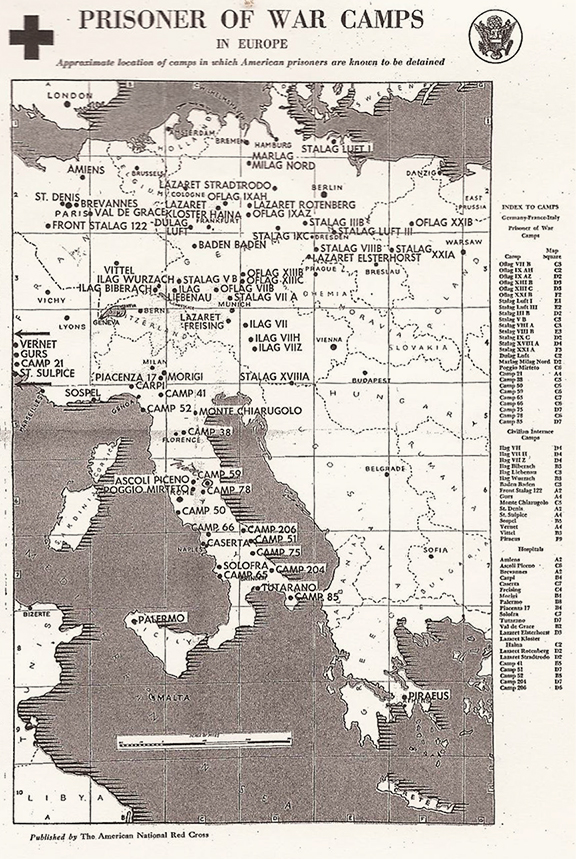
This map of Axis POW camps in Europe was published by the American National Red Cross during World War II.

A map index is divided into: prisoner of war camps, civilian internee camps, and hospitals.

The map was provided by Matthew James Brazil and Bonnie Jacobsen (née Brazil), whose father, Matthew Philip Brazil, was an American prisoner at Camp 59 after being shot down in on December 11, 1942 over Naples, during one of the first Allied raids against the Italian mainland.

Note that the dot marking Camp 59 is circled and “Matt” is written to the left of the camp name.

In his note to me, Matt said of the map, “I understand Matt’s mother obtained it during his incarceration. Matt probably wrote on the map after he returned to the U.S. in late 1943.”

Matt believes, based on stories, newspaper accounts, and letters, that his father escaped by before the mass breakout from Camp 59 in September 1943.

Some of those documents will be forthcoming in posts to this site.

News of Claude McLaughlin

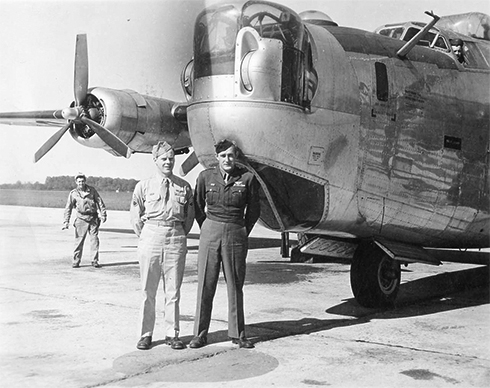
Photo of Claude McLaughlin (on left) with another crewmember.

Two months ago I received an e-mail from Claudia McLaughlin-Wood of Toronto, Canada. She wrote:

“I have discovered the Camp 59 website and am quite certain that my father, U.S. Army Air Force S/Sgt. Claude H. McLaughlin, was a prisoner there in 1943. He was in the 32nd squadron of the 301st Airborne Division flying in a B-17 bomber that was shot down over Gabes, Tunisia on February 4, 1943. From there he was sent to a prison hospital somewhere near Naples, then to a prison camp near Naples before being transferred to Camp 59.

“I have a newspaper account from his hometown in Iron Mountain, Michigan that states he was in Camp 59 in northern Italy. I’m not sure how long he was there but I know that he escaped and was hiding with an Italian peasant family for nine months before crossing enemy lines and meeting British forces on June 19, 1944. I note from your website that there was a massive escape in September 1943, but in his account he just said, ‘some of us managed to escape.’ He was with an English sergeant and a South African sergeant while hiding in the mountains. I assume the area is the Tenna Valley. In trying to figure out the dates it looks as though he would have escaped in October 1943. I am wondering if you have any information about escapes subsequent to September 1943.

“He was the only one of his crew that was in the camp because he was injured. The rest of his crew was sent to Germany for the duration of the war.

Continue reading

Maurice French—Prisoner from New Zealand

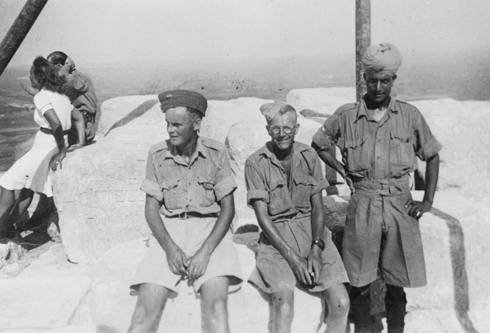
Above: Maurice French (at center) on top of the Pyramid at Giza. (This photo from the online Cenotaph Database (Auckland War Memorial Museum) was provided to the database by Maurice French).

I received a note on July 9 from Miriam McDonald. “I came across your website looking for more information on my grandfather’s experience in the war,” she explained.

“His name was Maurice Ernest French (known by his army friends as ‘Snow’), a New Zealander in the 27th machine gun battalion 2NZEF.”

Miriam wondered if I knew of her grandfather and if I had any record of his time spent in Camp 59.

I had never heard of Maurice French. In fact, this is the first evidence any New Zealanders in the camp I had come upon.

Part of the difficulty in documenting New Zealanders was the fact they are not listed separately in WW II prison records from that time.

Giuseppe Millozzi, in Allied Prisoners of War in the Region of the Marche and Prison Camp at Servigliano, notes that the Italian military authority list of internees did not distinguish between British and other nationalities (the general breakdown listed only British, Americans, and French). Irish, Canadians, Cypriots, New Zealanders, Australians, Poles, South Africans, Palestinians, Maltese, Rhodesians, and Norwegians, he explains, were included in the British total.

New Zealand WWII veteran and historian Ken Fenton told me he was unaware of any New Zealanders who were interned at Camp 59, although his main research concerns the Italian camps where most New Zealanders were held.

Ken goes on to explain:

“I have also looked at the only known and Official War Office Roll of NZ POWs held in Italian camps, a roll prepared between April and June 1943. It lists each POW by camp of imprisonment. There is not one NZ POW listed as being at PG 59, in fact PG 59 is not mentioned anywhere in the document.

“There is a faint possibility that some NZ POWs may have passed through PG 59 at some stage prior to the preparation of the Roll and ended up at PG 57 as most NZ POWs did. In these circumstances, if there were few involved, PG 59 might have escaped mention in the official history, but I am inclined to doubt it.”

And yet here we have the Cenotaph Database record indicating Maurice French’s presence in Camp 59. Perhaps additional information will surface over time about Maurice French and any other New Zealanders who either passed through Camp 59 or who were present at the time of the breakout in September 1943.

For now, here is a biography of Maurice French, based on the information available on the Cenotaph Database:

Maurice Ernest French

Private Maurice Ernest “Snow” French
Serial No. 36248
27 (Machine Gun) Battalion
Second New Zealand Expeditionary Force (2NZEF)

Maurice Ernest French was born in Hamilton, New Zealand on November 9, 1918.

His record in the Cenotaph Database lists his mother, Mrs. Ella Sarah French, (24 Paterson Street, Sandringham, Auckland, New Zealand) as his next-of-kin during the war.

Maurice enlisted the day he turned 21—November 9, 1939. He was single at the time he served.

He received military training in Trentham and Palmerston North, both in New Zealand.

His ship, the Nieuw Amsterdam, left Wellington, New Zealand on February 1, 1941 for Port Tewfik, Egypt.

In North Africa, Maurice served in the Western Desert, Minqar Qaim, and El Alamein campaigns.

His “action prior to capture” is given in the database as front line soldier. He was captured at Ruweisat Ridge, El Alamein—according to the database—in May or June, 1942.

Maurice was interned in Campo 42 (Italy), Campo 59 (Italy), and Campo in Bay of Venice (Italy). He was free for 7 months before being recaptured and sent to Germany, where he spent another year as a POW in German camps.

In Germany, he was held in Stalag VIIA Moosburg (Germany), Stalag IVB Muhlberg (Germany), and Stalag Esdenmein.

Following his release, he was returned to England in March 1945. He was discharged from service in October 1945.

He later married and had four children.

He received the following awards: 1939–1945 Star, Africa Star and 8th Army Clasp, New Zealand War Service Medal, War Medal 1939–1945, and the International P.O.W. Medal.

Maurice’s postwar occupations listed on the database are “carpenter per rehab” and zookeeper.

A category of “wounds and diseases” in the database lists these injuries: prolapsed invertebral disc, hammertoes (2 and 3 on left foot), and sensory neural deafness.

The database also indicates that Maurice was admitted to New Zealand General Hospital at Sweet Water Canal, Egypt.

The Cenotaph record was prepared with Maurice French in 1999.

Maurice French is No. WW2 3 in the New Zealand Nominal Roll. (The Nominal Roll is a list of all soldiers who embarked for active service overseas.)

Packages Sent from Home

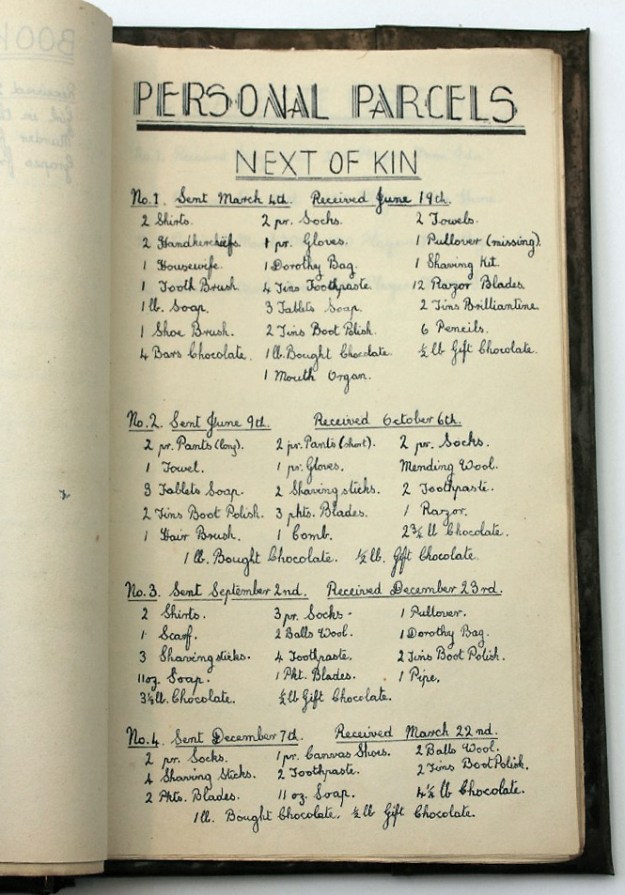
A page in Robert Dickinson’s journal,”Servigliano Calling,” is dedicated to “next-of-kin” parcels received.

Relatives of Allied prisoners were allowed to send one package four times a year to their loved ones. How this process was conducted in Canada was described in an Ottawa Citizen article about the services of the Canadian Red Cross Enquiry Bureau on April 26, 1944:

“There are 6,365 [Canadian] prisoners and internees on record whose next-of-kin are issued quarterly labels for personal parcels by the Department of National War Services….

“As soon as a man is officially declared a prisoner of war, another pamphlet is sent [by the Red Cross Enquiry Bureau] advising the next-of-kin what to do about parcels and enclosing the latest postal regulations.

“The bureau also receives reports from the supplementing committee of the Red Cross by which it is enabled to keep in touch with the next-of-kin who have difficulty in making up their quarterly parcels. One of the duties of the Red Cross is to see that the parcels are up to their full weight and it is through these reports that the liaison officers of the Red Cross branches are able to offer help to those in need of it.”

Continue reading

Red Cross Parcels

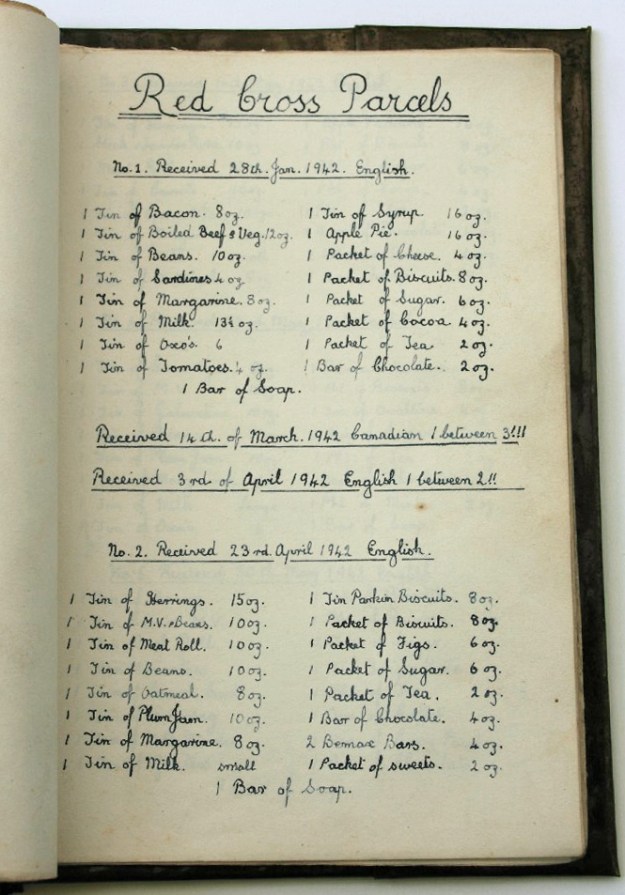
Red Cross Parcels distributed in Axis camps during the war were essential to the Allied POWs’ survival.

Robert Dickinson describes the eagerly awaited parcels in his diary; it’s clear that interruptions in parcel distribution were times of anguish.

Italian historian Giuseppe Millozzi, in his dissertation, Allied Prisoners of War in the Region of the Marche and Prison Camp at Servigliano, notes the following:

“English, Canadian and also New Zealand Red Cross sent to POWs various parcels some that contained clothes, tobacco and other necessities but the most important ones were food parcels that helped POWs to survive with the meagre Italian rations. Parcels coming from Canada and New Zealand were the richest as in those countries there was no food rationing such as in England that was under the constant threat of German bombing.

“Food parcels that had reached the camp were not enough for everybody and therefore they were divided among POWs. During the distribution of them, the Italian authorities usually punched food tins to prevent any the POWs from storing them for use in an eventual escape. POWs use tins of food, tobacco etc. as exchange goods; furthermore they recycled all the empty tins as the metal was very useful to construct a great variety of utensils.”

Continue reading