Author Archives: Dennis Hill

Lost Airmen Remembered in Pietragalla

ceremony-1a_r300

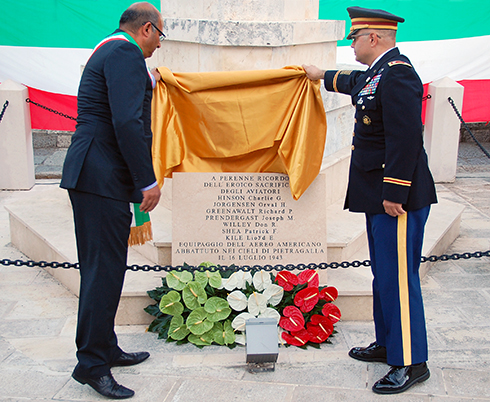
On August 4, Pietragalla Mayor Rocco Iacovera and Lieutenant Colonel Robert Ruffolo, representing the United States Embassy in Rome, unveiled a marble tablet honoring the seven airmen who died when the B-24 Bomber known as the Fyrtle Myrtle was shot down over Pietragalla in 1943.

ceremony-2_r72

Michele Potenza, who witnessed the crash of the Fyrtle Myrtle as a boy, speaks at the ceremony.

On July 16, 1943, a formation of three B-24 bombers left the Allied airbase in Berka, near Benghazi, Libya on a mission to damage or destroy the Axis airport at Bari. The fliers belonged to the 513th Bomb Squadron of the 376th Heavy Bombardment Group of the United States Air Force.

On their return, the first of the three planes, the Fyrtle Myrtle, was shot down over Pietragalla. The other two bombers were shot down soon after—near Altamura and Tricarico.

In 2012, the Salerno Air Finders, a group of volunteers from the Italian organization Salerno 1943, explored the crash site of the Fyrtle Myrtle and published a report of their findings on the Salerno 1943 website.

Then, last summer, a tablet was installed in Pietragallo comemmorating the men who lost their lives in the crash.

For the announcement of the ceremony, see “B-24 Bomber Crash Commemorated.”

The research and archaeological investigation into the crash of the Fyrtle Myrtle was first covered on this website through “B-24 Bomber Fyrtle Myrtle Discovered.”

Below is a transcript of the message Michele Potenza delivered at the ceremony.

It is presented in Italian, with translation of each section into English alternating throughout.
Continue reading

John Leon Turner—Survival in Italy

This fourth and final newspaper article covering the war bond speeches given by John Leon Turner in 1944–45 is the most detailed.

This talk was to the Rotary Club of Montreal—Westward.

To read the other articles, see “John Leon Turner, Royal Canadian Air Force” and “John Leon Turner with the Partisans.”

“If Freedom Dies…” Rotary Hears Adventures
Among Italian Partisans

Pilot Officer John L. Turner Tells Prisoner-of-War Story

“I have a tangle of memories from overseas and a tangle of ideas born from them, feel more or less helpless at expressing them and wish,” declared Pilot Officer John L. Turner, ex-prisoner of war in Italy, simply, “I had something prepared in front of me.”

Taking the place of as guest speaker in lieu of Nursing Sister Gabriel Cote at short notice, as she was suddenly recalled to duty, the modest flier opened his address at the Westward Rotary quietly and without bombast, warmed up to his subject and held the attention of all riveted to a breathless recital that had as its climax a gripping human interest story on “If Freedom Dies!”

When people learn he has been a prisoner of war, asserted the speaker, he is swamped with questions, and, for that reason, would give his impressions. On a flight to India after operations over Germany the plane was forced down and he came a captive in Italy in February, 1942. For a month, he revealed, he, with the others, was treated well while being solidly interrogated for information. Given the best, they were listening to the theme, “for you the war is over,” and the captors painted pictures of rest, ease, and luxury of P.O.W. Camps.

Disillusionment came swiftly when eventually they were entrained on a cattle car, which he was sure had square wheels, for a journey of two days and a night. Reaching the Camp in a downpour of rain they found it an enclosure with 15 ft. walls topped by barbed wire and broken glass, inside the compound were dingy white huts, a sea of mud and tired P.O.W.’s wading ankle deep.

A small loaf of dried bread was all they were given for a meal, and later a pint of thick soup of macaroni, boiled in cabbage water and some ersatz coffee.

Pilot Officer Turner declared he lost 50 lbs. in 4 months, coming down from 180 to 130 lbs., while a 200 lb. prisoner in the same period weighed less than he did, and 5 died of malnutrition, a pretty word for starvation, in that time. There were no such things as Red Cross parcels then, the captives had no energy to walk, they gazed over the walls at distant green hills that looked frightfully free, then back at the mud, dirty white huts and wondered—how long? All suffered from insomnia, day and night were the same, such were prison camps without the Red Cross aid, no recreation, no health to enjoy it, had it been afforded, and nothing left but to think.

Continue reading

John Leon Turner with the Partisans

j-turner-partisans_r72

This is a third article covering one of John Leon Turner’s service club visits—part of a national effort to promote sale of Canadian war bonds.

Read the first two news articles at “John Leon Turner, Royal Canadian Air Force.”

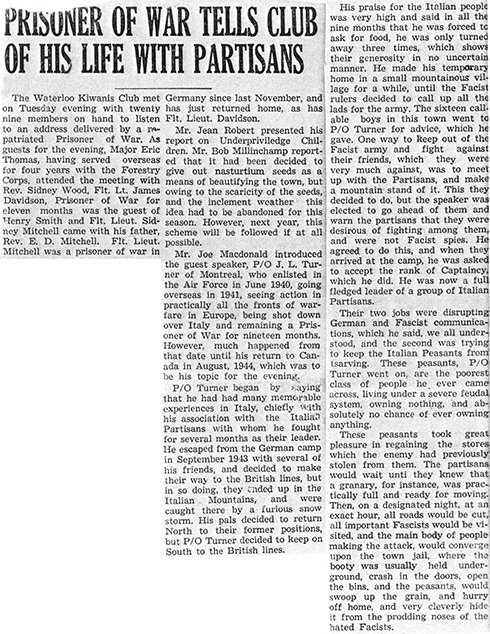
It would seem by references within this article that Leon’s presentation to the Waterloo (Southern Ontario) Kiwanis Club was in spring 1945.

Although the article reports Leon’s escape was from a German prison camp, he was in fact an escapee from Italian Camp 59.

Here is text of the article:

Prisoner of War Tells Club of His Life With Partisans

The Waterloo Kiwanis Club met on Tuesday evening with twenty-nine members on hand to listen to an address delivered by a repatriated Prisoner of War. As guests for the evening, Major Eric Thomas, having served overseas for four years with the Forestry Corps, attended the meeting with Rev. Sidney Wood, Flt. Lt. James Davidson, prisoner of war for eleven months was the guest of Henry Smith and Flt. Lieut. Sidney Mitchell came with his father. Rev. E. D. Mitchell. Flt. Lieut. Mitchell was a prisoner of war in Germany since last November, and has just returned home, as has Flt. Lieut. Davidson.

Continue reading

John Leon Turner, Royal Canadian Air Force

john-turner-portrait_c72

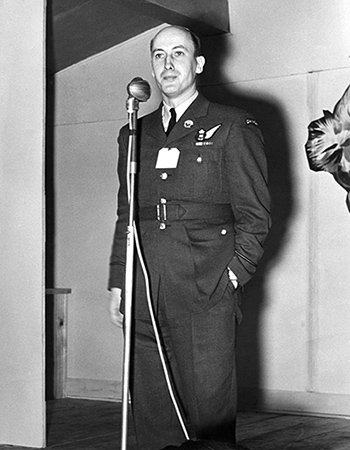
John Leon Turner in uniform speaking during one of his many stops on the War Bond circuit through Ontario and Quebec, Canada

I received an e-mail last month from Terry Marshall of London, Ontario (Canada). He wrote, “I would like to add one more name to the prisoner list which currently appears on your excellent site. The name to be added is that of my late father-in-law, John Leon (Lucky) Turner RCAF (Air Gunner) attached to RAF 99 squadron.”

There are several references to Canadian servicemen on the Camp 59 Survivors site, but I have detailed information on only one other Canadian at this time, Laurence Barker (see “Laurence Barker—Died for His Country“). Laurence, like John Turner, was a member of the Royal Canadian Air Force.

In his notes to me, Terry referred to his father-in-law as Leon. I asked him about this and he replied, “As far as I know, he always referred to himself as Leon, although to those who knew him well, he was Lucky (a reference to his skill and success at cards I believe).”

Therefore, I will refer to John on this site as Leon.

Continue reading

Sidney Seymour Smith—the Interviews

WO_311_1195_0046_r72

Sidney Smith left his memorandum, known as a “chit,” with the Mazzoni family. It was common for escapees to leave statements concerning help received with their protectors. A chit could later be presented to the Allies by the Italians as evidence when requesting compensation.

“To any British Officer:–

“This is to certify that Signalman Smith, Sidney Seymour, No. 2372205 stayed at this house (Mazzoni, Montelparo) from 2nd. November 1943 to 27th. February 1944 both dates inclusive less eight days and received the best of treatment.

“Signed. Sidney S. Smith
No. 2372205
Signalman”

At the bottom of the sheet, in another person’s handwriting, is this additional note:

“The above mentioned was at this house until the 21st March when he was killed by fascists.”

The last sentence is signed, but the signature is not readable.

The Interviews

The following interviews were conducted in 1945–46 by the Special Investigation Branch (SIB) of the Royal Military Police in the course of a thorough inquiry into the death of escaped POW Sidney Smith.

The interviews together create a vivid, disturbing picture of the soldier’s apprehension and murder on March 21, 1944. But the identities of the Germans and fascist collaborators who are responsible for Sidney’s death are never discovered.

Continue reading

Sidney Seymour Smith—A Mystery Solved

sidney-smith2_r72

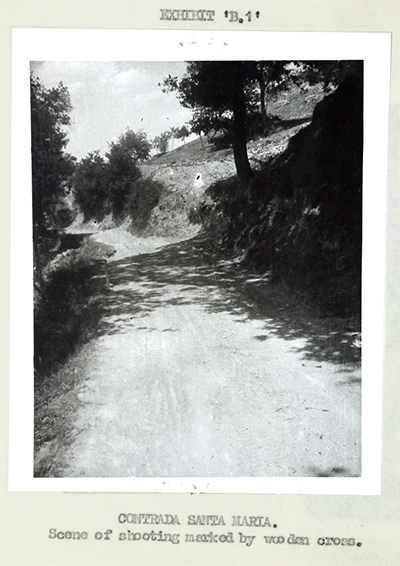
This photograph from the file of inquiry into the death of Signalman Sidney Smith by the Special Investigation Branch (SIB) of the Royal Military Police shows the spot on a road outside the comune of Montelparo, Italy, where the soldier was killed.

cross2_r72

This detail (from the above photograph) shows the wooden cross erected by local Italians in remembrance of Sidney Smith, the man they affectionately knew as “Giorgio.”

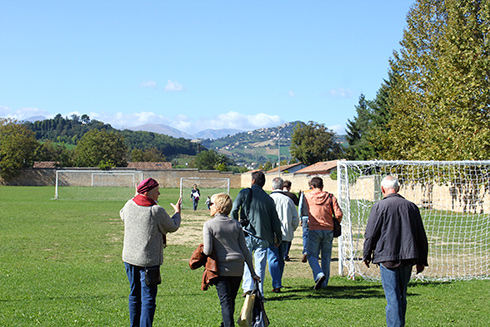
The killing of an escaped prisoner of war outside the village of Montelparo is a subject that has come up twice on this site recently. In “Tenna Valley Memorial Walks,” Anne Copley recounted how, two months ago, Freedom Trail walkers visited the spot outside Montelparo where a young British soldier, known to locals only as George—or “Giorgio” in Italian—had been shot by German soldiers.

And in “War Crimes—Sorting through the Accounts,” I questioned whether George Godfrey was the same soldier killed at Montelparo.

But now, thanks to help from British researcher Brian Sims, we have a clear answer to the identify of the soldier and a detailed account of the tragic end to the life of Sidney Smith.

Below is the official summary of an investigation by the Special Investigation Branch (SIB) of the Royal Military Police into the death of Scottish soldier Sidney Seymour Smith, Signalman, Royal Corps of Signals.

Continue reading

Details on Remaining 10 British Escapees

Here are further details on the remaining 10 of the 24 British soldiers first mentioned in “British Escapees from Camp 59—New Names.” See also “Detailed Accounts of 14 British Escapees.”

Once again, I am grateful to researcher Brian Sims for sharing records concerning these soldiers from the British National Archives.

Of particular interest in the details below are the individual soldiers’ descriptions of the escape night, the names and addresses of their helpers (and one blacklisted fascist), and the escape routes each followed to freedom.

Note that some of the reports are carbon copies of others. Presumably when two soldiers traveled and reached the Allied forces together, only one debriefing report was deemed necessary. In those cases, a carbon was made and the second soldier’s personal information was then added to the top.

John Georgiou

Service Number—1712593
Gunner
49th Battalion, Light Anti-Aircraft Regiment, Royal Artillery
Escaped from Camp 59 on September 14, 1943

Helper:

Domenico Censori
Montefalcone Appenino
Ascoli-Piceno
Provided food and shelter December 2, 1943–June 25, 1944

George Aitken

Service Number—2980168
Lance-Sergeant
93rd Battalion, Anti-Tank Regiment, Royal Artillery
Captured—January 21, 1943, Maktar, Tunisia
Escaped from Camp 59 on September 14, 1943

George Aitken’s report is a carbon copy of Gregor McKenzie’s report (below).

Continue reading

Anne Copley in the Italian American Journal

Anne-Copley_r72

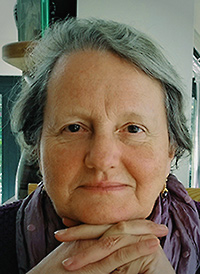
Author Anne Copley

Anne Copley’s excellent article on the escaped Allied prisoners and their Italian helpers, Italy’s Courage: The unknown story of WW2 escapees and the Italian peasantry, is now online on the website of the Italian American Journal.

The following description of the author is posted on the IA Journal site:

Anne Copley is a lawyer living and working in Oxford, England. She bought and renovated a house near Montefalcone Appennino in Le Marche region of Italy 10 years ago, and now spends as much time there as possible. She became fascinated by the story of Allied PoWs and their Italian saviours when she found that most of her neighbours’ parents and grandparents were involved. She now takes part in guided “Freedom Trails” in the area, reviving the memories of 70 years ago. She is also involved with the Casa Della Memoria in Servigliano, a museum dedicated to this subject.

Detailed Accounts of 14 British Escapees

Here are further details about 14 of the 24 prisoners listed in “British Escapees from Camp 59—New Names.” This additional information is courtesy of researcher Brian Sims.

These British prisoners were all in Camp 59 at the time of the escape in September 1943. They all reached Allied lines by traveling southward—some over land and some by means of transportation down the coast.

Note that several of the entries reference an escape by boat along the Adriatic Coast from San Benedetto Del Tronto to Termoli. This surely is the escape described in “Nicola and Liberato Lagalla—Rescue by Sea.” In fact, one of escapees listed below, Howard Jones, we know to have escaped from Camp 59 with Captain J. H. D. Millar, and Captain Millar was among those known to have been skippered to safety by the Lagalla brothers (although he is not on Brian’s list).

Frederick Thomas Lockett

Service Number—5050489
Sergeant
2nd Battalion, Parachute Regiment
Date of Birth—February 20, 1921
Home address—Woodbank, Penkridge Staffs, UK

Captured—December 2, 1942
Transit in North Africa
Camp 98 Sicily, December 3–29, 1942
PG 66 Capua, January 2–February 5, 1943
PG 59 Servigliano, February 7–September 15, 1943

Helper:

Francesco Vallorani (farmer)
Montefalcone
Sheltered and fed September 20–November 14, 1943

Transported from San Benedetto to Termoli by boat; arrived November 18, 1943

Albert Ambrose Willis

Service Number—5774137
Sergeant
2nd Battalion, Parachute Regiment
Date of Birth—January 27, 1912

Captured—December 1, 1942
Transit North Africa
PG 98 Sicily
PG 66 Capua, January–February 8, 1943
PG 59 Servigliano, February 9–September 14, 1943

Helper:

Gino Mundi (Farmer)
San Lorenzo
Sheltered and fed for two weeks

Transported from San Benedito to Termoli by boat with help from “A Force”; arrived December 13, 1943

Continue reading

Inside and Out—More Views of the Camp

campo-servigliano_r72

A photograph of Camp 59 shot when the camp was occupied by Allied prisoners during World War II

This photo was taken from near the main gate (perhaps from the top of a building or a sentry hut), looking southwestward through the full length of the camp.

Rows of prisoner’s barracks are to the left and right. The small, shorter buildings between the barracks are latrines.

The photo may have been taken at roll call—the time each morning when the men were lined up outdoors to be counted.

full-field_r72

field-camp_r72

The interior of the camp as it appears today

Both of these shots are from the same southwestward perspective as the archival image above.

Continue reading