Recently British researcher Brian Sims shared an interesting document with me that he had discovered in the British National Archives.
Written at the end of World War II, the document, a history of I.S.9 (Intelligence School 9) from November 1, 1943 to May 31, 1945, was written as an attachment to a memorandum to the Deputy Director of Military Intelligence (DDMI).
Fortunately for today’s readers, it was written in a style, “which might easily be read by non-regular soldiers.”
The 196-page report offers a detailed account of the structure, mission, and activities of I.S.9, which had as its chief task the support and rescue of escaped POWs and evaders (E&Es) stranded in enemy territory in Italy and elsewhere in Europe.
I.S.9 activities fell under M.I.9 (British Directorate of Military Intelligence Section 9), a department of the War Office during WW II.
This post will be the first of several on this site over the coming weeks that shed light on I.S.9, drawing from various sections of the report.
I am grateful to Brian for this material and for assistance in helping me sort through sundry military abbreviations and acronyms.
Below is a transcript of the opening section of the history, which explains the origin and organizational structure of I.S.9.
History of I.S.9 Central Mediterranean Force
ATTACHMENT “F” to DDMI (PW)s Memorandum
HISTORICAL RECORD OF I.S.9 (CMF)
(FORMERLY KNOWN AS ‘N’ SECTION ‘A’ FORCE)
FROM 1.11.43 TO 31.5.45 [November 1, 1943—May 31, 1945]
THE ORGANIZATION
To write the history of, or a guide to, M.I.9 activities in a Theatre of War and in particular the actual Theatre of War allocated to I.S.9 (CMF) calls for a writer of historic novels, a writer with a sense of the dramatic but a writer who would always maintain a sense of proportion.
So much has happened during the course of the exciting two years, which started for I.S.9 (CMF) with 2 officers being landed on the beach at SYRACUSE: 2 officers with their kit but with no transport and with no idea as to their purpose in life, apart from the most pointed directive that they were to learn how best rescue work might be accomplished with an Army in the Field.
These two officers learned, quite quickly, one vital lesson, namely, that no rescue work of any kind would be possible unless an I.S.9 team or Unit was self contained and mobile.
Continue reading →

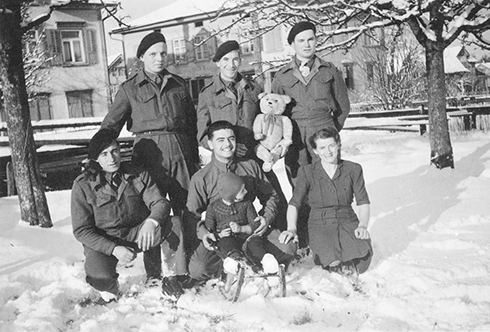
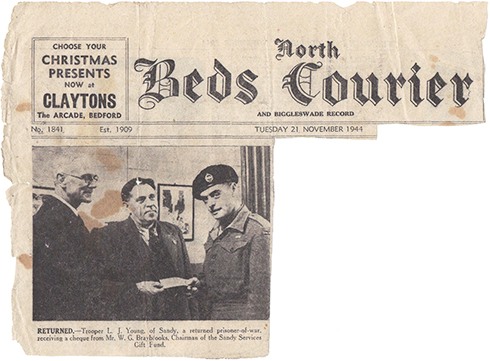


 Camp 59 Survivors