Author Archives: Dennis Hill

George Payne, U.S. Army Medic

george-payne-3

Private First Class George A. Payne

I received an e-mail on May 27 from Julie Payne Williams. Julie wrote she began an archive of the WW II experiences of her father, George Payne, in spring 2003. He passed away in December 2003.

George Payne was a prisoner in Camp 59.

Julie sent me a transcript of an interview she did with her father, photos of him, and documents pertaining to his capture and internment as a POW.

Julie asked whether I might be able to provide information on the Italian civilians who helped her father, the Tirabassi family.

“The Tirabassi family lived in Comunanza,” Julie wrote. “Dad could only remember the name of the father (Francesco, called Paco) and the oldest daughter, Maria. Paco had a wife and a younger daughter also. Maria was around 18—only a year younger than my dad—and a younger (blonde) daughter was around 11.

“Dad always wondered which members of the family, if any, survived the war. He carried around a lot of guilt his entire life from not knowing if they survived or, if they didn’t, if they were killed for helping him.

Continue reading

Raimondo Illuminati on Sidney Seymour Smith

raimondo-illuminati_r72

Raimondo Illuminati at the site of the Sidney Seymour Smith memorial plaque.

Tenna Valley Freedom Trail Walk activities last month included the installation, on May 10, of a plaque in memory of British soldier Sidney Seymour Smith on the road outside the village of Montelparo where Sidney was shot to death. Sidney was known to the Italians as “Giorgio.”

See “Sidney Seymour Smith—A Mystery Solved” and “Sidney Seymour Smith—the Interviews.”

Just prior to the unveiling of the plaque, Raimondo Illuminati, who as a boy knew Sidney, spoke about his memory of him at the Montelparo town hall.

I am grateful to Anne Copley for her translation of the speech from Italian into English. Anne’s comments are in brackets.

Raimondo Illuminati’s Speech

“8th September 1943; church bells were ringing in all the villages, the Armistice had been declared between Badoglio’s Italy and the Anglo-American troops. In our district, at Servigliano, there was a concentration camp; the gates were opened and the prisoners were free. It seemed it was over, the war which had not touched us, which had taken place far from our peaceful lives. But it ended up in our houses, with the immediate occupation by the Germans, endorsed by the Salo Republic. The prisoners, once free, took refuge in our countryside, welcomed with love into our homes. And indeed our own soldiers were prisoners in their lands.

“One of these prisoners was called, or at least he gave himself the name GIORGIO. He was an English soldier. He took refuge in the contrada Santa Maria di Montelparo with the family “Ndunucciu” [Italian peasant families had a real name and then a nickname—it seems likely this was the nickname for the Mazzoni family], adjacent to the Tirabassi elementary school. I was seven years old and went to the primary class, I remember Giorgio because sometimes he came to our school when the master was away, and he read us books and stories. Giorgio was “a boy” [I’m not sure how to translate ragazzo, which literally means “boy” but here seems to have a deeper significance], about thirty-six years old, tall, slender, blond with blue eyes. He was always smiling and he was very dear to us, we always behaved well and kept quiet whilst he was reading to us. But one day the brutality of war took him away. One day in March he received a visit from three individuals—“friends” they called themselves, but they were two Germans and a local Fascist and they slaughtered him, unloading into him forty machine-gun bullets. This unhappy event happened north of the contrada Santa Maria and right next to the house of Paolo Traini (Cucurre). I passed that way the next morning and saw signs of his blood and fragments of his body on the edge of the road. He was accompanied to the cemetery by a large cortege, and by all us schoolboys to give him a final farewell.”

Upcoming Italian Freedom Trail Walk

monte-san-martino_r72

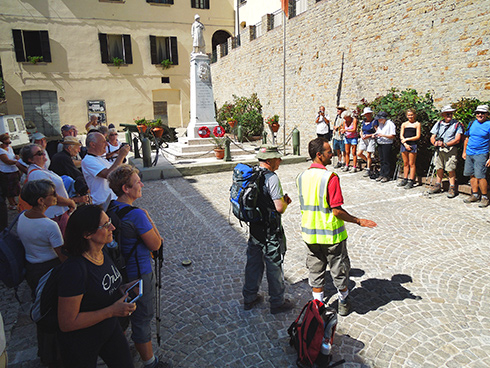
A wreath-laying ceremony in Monte San Martino, Italy, during the Freedom Trail Walk in September 2013.

A Tenna Valley Freedom Trail Walk sponsored by WW2 Escape Lines Memorial Society and Monte San Martino Trust is scheduled for May 7–12. The annual walks, begun in 2001, retrace routes taken by Allied escapers and evaders caught in enemy territory in Italy during World War II.

The last Freedom Trail walk was held just seven months ago, to commemorate the 70th anniversary of the September 1943 Italian armistice and the subsequent escape of prisoners from camps across central and northern Italy.

The walks are dedicated to the people of the Italian countryside, the contadini, who, at great risk to themselves and their families, provided shelter, food, clothing, and medical assistance to the young Allied servicemen.

This year’s walk will cover approximately 80 kilometers and include visits to the villages of Monte San Martino, Massa Fermana, Montappone, Montelparo, Montalto delle Marche, Monte Urano, Fermo, and Porto San Georgio.

freedom-walkers_r72

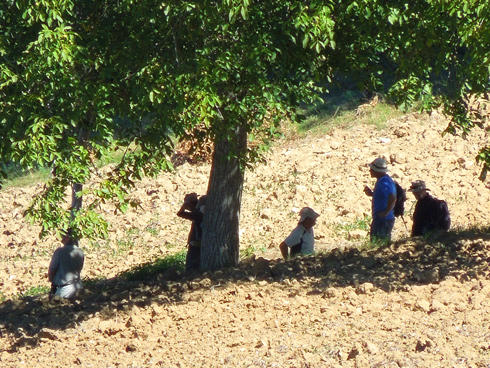
A shady rest during the Freedom Trail Walk last September.

freedom_trail_g72

Program cover for the first Freedom Trail Walk, 2001.

The Brandenburgers—War Crimes Investigations

An interesting report from the British National Archives documents investigations carried out in January 1948 by Captain C. Hillman and a second investigator referred to only as Mr. Suesserott.

The report contains recommendations for further action, including interviews that might lead to crucial new evidence and war crimes prosecutions.

Much of the Hillman/Suesserott report concerns the execution of four British and two American escaped prisoners of war in Comunanza, likely by members of the “Hettinger Group” of the Brandenburg Regiment.

The rest of the report lists seven instances of killings possibly attributable to the “Bansen Group” of the same regiment. These incidents include the killings of Sidney Seymour Smith, and Robert Alvey Newton and Martin Majeski.

My access to this investigations document is courtesy of researcher Brian Sims. I asked Brian about the “SEE” listing of these war crimes. He answered, “As with most series of UK files each department had their own particular set of references. These were later rationalised when gathered together in the WO series.”

Here is the full report:

The Investigations Report

Report on investigations carried out by Captain C. HILLMAN and Mr. SUESSEROTT covering the period from 8 Jan 48 till 29 Jan 48.

On 8 Jan 48 we proceeded from this H.Q. to investigate the deaths of Allied PoWs who were shot in Italy in May 1944. (SEE/88 and SEE/72). On 10 Jan 48 I contacted the British I.O. [Intelligence Officer] at MUNICH in an effort to get a certain REISCHEL, a former police officer in CARINTHIA who is wanted by the Austrian Authorities for various crimes committed by himself and his men against Austrian Partisans, arrested and extradited. This was met with some difficulty which was finally overcome by Mr. SUESSEROTT and the arrest of REISCHEL was effected approx. 14 days later by German Police acting on U.S. Mil. Govt. [Military Government] instructions. By way of MANNHEIM, FRANKFURT and HANNOVER I reached HAMBURG where I immediately started to make inquiries regarding the whereabouts of the former members of the BRANDENBURG Regt., such WEHLAN, LIEBHARD (or LIPPHART) and UNRAU. I was able to obtain particulars, of several persons whom I later interviewed. With the exception of WEHLAN and Hans ULRICH all persons were not identical with our traces and were set free after a short interrogation.

Continue reading

William Percy Hill—Escaped from Camp 65

wm-hill_r72

William Percy “Bob” Hill. Bob’s daughter-in-law Gillian feels this photo might have been taken while Bob was a prisoner.

Information for this post is from Gillian Hill, who lives in Beldon, Western Australia.

“My father-in-law was a POW in WW2. He was William Percy Hill, 1st Battalion, Rifle Brigade (Army No. 6917847), Gillian wrote. “He would have probably either gone by the name Bob, or Percy, rather than William.”

Bob was British. His address at wartime was 7 Emanual Road, Northwood, Middlesex UK.

He was captured in the North African Desert at Antelat, Libya, on January 23, 1942.

“Bob had a book on the Afrika Korps, “Gillian wrote. “He has handwritten notes throughout the book. He mentions he was attached to 7th Armoured Brigade as spotter for tanks in a bren gun carrier: ‘Last carrier left out of 44. Only 6 of us left.’

“He also mentions that he met Rommel in a field hospital.

Continue reading

I.S.9 History—A Final Installment

This is a final post in a series drawn from a History of I.S.9 (CMF) in the British National Archives.

I am indebted to researcher Brian Sims for access to the report.

For earlier postings on I.S.9 history, see “I.S.9 History—Organization,” “I.S.9 History—Tasks,”I.S.9 History—Methods,” “I.S.9 History—Communications,,” “I.S.9 History—Agent Choice and Training,” “I.S.9 History—Air Operations,” “I.S.9 History—Sea Borne Operations,” “I.S.9 History—Operations in Italy, Part 1,” and “I.S.9 History—Operations in Italy, Part 2,I.S.9 History—Operations in Italy, Part 3,” “I.S.9 History—Operations in Italy, Part 4,” “I.S.9 History—Operations in Italy, Part 5,” and “I.S.9 History—Operations in Italy, Part 6.”

After the I.S.9 history’s lengthy chapters on operations in Italy, it offers chapters on operations in Yugoslavia, Greece, Austria, Albania, the Balkans (Bulgaria and Roumania, and Central Europe (Hungary and Slovokia).

The history also includes chapters on preventative training, I.S.9 newsletters, and a short section entitled “THE RESULTS AND THE COST.”

Concerning “the cost,” the report states:

“We make no attempt to assess the cost in terms of money. To do so we should require to know the answer to ‘What is the monetary value of human life and the cost of human suffering?’.

Continue reading

I.S.9 History—Operations in Italy, Part 6

This post is twelfth in a series drawn from a History of I.S.9 (CMF) in the British National Archives. Access to this report is courtesy of researcher Brian Sims.

For earlier postings on I.S.9 history, see “I.S.9 History—Organization,” “I.S.9 History—Tasks,”I.S.9 History—Methods,” “I.S.9 History—Communications,,” “I.S.9 History—Agent Choice and Training,” “I.S.9 History—Air Operations,” “I.S.9 History—Sea Borne Operations,” “I.S.9 History—Operations in Italy, Part 1,” and “I.S.9 History—Operations in Italy, Part 2,I.S.9 History—Operations in Italy, Part 3,” “I.S.9 History—Operations in Italy, Part 4,” and “I.S.9 History—Operations in Italy, Part 5.”

Here is a transcript of Part 6 of the I.S.9 history’s report on operations in Italy:

Part Six—Conclusion.

Before we leave Operations ITALY, it would be as well, perhaps to write somewhat briefly on one or two of our rather longer range operations and activities.

“Committee of National Liberation” (C.L.N.A.I.) – MILAN [Comitato di Liberazione Nazionale Alta Italia].

Late in 1943, reports began to reach us of fairly large numbers of ex-P/Ws crossing into SWITZERLAND from NORTHERN ITALY. It was thought that the Committee of National Liberation [Comitato di Liberazione Nazionale], whose headquarters were in MILAN, were giving help to those ex-P/Ws.

With a view to further encouraging such help and with a view, also, to encouraging the flow of ex-P/Ws to SWITZERLAND by another means, an Italian officer (BALDO) volunteered to be infiltrated into NORTH ITALY, together with a W/T operator, with the intention of making his headquarters at MILAN.

Continue reading

I.S.9 History—Operations in Italy, Part 5

This post is eleventh in a series drawn from a History of I.S.9 (CMF) in the British National Archives. Access to this report is courtesy of researcher Brian Sims.

For earlier postings on I.S.9 history, see “I.S.9 History—Organization,” “I.S.9 History—Tasks,”I.S.9 History—Methods,” “I.S.9 History—Communications,,” “I.S.9 History—Agent Choice and Training,” “I.S.9 History—Air Operations,” “I.S.9 History—Sea Borne Operations,” “I.S.9 History—Operations in Italy, Part 1,” and “I.S.9 History—Operations in Italy, Part 2,I.S.9 History—Operations in Italy, Part 3,” and “I.S.9 History—Operations in Italy, Part 4.”

Here is a transcript of Part 5 of the I.S.9 history’s report on operations in Italy:

Part Five—The Final Phase.

April 1st to the final capitulation of the German forces in Italy, 2 May 45.

At the beginning of April 1945, it was obvious that full preparations had been made to conduct an all-out attack finally to defeat the German forces in ITALY. The opening of the attack saw the 8th Army advance up to and through the ARGENTA gap and on to the River PO. 5th Army, after initial stiff resistance, swept through the APPENINES and onwards to VERONA. It was clear that the campaign had developed suddenly and more rapidly than had been anticipated and the enemy was already floundering in chaos. Throughout the NORTH, partizan bands had risen and were offering an additional threat to the German lines of communications, which already had been reduced to the minimum by the Allied Air Forces. It was anticipated that the enemy might attempt to make a stand on the ADIGE Line, but this was quickly turned and the way laid open to the BRENNER PASS and AUSTRIA and to VENICE, UDINE and TRIESTE. At this stage the American 92nd division pushed out columns into the NORTH WEST corner of ITALY and sealed off any escape routes the German 75th Army Corps had contemplated using, and by the end of April it was clear that the enemy would be reduced to complete submission within a matter of days. The final capitulation was signed on 2nd May 45, the enemy having been utterly defeated. Once the 8th Army was through the ARGENTA gap, and 5th Army had captured BOLOGNA, the Germans had been unable to offer any organized resistance.

Continue reading

I.S.9 History—Operations in Italy, Part 4

This post is eleventh in a series drawn from a History of I.S.9 (CMF) in the British National Archives.

The chief task of I.S.9 was the support and rescue of escaped POWs and evaders (E&Es) stranded in enemy territory in Italy and elsewhere in Europe. I.S.9 was a division of M.I.9 (British Directorate of Military Intelligence Section 9), a department of the War Office during WW II.

Access to this report is courtesy of researcher Brian Sims.

See also “I.S.9 History—Organization,” “I.S.9 History—Tasks,”I.S.9 History—Methods,” “I.S.9 History—Communications,,” “I.S.9 History—Agent Choice and Training,” “I.S.9 History—Air Operations,” “I.S.9 History—Sea Borne Operations,” “I.S.9 History—Operations in Italy, Part 1,” and “I.S.9 History—Operations in Italy, Part 2, and “I.S.9 History—Operations in Italy, Part 3.”

Activities of Field Sections 1, 2, and 5, as well at the Boating Section, are described in this part of the report, and accounts of several named missions are given.

Of particular interest is an account of a Section 5 Lysander aircraft being downed by friendly fire while on a mission, and of the daring rescue of a wounded pilot who was stranded near the frontline by a small craft which landed on a makeshift dry riverbed runway.

The report also touches on I.S.9 (CMF) involvement in field activities in southern France.

The report contains a reference to the “several E & Es, including private soldiers, [who] were so highly thought of by the Italian patriots for their bravery, leadership and devotion to duty, that they were put in command of patriot battalions.” Canadian Pilot Officer John Leon Turner, Royal Canadian Air Force, who was chosen for captaincy of a band of partisans, is an example on this site.

Here is a transcript of Part 4 of the I.S.9 history’s report on operations in Italy:

Part Four—the Italian Winter Campaign,
from 1 Oct 44 until 31 Apr 45

1. General Military Situation.

2. Field Section Activities.

3. Special Operations (Land).

4. I.S.9 activities in the invasion of SOUTHERN FRANCE.

5. Operation “FERRET”.

1. GENERAL MILITARY SITUATION.

From 1st Oct 1944 and onwards through the Winter, and indeed even until the final battles of the Italian campaign, most of the activity in ITALY took place on the ADRIATIC coast, to which the 8th Army had been switched back in July and August 1944. It is doubtful if the Allies could ever have broken the German’s Winter line at CASSINO without the element of surprise achieved by the secret transfer of practically the whole of 8th Army from the ADRIATIC coast to the LIRI Valley in April 1944, so, too, the Allies might never have broken the GOTHIC LINE if Field Marshal ALEXANDER had not transferred the 8th Army back to the ADRIATIC coast in August. Due to the secrecy of this last move, which was carried out under cover of all ways and means of deception, KESSELRING discovered the Allied strength on the ADRIATIC coast too late, and the 8th Army pierced the EAST end of the German line. KESSELRING was forced to weaken his centre to prevent a disastrous break-through on the EAST coast.

Continue reading

I.S.9 History—Operations in Italy, Part 3

This post is tenth in a series drawn from a History of I.S.9 (CMF) in the British National Archives. Research courtesy of Brian Sims.

See also “I.S.9 History—Organization,” “I.S.9 History—Tasks,”I.S.9 History—Methods,” “I.S.9 History—Communications,,” “I.S.9 History—Agent Choice and Training,” “I.S.9 History—Air Operations,” “I.S.9 History—Sea Borne Operations,” “I.S.9 History—Operations in Italy, Part 1,” and “I.S.9 History—Operations in Italy, Part 2.”

One of the more interesting bits of information in this installment of I.S.9 operations in Italy is news that the leadership of I.S.9 had almost no contact with the Rome Escape Organization, its companion POW assistance and rescue group that was in operation from the Vatican, until after the fall of Rome in June 1944.

Limited contact with the Rome organization during German occupation was made via I.S.9 couriers, but close communication and coordination was not feasible during German occupation.

Here is a transcript of Part 3 of the I.S.9 history’s report on operations in Italy:

Part Three—the Spring and Summer Campaigns 1944

1. The military situation at 1 May and onwards through the Summer of 1944.

2. Field Section Activities.

3. Field HQ.

4. Sea Evacuations.

5. Special Operations (Land)

6. Rome.

1. THE MILITARY SITUATION AT 1 MAY AND ONWARDS THROUGH THE SUMMER OF 1944.

At the end of the Winter 44, it was obvious that the enemy was re-grouping his forces and arranging his defence in order to delay the capture of ROME for as long as possible. They were still entrenched along the GUSTAV LINE which was heavily defended, particularly along the approaches to ROME – (MONTE CASSINO, MONTE CAIRO and the LIRI Valley).

Continue reading