
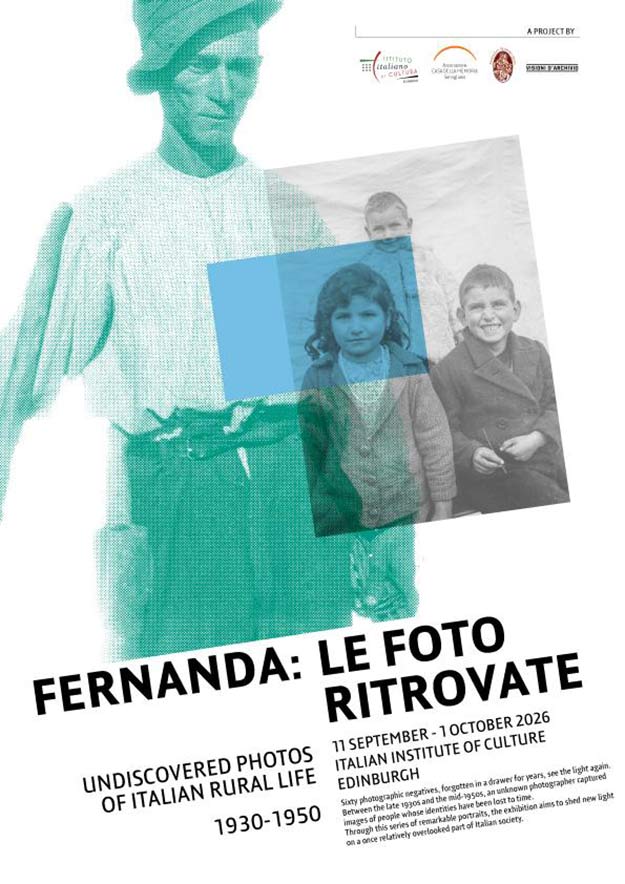
“Fernanda: Le Foto Ritrovate”—Rare images of Italian rural life
A remarkable group of photographs of rural Italians is on exhibit this month at the Italian Cultural Institute in Edinburgh, Scotland.
Fernanda: Le Foto Ritrovate brings together photographs taken in the southern Marche between the late 1930s and the mid-1950s—images that offer a rare glimpse into the lives of the contadini, the impoverished sharecroppers who formed the backbone of rural society in this part of Italy.
The exhibition is organized by Casa della Memoria and the Monte San Martino Trust, in collaboration with the Italian Cultural Institute of Edinburgh.
For those of us interested in the story of Allied prisoners of war who escaped from Italian POW camps after the Armistice of September 1943, the exhibition has particular significance. These are the very kinds of people among whom thousands of escapees found refuge. The rural families who sheltered them risked imprisonment, beatings, or death by hiding the fugitives, feeding them, and sharing what little they possessed.
In most photographs of rural Italy, these stalwart people appear simply as figures in the landscape. However, in these images they are the focus.
This collection has been exhibited at other venues in Italy and Britain. In Edinburgh, it will be on display through October 1.
Forgotten in a drawer
The story behind the photographs is almost as remarkable as the images themselves.
After the death of his aunt Fernanda Millevolte, filmmaker Giordano Viozzi was clearing out her house when he discovered a collection of black-and-white negatives that had remained untouched in a drawer for many years.
Giordano printed the negatives and attempted to learn about the people in the pictures. The photographer is unknown, but research and local efforts to identify the subjects have succeeded in matching names to many of the previously unknown faces.
Much remains to be discovered, but the process of identification is worthwhile. Every name recovered transforms an anonymous face into a person with a family, a home, and a story.
The photographs are not technically perfect. Although the photographer at times was attempting to emulate a professional style, the images have unmistakable qualities of amateur photography, suggesting that the photographer had limited experience with a camera. The imperfection is part of their charm and value—the photos are intimate, direct, and unpolished. They record people at work, families together, celebrations and mourning, women in the fields, and the faces of men and women whose lives might otherwise have been lost to time.
As the exhibition’s description notes, the contadini are placed “front and centre.” The subjects look directly at the camera—and, through the lens, at us.
The world into which Allied prisoners fled
The connection to the history of PG 59 and the other camps of the Italian Marche is particularly compelling.
Although many Allied POWs were recaptured soon after their escape, thousands remained at large, often because of the selfless assistance offered by Italian families that sheltered and fed them for weeks, months, and sometimes much longer.
The people who took in the escapees were overwhelmingly sharecroppers, laborers, women, and families struggling to survive under extraordinarily difficult conditions. These photographs offer us a glimpse of the world into which those escaped prisoners disappeared.
They also remind us that the history of the escapees cannot be separated from the lives and history of the people who sheltered them.
For Camp 59 Survivors, that is perhaps the most intriguing aspect of this collection. The photographs are not simply historical images of “Italian peasants.” They are fragments of the rural world inhabited by the people who helped Allied prisoners survive after their escape.
And perhaps some of those faces are people whose names—or whose stories—will eventually connect directly with the men who passed through Camp 59.
See the exhibition
Fernanda: Le Foto Ritrovate — Undiscovered Photos of Italian Rural Life 1930–1950
Italian Cultural Institute of Edinburgh
Italy House
20–22 East London Street
Edinburgh EH7 4BQ
September 11–October 1, 2026
The exhibition is free, but visits are by appointment. The Institute asks visitors to contact them in advance to arrange a visit.
See the exhibition information at the Italian Cultural Institute of Edinburgh
About the Italian Cultural Institute of Edinburgh
The Italian Cultural Institute of Edinburgh is an Italian government cultural institute that promotes Italian language and culture in Scotland and Northern Ireland. Its activities include language courses, exhibitions, film programs, lectures, and other cultural events, as well as fostering cultural and scientific connections between Italy and Scotland. The Institute is part of Italy’s network of cultural institutes around the world.
For Camp 59 Survivors, it is wonderful to see another institution in Britain giving these largely forgotten rural Italians the attention they deserve.


Thank you ??
Get Outlook for Androidhttps://aka.ms/AAb9ysg ________________________________