Monthly Archives: November 2013

Sidney Seymour Smith—the Interviews

WO_311_1195_0046_r72

Sidney Smith left his memorandum, known as a “chit,” with the Mazzoni family. It was common for escapees to leave statements concerning help received with their protectors. A chit could later be presented to the Allies by the Italians as evidence when requesting compensation.

“To any British Officer:–

“This is to certify that Signalman Smith, Sidney Seymour, No. 2372205 stayed at this house (Mazzoni, Montelparo) from 2nd. November 1943 to 27th. February 1944 both dates inclusive less eight days and received the best of treatment.

“Signed. Sidney S. Smith
No. 2372205
Signalman”

At the bottom of the sheet, in another person’s handwriting, is this additional note:

“The above mentioned was at this house until the 21st March when he was killed by fascists.”

The last sentence is signed, but the signature is not readable.

The Interviews

The following interviews were conducted in 1945–46 by the Special Investigation Branch (SIB) of the Royal Military Police in the course of a thorough inquiry into the death of escaped POW Sidney Smith.

The interviews together create a vivid, disturbing picture of the soldier’s apprehension and murder on March 21, 1944. But the identities of the Germans and fascist collaborators who are responsible for Sidney’s death are never discovered.
Continue reading

Sidney Seymour Smith—A Mystery Solved

sidney-smith2_r72

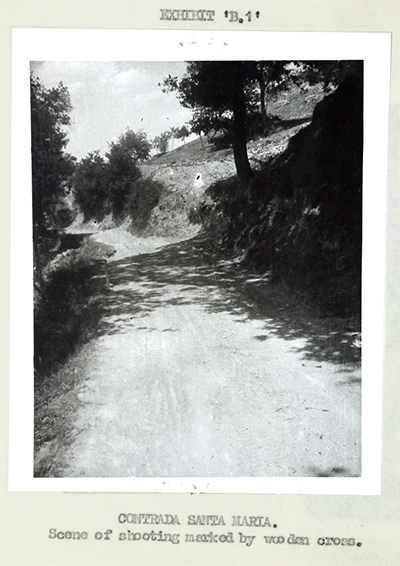
This photograph from the file of inquiry into the death of Signalman Sidney Smith by the Special Investigation Branch (SIB) of the Royal Military Police shows the spot on a road outside the comune of Montelparo, Italy, where the soldier was killed.

cross2_r72

This detail (from the above photograph) shows the wooden cross erected by local Italians in remembrance of Sidney Smith, the man they affectionately knew as “Giorgio.”

The killing of an escaped prisoner of war outside the village of Montelparo is a subject that has come up twice on this site recently. In “Tenna Valley Memorial Walks,” Anne Copley recounted how, two months ago, Freedom Trail walkers visited the spot outside Montelparo where a young British soldier, known to locals only as George—or “Giorgio” in Italian—had been shot by German soldiers.

And in “War Crimes—Sorting through the Accounts,” I questioned whether George Godfrey was the same soldier killed at Montelparo.

But now, thanks to help from British researcher Brian Sims, we have a clear answer to the identify of the soldier and a detailed account of the tragic end to the life of Sidney Smith.

Below is the official summary of an investigation by the Special Investigation Branch (SIB) of the Royal Military Police into the death of Scottish soldier Sidney Seymour Smith, Signalman, Royal Corps of Signals.

Continue reading

Details on Remaining 10 British Escapees

Here are further details on the remaining 10 of the 24 British soldiers first mentioned in “British Escapees from Camp 59—New Names.” See also “Detailed Accounts of 14 British Escapees.”

Once again, I am grateful to researcher Brian Sims for sharing records concerning these soldiers from the British National Archives.

Of particular interest in the details below are the individual soldiers’ descriptions of the escape night, the names and addresses of their helpers (and one blacklisted fascist), and the escape routes each followed to freedom.

Note that some of the reports are carbon copies of others. Presumably when two soldiers traveled and reached the Allied forces together, only one debriefing report was deemed necessary. In those cases, a carbon was made and the second soldier’s personal information was then added to the top.

John Georgiou

Service Number—1712593
Gunner
49th Battalion, Light Anti-Aircraft Regiment, Royal Artillery
Escaped from Camp 59 on September 14, 1943

Helper:

Domenico Censori
Montefalcone Appenino
Ascoli-Piceno
Provided food and shelter December 2, 1943–June 25, 1944

George Aitken

Service Number—2980168
Lance-Sergeant
93rd Battalion, Anti-Tank Regiment, Royal Artillery
Captured—January 21, 1943, Maktar, Tunisia
Escaped from Camp 59 on September 14, 1943

George Aitken’s report is a carbon copy of Gregor McKenzie’s report (below).

Continue reading

Anne Copley in the Italian American Journal

Anne-Copley_r72

Author Anne Copley

Anne Copley’s excellent article on the escaped Allied prisoners and their Italian helpers, Italy’s Courage: The unknown story of WW2 escapees and the Italian peasantry, is now online on the website of the Italian American Journal.

The following description of the author is posted on the IA Journal site:

Anne Copley is a lawyer living and working in Oxford, England. She bought and renovated a house near Montefalcone Appennino in Le Marche region of Italy 10 years ago, and now spends as much time there as possible. She became fascinated by the story of Allied PoWs and their Italian saviours when she found that most of her neighbours’ parents and grandparents were involved. She now takes part in guided “Freedom Trails” in the area, reviving the memories of 70 years ago. She is also involved with the Casa Della Memoria in Servigliano, a museum dedicated to this subject.

Detailed Accounts of 14 British Escapees

Here are further details about 14 of the 24 prisoners listed in “British Escapees from Camp 59—New Names.” This additional information is courtesy of researcher Brian Sims.

These British prisoners were all in Camp 59 at the time of the escape in September 1943. They all reached Allied lines by traveling southward—some over land and some by means of transportation down the coast.

Note that several of the entries reference an escape by boat along the Adriatic Coast from San Benedetto Del Tronto to Termoli. This surely is the escape described in “Nicola and Liberato Lagalla—Rescue by Sea.” In fact, one of escapees listed below, Howard Jones, we know to have escaped from Camp 59 with Captain J. H. D. Millar, and Captain Millar was among those known to have been skippered to safety by the Lagalla brothers (although he is not on Brian’s list).

Frederick Thomas Lockett

Service Number—5050489
Sergeant
2nd Battalion, Parachute Regiment
Date of Birth—February 20, 1921
Home address—Woodbank, Penkridge Staffs, UK

Captured—December 2, 1942
Transit in North Africa
Camp 98 Sicily, December 3–29, 1942
PG 66 Capua, January 2–February 5, 1943
PG 59 Servigliano, February 7–September 15, 1943

Helper:

Francesco Vallorani (farmer)
Montefalcone
Sheltered and fed September 20–November 14, 1943

Transported from San Benedetto to Termoli by boat; arrived November 18, 1943

Albert Ambrose Willis

Service Number—5774137
Sergeant
2nd Battalion, Parachute Regiment
Date of Birth—January 27, 1912

Captured—December 1, 1942
Transit North Africa
PG 98 Sicily
PG 66 Capua, January–February 8, 1943
PG 59 Servigliano, February 9–September 14, 1943

Helper:

Gino Mundi (Farmer)
San Lorenzo
Sheltered and fed for two weeks

Transported from San Benedito to Termoli by boat with help from “A Force”; arrived December 13, 1943

Continue reading