News of Robert Dickinson’s Death

A letter was sent to the family of Robert Dickinson soon after Robert’s death in Italy by Varesio Vincenza. Her family had cared deeply for Robert, and this touching letter reflects that deep affection and their grief in losing him.

Following is a transcription of the letter:

17/6/45.

The scope of this letter is because of a sworn promise that I would send you news of your dear Robert. Unfortunately he is dead. He was killed by some ex fascists and Germans. He died on the 3rd March 1945. Dear Robert was seriously wounded in one of his legs but was able to draw himself as far as our village where his wounds were immediately attended to. He placed his machine gun and ammunition in a house from which he kept on firing right up to the last as a real warrior would do after which he took the smallest firearm and endeavoured to make his way to join his comrades, however, being wounded could no longer walk and because of firing against the Republic stayed near a small stream. All of a sudden he was surrounded by three ruffians who beat him to death. Poor Robert, whilst he could, he always called for his dear mother and family but no one could go to his help at that moment. When he died he was abandoned and he was eventually found by our partisans during the night when together with his friend, who was also killed, they were brought to a house and after a few days they were given a most honourable burial. His honour was very great. We cannot pray for him because we belong to a different religion, but this notwithstanding, I never miss to go to his grave every Sunday and place flowers on his grave.

The cemetery he is buried in is quite near to us. He has been placed in two coffins one of wood and one of zinc.

He always did his duty and always carefully listened to the advice of his officers, but destiny would be barbarously cruel to him. He told me a good many of his experiences. Now he is reposing and resting in peace. When his body was brought in I was able to wash him and clean him up. I have done so to a great many of the wounded. Robert did not seem to me he looked any different to when he was alive.

Do pray for him and always remember him because he was really good and a great warrior. To be able to write all about Robert it would take me a book. Many, many times he came to our house and have happy days but the Fascists would kill him. Now he rests in peace and do pray for him because he was such a good lad.

With kindest regards and with deepest sympathy

I am
VARESIO VINCENZA
PIEMONTE.
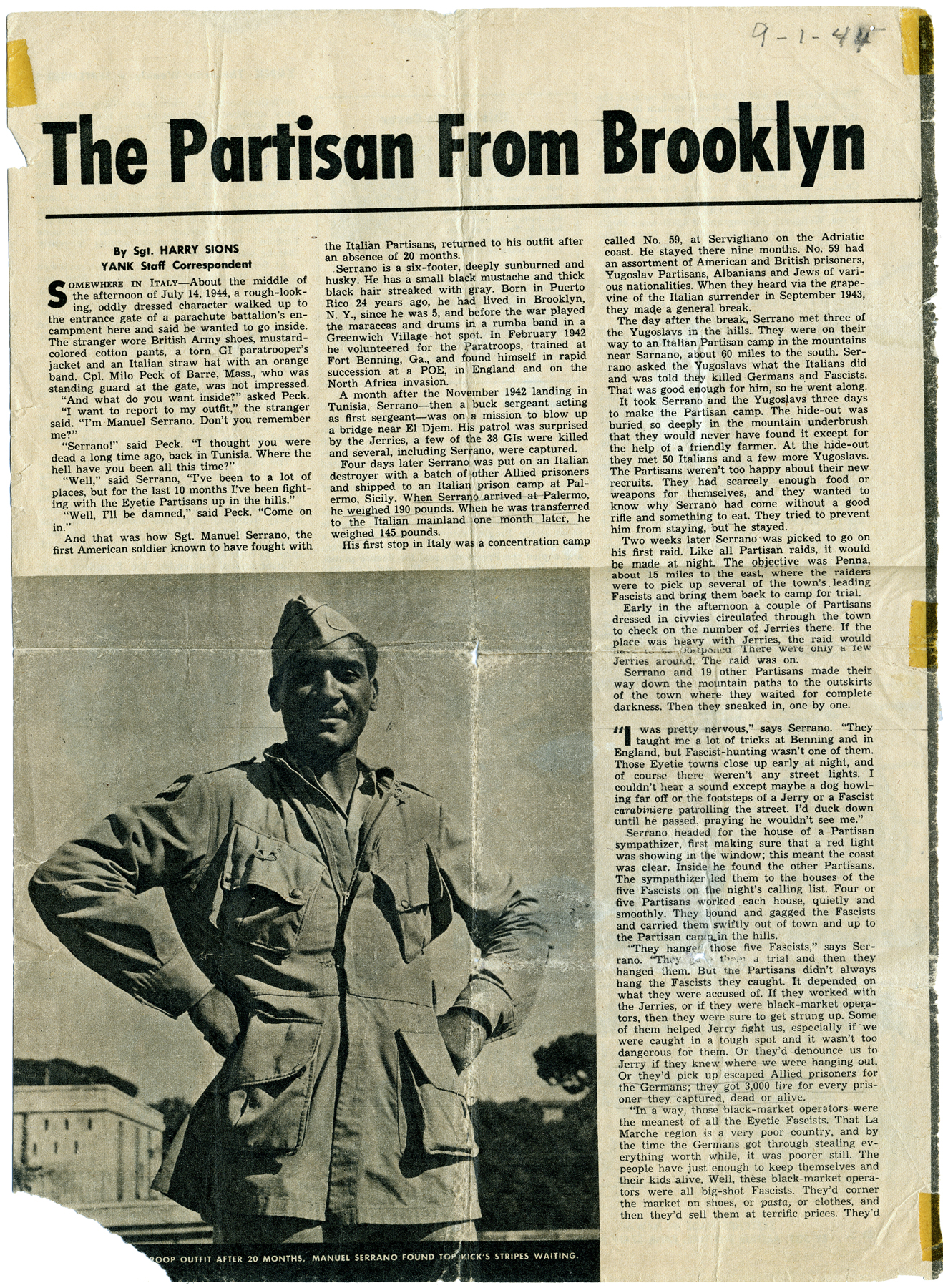
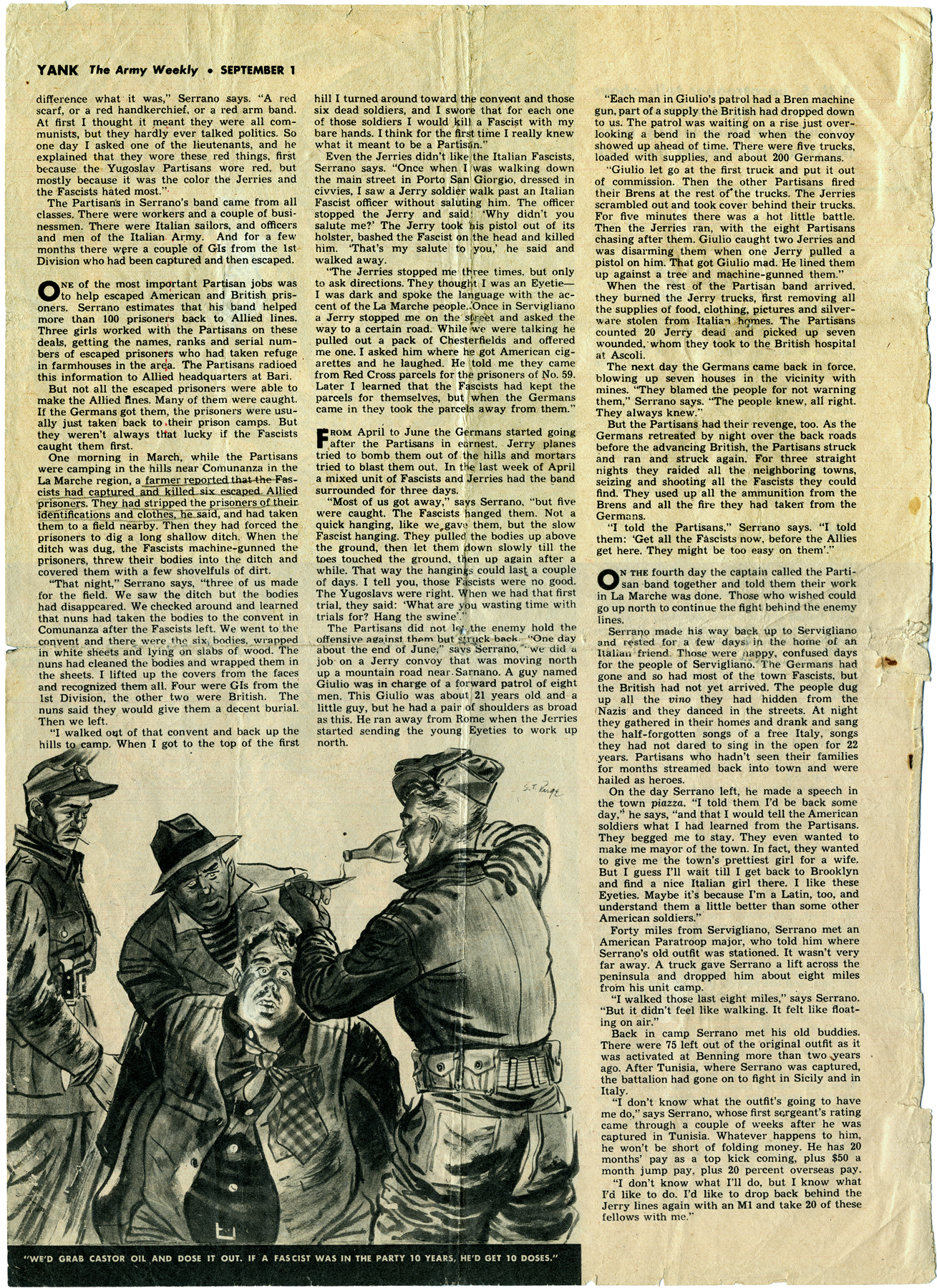
The Partisan from Brooklyn

My father, Armie Hill, kept a clipping from Yank magazine for many years. The article, dated September 1, 1944, is “The Partisan from Brooklyn,” by Sgt. Harry Sions. It tells the story of Manuel Serrano’s involvement with the Italian Partisan underground movement after his escape from Camp 59. Links to the three-page article are below.

What I know about Manuel Serrano is limited to information available through his enlistment and POW records at the National Archives:

Manuel S. Serrano was born in 1919. He enlisted in the army on February 5, 1942 at Fort Dix, New Jersey. His term of enlistment was “for the duration of the War or other emergency, plus six months, subject to the discretion of the President or otherwise according to the law.” He is listed as single and his education is given as “grammar school.” According to the record, he was Puerto Rican and a resident of King’s County, New York.

Serrano’s POW record at the Archives indicates he was a first sergeant in the Army Parachute Infantry, and that he served in the North African Theatre. The record confirms he was a prisoner at “CC 59 Ascoli Picenzo Italy 43-13.”

Yank magazine was published weekly by the U.S. Army during WW II. The magazine was written entirely by enlisted rank soldiers and it was available, for five cents per issue, to servicemen overseas.

Robert Dickinson Killed in Action

After his escape from Camp 59, gunner Robert Dickinson of the Royal Artillery spent time with an Italian family in Gassino in northern Italy. He joined the Partisans in October 1944, and fought with them against the German army until March 3, 1945, when he was mortally wounded. This article from the August 25, 1945 Lincolnshire Chronicle provides details of his death.

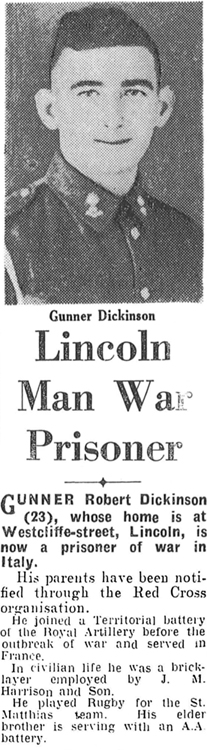
Robert Dickinson Taken Captive

Robert Dickinson joined the Royal Artillery in 1938. Following the outbreak of the war, he saw action in France and the Middle East. He was taken captive in Libya in November 1941 and was sent to Camp 59 in January 1942.

A letter to Robert’s family from the “Officer in charge of Records” confirmed his POW status, and on February 20, 1942, an article in the Lincolnshire Echo provided the local community with news of Robert’s captivity.

Letter to Edmond

This is a letter my Dad, Raymond Cox, wrote to a WWII vetern with whom he had served. He hand-wrote the letter himself sometime in the 1980’s. He always had me type the final draft.  He got the address for Edmond (?) from the POW Magazine, but, to my knowledge, never received a reply.

Click on the following link to read the letter.

letter-from-raymond-cox

Article by James M. Gifford, PhD

Several year ago, I told my friend, Dr. Jim Gifford, as much as I knew about my Dad’s experience in the WWII, and he thought it would make a wonderful story for publication. He wanted me to write the story. I kept telling him that I liked working with computers and accounting, but a writer I was not.  He is CEO and Senior Editor of the Jesse Stuart Foundation which specializes in publishing, selling, and promoting Appalachian values and literature. Finally, he said he would write the story with my help—with me providing the material and him writing. He even had a researcher try to locate my Dad’s debriefing in Washington, DC and College Park, MD. The military people with whom he talked said the debriefing had to have been extensive for him to have been kept in Europe for four months after being reunited with the Allied Forces. All to no avail, nothing was found.

Click on the following link to access Dr. Gifford’s article about my Dad:


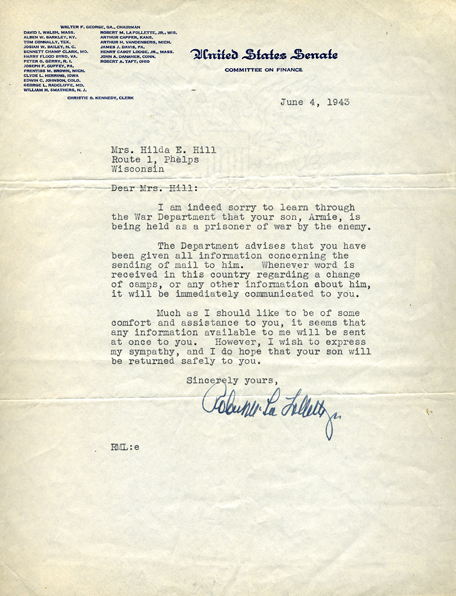
Sympathy of a Senator

In June 1943, U.S. Senator Robert M. La Follette, Jr. of Wisconsin wrote this letter to Hilda Hill expressing his sympathy and encouragement.

Robert M. La Follete, Jr. was elected to Congress in 1925 to fill the vacancy that resulted from the death of his father, Senator Robert M. (“Fighting Bob”) La Follette, Sr. “Young Bob” La Follette, as he was known, served in the U.S. Senate for over two decades.

In 1946, he ran unsuccessfully for reelection against Joseph McCarthy. He lost the 1946 election by about 5,000 votes.

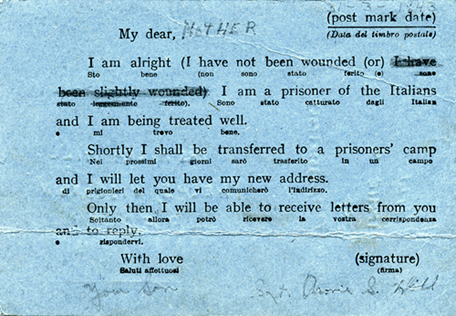
News of a Captured Son

This first word to reach Hilda Hill of her son Armie’s capture was a record of a broadcast by short wave radio from Berlin on March 24, 1943. Note that Armie’s name is given incorrectly as “Arnold” and “Arnie.”

The following postcard, sent from Camp 98 on Sicily, is dated March 31, 1943. The mimeographed form that accompanied the card was from Colonel Howard F. Bresee of the Prisoner of War Information Bureau in Washington, D.C.

This later correspondence from Colonel Bresee does not give a great deal of information, but it must have been a reassurance all the same.

Honoring Raymond Cox

Ethel Stafford speaks of her father, Raymond Cox, World War II prisoner of war, on November 2, 2006 at Fairland West Elementary School in Proctorville, Ohio.

At a Veterans Day 2006 assembly, Raymond E. Cox received a posthumous honor: the Prisoner of War Medal, a military decoration of the United States Armed Forces.

Eloise Cox accepted the medal on behalf of her husband.

The event was covered by The Daily Independent of Ashland. The article “WW II vet receives posthumous honor” is available online. The article tells the story of Raymond Cox’s emprisonment and escape, and how he was sheltered for nine months at an Italian farm by the family of Primo Mecossi.

The Prisoner of War Medal was authorized by Congress and signed into law by President Ronald Reagan in 1986. You can find more information about the medal at the “Prisoner of War Medal” entry on Wikipedia.