
This article and photo of my father appeared in the Williamson Daily News. He had been ill for some time with what is now know as PTSD. About this time he began sharing more of his experience in Italy and Camp 59.
Ethel Cox Stafford

This article and photo of my father appeared in the Williamson Daily News. He had been ill for some time with what is now know as PTSD. About this time he began sharing more of his experience in Italy and Camp 59.
Ethel Cox Stafford
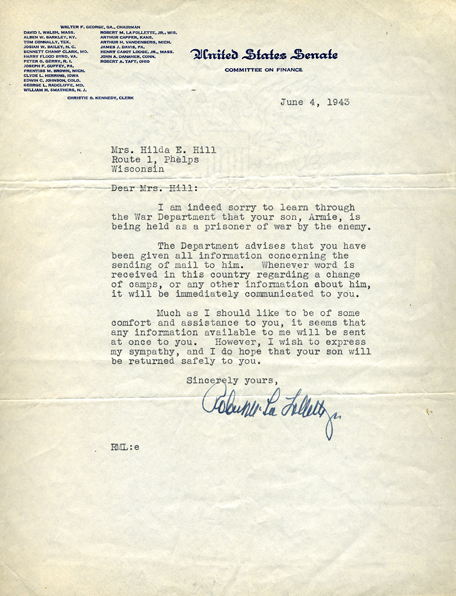
In June 1943, U.S. Senator Robert M. La Follette, Jr. of Wisconsin wrote this letter to Hilda Hill expressing his sympathy and encouragement.
Robert M. La Follete, Jr. was elected to Congress in 1925 to fill the vacancy that resulted from the death of his father, Senator Robert M. (“Fighting Bob”) La Follette, Sr. “Young Bob” La Follette, as he was known, served in the U.S. Senate for over two decades.
In 1946, he ran unsuccessfully for reelection against Joseph McCarthy. He lost the 1946 election by about 5,000 votes.

This first word to reach Hilda Hill of her son Armie’s capture was a record of a broadcast by short wave radio from Berlin on March 24, 1943. Note that Armie’s name is given incorrectly as “Arnold” and “Arnie.”

The following postcard, sent from Camp 98 on Sicily, is dated March 31, 1943. The mimeographed form that accompanied the card was from Colonel Howard F. Bresee of the Prisoner of War Information Bureau in Washington, D.C.
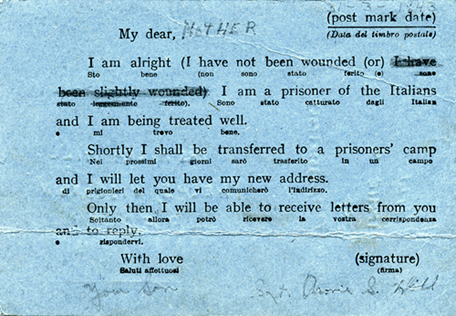

This later correspondence from Colonel Bresee does not give a great deal of information, but it must have been a reassurance all the same.

Ethel Stafford speaks of her father, Raymond Cox, World War II prisoner of war, on November 2, 2006 at Fairland West Elementary School in Proctorville, Ohio.
At a Veterans Day 2006 assembly, Raymond E. Cox received a posthumous honor: the Prisoner of War Medal, a military decoration of the United States Armed Forces.
Eloise Cox accepted the medal on behalf of her husband.
The event was covered by The Daily Independent of Ashland. The article “WW II vet receives posthumous honor” is available online. The article tells the story of Raymond Cox’s emprisonment and escape, and how he was sheltered for nine months at an Italian farm by the family of Primo Mecossi.
The Prisoner of War Medal was authorized by Congress and signed into law by President Ronald Reagan in 1986. You can find more information about the medal at the “Prisoner of War Medal” entry on Wikipedia.

This official military ID was issued to Armie on July 31, 1942, one month before he left the U.S. for the invasion of North Africa. Armie carried the ID during his imprisonment and during his crosscountry escape.
Of the two audio recordings of the POW experience that I made with my father, Armie Hill, this is the second, taped in 1987. Some stories from the first account are repeated here, but there are new details, too. The recall of some of the same events, such as the encounter with the man with the butcher knife in Roccafluvione and the crossing of the Pescara River, are subtly different.
Here is Armie’s 1987 account of the escape. It is a continuation of the entry describing the camp entitled “A First-Hand Account of Camp 59.”
“It was a bright moonlit night. All of a sudden there was shooting at the main gate and somebody got on the loud speaker and said, ‘The Germans are here taking over the camp.’
“He said, ‘Get out of here any way that you can. Try to get out!’ And he added, ‘God be with you.’
“I looked around. The guys were all milling around. They were running to the front gate. I had noticed someone had made a hole in the wall at the back. I think the Italians had helped to dig it out. They used big sledgehammers or something to knock the hole through the back wall. The Germans were there—they had just arrived there.
“I didn’t know who to go with and but I figured I was going to get through there, get outside the gate. I had quite a bit of food with me when I got outside. A bunch of us stood around. I told them, ‘We’re all safe here for now. But the best thing will be to get away from here fast as we can.’
“They said, ‘Let’s all go.’
“I said, ‘We can’t all go together, or surely we’ll all get caught. The best way is to break up into small groups. The best way is to break up into pairs—and each go in a little bit different direction. Some of us will get through.’
After the signing of the Armistice between the Allied and Italian forces in September 1943, security was relaxed in Camp 59 and the prisoners broke out and fled into the countryside. Armie Hill was among the men who escaped camp through a hole that had been battered in the prison wall.
In his dissertation on “Allied Prisoners of War in the Region of the Marche and Prison Camp at Servigliano,” Giuseppe Millozzi explains that British Captain J.H.D. Millar had kept hidden during his captivity a copy of a British SAS (Special Air Service) “escape map” of Italy. The maps had been printed on large handkerchiefs.
At the time of the breakout, copies of this map were hastily drawn. When Armie left the camp he had the following map, drawn on prison aerogram stationery. Most likely this map was copied from Captain Millar’s original map. Note that rivers were drawn in blue pencil and roadways in red.

I made two audio recordings of the prison experience with Armie Hill, who was my father. The first recording we made in 1976 and the second in 1987. Armie felt that he had left too many details out of the first recording, and so years later he was willing to retell the story and fill in those additional details.
Here is the 1976 account of the escape:
“The night of the escape was a mass confusion. I don’t really know how the escape came about, but at 10:30 in the evening men were running through the camp, calling out, ‘They have come to take us to Germany.’
“Someone must have taken control of the gate, and someone had battered a hole in one wall that was large enough for a man to escape through. Many of the men had slipped through this hole soon after the confusion began. I had been without food and water at Kasserine when I was separated from the army. I knew enough to prepare for this escape. I found two canteens—a British one and an American one—and I filled them with water. I found a sack and threw all the food I could find into it, and then I then crawled through the hole.
“On the outside the confused men didn’t know which way to go. I told them to just begin walking—to get as far away as possible before day. I felt it would be wise to either pair up or travel alone, but not to move in large groups. Numbers are easily noticed and captured, and if one or two were caught at least we wouldn’t all be recaptured.
“I saw Ben Farley. We decided to travel together. Ben was a Kentuckian. He and I hadn’t gotten along especially well earlier. Ben was among the men I had charge of in the camp. Once I was passing tobacco to the men and I had some black tobacco, which no one wanted. Ben said he’d take it. So the next time I passed out tobacco I gave the black to him and he was angry and said he didn’t like it.
“Ben hadn’t taken along supplies, so I gave him one of my canteens.
The following letters were sent by Armie Hill to his mother from Camp 59.
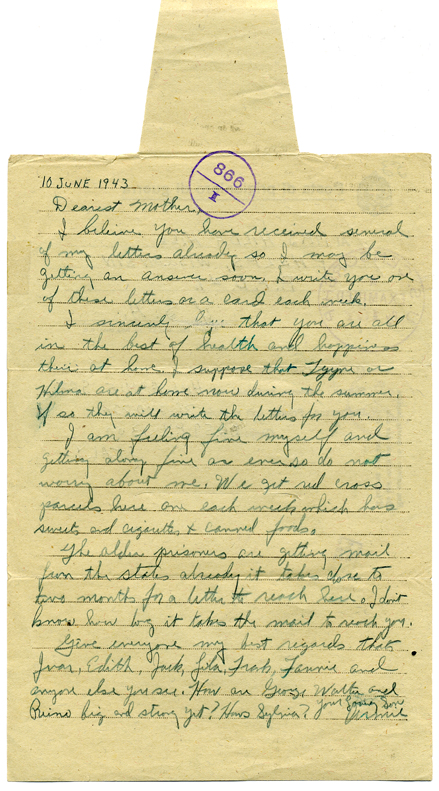

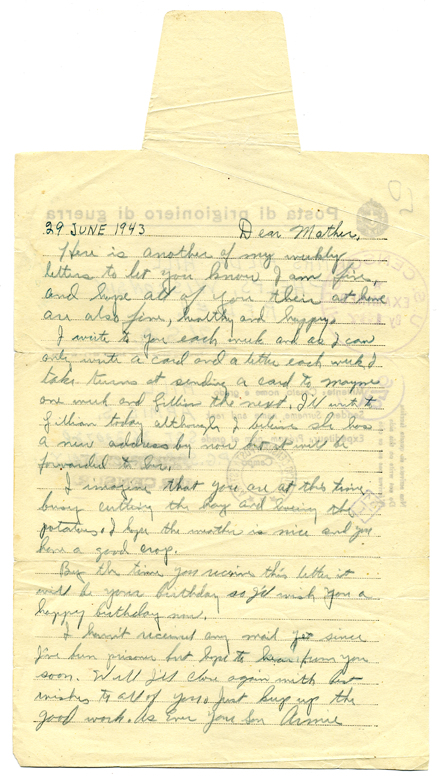
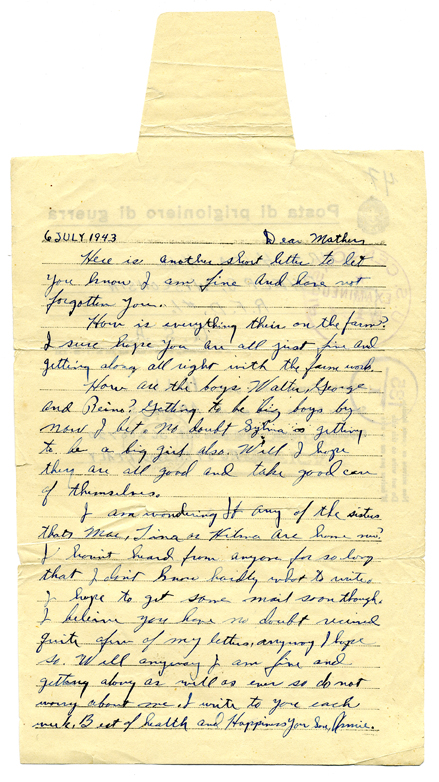
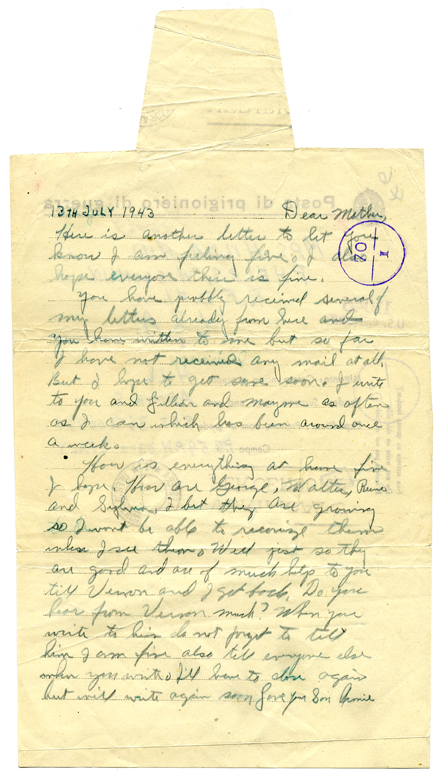
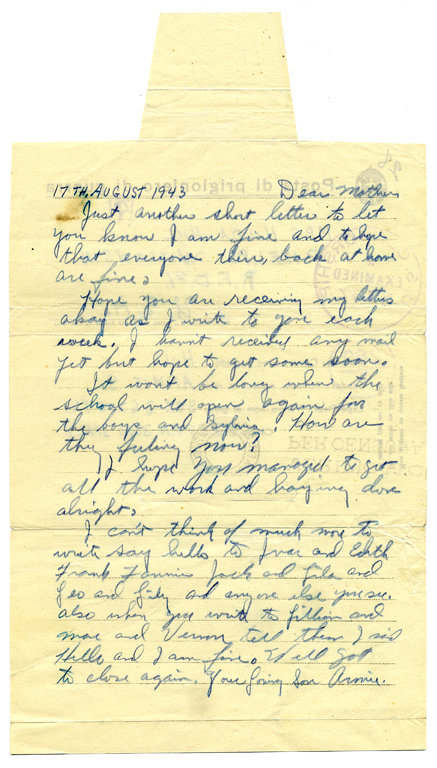
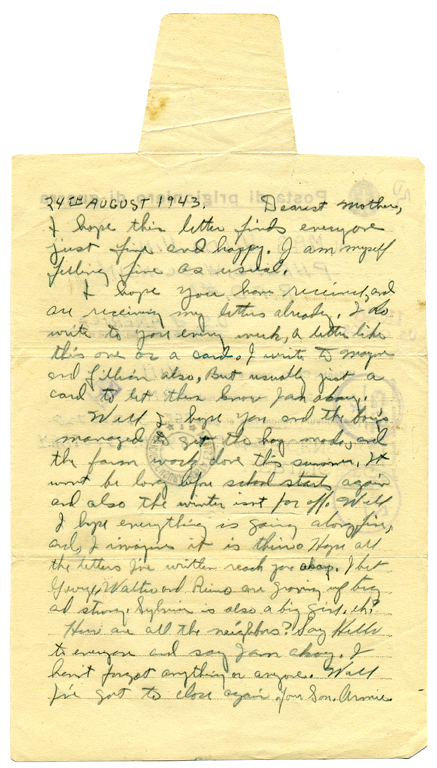
Armie was a son of Finnish immigrants Jack and Hilda Hill. Jack and Hilda met in Saint Louis County, Minnesota and lived in various farming and logging communities in Upper Michigan and northern Wisconsin. Armie was born in a Michigan logging camp.
Armie was the third of 10 children born to Jack and Hilda, and the eldest son. When his father died unexpected in 1937, Armie, then only 19 years old, took on a major role in caring for and supporting his family. In August 1938, Armie, who had been working since he graduated from eighth grade, purchased 40 acres of cleared land for a small family farm. With help from his brother Vernon and uncle Ivar, he built a log home for his mother.
Armie received an induction call in December 1940 and reported to duty the following month. He left home expecting to return in a year, but when the Japanese attacked Pearl Harbor in December 1941, Armie suddenly found himself in the Army for the duration of the war. Vernon went into the service, too. The absence of her two eldest boys was a great hardship for Hilda Hill.
Armie’s letters from Camp 59 betray a longing for the Wisconsin farm and a lonesomeness for family and neighbors. He imagines what is going on on the farm, “cutting the hay and hoeing the potatoes.” He inquires about his siblings. Armie’s four oldest sisters (Lillian, Mae, Tina, and Hilma) had left home and were working in Chicago and New York City. Ivar and Edith and Frank and Fannie were Armie’s uncles and their wives.
Armie mentions receiving Red Cross parcels once a week and offers reassurance that he is being well cared for.
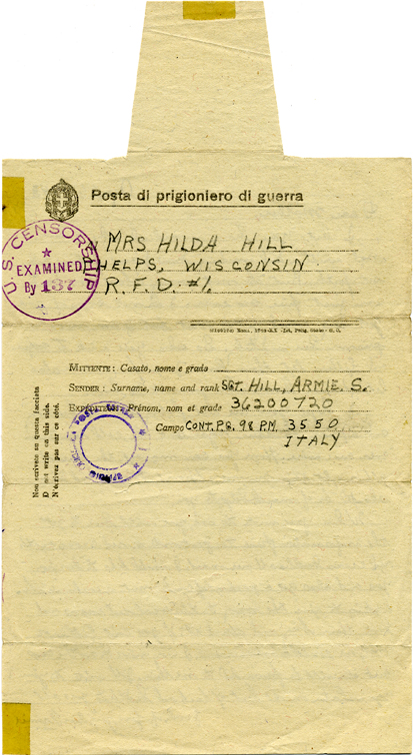
Each POW was entitled to send one postcard and one letter from camp each week. The letters were an early form of aerogram, a lightweight piece of paper that became its own envelope when folded. Note the shape of the following aerogram sent by Armie Hill from Camp 98 on Sicily to his mother.

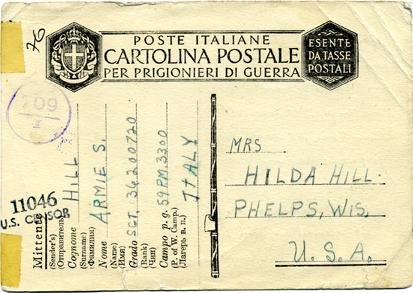
The following postcard was sent by Armie to his mother from Camp 59. Note the letters and cards are lined with 24 lines and 10 lines, respectively, thereby limiting the writer’s message space. Note also that the correspondence bears the stamps of both Italian and U.S. censors.


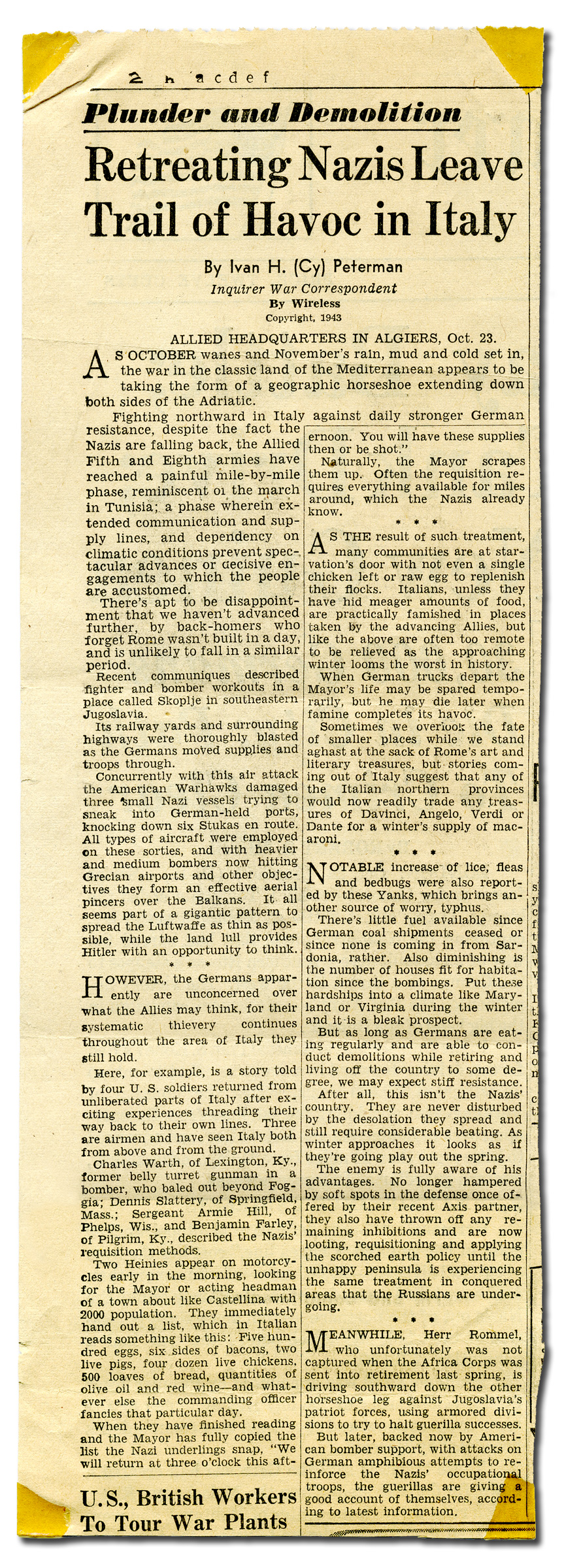
The attached clipping is one that Armie Hill had saved for many years. It is an article submitted for publication on October 23, 1943 to the Philadelphia Inquirer by the paper’s war correspondent Ivan H. (Cy) Peterman.
Armie and his traveling companion Ben Farley, who just reached British lines eight days earlier, served as informants for the story. As they traveled across Italy they had seen first-hand the dire situation of the Italian farmers and had heard stories of how poorly the Nazis were treating the Italians. Also serving as sources for the article were American servicemen Charles Warth and Dennis Slattery.
Click on the thumbnail below to view the full article (1MB).

Armie Hill kept a journal while he was in Camp 59. This journal contains some lines of poetry, a list of the men in Armie’s hut, two drawings, notes about his own personal interests, Italian lessons, and notes on technical English and sciences from the lectures prisoners gave to one another.
The journal also contains a diary of the first 10 days following the escape from Camp 59, as Armie and Ben Farley traveled cross country in their attempt to reach the landing Allied forces.
The following PDF file (4MB) contains scans of each page of the journal and ends with a section of explanatory notes:

