Category Archives: Rescue Efforts

I.S.9 Progress Reports for November 4–21, 1943

ROBB-Nov.-4-13-1943-r72

First page of the progress report issued on November 13, 1943

The transcription and notes in this post are by Dr. Luigi Donfrancesco, nephew of I.S.9 agent Andrea Scattini. Access to the two progress reports (from the British National Archives) was courtesy of researcher Brian Sims.

Following the September 8, 1943 Armistice, German Divisions promptly invaded Italy and took control of the military situation. In October 1943, from among the many who did not want to collaborate with the Germans, six Italian patriots reached the Allied lines of the 8th Army in just-liberated TERMOLI (Campobasso, Molise).

They were immediately enrolled as agents in the “A” FORCE (I.S.9, or Intelligence School 9, called “A” Force on that front) and assigned to the No. 5 FIELD SECTION, operating in the east along the Adriatic coast.

The six men formed group “RATBERRY SECTION A” of No. 5 FIELD SECTION, under the command of Intelligence Captain Andrew ROBB, who was from New Zealand.

The six original “RATBERRY” agents, often referred to as “the RATBERRY Boys,” were:

1) Hugh/Ugo – Uguccione RANIERI – age 37 – (born 1906 in Florence). Lieutenant, Italian Army; Count of Sorbello – Bourbon del Monte; from Perugia. As he was the eldest, highest in military rank, and was perfectly Italian-English bilingual, he served as the head of the group.

2) “Don” Domenico ORLANDINI, age 30 (born 1913 in Poiano di Villa Minozzo, Reggio Emilia). A Catholic priest; cover name “Carlo.”

3) Ermanno FINOCCHI – age unknown – (“Marina Velica”? – Navy Sailing?); from Grottammare, Ascoli Piceno. Nephew of “Colonel Dolfi” (Gustavo Dolfi, Captain of the Merchant Navy and chief partisan of San Benedetto del Tronto).

4) Andrea SCATTINI – age 26 – (born 1917 in Marina San Vito, Chieti, Abruzzo). Student in Medicine and Surgery. Soldier in the Medical Corps of Italian Army at Celio Military Hospital, Rome.

5) Fausto SIMONETTI – age 23 – (born 1920 in Palmiano di Venarotta, Ascoli Piceno). Student in Medicine and Surgery. Soldier (perhaps in the Medical Corps) of Italian Air Force.

6) “GUIDO” (surname unknown). From TERMOLI, Fausto SIMONETTI and GUIDO were landed at CUPRA MARITTIMA (Ascoli Piceno, Marche) on October 22, 1943.
Continue reading

I.S.9 Situation Report—November 3–4, 1943

SITREP_Nov _3-4_1943

SITREP [Situation Report] for November 3–4, 1943

Two years ago my friend researcher Brian Sims sent me a series of I.S.9 rescue operation diaries and situation reports from 1943–44 that he had copied in the British National Archives.

These documents give a detailed day-to-day (in some cases hour-to-hour) account of I.S.9 rescues of escaped POWs and evaders.

Recently, I shared these reports with Dr. Luigi DONFRANCESCO, nephew of I.S.9 agent Andrea Scattini.

He has transcribed the reports and added clarifications and additional information. Here is the first of a series of these document transcriptions that I will add to this site over the next several weeks.

I am grateful to Luigi for his careful attention to these documents.

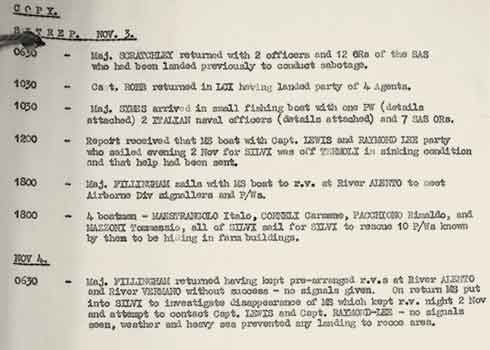
NOV. 3

0630 – Maj. SCRATCHLEY returned with 2 officers and 12 ORs [other ranks] of the SAS [Special Air Service] who had been landed previously to conduct sabotage.

1030 – Capt. ROBB returned in LCI [Landing Craft Infantry] having landed party of 4 Agents.

[Note from Luigi Donfrancesco. The four agents were: Uguccione RANIERI di Sorbello; Catholic Priest “Don” Domenico ORLANDINI (cover name “Carlo”); Ermanno FINOCCHI; and Andrea SCATTINI. From TERMOLI, they were landed at CUPRA MARITTIMA in the night of November 2, 1943. In her Diaries (published by Alessandro Perini) “Babka” says they arrived at 2:30 a.m. on November 3 at “Villa Boccabianca” (property of Count Zeno Vinci, Babka’s husband, and base of the “RATBERRY LINE – RAT LINE”), joining there Agent Fausto SIMONETTI, who was previously landed with “GUIDO” on October 22 and who had been waiting for them since October 29].

1030 – Maj. SYMES arrived in small fishing boat with one PW [prisoner of war] – (details attached), 2 ITALIAN naval officers (details attached) and 7 SAS [Special Air Service] ORs [other ranks].

1200 – Report received that MS boat [moto-silurante, or MAS (motoscafo armato silurante), torpedo motorboat] with [U.S. Army Air Force] Capt. [Richard W. B.] LEWIS and [French-British] Capt. RAYMOND LEE [COURAUD, commander of the “French Squad” of 2nd Special Air Service] party who sailed evening 2 Nov for SILVI was off TERMOLI in sinking condition and that help had been sent.

1800 – Maj. [John Francis] FILLINGHAM sails with MS to r.v. (rendezvous, appointment, or encounter] at River ALENTO [south of River PESCARA, just north of FRANCAVILLA] to meet Airborne Div [Division] signalers and P/Ws (Prisoners of War).

[Note in the entry below apparent misspelling of Italian names. Suggested corrections are in brackets.]

1800 – 4 boatmen – MAESTRANGOLO [probably MASTRANGELO] Italo, CORNELI Carmene [Carmine], PACCHIONO [the correct spelling could be PACCHIANO, PACCHIONE, or PACCHIONI] Rimaldo [Rinaldo] and MAZZONI Tommassio [Tommaso], all of SILVI, sail for SILVI to rescue 10 P/Ws [prisoners of war] known by them to be hiding in farm buildings.

NOV. 4

0630 – Maj. FILLINGHAM returned having kept pre-arranged r.v.s. [rendezvous] at River ALENTO and River VERMANO without success – no signals given. On return [of] MS put into SILVI to investigate disappearance of MS which kept r.v. [rendezvous] night 2 Nov. and attempt to contact Capt. LEWIS and Capt. RAYMOND-LEE – no signals seen, weather and heavy sea preventing any landing to recce [reconnaissance] area.

A Letter of Tribute to Andrea Scattini

uguccione-scattini_r72

In a letter written after the death of Andrea Scattini, Uguccione Ranieri di Sorbello (Bourbon del Monte) pays tribute to his comrade’s heroism and strength of character.

Following a transcript in Italian—immediately below—is the text of the letter translated into English by Luigi Donfrancesco, Andrea’s nephew.

21 marzo 1946. Nel dopoguerra il Tenente Uguccione Ranieri (di Sorbello) Bourbon Del Monte, al quale nel frattempo è stata conferita la Medaglia d’Argento, dal suo domicilio di Roma in Via Due Macelli 31, indirizza alla Commissione per il Riconoscimento della Qualifica di Partigiano di Ancona una relazione nella quale descrive l’opera del suo collaboratore Andrea Scattini durante la guerra di liberazione:

“E’ mio dovere segnalare a codesta Commissione l’opera di un mio collaboratore, Andrea SCATTINI, morto l’8 marzo 1944 nella guerra di liberazione.

L’8 settembre 1943, fuggito dai Tedeschi a Cento (Ferrara) dove prestavo servizio, riuscii a raggiungere Termoli, allora appena liberata, dove – previo assenso del nostro Comando di Stato Maggiore – presi servizio in un Comando inglese i cui compiti, di natura riservata, si svolgevano dietro le linee in territorio nemico.

Continue reading

Honor Recommended for Mario Mottes

mottes-silver-medal-1-r72

First page of a letter from Major Luigi Stipa recommending that I.S.9 agent Mario Mottes be posthumously awarded the Italian Silver Medal of Military Valor (Medaglia d’Argento al Valore Militare)

In January 1944, Sergeant Mario Mottes was wounded in the area of Montalto Marche during a parachute drop, when his parachute opened too late to prevent a violent landing.

He continued on his mission, and two months later, on March 10, 1944, he was arrested by the Germans and shot with three escaped Allied prisoners of war.

Major Luigi Stipa proposed the Italian Silver Medal of Military Valor (Medaglia d’Argento al Valore Militare) be awarded to Mario. His letter of recommendation details Mario’s valiant service.

Access to this document from the “Stipa Papers” came through Dr. Luigino Nespeca of Offida. Luigi Donfrancesco translated the Silver Medal nomination into English:

REPORT ATTACHED TO PROPOSAL OF SILVER MEDAL “TO MILITARY BRAVERY, IN MEMORIUM” to Sergeant Radio-Telegrapher Paratrooper of the Army Mario MOTTES

Name: MOTTES Mario
Born: Belgium, November 18, 1919
Degree: Sergeant R.T. Paratrooper
Unit: Royal Army, Battalion Paratroopers
Enrolled in force on January 17, 1944
Residence: PERGINE VALSUGANA (TRENTO)
Shot at MONTALTO (MARCHE) on March 10, 1944

Continue reading

Andrea Scattini—Youthful I.S.9 Agent

Scattini-Spoltore-1944_r72

Portrait of Andrea Scattini by Federico Spoltore, Lanciano, February 14, 1944

As a young man and a medical student, Andrea Scattini was enrolled in the Medical Corps of the Italian Army and assigned to the Celio Military Hospital, Rome, according to his nephew Luigi Donfrancesco.

In September 1943, after Italy signed the Armistice, Andrea was captured by Germans outside the hospital. He and several other young men were slated for transport to Germany when Andrea escaped.

He returned to his home in San Vito Chietino Marina, on the Adriatic coast.

In October 1943, in Termoli, Andrea offered his services to the Allies and was enrolled as an agent under Captain Andrew Robb, No. 5 Field Section, “A” Force (I.S.9). He was among the first small group of six Italians to be employed in that capacity (the others being Uguccione Ranieri di Sorbello, Don Domenico Orlandini, Ermanno Finocchi, Fausto Simonetti, and “Guido”—full name unknown).

Andrea’s mission was to organize escape “Rat-lines” and to guide former POWs to safety over land and along the Adriatic coastline.

This was named Plan RATBERRY Section “A”, No. 5 Field Section, and Andrea and the other agents of his group were often referred to as “the Ratberry boys.”

Luigi is trying to acquire documents with details of Andrea’s missions and activities as an “A” Force/I.S.9 agent in the Marche and Abruzzo regions.

In a No. 5 Field Section progress report from Lanciano, Captain Robb states that on December 21, 1943, Andrea arrived at the Allied lines of the New Zealand Division, taking with him ex-POW Lance Corporal “Spiro.”

In the same report, Captain Robb states Andrea is “one of the original planners of MILKY WAY.”

“MILKY WAY” was a plan to extend RATBERRY in other directions, north and possibly east, to take prisoners to Switzerland and/or Yugoslavia.

On March 8, 1944, at age 26, Andrea was killed in the village of Force—the victim of an apparent ambush.

Continue reading

Monument to Valiant Rescuers

war-memorial-r72

I recently exchanged several e-mails with Luigi Donfrancesco, who lives in Rome. His uncle, Andrea Scattini, was an Italian I.S.9 agent during the war.

I.S.9 was a sub-organization of special Allied operations unit “A” Force. I.S.9 formed escape chains to evacuate Allied escapers and evaders (E & Es) from enemy-occupied territory.

Luigi sent me photographs taken by Dr. Luigino Nespeca of a monument at Villa Stipa at Offida (Ascoli Piceno, Italy) that commemorates No. 5 Field Section of I.S.9, which produced the largest number of E & Es of any I.S.9 land unit in Italy.

See “I.S.9 History—Operations in Italy, Part 2” for detailed information on No. 5 Field Section.

Villa Stipa was one of the main bases of I.S.9 “Rat Line” rescues.

“My uncle Andrea Scattini is improperly placed with the shot [executed] patriots, but he should be with the fallen in service instead, because he was never captured,” Luigi clarified.

“Also, Don Domenico Orlandini was never shot nor dead (they erroneously thought so), but survived the war and died later in his sixties.”

Here are the names acknowledged on the memorial:

GUERRA DI LIBERAZIONE [War of Liberation]

N.5 A FORCE FED. SEC C OCAO.
A.M.G. MAGG. ROBB E CAP. R. W. LEWIS [Allied Military Government, Major (maggiore in Italian) A. Robb and U.S. Army Air Force Captain R. W. B. Lewis]
COMANDO RAT LINE
COMANDANTE CAP. G.A.R.I. [Genio Aeronautico Ruolo Ingegneri, Aeronautical Engineer Corps] STIPA LUIGI
COLLEGAMENTO VIA RADIO
CON ALGERI BARI E LANCIANO [wireless connection, Algiers with Bari and Lanciano]
SETTEMBRE 1943—18 GIUGNO 1944 [September 1943 to June 18, 1944]

Continue reading

A Rescue Mission Gone Awry

squadra-di-calcio_r72

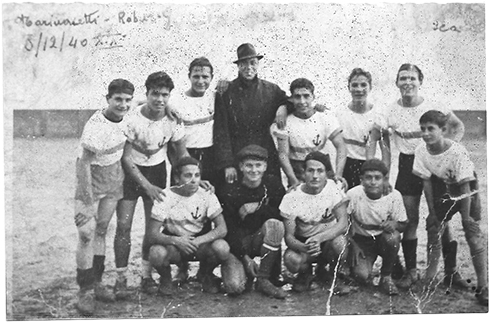
Giovanni Nebbia with the football team he organized at his Marine School (Scuola di Avviamento Marinaro). The photo was taken in the year they won a championship. December 3, 1940.

In 2005, at a ceremony in Monte Urano, Italy, to honour Ken de Souza—a former POW and author of Escape from Ascoli, which Annelisa Nebbia translated from English into Italian—Annelisa shared an account of a rescue mission her father experienced that nearly ended in tragedy.

Annelisa’s speech is here translated into English:

“Missions to rescue escaping POWs from the Adriactic coast frequently failed due to the Italian captains’ lack of local knowledge, resulting in their being unable to find the exact point of the coastline where escapers were to be picked up.

“Allied Headquarters in Termoli asked Elio Tremaroli—who worked for them and crossed the lines [into enemy-occupied territory] continuously—if he knew somebody who was truly an expert on the Adriatic coast.

Continue reading

I.S.9 Captain Uguccione Ranieri di Sorbello

Uguccione-Ranieri-di-Sorbello_r72

Uguccione Ranieri di Sorbello

Many of the stories on this site concerning the protection of escaped POWs describe the brave actions of the contadini, the poor farmers of central Italy.

But people from other strata of Italian society were also involved in the rescue of escapees and evaders. Uguccione Ranieri di Sorbello, the son of R. Ranieri Bourbon del Monte, Marquis of Sorbello, and of Romeyne Robert, an American, is one example of an aristocrat and scholar who lent his expertise and means to the cause of rescuing these stranded soldiers.

A document recommending an award for Uguccione, now in the British National Archives (provided by researcher Brian Sims), has this to say about Uguccione’s service:

“From early November, 1943 until June, 1944 this officer worked behind the lines organising the escape of Allied P/W and showed great personal courage and disregard of danger. On one occasion when the land escape route was disrupted due to enemy vigilance and activity he successfully arranged the evacuation by fishing boat of 27 P/Ws. He was constantly aware of the atrocities committed against P/W by the Germans and Fascists and did all in his power to alleviate the plight of these prisoners. Through the partisans he pursued the originators of these atrocities and saw to it that a number met a proper fate. His energy and extreme loyalty was an inspiration to the many Italian soldiers who worked alongside him.”

In 1945, Uguccione was decorated with a silver medal for valor—and, in 1949, a Ministry of Defense bronze medal—for his rescue and recovery involvement.

I am grateful to Uguccione’s son, Professor Ruggero Ranieri, for allowing me to share on this site the following paper about his father.

The role of Uguccione Ranieri di Sorbello in the operations of the Ratline (Marche and Abruzzi)

1. Sources used

There are two main sources on the history of the Adriatic coast Ratline, which was active between December 1943 and June 1944. One consists of the documents of IS9 itself, which are kept at the NA in Kew Garden. The documentation is fairly vast, but there are two important files covering the key events: Major Fillingham’s report and the Newsletter of IS9 itself, printed every fortnight with news from the various battle fronts, or better from the various Field Section in which A-Force was divided.

Continue reading

Official Advice to Escapers and Evaders

“…one thing is essential, namely a stout heart.”

A bulletin of tips for escapers and evaders (E&Es) behind enemy lines in Italy was issued from the “N” Section unit of “A” Force C.M.F. (Central Mediterranean Force) in February 1944.

This “most secret” document was evidently intended for agents involved in directly assisting E&Es behind the lines. Agents were to read the document and later use the information in coaching E&Es one-on-one in how to avoid capture and find their way to freedom.

The following three paragraphs from the “I.S.9 History—Organization” post will help to clarify the organization of “A” Force as it evolved during the war.

“In order not to confuse the reader more than is necessary it is explained that M.I.9 [British Directorate of Military Intelligence Section 9] work in the Mediterranean Theatre of Operations first started early in 1941 and was carried out by ‘A’ Force, commanded by Lt-Col [lieutenant-colonel] (later Brigadier) D.W. CLARKE, CBE. A few months later, ‘N’ Section was set up in Cairo as a separate Section of ‘A’ Force and Major (later Lieut-Col) A.C. SIMONDS, OBE, placed in charge of all M.I.9 duties in the Mediterranean Command.

“On the 1st November 1943 ‘N’ Section ‘A’ Force was divided into EAST and WEST, Lt-Col. A.C. SIMONDS being placed in charge of ‘N’ Section ‘A’ Force (EAST) and S/Ldr [Squadron Leader] (later W/Cdr [wing commander]) E.A. DENNIS, OBE, placed in charge of ‘N’ Section ‘A’ Force (WEST).

“On the 20th August 1944 responsibility for M.I.9 work in the Mediterranean Theatre passed from ‘A’ Force and became the responsibility of G-2 (P/W) AFHQ. ‘N’ Section ‘A’ Force title was changed and became I.S.9 [Intelligence School 9], the initials (ME) and (CMF) indicating (East) and (West) respectively.”

Therefore, “N” Section is essentially synonymous with I.S.9.

I am most grateful to researcher Brian Sims for sharing access to this bulletin from the British National Archives, as well as I.S.9 documents that give the bulletin fuller context.

There is the bulletin in its entirety:

MOST SECRET
OFFICER ONLY

‘N’ SECTION
Adv. H.Q. “A” Force
c/o No. 2 District H.Q.
C.M.F.

10th February, 1944.

BULLETIN NO. 21

The following are a few hints to Escapers and Evaders in Italy. They are the suggestions of an “A” Force Officer who, out of less than five months service in Italy spent more than three of them behind enemy lines. They are comments by an officer who spent many months with “A” Force patrols operating behind Rommel’s lines in the Western Desert and at one time he escaped from Tortorette Prison Camp after having been taken prisoner.

Continue reading

“Courage of the Very Highest Order”

The following letter recommending formal decoration of an Italian youth was sent to British authorities from “the field” of Italy in January 1944 by Captain B. G. McGibbon-Lewis, The Black Watch, Royal Highland Regiment.

The letter is a moving tribute to 18-year-old Franco Scoletta, who valiantly served I.S.9 (‘A’ Force) in escaped POWs rescue operations.

The document, from the British National Archives, is courtesy of Brian Sims.

Franco Scoletta

This Italian boy of 18 has worked with me since September 15th, 1943, up until December 1st, 1943. I picked him, whilst escaping from German-occupied ITALY, on the train from ANCONA to PESCARA. He told me he was disgusted with ITALY and the inhabitants and his one object was to reach and work for the BRITISH in whatever capacity they saw fit. When I was enrolled as a temporary member of ‘A’ Force I brought him with me. I arranged he should be paid 2000 Lire a month and he could receive 1000 Lire per P/W as arranged for all ITALIAN agents on operation SIMCOL. He has refused to accept any of this on the grounds that his motives are not financial. He accompanied Major McKEE, M.C. and myself on our first operation for 14 days and proved himself to be of invaluable assistance. He showed no fear when crossing the lines and was willing to do anything we asked of him. Frequently he had to approach ‘doubtful’ ITALIANS and he never refused any order or request given him. On our return we went to GULIONESE to pull thorough the lines the P/Ws we had left on the other side. SCOLETTA went through again and was responsible for some twenty to thirty getting through safely. He was captured by the GERMANS with 5 P.O.Ws, and by driving into a WADI not only escaped himself but enabled the P/Ws to do so as well. He then returned with a sprained knee to me with four P/Ws. Within two days he was back the other side again and succeeded in liberating the remains of an American Bomber crew. On each of these occasions he brought back Military Information of great use which I handed on to 36 Brigade, this included details of gun positions and mines on that front.

Continue reading