Category Archives: Servigliano Calling

“Servigliano Calling” Poem #19

What better day than December 31 to post this powerful poem by C.A. Hollis, “Wasted Years,” from “Servigliano Calling”?

The first three stanzas condemn greed, hatred, and human failings as the cause of wasted years.

Then, the final stanza offers a glimmer of hope as “Nations unite, together fight/This useless waste to banish.” These young men’s sacrifice of the best years of their lives will ensure a future “happy and free” for all.

The poem is rich with allegorical figures: Peace weeping, Mars (god of war) ruling supreme, Death reaping human lives, and Hate planting the seeds of enslavement.

Wasted Years

Peace is weeping, progress is sleeping,
Mars is ruling the world.
Death’s scythe is creeping, and steadily reaping,
Since the war flags were unfurled.
We are back upon the track,
That leads to death and tears,
Thrones and tumbling, guns are rumbling,
Now’s the time of wasted years.

Man’s intentions, and inventions
Are enlisted in the course to kill.
Human greed, and ill-famed deed
Has conquered human will.
Lack of trust, in human dust,
T’is the point of all our fears.
Love of sword, before the word,
Is the cause of wasted years.

Wasted cities; —useless pities
Do not upbuild them all anew.
Rape and raving, starvation, craving,
Make this world a hellish brew.
Desolation, pestilation,
Overhead annihilation rears.
Hate planted the seed, of this enslaving weed,
The cause of wasted years.

Nations unite, together fight
This useless waste to banish.
Trust each other, call all brother,
Fears will then all banish.
Use your resources, and all your forces,
To make war disappear.
United you’ll be, happy and free,
And ne’er have a wasted year.
“Servigliano Calling” Poem #18

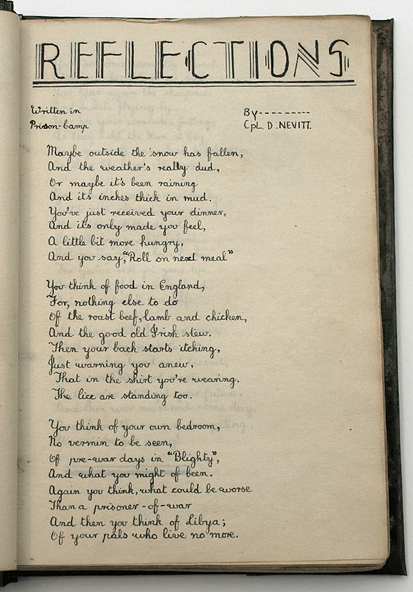
Eight poems by Cpl. D. Nevitt were included by Robert Dickinson in his prison camp journal, “Servigliano Calling.”

During the holidays, when we are reminded in song that “there is no place like home” and when we feast and make merry with loved ones, Corporal Nevitt’s poem and the other four others I have posted today have a special poignancy.

These poems reflect love of England, craving for home and family, and optimism that the war would one day end and normal civilian life would resume.

Reflections

Maybe outside the snow has fallen,
And the weather’s really dud,
Or maybe it’s been raining
And it’s inches thick in mud.
You’ve just received your dinner,
And it’s only made you feel,
A little bit more hungry,
And you say, “Roll on next meal”

You think of food in England,
For, nothing else to do
Of the roast beef, lamb and chicken,
And the good old Irish stew.
Then your back starts itching,
Just warning you anew,
That in the shirt you’re wearing,
The lice are standing too.

You think of your own bedroom,
No vermin to be seen,
Of pre-war days in “Blighty”,
And what you might have been.
Again you think, what could be worse
Than a prisoner-of-war
And then you think of Libya;
Of your pals who live no more.

Continue reading

“Servigliano Calling” Poem #17

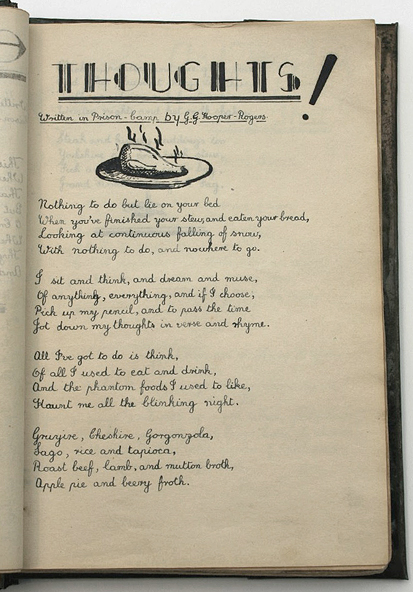
This delightful poem by C.G. Hooper-Rogers is a veritable menu of delicious (and profoundly missed) foods.

Hooper-Rogers wrote two poems recorded in “Servigliano Calling,” and he co-authored a third with Alec Forman. Although on this page his initials appear to be G.G., the other two poems clearly list his initials as C.G.

Thoughts

Nothing to do but lie on your bed
When you’ve finished your stew, and eaten your bread,
Looking at continuous falling of snow,
With nothing to do, and nowhere to go.

I sit and think, and dream and muse,
Of anything, everything, and if I choose,
Pick up my pencil, and to pass the time
Jot down my thoughts in verse and rhyme.

All I’ve got to do is think,
Of all I used to eat and drink,
And the phantom foods I used to like,
Haunt me all the blinking night.

Gruyère, Cheshire, Gorgonzola,
Sago, rice and tapioca,
Roast beef, lamb, and mutton broth,
Apple pie and beery froth.

Chicken, potatoes and nice green peas
And other pleasant things like these,
Trifle, pastries, rich fruit cakes,
Winter nights and hot milk shakes.

Steak and kidney puddings too
Yorkshire pud and Irish stew,
Fish and chips in paper bag,
Grand Finale—English fag.

“Servigliano Calling” Poem #16

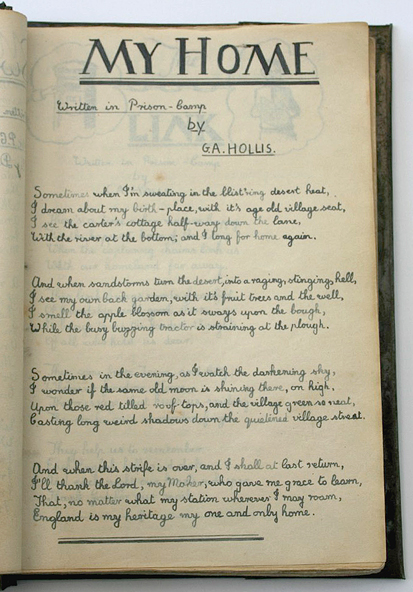
Six poems by G.A. Hollis appear in “Servigliano Calling,” Robert Dickinson’s journal.

My Home

Sometimes when I’m sweating in the blist’ring desert heat,
I dream about my birth-place, with it’s age old village seat,
I see the carter’s cottage half-way down the lane,
With the river at the bottom; and I long for home again.

And when sandstorms turn the desert into a raging, stinging hell,
I see my own back garden, with it’s fruit trees and the well,
I smell the apple blossom as it sways upon the bough,
While the busy buzzing tractor is straining at the plough.

Sometimes in the evening, as I watch the darkening sky,
I wonder if the same old moon is shining there, on high,
Upon those red tiled roof-tops, and the village green so neat,
Casting long weird shadows down the quilined village street.

And when this strife is over, and I shall at last return,
I’ll thank the Lord, my Maker, who gave me grace to learn,
That, no matter what my station wherever I may roam,
England is my heritage my one and only home.

“Servigliano Calling” Poem #15

This poem of longing for England is one of three poems in “Servigliano Calling” by Denis Crooks of Southend-on-Sea, Essex.

England

This place of heat and sun and sand!
When shall that day return
That I shall no more tread this land,
But that for which I yearn!
O England mine—my home, my love,
When shall I see thee more?
Thy pleasant fields, white clouds above,
And sea-encircled shore.

“Servigliano Calling” Poem #14

“Memories of Home” is one of three poems by Bombardier P.G. Whapples recorded in Robert Dickinson’s journal.

Memories of Home

Imagine a cool, new forest dell
Your turn at the lane, then at the well,
Into nature’s own store,
The earth as a floor,
Where nothing has changed ten decades or more.
Amongst stately trees,
In a clean healthy breeze,
Mingling with song the humming of bees.

A myriad of colours stretch into the deep,
Of a forest, or listen! The bleating of sheep,
That have wandered astray,
In the heat of the day,
Unknown to the shepherd, asleep in the hay.
Then a dog’s heavy bark,
Or the song of a lark,
Comes through the twilight, before the dark.

While musing of this, ’tis a fine English day,
Where my friends are all happy—and I far away,
In a country way up in the hills, very cold,
In the land where Vesuvius bursts, we are told,
In a cold prison-camp, just over the foam,
From England, and you, and all that is home.

Robert Dickinson’s Address List

dickinson_diary_angle_2001

addresses_r300

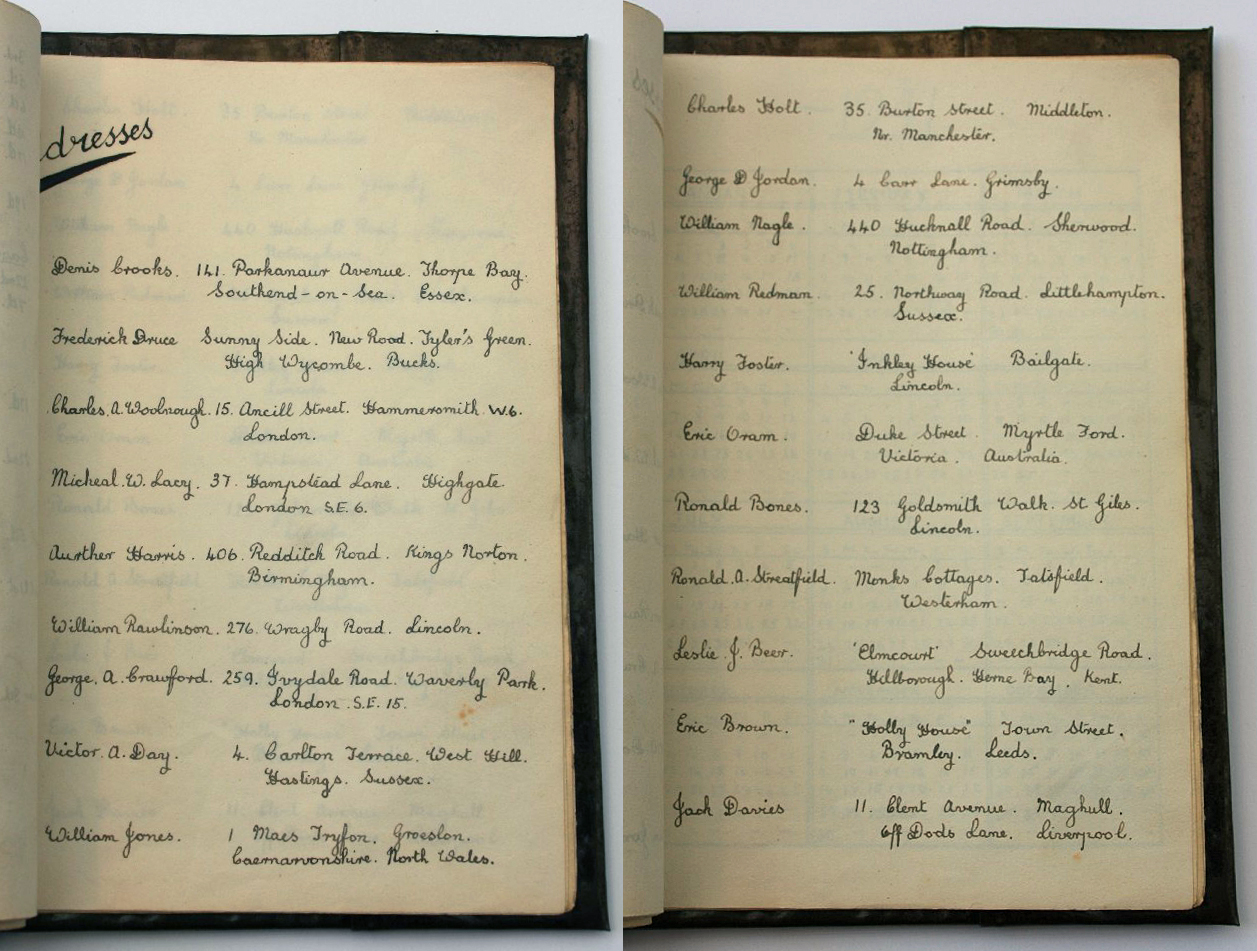
Two pages of Robert Dickinson’s journal, “Servigliano Calling,” contain names and addresses of 20 fellow prisoners. These are listed here:

Denis Crooks

141. Parkanaur Avenue. Thorpe Bay.

Southend-on-Sea. Essex.

Frederick Druce
Sunny Side. New Road. Tyler’s Green.
High Wycombe. Bucks.

Charles A. Woolnough
15. Ancill Street. Hammersmith. W.6.
London

Micheal W. Lacy
37. Hampstead Lane. Highgate.
London S.E.6.

Continue reading

The “Servigliano Calling” Poets

Robert Dickinson’s journal, “Servigliano Calling,” contains 34 poems. The ten identified poets whose works appear in the journal are: 

C.A. Hollis, J.R. Cromley, Corporal D. Nevitt, Denis Crooks, G.A. Crawford, C.G. Hooper-Rogers, Alec. Forman (A. Forman), Bombardier P.G. Whapples, Harry Stewart (H. Stewart), and F. Chiltern. 

One poem, The Alphabet, is simply attributed to “a South African.”

Only the addresses of two of the poets are recorded in the journal. They are:

Denis Crooks
141. Parkanaur Avenue. Thorpe Bay.
Southend-on-Sea. Essex.

George A. Crawford
259. Ivydale Road. Waverly Park.
London. S.E. 15.

Continue reading

“Servigliano Calling” Camp Poem #13

dickinson_diary_angle_2001

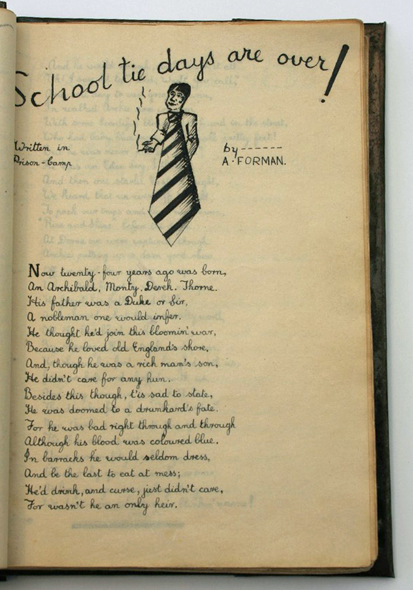
This clever poem pokes fun at early 1940s British class structure, but then reflects on how in time of crisis men are brothers and “personality’s what you are.” It is one of four poems by A. Forman in Robert Dickinson’s diary.

038_school_r150

School tie days are over!

Now twenty-four years ago was born,
An Archibald. Monty. Derek. Thorne.
His father was a Duke or Sir,
A nobleman one would infer,
He thought he’d join this bloomin’ war,
Because he loved old England’s shore.
And, though he was a rich man’s son,
He didn’t care for any hun.
Besides this though, t’is sad to state,
He was doomed to a drunkard’s fate.
For he was bad right through and through
Although his blood was coloured blue.
Continue reading

Letters from Loved Ones

dickinson_diary-ida_angle_200

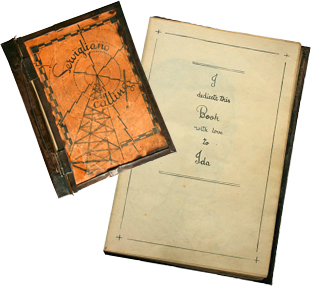
Following the fancy title page of Robert Dickinson’s journal is a simple, full-page inscription, which reads: “I dedicate this Book with love to Ida.”

Farther into Robert’s journal is a six-page record of the 225 letters Robert received while he was in Servigliano Camp 59, Bonservizi Camp 53, Casanova Elvo Camp 106, and Gassino Camp 112.

Dates for receipt of the letters are March 30, 1942 to September 8, 1943. Letters from Robert’s sweetheart Ida (129 in all) account for the greatest number.

On the one Valentine’s Day within this 18 month period (February 14, 1943) Robert received a letter from Ida, which she had written on January 18. Some letters, delayed for unknown reasons (particularly at the latter two camps) arrived all in one day. Sometimes four, five, or six letters—usually from Ida—arrived all at once.

Robert and the other prisoners eagerly anticipated arrival of mail. Robert wrote in his diary on March 30, 1942, “At last the long awaited mail!!!”

There were 57 letters from home.

Continue reading