Category Archives: Robert Dickinson

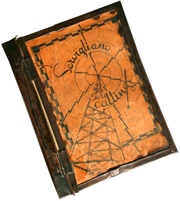
“Servigliano Calling” Poem #15

This poem of longing for England is one of three poems in “Servigliano Calling” by Denis Crooks of Southend-on-Sea, Essex.

England

This place of heat and sun and sand!
When shall that day return
That I shall no more tread this land,
But that for which I yearn!
O England mine—my home, my love,
When shall I see thee more?
Thy pleasant fields, white clouds above,
And sea-encircled shore.

“Servigliano Calling” Poem #14

“Memories of Home” is one of three poems by Bombardier P.G. Whapples recorded in Robert Dickinson’s journal.

Memories of Home

Imagine a cool, new forest dell
Your turn at the lane, then at the well,
Into nature’s own store,
The earth as a floor,
Where nothing has changed ten decades or more.
Amongst stately trees,
In a clean healthy breeze,
Mingling with song the humming of bees.

A myriad of colours stretch into the deep,
Of a forest, or listen! The bleating of sheep,
That have wandered astray,
In the heat of the day,
Unknown to the shepherd, asleep in the hay.
Then a dog’s heavy bark,
Or the song of a lark,
Comes through the twilight, before the dark.

While musing of this, ’tis a fine English day,
Where my friends are all happy—and I far away,
In a country way up in the hills, very cold,
In the land where Vesuvius bursts, we are told,
In a cold prison-camp, just over the foam,
From England, and you, and all that is home.

Remembering Robert Dickinson

milan-steve_r150

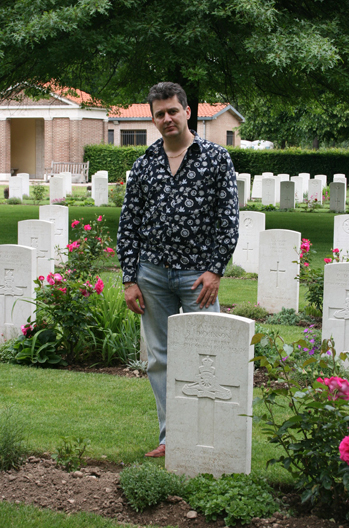
Steve Dickinson at the grave of his uncle, Robert Dickinson, in Milan War Cemetery. May 2009.

After escaping from prison camp, Robert Dickinson was sheltered by a family in Gassino (a small town near Turin in northern Italy).

Steve Dickinson, Robert’s nephew, believes he was hidden by a family with the surname of Bauducco at a farmhouse on Via Armando Diaz in Gassino. (A loose page in Robert’s diary, “Servigliano Calling,” bears the address of “Bauducco, Via A. Diaz, Gassino.”)

While in Gassino, Robert fought with the Italian Partisans against the German forces. He was killed in action on March 3, 1945. Initially, he was laid to rest by his Partisan comrades in Viali Cemetery in the town of Asti. After the war Robert’s body was moved to the Milan War Cemetery.

Steve Dickinson first visited Robert’s grave in August 1992. This month he made a return visit to the cemetery.

He also traveled to Gassino. In advance of his trip, Steve created “request for information” leaflets, translated by an Italian friend into Italian, for distribution in Gassino.

On returning to his home in the UK, Steve wrote:

“Spent some time in the village where Robert was hidden and left some of the fliers in various places. Several shops including the pharmacy said they would put them in their windows. Also left many in post boxes on Via Armando Diaz. Doubt I’ll get a reply but given the visit I had to try.

“Following this I visited Robert’s grave in Milan. I was greatly pleased to see that the cemetery was as well kept as when I had previously visited. In fact, probably better as the roses were in full bloom. As with my previous visit it was a moving experience. I probably spent an hour walking around the cemetery taking photos and reading/observing the graves. I found 5 graves buried all together, these being the crew of a plane shot down over Italy. Also found another grave of one of the Lincolnshire’s due to the Lincolnshire’s emblem (The Sphinx) on his gravestone.”

milan_064_r150

Robert Dickinson’s Address List

dickinson_diary_angle_2001

addresses_r300

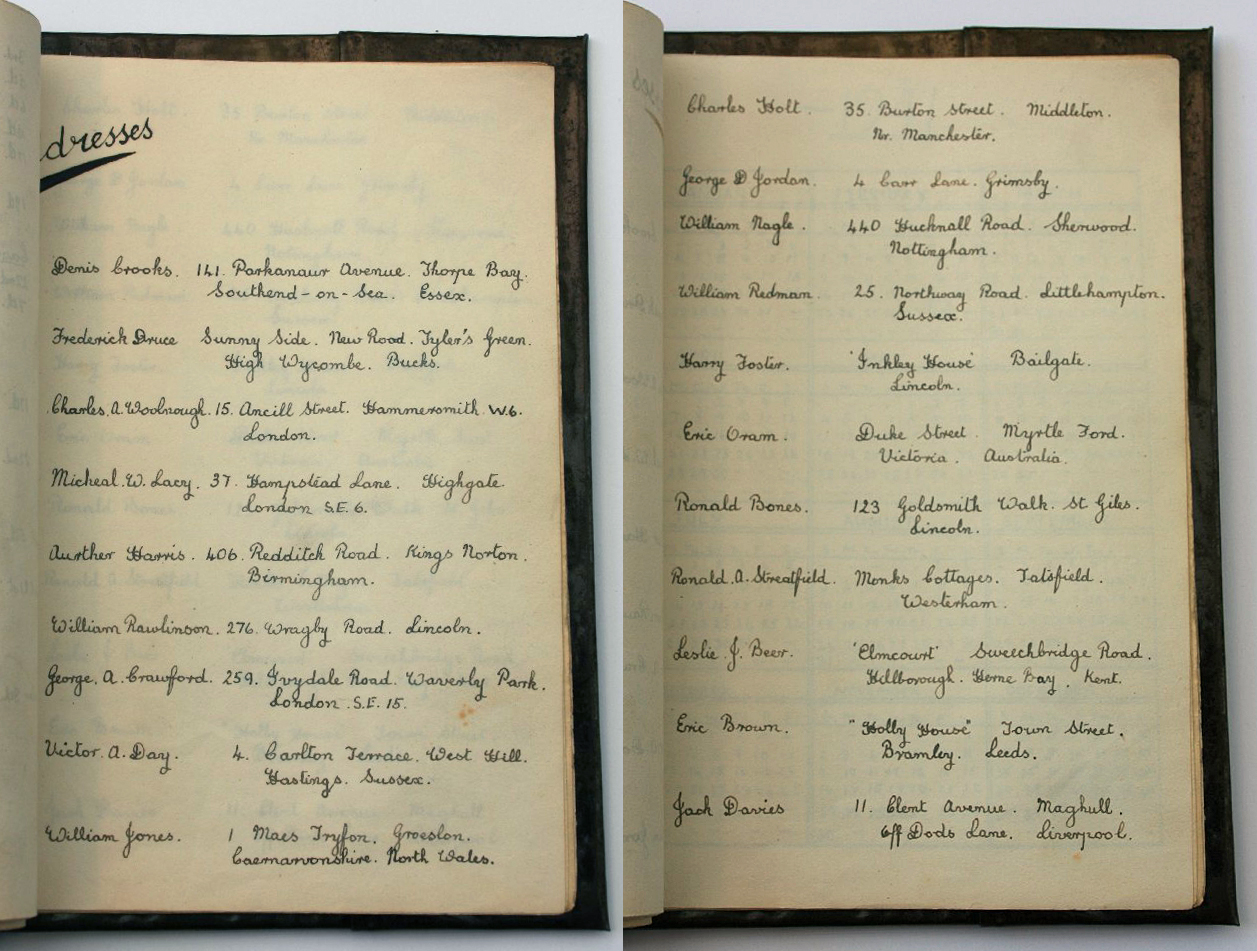
Two pages of Robert Dickinson’s journal, “Servigliano Calling,” contain names and addresses of 20 fellow prisoners. These are listed here:

Denis Crooks

141. Parkanaur Avenue. Thorpe Bay.

Southend-on-Sea. Essex.

Frederick Druce
Sunny Side. New Road. Tyler’s Green.
High Wycombe. Bucks.

Charles A. Woolnough
15. Ancill Street. Hammersmith. W.6.
London

Micheal W. Lacy
37. Hampstead Lane. Highgate.
London S.E.6.

Continue reading

The “Servigliano Calling” Poets

Robert Dickinson’s journal, “Servigliano Calling,” contains 34 poems. The ten identified poets whose works appear in the journal are: 

C.A. Hollis, J.R. Cromley, Corporal D. Nevitt, Denis Crooks, G.A. Crawford, C.G. Hooper-Rogers, Alec. Forman (A. Forman), Bombardier P.G. Whapples, Harry Stewart (H. Stewart), and F. Chiltern. 

One poem, The Alphabet, is simply attributed to “a South African.”

Only the addresses of two of the poets are recorded in the journal. They are:

Denis Crooks
141. Parkanaur Avenue. Thorpe Bay.
Southend-on-Sea. Essex.

George A. Crawford
259. Ivydale Road. Waverly Park.
London. S.E. 15.

Continue reading

“Servigliano Calling” Camp Poem #13

dickinson_diary_angle_2001

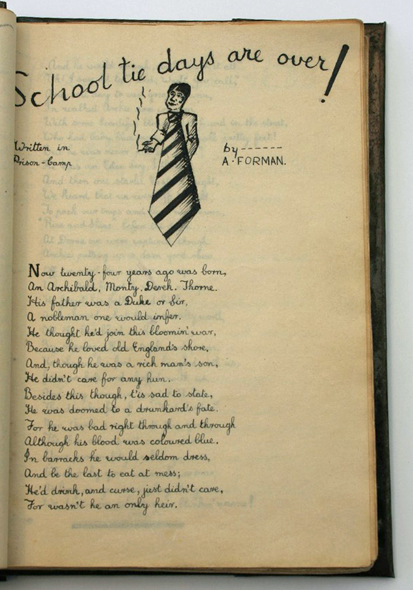
This clever poem pokes fun at early 1940s British class structure, but then reflects on how in time of crisis men are brothers and “personality’s what you are.” It is one of four poems by A. Forman in Robert Dickinson’s diary.

038_school_r150

School tie days are over!

Now twenty-four years ago was born,
An Archibald. Monty. Derek. Thorne.
His father was a Duke or Sir,
A nobleman one would infer,
He thought he’d join this bloomin’ war,
Because he loved old England’s shore.
And, though he was a rich man’s son,
He didn’t care for any hun.
Besides this though, t’is sad to state,
He was doomed to a drunkard’s fate.
For he was bad right through and through
Although his blood was coloured blue.
Continue reading

Letters from Loved Ones

dickinson_diary-ida_angle_200

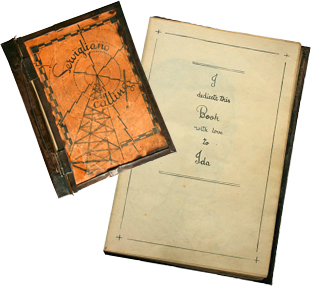
Following the fancy title page of Robert Dickinson’s journal is a simple, full-page inscription, which reads: “I dedicate this Book with love to Ida.”

Farther into Robert’s journal is a six-page record of the 225 letters Robert received while he was in Servigliano Camp 59, Bonservizi Camp 53, Casanova Elvo Camp 106, and Gassino Camp 112.

Dates for receipt of the letters are March 30, 1942 to September 8, 1943. Letters from Robert’s sweetheart Ida (129 in all) account for the greatest number.

On the one Valentine’s Day within this 18 month period (February 14, 1943) Robert received a letter from Ida, which she had written on January 18. Some letters, delayed for unknown reasons (particularly at the latter two camps) arrived all in one day. Sometimes four, five, or six letters—usually from Ida—arrived all at once.

Robert and the other prisoners eagerly anticipated arrival of mail. Robert wrote in his diary on March 30, 1942, “At last the long awaited mail!!!”

There were 57 letters from home.

Continue reading

“Servigliano Calling” Poem #12

dickinson_diary_angle_2001

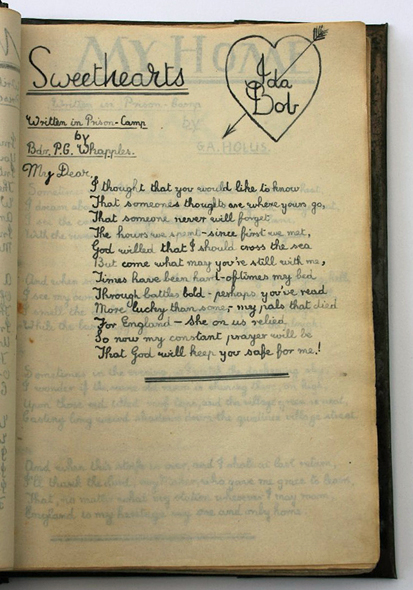
“Sweethearts,” is one of three poems by Bombardier G. P. Whapples in Robert Dickinson’s journal. This poignant poem speaks to the longing felt by many soldiers for their distant girlfriends or wives.

The pierced-heart icon on this page proclaims Robert’s love for Ida. Sadly, he did not return to her from the war.

sweethearts_047_r150

Sweethearts

My Dear,

I thought that you would like to know
That someone’s thoughts are where yours go,
That someone never will forget
The hours we spent—since first we met,
God willed that I should cross the sea
But come what may you’re still with me,
Times have been hard—of times my bed
Through battles bold—perhaps you’ve read
More lucky than some—my pals that died
For England—she on us relied
So now my constant prayer will be
That God will keep you safe for me!

“Servigliano Calling” Poem #11

dickinson_diary_angle_2001

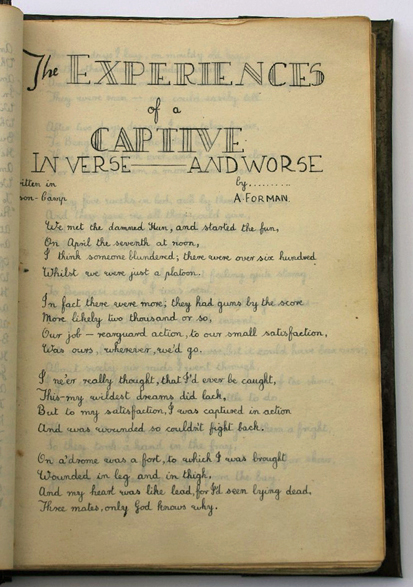
“The Experiences of a Captive: In Verse—And Worse” is one of four poems by A. Forman in Robert Dickinson’s diary.

This poem spans five pages and is remarkably full of detail about the battle in which Forman was captured, his transfer from prison to prison, the prisoners’ illnesses, their mistreatment by the Germans and humane treatment by the Italians, and Forman’s impressions of the countryside as they were transported.

The tale begins in North Africa on April 7, 1941, with the ambush and capture, by a German patrol, of British generals Richard O’Connor and Philip Neame, and it concludes with the arrival of the prisoners at Camp 59 in February 1942.

040_experi_r150

The Experiences of a Captive:
In Verse—And Worse

We met the damned Hun, and started the fun,
On April the seventh at noon,
I think someone blundered; there were over six hundred
Whilst we were just a platoon.

In fact there were more; they had guns by the score
More likely two thousand or so,
Our job—rearguard action, to our small satisfaction,
Was ours, wherever, we’d go.

I ne’er really thought, that I’d ever be caught,
This—my wildest dreams did lack,
But to my satisfaction, I was captured in action
And was wounded so couldn’t fight back.

On a’drome was a fort, to which I was brought
Wounded in legs and in thigh,
And my heart was like lead, for I’d seen lying dead,
Three mates, only God knows why.

Continue reading

“Servigliano Calling” Camp Poem #10

dickinson_diary_angle_2001

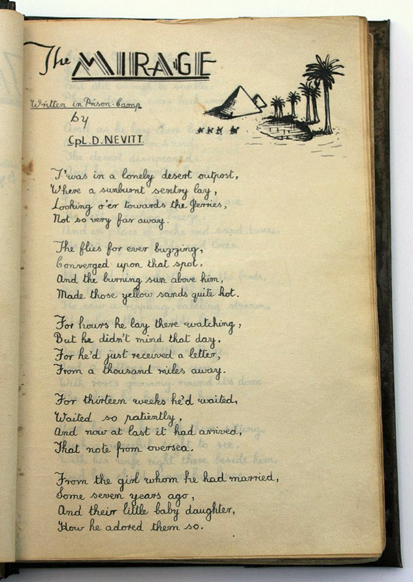
“The Mirage” is one of eight poems by Cpl. D. Nevitt in Robert Dickinson’s Camp 59 journal, “Servigliano Calling.”

014_mirage_r150

The Mirage

T’was in a lonely desert outpost,
Where a sunburnt sentry lay,
Looking o’er towards the Jerries,
Not so very far away.

The flies for ever buzzing,
Converged upon that spot,
And the burning sun above him,
Made those yellow sands quite hot.

For hours he lay there watching,
But he didn’t mind that day.
For he’d just received a letter,
From a thousand miles away.

For thirteen weeks he’d waited,
Waited so patiently,
And now at last it had arrived,
That note from oversea.

Continue reading