Category Archives: Robert Dickinson

William Redman—Captivity, 1941–45

William Redman was one of 20 men recorded in Robert Dickinson’s Address List in his journal, “Servigliano Calling.”

To date we have learned more about three of these fellows: Fred Druce, Jack Davies, and now William Redman.

In February, Jo Millard of Littlehampton (Sussex, England) wrote, “I have been researching my family tree, and I always knew my Mother’s brother was a prisoner of war in Italy but never knew where, as he very rarely talked about those days.

“Just by chance I stumbled onto your site and saw his name and address. So I now have a little bit more of the puzzle that is my family.”

Two months later, Jo sent her uncle’s story, which she found archived at the local government records office.

William’s POW Story

In due course, I joined up and very soon found myself in the Middle East, where I met up with Sef [William’s younger brother] in Cairo. After a short spell in the Artillery base, which was at Heliopolis—the biblical “City of the Sun”—I got posted to a unit somewhere up the desert. I was miles away from anywhere and after a while our captain warned us to be ready to move “up to the wire,” as the sappers would be cutting the wire for us to go into Libya.

The wire was a monstrous affair, quite eight feet high, four feet at the base, and tapered up until it finished at two feet at the top. It was one mass of barbed wire. I met up with a chap who had been with the Long Range Desert Group. He came with us to the quarry in Germany [the quarry—described later—was a work camp in Grimma, Germany]. He told me that they ranged all over Libya and as far as he knew the fence was all around the country.

We went through the cutting and turned south. There, in the vast uninhabited interior, we spent our time on maneuvers, getting ready for “the big one.” We had several skirmishes with the Germans and Italians whilst we prowled around there. Not too bad. I cannot remember if we lost any men. Then one day we were ordered to pack and go north to take up our positions for attacking the Germans, who were dug in around Tobruck. It was in November 1941. We opened up at about 10,000 yards according to our No.1, who timed another gun’s shell explosion. It was the commencement of the Battle of Sidi Rezegh. The 6th Tanks came through our guns, and their commanders, with their heads out of the turrets, waved gaily to us as they rolled on towards the enemy.

Continue reading

Camp 59 Poets

Bernard Petrulis’s story in the previous post ends with the poem “Prisoner Son,” which is one of the poems recorded in Robert Dickinson’s journal and presented on this site as “Servigliano Calling” Poem #4.

In Robert’s journal, F. Chiltern is credited for the poem.

The poem is also recorded in Edward Smith’s book of poems, and there, too, it is credited to F. Chiltern.

Alan Petrulis wrote that the poem “came from a small notebook full of poems in my father’s hand. I had thought he may have written them in camp but I was very apprehensive about ever attributing them to him.

“My father’s book contained nine poems: Unholy Conflict, Prayer of a Soldier, Wishful Thinking, Doubtful Future, Prisoner Son, In a Desert Outpost, Far Away Dream, Tribute to Women in an Air Raid, and The Gunner.”

Some of these poems are in Robert’s journal.

Of the nine poems, “In a Desert Outpost” is in G. Norman Davison’s notebook. And although “Prisoner Son” is recorded in Norman’s notebook—yet a fourth appearance of the poem—there the title of the poem is “Diplomacy” and the author is F. Chilton (not Chiltern).

Norman recorded an address for F. Chilton in his notebook:

F. Chilton
8, Alfred Road
Sheffield

This is Norman’s mate Fred Chilton. The two were sent to North Africa on the same boat, were captured together in Libya in April 1940, and were transferred from camp to camp together, eventually ending up in Camp 59. After their time in Servigliano, the men were sent to separate camps and, after escape from their respective camps, both made their way north to freedom in Switzerland. They were later reunited in their hometown of Sheffield. The story of the friendship is recounted in Norman’s memoirs, In the Prison of His Days.

There are more poems in Norman’s book: “A Point We All Agree,” “Ten Little Foreign Lands,” “A Little Toast to Love,” “Reflections of A P.O.W.,” and “A Tribute to The Women of Blighty.”

Of these, “Reflections of a P.O.W.” is the same poem as “Reflections” in Robert’s journal (though the poem is a slight variation).

“A Tribute to the Women of Blighty” is also in Robert’s journal. Again, some of the wording is different.

These poems convey so freshly and intimately the prisoner-poets’ longing for home and loved ones, pride in country, and feelings about war and the experience of captivity that it is a moving experience to read them again so many years after the war.

“Servigliano Calling” Poem #21

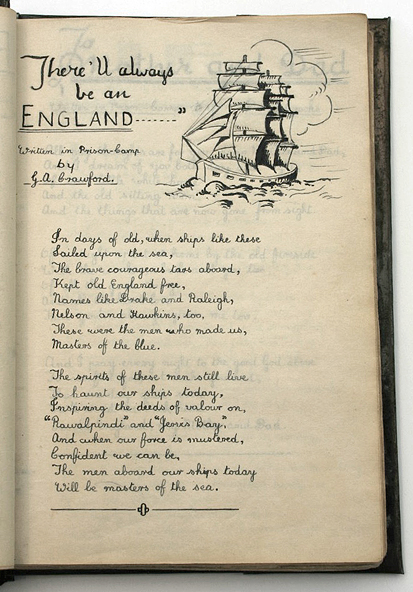
“There’ll always be an England….” by G.A. Crawford is one of two works by this soldier-poet in Robert Dickinson’s journal, “Servigliano Calling.”

We know G.A. Crawford to be George A. Crawford of London, as Robert recorded his address in the book.

There’ll always be an England….

In days of old, when ships like these
Sailed upon the sea,
The brave courageous tars aboard,
Kept old England free,
Names like Drake and Raleigh,
Nelson and Hawkins, too,
These were the men who made us,
Masters of the blue.

The spirits of these men still live
To haunt our ships today,
Inspiring the deeds of valour on,
“Rawalpindi” and Jeori’s Bay”,
And when our force is mustered,
Confident we can be,
The men aboard our ships today
Will be masters of the sea.

Jack Davies’ First Aid Book

Jack Davies is another of the 20 men whose addresses are recorded in Robert Dickinson’s “Servigliano Calling” journal:

Jack Davies
11. Clent Avenue. Maghull.
Off Dods Lane. Liverpool.

I heard from Lorraine McLoughlin in October of last year. She wrote:

“I am just writing, with much excitement I must say, to find that I have information about POW Jack Davies of Camp 59.

“My mother was Jack’s daughter-in-law.

“Jack’s son, Rick Davies, was my mum’s (Ivy Davies nee Hindley) first husband.

“My mum is now 94 years of age but still remembers nursing her father-in-law, Jack, at 11 Clent Avenue, Maghull, before he died.”

A second note from Lorraine, two months later, informed me that her mother had passed away in early December.

Lorraine kindly shared scans of the covers of Jack’s St. John’s Ambulance First Aid Book. She wrote that it “was obviously with Jack during his time at the camp—as it has the camp address in the back cover.”

The inscription reads:

Davies
John
Pte 7597368
Campo P.G. No 59 3 Secttro 3 A/34
PM 3300. ITALIA

Jack was in the RAOC (Royal Army Ordnance Corps), a corps of the British Army that dealt exclusively with supply and maintenance of weaponry, munitions and other military equipment.

Memories of Fred Druce


Fred looking very dapper on his motorbike in the desert, presumably before his capture and imprisonment in Italy.

Fred Druce was one of 20 POWs whose addresses are listed in Robert Dickenson’s prison camp journal, “Servigliano Calling”:

Frederick Druce
Sunny Side. New Road. Tyler’s Green.
High Wycombe. Bucks.

Many thanks to Anne Copley of Oxford, UK, for having found information on Fred Druce for me.

Anne’s inquiry to the Penn and Tylers Green blog, a site dedicated to news about Fred’s home village, yielded two photos of Fred and some amusing stories about Fred in his youth.

For some unknown reason his nickname was “Wedger.”

Here are the comments:

“Knowing his personality as a teenager when he was a ‘bit of a lad’, I can understand why he was a successful evader.”

“You are right about Wedger being a character, I can remember him and a friend, standing up in the swing boats at Penn Fair and working them way past the horizontal position. Also, I believe, he took on one of the professional boxers who used to challenge all comers at the fair.”

“I’m afraid I can’t add much to the facts about Fred Druce but oh what memories it brings back of such a character. As a kid delivering vegetables for my Uncle Bob Long in the 1950’s from his market garden up near Penn Church I used to stand listening to Wedger who was a gardener nearby. My young eyes popped out of my head as I learnt swear-words that I’d never heard before and was told endless unbelievable tales. Thank you writers for reminding me of happy days long before political correctness was invented.”


In later years—Fred Druce and his wife Betty at a wedding dinner.

“Servigliano Calling” Poem #20

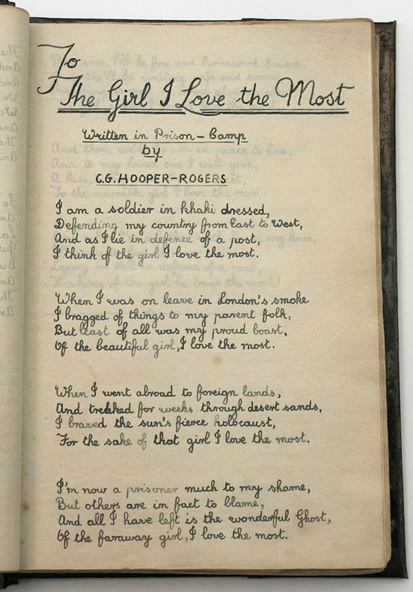
This poem, an expression of longing and adoration for “the girl I love the most” by C. G. Hooper-Rogers, is this site’s Valentine’s Day feature.

C. G. Hooper-Rogers wrote two poems and co-authored a third that are recorded in Robert Dickinson’s prison camp journal.

To the Girl I Love the Most

I am a soldier in khaki dressed,
Defending my country from East to West,
And as I lie in defence of a post,
I think of the girl I love the most.

When I was on leave in London’s smoke
I bragged of things to my parent folk,
But least of all was my proud boast,
Of the beautiful girl, I love the most.

When I went abroad to foreign lands,
And trekked for weeks through desert sands,
I braved the sun’s fierce holocaust,
For the sake of that girl I love the most.

Continue reading

“Servigliano Calling” Poem #19

What better day than December 31 to post this powerful poem by C.A. Hollis, “Wasted Years,” from “Servigliano Calling”?

The first three stanzas condemn greed, hatred, and human failings as the cause of wasted years.

Then, the final stanza offers a glimmer of hope as “Nations unite, together fight/This useless waste to banish.” These young men’s sacrifice of the best years of their lives will ensure a future “happy and free” for all.

The poem is rich with allegorical figures: Peace weeping, Mars (god of war) ruling supreme, Death reaping human lives, and Hate planting the seeds of enslavement.

Wasted Years

Peace is weeping, progress is sleeping,
Mars is ruling the world.
Death’s scythe is creeping, and steadily reaping,
Since the war flags were unfurled.
We are back upon the track,
That leads to death and tears,
Thrones and tumbling, guns are rumbling,
Now’s the time of wasted years.

Man’s intentions, and inventions
Are enlisted in the course to kill.
Human greed, and ill-famed deed
Has conquered human will.
Lack of trust, in human dust,
T’is the point of all our fears.
Love of sword, before the word,
Is the cause of wasted years.

Wasted cities; —useless pities
Do not upbuild them all anew.
Rape and raving, starvation, craving,
Make this world a hellish brew.
Desolation, pestilation,
Overhead annihilation rears.
Hate planted the seed, of this enslaving weed,
The cause of wasted years.

Nations unite, together fight
This useless waste to banish.
Trust each other, call all brother,
Fears will then all banish.
Use your resources, and all your forces,
To make war disappear.
United you’ll be, happy and free,
And ne’er have a wasted year.

“Servigliano Calling” Poem #18

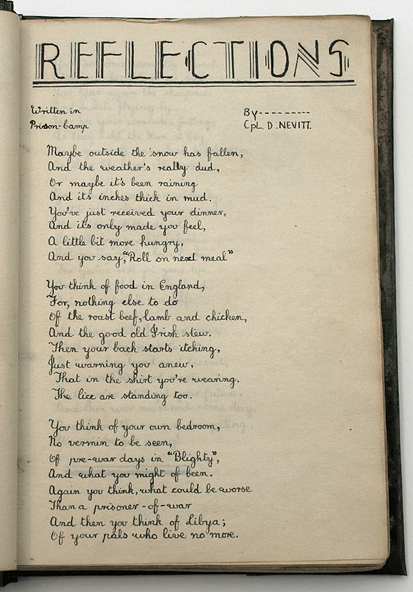
Eight poems by Cpl. D. Nevitt were included by Robert Dickinson in his prison camp journal, “Servigliano Calling.”

During the holidays, when we are reminded in song that “there is no place like home” and when we feast and make merry with loved ones, Corporal Nevitt’s poem and the other four others I have posted today have a special poignancy.

These poems reflect love of England, craving for home and family, and optimism that the war would one day end and normal civilian life would resume.

Reflections

Maybe outside the snow has fallen,
And the weather’s really dud,
Or maybe it’s been raining
And it’s inches thick in mud.
You’ve just received your dinner,
And it’s only made you feel,
A little bit more hungry,
And you say, “Roll on next meal”

You think of food in England,
For, nothing else to do
Of the roast beef, lamb and chicken,
And the good old Irish stew.
Then your back starts itching,
Just warning you anew,
That in the shirt you’re wearing,
The lice are standing too.

You think of your own bedroom,
No vermin to be seen,
Of pre-war days in “Blighty”,
And what you might have been.
Again you think, what could be worse
Than a prisoner-of-war
And then you think of Libya;
Of your pals who live no more.

Continue reading

“Servigliano Calling” Poem #17

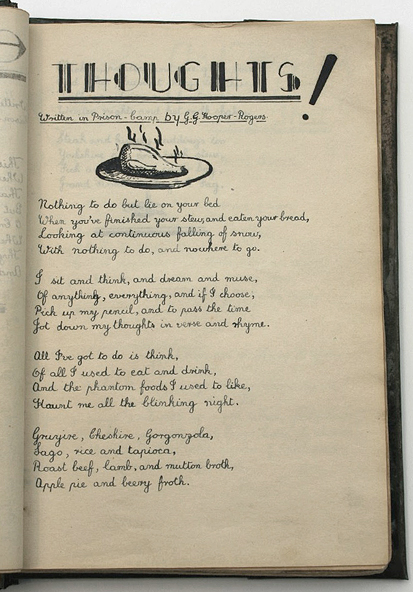
This delightful poem by C.G. Hooper-Rogers is a veritable menu of delicious (and profoundly missed) foods.

Hooper-Rogers wrote two poems recorded in “Servigliano Calling,” and he co-authored a third with Alec Forman. Although on this page his initials appear to be G.G., the other two poems clearly list his initials as C.G.

Thoughts

Nothing to do but lie on your bed
When you’ve finished your stew, and eaten your bread,
Looking at continuous falling of snow,
With nothing to do, and nowhere to go.

I sit and think, and dream and muse,
Of anything, everything, and if I choose,
Pick up my pencil, and to pass the time
Jot down my thoughts in verse and rhyme.

All I’ve got to do is think,
Of all I used to eat and drink,
And the phantom foods I used to like,
Haunt me all the blinking night.

Gruyère, Cheshire, Gorgonzola,
Sago, rice and tapioca,
Roast beef, lamb, and mutton broth,
Apple pie and beery froth.

Chicken, potatoes and nice green peas
And other pleasant things like these,
Trifle, pastries, rich fruit cakes,
Winter nights and hot milk shakes.

Steak and kidney puddings too
Yorkshire pud and Irish stew,
Fish and chips in paper bag,
Grand Finale—English fag.

“Servigliano Calling” Poem #16

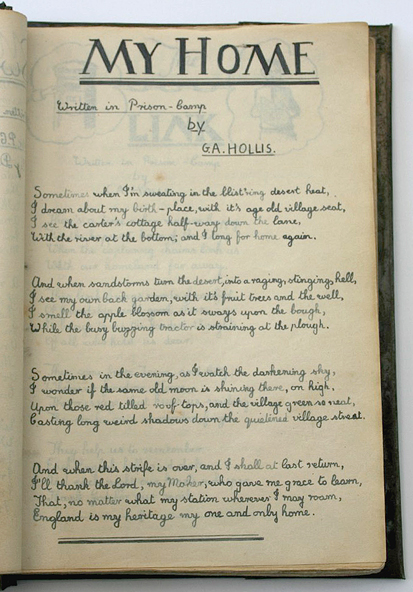
Six poems by G.A. Hollis appear in “Servigliano Calling,” Robert Dickinson’s journal.

My Home

Sometimes when I’m sweating in the blist’ring desert heat,
I dream about my birth-place, with it’s age old village seat,
I see the carter’s cottage half-way down the lane,
With the river at the bottom; and I long for home again.

And when sandstorms turn the desert into a raging, stinging hell,
I see my own back garden, with it’s fruit trees and the well,
I smell the apple blossom as it sways upon the bough,
While the busy buzzing tractor is straining at the plough.

Sometimes in the evening, as I watch the darkening sky,
I wonder if the same old moon is shining there, on high,
Upon those red tiled roof-tops, and the village green so neat,
Casting long weird shadows down the quilined village street.

And when this strife is over, and I shall at last return,
I’ll thank the Lord, my Maker, who gave me grace to learn,
That, no matter what my station wherever I may roam,
England is my heritage my one and only home.