Category Archives: Robert Dickinson

Robert and Denis—“Best of Chums”

Pictured above are Robert Dickinson (left) and Denis Crooks.

The 12 letters in this post were sent to me by Maggie Clarke, Denis Crook’s daughter.

Ten of the letters were among those Denis sent to his parents while he was interned at Camp 59–Servigliano. The final two were written in Camp 53–Sforzacosta. The letters are a testament to the deep friendship between Denis and fellow prisoner Robert Dickinson, who is mentioned in each of the letters.

Denis also is frequently mentioned in the log of daily events in Robert’s prison camp journal, “Servigliano Calling.”

The two men were, as Denis put it, “best of chums” from January 1942 to May 1943. When Robert was transferred from Camp 53, it would be the last time the two men would see each other, as Robert did not return from the war.

In addition to reports of what Denis and Robert were up to, the letters provide a wealth of information about daily life in camp—invention and refinement of the “blowers” the men used to warm food, the concoctions that they created from Red Cross parcel contents (see also “Robert Dickinson’s ‘Campo 59 Cookery'”), and details of a camp-sponsored “grand carnival” (see also “Carnival Time”).

(No. 11) April 12th. [1942]

Dear Mother and Dad,
I received another two letters last week—no. 50 dated 4th. Feb. and letter-card dated 30th. Oct. and then today I had a letter-card (no. 3) dated 1st. of March, so I was very pleased. After I had written my last letter on Easter Sunday we received another Red-Cross food parcel, one between two. I and my friend Bob were very lucky, we had an apple pudding (tinned of course) and with it we each ate a pound of jam which we had bought at the canteen; we get paid here and can buy cheese and jam at the canteen. Gee! was it good!!! Amongst other things we had ½ lb. oatmeal, so on Monday the cookhouse made porridge for those who had oatmeal, and that was jolly good too. I hope these parcels come fairly regularly now. [missing text] had an extra 8 o’clock service last Sunday morn… [missing text] that. There were over 100 chaps there. The padre has [text missing] evening services every evening at 7:30 for about 10 minutes. I hope you are receiving my letters every week now, we write regularly every Sunday. Please thank everybody for their greetings, and for being so good to you at home, it must have been very worrying for you. Remember me to Michael and Joan Field, and also to Elsa and through her to Ron Gilbert. Yes, I do smoke a little, it helps to pass the time, so I’d love to get some cigarettes. We have an Italian issue every week, and also 50 English with each parcel. Glad your back is O.K. Dad, keep it up! Lot of love and kisses from Denis xxxxxxx

Continue reading

Denis Crooks—Prisoner Poet

Denis Crooks, photo taken in Camp 59.

In February, I received a note from Maggie Clarke in England.

Her father, she explained, was Denis Crooks, one of the servicemen whose poetry was included in Robert Dickinson’s “Servigliano Calling” prison camp journal.

Read Denis’ poems “Campo 59,” “To Mother and Dad,” and “England” in posts on this site.

Maggie wrote, “I have just downloaded and read the ‘Servigliano Calling’ camp poems of Robert Dickinson and had to write to let you know that Denis Crooks, who wrote three of them, was my father. I was so excited to read these poems, as I never knew that he wrote poetry—he certainly never wrote any after the war—and even my mother was not aware he did this.

“We have all my Dad’s POW letters written home and Bob is mentioned in so many of them. They were so close and I know he was devastated when they were split up. I’m sure they kept each other going in those bad times.

Continue reading

Robert Dickinson’s “Campo 59 Cookery”

During this time of year, as we devote time in our kitchens to preparation of holiday meals and mouthwatering pastries and desserts, consider for a moment how our imprisoned soldiers craved their favorite foods from home—probably more during this season than at any other time of year.

It is any surprise that the prisoners attempted to recreate some of these dishes, using their daily camp rations and items from the precious Red Cross parcels?

Three pages of Robert Dickinson’s journal, “Servigliano Calling,” are devoted to recipes, ranging from a compote and spreads to pies and fig pudding.

The situation called for some invention—fruit pie crust made of a paste of grated bread mixed with margarine for example.

Cooking was done handily on the camp cook stoves built by fellow prisoners from scraps of tin and shoelaces.

Although Robert titled this section of his journal “Campo 59 Cookery,” the last recipe, “Campo 53 Rarebit,” is evidence that the culinary experiments continued after his transfer to Camp 53 Sforzacosta in January 1943.

One of the poems in Robert’s journal, “Thoughts,” by C. G. Hooper-Rogers, contains a list of sorely missed foods from home. Of his yearnings, Hooper-Rogers writes:

“All I’ve got to do is think, / Of all I used to eat and drink, / And the phantom foods I used to like, / Haunt me all the blinking night.”

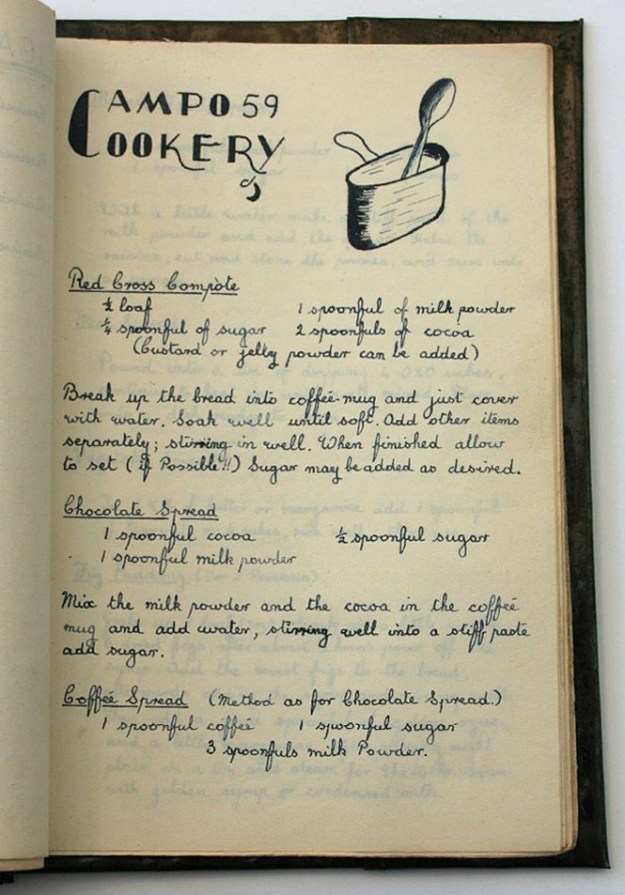
Red Cross Compòte

½ loaf
¼ spoonful of sugar
1 spoonful of milk powder
2 spoonfuls of cocoa
(Custard or jelly powder can be added)

Break up the bread into coffeé mug and just cover with water. Soak well until soft. Add other items separately; stirring in well. When finished allow to set (if possible!!) Sugar may be added as desired.

Chocolate Spread

1 spoonful cocoa
1 spoonful milk powder
½ spoonful sugar

Mix the milk powder and the cocoa in the coffeé mug and add water, stirring well into a stiff paste add sugar.

Coffeé Spread (Method as for Chocolate Spread.)

1 spoonful coffeé
1 spoonful sugar
3 spoonfuls milk powder

Continue reading

Il Resto del Carlino on the Camp Visit

Camp 59 and the blog dedicated to it

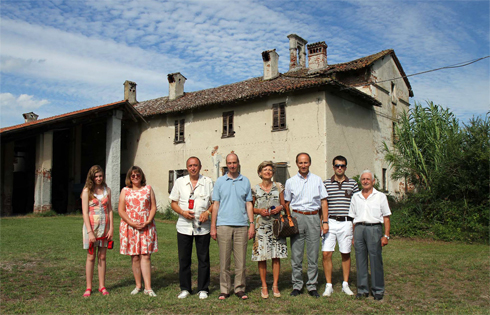
Coming upon their POW relatives on the web leads these two to Servigliano

Il Resto del Carlino
Tuesday, September 28, 2010

Caption: Englishman Steve Dickins[on] and American Dennis Hill in front of the wall through which their uncle and father managed an escape. [Note: Steve’s uncle Robert was transferred from Camp 59 before the September 1943 escape; however, around that same time Robert escaped from the camp where he was held.]

MEMORIES—The meeting between an American and an Englishman, the son and nephew of two interned soldiers

They wanted news about the Servigliano refugee camp, from which their relatives fled in 1943. In doing research on the Internet, the two discovered the blog “Cam[p] 59,” dedicated to the prisoner of war camp in this town. That’s how Englishman Steve Dickinson and American Dennis Hill began a “virtual” friendship, which brought them to Servigliano yesterday—to share their family stories.

Steve’s uncle Robert, a British soldier, was captured in Africa and interned at Servigliano. “I found his diary—a sort of copybook of the Red Cross—where my uncle recorded all his activities through the war and until his death. I read those pages and decided to retrace his steps. When he arrived at Servigliano, on 18 January 1942, he described the landscape as charming, though he explained that hunger did not allow him to enjoy the place.

“At Servigliano he found consolations—his first shower in 24 days, and clean sheets. He escaped through the hole in the wall and headed north, aided people of the area. He became a partisan and settled in Gassino Torinese, which is where he died. His body rests in the Milan war cemetery.”

Armie Hill’s story is different. Dennis’ father was an American soldier who was captured in Africa in 1943 and transferred to Servigliano. “My father escaped through the hole in the wall caused by the bombing,” Dennis said, “But he headed south—to meet the Allies—and he returned home. He recalls in his story [receiving help from] Don Giuseppe Ciabattoni, the rector at Roccafluvione.

Alessio Carassai

Continue reading

Celebrating Family Ties

A Dickinson family outing to the beach. At front are Robert, youngest brother Len on the lap of his mother, and his father. In back are brothers James and William.

On this occasion—the Thanksgiving weekend, when American families gather to feast, remember the past, and meditate on their blessings—I’ll pause for a moment to reflect on the universality of family ties.

Here are three families—British, American, and Italian—who have connections to prisoners from Camp 59. The stories of Robert Dickinson, Marino Palmoni, and Armie Hill are well-covered in a number of posts on this site.

In celebration of this holiday, here is an international family album.
Continue reading

“Servigliano Calling”—A Return to Camp 59

Robert Dickinson kept a diary, titled “Servigliano Calling,” from the date of his capture by the Germans until six months before his death (November 23, 1941 to September 3, 1944).

Robert arrived at Camp 59 on January 18, 1942, and a year later—on January 24, 1943—he was transferred to Camp 53 in Sforzacosta.

Robert’s log for his year in Servigliano is a fascinating, candid record of daily life and events in the camp.

I first learned about “Servigliano Calling” though e-mails from Robert’s nephew Steve Dickinson in April 2008.

Referring to Camp 59, Steve wrote:

“My uncle spent some time there during WW2, but was later transferred to another camp in Northern Italy. At the time of the armistice he walked out of that camp and fought with the Italian partisans until his death towards the end of the Italian Campaign.

“However, during his stay at Servigliano he kept a diary like many of the POW’s. This was found during renovations in a farmhouse [in Gassino, Italy] where the partisans had been hiding him some time after the war and returned to the family. It details the day to day events in Servigliano, football matches, escape attempts, cooking recipes, poetry, etc….”

Continue reading

A Season for Visits

John Davison, his family, and new Italian friends explore the grounds of the old Cararola farm, where Norman Davison was at first assigned to work and where he later found shelter.

Steve Dickinson and Dennis Hill were among visitors to Camp 59, where Steve’s uncle Robert Dickinson and Dennis’ father Armie Hill were imprisoned. At center was the hole in the wall—since mortared shut—through which many prisoners escaped from the camp.

For three individuals who have an intimate family connection to the prisoner-of-war camp at Servigliano, this fall was a unique time for discovery.

John Davison this year made contact with descendants of Giovanni Bellazzi, the northern Italian farmer who sheltered his father, escaped prisoner G. Norman Davison. Giovanni and his friends helped to arrange for Norman’s safe passage to Switzerland.

Norman had been a prisoner at Camp 59 before he was transferred to camps farther north, where he was required to work on farms.

In early September, John and his family visited the town of Vigevano and experienced a thrilling welcome. (See posts In Their Fathers’ Footsteps, Part 1 and Part 2).

Then, at the end of September, Steve Dickinson and I were among visitors to Camp 59 in Servigliano, where Steve’s uncle Robert Dickinson and my father Armie Hill were interned.

Continue reading

“Servigliano Calling” Poem #34

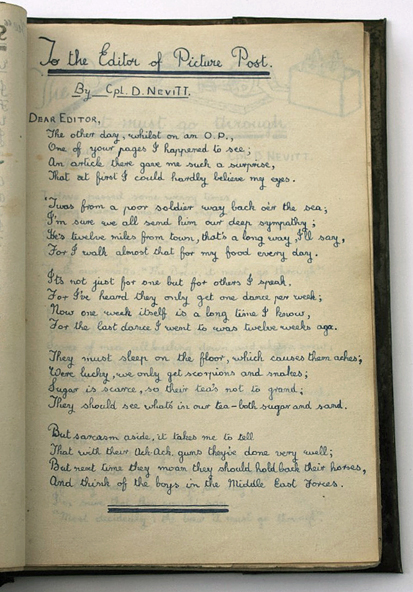
This poem by Cpl. D. Nevitt brings to a close the posts of prisoners’ poems recorded in Robert Dickinson’s “Servigliano Calling” prison camp diary. There are 34 poems in all in Robert’s journal.

In this poem, “To the Editor of Picture Post,” Corporal Nevitt expresses dismay at the complaints of soldiers at home over the deprivations they feel they are suffering.

Compare their situation to the lot of soldiers at war, Nevitt says, to realize where true hardship lies.

To the Editor of Picture Post

DEAR EDITOR,

The other day, whilst on an O.P.,
One of your pages I happened to see;
An article there gave me such a surprise,
That at first I could hardly believe my eyes.

“Twas from a poor soldier way back o’er the sea;
I’m sure we all send him our deep sympathy;
He’s twelve miles from town, that’s a long way, I’ll say,
For I walk almost that for my food every day.

It’s not just for one but for others I speak,
For I’ve heard they only get one dance per week;
Now one week itself is a long time I know,
For the last dance I went to was twelve weeks ago.

They must sleep on the floor, which causes them aches;
We’re lucky, we only get scorpions and snakes;
Sugar is scarce, so their tea’s not too grand;
They should see what’s in our tea—both sugar and sand.

But sarcasm aside, it takes me to tell
That with their ack-ack guns they’ve done very well;
But next time they moan they should hold back their horses,
And think of the boys in the Middle East Forces.

Note: O.P. is perhaps a military operating procedure. Ack-ack is slang for anti-aircraft fire.

“Servigliano Calling” Poem #33


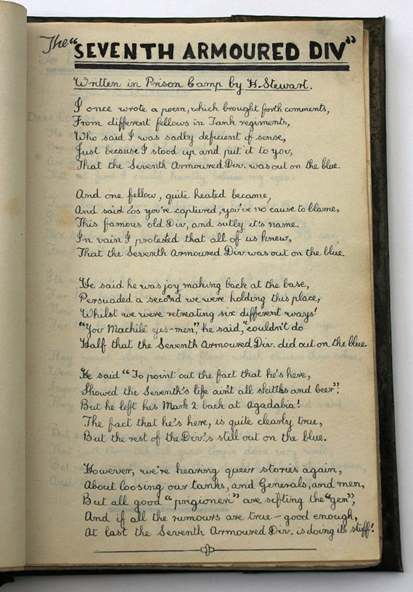
This poem by H. Stewart is a rousing defense of the reputation of the British Army’s Seventh Armoured Division. The division was known as the “Desert Rats” and its mascot—a red jerboa—is displayed on its insignia.

“The ‘Seventh Armoured Div’” is one of three poems by Harry Stewart in Robert Dickinson’s journal, “Servigliano Calling.”

The “Seventh Armoured Div”

I once wrote a poem, which brought forth comments,
From different fellows in tank regiments,
Who said I was sadly deficient of sense,
Just because I stood up and put it to you,
That the Seventh Armoured Div. was out on the blue.

And one fellow, quite heated became,
And said ’cos you’re captured, you’ve no cause to blame,
This famous old Div., and subtly its name,
In vain I protested that all of us knew,
That the Seventh Armoured Div. was out of on the blue.

He said he was joy-making back at the base,
Persuaded a second we were holding this place,
Whilst we were retreating six different ways!
“You Machilé yes-men”, he said, “couldn’t do
Half that the Seventh Armoured Div. did out on the blue.”

He said “To point out the fact that he’s here,
Showed the Seventh’s life ain’t all skittles and beer”;
But he left his Mark 2 back at Agadabia!
The fact that he’s here is quite clearly true,
But the rest of the Div.’s still out on the blue.

However, we’re hearing queer stories again,
About loosing our tanks, and generals, and men,
But all good “prigioniere” are sifting the “gen”,
And if all the rumours are true—good enough,
At last the Seventh Armoured Div. is doing its stuff!

Note: The phase “all good ‘prigioniere’ are sifting the ‘gen'” seems to mean that the attentive prisoners are weighing incoming information about the war.

“Servigliano Calling” Poem #32

This is another of Cpl. D. Nevitt’s eight poems in Robert Dickinson’s journal.

Like several of the corporal’s other poems, “Escarpment Escapade” is a ballad of an event during the war.

Escarpment Escape:
An account of the June encounter

The dawn broke clear and crimson,
With a halo of golden rays,
As the Tommies woke up early,
For this was a day of days.
Today the “Wops” and “Jerries”,
Were to get a big surprise,
And not a pleasant one at all
By the look in those soldiers’ eyes.

At zero hour the trucks moved off,
Arcoss the yellow sand,
The sight they made, dispersed for miles,
Was nothing short of grand.
The men all joked as usual,
And sang any old refrain,
Although they knew that some of them
Would ne’er see dawn again.

They stopped, at last, to let the tanks
Wake Jerry from his bed,
He didn’t get hot coffee that morn,
But hot lead instead.
For above the roar of artillery.
Came the Besa’s deadly rattle,
And the men slide on their bayonets,
Then charged into the battle.

Continue reading