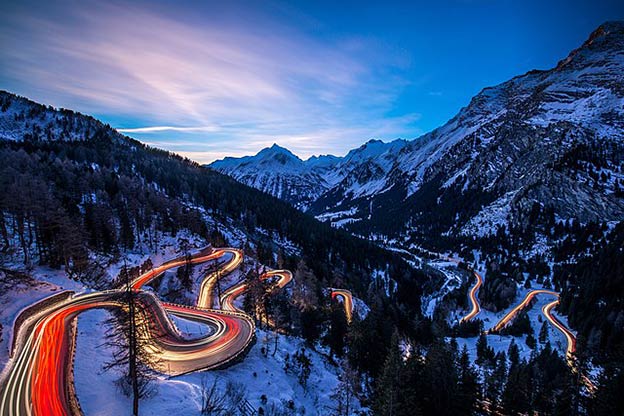
In 1943 Robert Brawn and Albert “Paddy” Douglas escaped through the Maloja Pass (pictured here) into Switzerland. Photo courtesy Wikimedia Commons / Böhringer.
This story begins with two POWs during wartime whose lives became intertwined, and who formed a tight friendship in Italy.
Corporal Robert Brawn (1433896, Royal Artillery—from Sheffield, England) and Lance Corporal Albert “Paddy” Douglas (T/150993, Royal Army Service Corps—from Belfast, Northern Ireland) were both captured in North Africa. They were interned in Feldpost 12545 and P.G. 59 Servigliano before being transferred north to the Po Valley working farms of P.G.146/25 Chignolo Po.
They escaped captivity on 8 September 1943, met up again on the run, and then made their way together to Switzerland—arriving on October 30.
After the war, the men returned to home and family life.
Robert married his fiancée, Betty Wray, in 1945, and together they had two children—a a son, Tim, and a daughter, Debby. Betty had had her own war service at home—she was cited in Sheffield newspapers as a hero for collecting the dead and injured in an ambulance during the blitz on Sheffield when she was aged 17.
Albert and his wife Ellen had their son Albert, who like his father also goes by the nickname of Paddy.
Ten years ago, in August 2013, I wrote a post on this site, “Peter Grillo—Surgery ‘Sans Anesthetic,’” concerning a harrowing operation P.G. 59 prisoner Peter Grillo had for appendicitis. At the time, Peter’s son Roy and I knew that after Peter had been interned in P.G. 59, he eventually ended up in Stalag 2B Hammerstein, from which he was liberated at the end of the war. (See “Liberated Comrades-in-Arms.”)
What we weren’t sure of until recently was his actual dates of internment and where Peter’s surgery had been performed. We weren’t even sure whether the operation was in Italy or Germany.
I discovered the missing details recently through accessing Peter’s Italian POW card on the U.S. National Archives (NARA) website. (These identity cards were created and maintained by the Italian Ministry of War during the war as a way for the Italians to maintain records on the prisoners—and to meet basic requirements of the 1929 Geneva Convention.)
From Peter’s card I learned that after P.G. 59, he was held in three additional locations in Italy.
Martin Luther King Jr., 1964—Image courtesy of the U.S. Library of Congress
Every year on the third Monday in January, in the United States we celebrate a national holiday honoring the life and legacy of Dr. Martin Luther King Jr.
Beginning in 1955, Dr. King was one of the most prominent human rights leaders in America, heading a movement to advance equal treatment of people of color through nonviolent resistance and civil disobedience. As a Baptist minister, he was inspired by his Christian beliefs, as well as the nonviolent activism of Mahatma Gandhi.
Dr. King knew the personal risks he faced, but in an atmosphere of ever-present hatred and threats, he remained steadfast. He was planning a national occupation of Washington, D.C., to be called the Poor People’s Campaign, when he was assassinated on April 4, 1968.
A few of the many heroes of Italian compassionate resistance: Letizia Galiè in Del Gobbo, the Zagnoli family, Giovina Fioravanti, Iginia and Luigi Palmoni, and Sebastiano “Bastiano” Crescenzi
Italian Heroic Resistance
During the Second World War, not dozens, not hundreds, but thousands of Italian citizens—many of them poor farmers and laborers—risked their lives to practice the type of compassion resistance and civil disobedience Dr. King was later to embrace through their feeding and sheltering of escaped POWs who appeared at their doorsteps.
In a preface to Monte San Martino Trust founder J. Keith Killby’s memoir, In Combat, Unarmed, Giuseppe Millozzi writes of the courageous humanity of these Italians:
“They reached out despite this October 9, 1943 proclamation of Mussolini: ‘Anyone who helps escaped prisoners of war or any enemy by assisting them to escape or by offering them hiding places will be punished by death.’ An evangelical doctrine states, ‘There is no greater love than this: to give up your life for your friends.’ In light of the actions of these Italian peasants, this doctrine might be rephrased to read, ‘There is no greater love than this: to give up your life for your enemies.’ Even though fascist propaganda painted a gloomy picture of the Allied soldiers, these uneducated, simple, and poor farmers were capable of immense courage when they were confronted by these young men. Thanks to their alacrity and kindness, many escapees were saved from deportation. Their selfless actions helped to counterbalance the shame of Italy.”
Today, I remember these remarkable people, just as I pause to remember Dr. King.
An Anniversary
Martin Luther King Jr. Day has a further personal significance for me.
It was on the Martin Luther King Jr. holiday in 2008 that I began camp59survivors.com. The website is 15 years old today!
To date there are nearly 500 posts on the site. Through my research, I’ve made dozens of wonderful new friends—former servicemen interned in P.G. 59, descendants of the POWs and of Italian helpers, relatives of agents active in the I.S.9 rescues, researchers, and archivists.
I’ve found that in spite of the fact 80 years have passed since the escaped POWs were on the run, there is no shortage of interest in this subject. Whereas in the beginning I was being contacted by children, nieces, and nephews of POWs, increasingly I am hearing from grandchildren and great-grandchildren.
My own interest in the POW stories is as keen as ever, and I’m looking forward to the next 15 years.
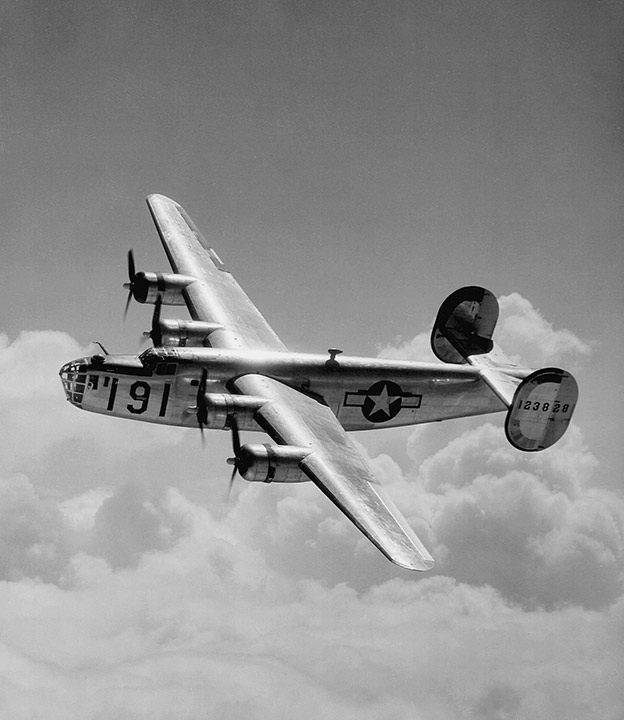
While on a mission, American airmen John Gaffney and Albert Romero’s B-24 bomber was shot down over the sea near Messina, Italy, on 30 April 1943. The only two survivors, they were interned in P.G. 59. Both escaped on the night of the 14 September 1943 mass breakout. Although John Gaffney paired up with Sgt. William Casey and Albert Romero traveled alone, they all headed south for the Allied lines, arriving a couple of days apart in late October.
The following information is from their POW repatriation reports prepared by MIS-X Section, POW Branch, of the U.S. War Department. The reports are courtesy of the United States Air Force Historical Research Agency (AFHRA), Maxwell Air Force Base, Montgomery, Alabama. Their reports contain a wealth of information, including the names and addresses of Italian helpers.
“Peter” is described in Robert Williams’ repatriation report as a “British agent dressed in civilian clothes,” typically “accompanied by an Italian civilian carrying a box of pigeons.”
The agent is mentioned three times in the official I.S.9 history of escaper/evader rescues in Italy. The first mention concerns I.S.9 Boating Section landings on the Adriatic coast, north of the Allied lines. The particular landing was accomplished in late February 1944, “during the non-moon period” (the new moon was on February 24): “The seas during February were again exceedingly rough and prevented all but two operations – ‘PETER’ and ‘JUG’, both of which were successfully carried out.”
Later in 1944, the agent was described as, “not only one of our most likeable officers, but he was thoroughly efficient and sincere in his work. He had previously been in command of our Boating Section based at BASTIA, in CORSICA, where he personally planned and took part in many hazardous landing operations on the WEST coast of ITALY.”
There is a final mention of the agent at the end of 1944—the history states, “‘PETER’ had joined the CLN and was now an active ‘saboteur’. W/Cdr DENNIS said he would deal with Peter later on for deserting the cause of ex-P/Ws.”
Recently Nigel Hackett wrote to me, “My father, Alfred Hackett (Gunner, 31st Field Regiment, Royal Artillery), was a prisoner of war at P.G. 59 Servigliano from late January/early February 1942 to June 1942.
“Dad was captured in a desert battle in December 1941 and was taken to Servigliano via the military hospital at Caserta and the transit camp at Capua.
“He was moved to P.G. 29 Veano from which he escaped in September 1943 at the time of the Italian Armistice.
“He made it back to the British lines at Termoli in October 1943 with the help of an Italian family, two Italian deserters, plus special forces taking part in Operation SIMCOL.
“I am a member of the Escape Lines Memorial Society (ELMS) and a supporter of Monte San Martino Trust (MSMT), and I have visited Servigliano a couple of times with ELMS.
“Dad—who was born in 1916 and died in 2002—had dictated his story to Roger Stanton, now Director of ELMS, when my father was a member of the Army Escape Club. I discovered more details at the Paradata Archive at Duxford about Operation SIMCOL some years ago.
Escaped Allied POWs bask in the beauty of their Swiss harbor
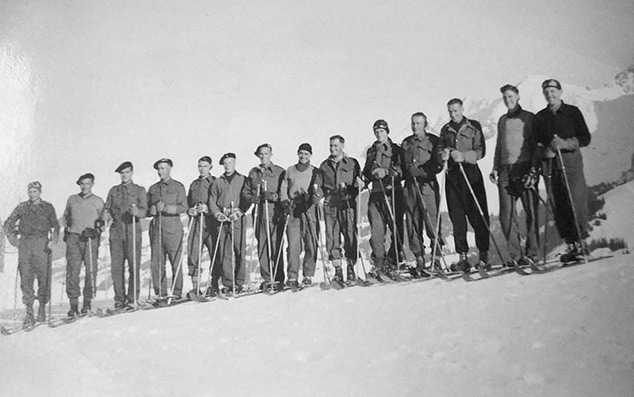
Many Allied soldiers who escaped from prison camps in northern Italy in the fall of 1943 made their way safely to neutral Switzerland.
Reginald Skinner was among them.
Reginald’s granddaughter Hannah Angell doesn’t know in which Swiss community he found shelter. Other POWs represented on this site found refuge in Alpine resort villages such as Adelboden, Arosa, and St. Gallen.
Reginald kept the following photographs as reminders of his time spent Switzerland.
The poems are: Reflections of a P.O.W. Appreciation The Fireside Fusiliers The Mirage Evening The Long Range Desert Group A Father’s Story to His Son
Reginald did not record the authors of the poems, but some of the poems appear with attributions in other prisoner’s notebooks, most notably Robert Dickinson’s “Servigliano Calling.”
“Reflections on a P.O.W.” is in G. Norman Davison’s diary, and the same poem also appears in “Servigliano Calling” with the shortened title “Reflections.” See “Camp 59 Poets.”
On the inside cover of his POW notebook, Reginald Skinner recorded his name, rank and company, as well as his bed and hut assignment in P.G. 59:
R.E.J. SKINNER. PTE. 6097228 BUFFS BED. NO 1019 9 HUT. CAMPO 59. PM. 3300 ITALIA.
Reginald Skinner of the Buffs
Recently Hannah Angell wrote to me from the UK.
“My daughter has been doing a school project on WW2,” she explained. “My grandfather was a prisoner of war in Italy. After doing a little research, I believe he was a POW in Servigliano. I have attached some pictures of a pocket notebook from his time there and a picture of him. His name was Reginald Skinner.
“My grandfather passed away eight years ago and he was a man of few words. He never shared any stories from his time in the war. All he told us was he was a POW in Italy and escaped to Switzerland.
“The only memory he ever shared with me was when he had a toothache an Italian soldier took him away and they ripped the tooth out of his mouth!
“He was in North Africa before Italy. I’ve found records with dates of capture and when he was interviewed in Switzerland.”
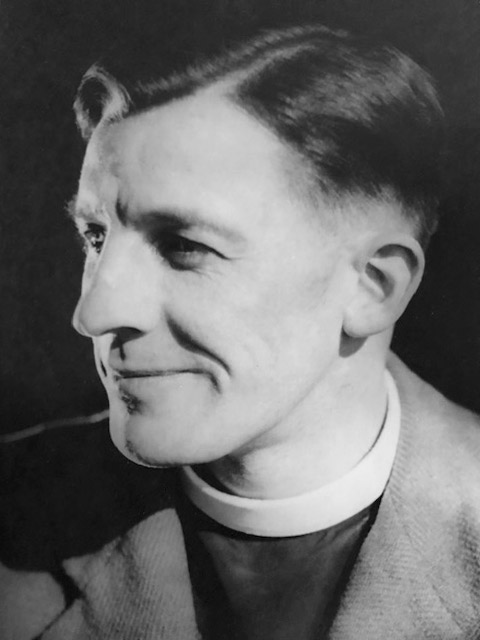
Today is Easter Sunday, and I can’t think of a better day to add a post on Niel Nye, who was a chaplain in Camp 59, to this site.
On a deep, personal level, Niel felt Easter represented hope and renewal. As a Royal Air Force chaplain, it was that spirit that he sought to impart year-around to soldiers fighting in France and North Africa, and to the interned POWs of P.G. 59.
I’ve mentioned him on this site before.
A few weeks ago, I received an email from David Osborn, who wrote, “I was researching family history for a friend of mine (Christopher Nye) when I came across this page which amazingly contains a letter, handwritten by his father Niel Nye:
When David contacted me he had already shared the page with Chris, and he told me Chris “was absolutely delighted to read the letter, and he recognised his father’s handwriting instantly. He is extremely grateful to Ms. Stewart that she shared the letter with you—it is a priceless piece of his family history that he would otherwise never have known existed.”
David put me in touch with Chris, and Chris and I exchanged a number of emails:
“My dad was a remarkable man who had a remarkable war.” Chris wrote. “After he escaped from P.G. 59, he had an exciting four months travelling south to meet the American forces as they drove north. He had several near misses and I recall him telling me of his adventures when I was about six, sitting in a bath that became colder and colder (but I didn’t notice, as I was so wrapped up with his story!!). When he got back to the UK, his adventures continued: he was appointed chaplain to Bomber Command, then went across to Europe a few days after D-Day. He was one of the first British officers to relieve Belsen concentration camp and, after the German surrender, set up a leadership training college in Hamburg to help with the German reconstruction. When he finally returned to England, he was appointed as vicar in three different parishes (Clapham, Morden, and Maidstone), and then joined the Archbishop of Canterbury’s staff as diocesan missionary. He was finally appointed as Archdeacon of Maidstone. He retired in the 1980s and died in 2003. His obituary in the London Times covered half a page!
“I will look out his biography which is hand typed (so I can’t easily send it electronically) and will post you a paper copy, if you like. It’s not brilliantly written (to quote your docs, he was never that academic!!) but it covers the basics of an interesting life.”
I was thrilled to receive the manuscript in the mail about a week later. It’s a fascinating, candid, frequently intimate account of his experiences—spiced throughout with rich humor. From his first memories of childhood in Bromley (in Greater London, England) to a very active retirement after leaving his position as Archdeacon of Maidstone, I was captivated by the tale!
Today I’m sharing the several chapters that cover Niel’s wartime years.