Category Archives: Prisoners—Camp 59

“Servigliano Calling” Camp Poem #9

dickinson_diary_angle_2001

“To Mother and Dad” is one of three poems by Denis Crooks recorded in Robert Dickinson’s diary, “Servigliano Calling.”

mother-dad_r150

To Mother and Dad

All my thoughts are for you, dear Mother and Dad,
And I dream of you both day and night;
Our our little white home
And the old sitting room,
And the things that are now gone from sight.

Of a night spent at home by the old fireside
With the wireless, a book and you two,
Of all the good things
And all the kind love
That you’ve always given me too.

And I pray every night to the good God above
To comfort you, not make you sad;
That one day quite soon
He’ll send me back home
To old England, my Mother and Dad.

A Timeline of Armie Hill’s Service

ahill_delousing_r150

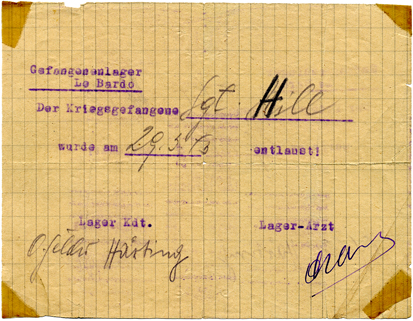
The above mimeographed certificate indicates that Armie Hill was deloused on March 29, 1943. At the time Armie was being held in Le Bardo, a Tunisian city west of Tunis in North Africa. He had been at the camp since March 3, and on the day after the delousing, March 30, he was flown to Camp 98 on Sicily.

Translated from German, the certificate reads:

“Prisoner-of-War Camp Le Bardo
The prisoner-of-war Sgt. Hill
was on 29.3.43 deloused
[signature] Camp Commander [signature] Camp Doctor”

Timeline

Here is a timeline of Armie Hill’s service in the United States Army, from induction to discharge:

1941

January 20—accepted for active military service at Induction Center, Milwaukee, and sent to Reception Center, Fort Sheridan, Illinois

January 23—assigned to 19th Engineer Corps, Fort Ord, California

Continue reading

Men of Hut 4–Section 11

As I mentioned in earlier posts, my father, Armie Hill, was put in charge of a section of 35 men (Hut 4–Section 11) in Camp 59. The first page of his camp notebook contains a roll of the men.

Armie listed them according to B. No. (perhaps an abbreviation for bunk or bed number), Rate (rank), Surname–First Name–Middle Initial, and Serial Number.

Interestingly, I noticed that three of the men (Edgar J. Curttright, Allen A. Coombs, and Claude J. Cole) had consecutive serial numbers. On investigation, I learned that the three were inducted at Cedar Rapids, Iowa on the same day—February 10, 1941—into the Army National Guard Infantry. I assume they knew each other, served in the same unit in North Africa, and were captured together.

All 35 men are listed in the U.S. National Archives WW II POW records. Armie’s address book contains addresses for a number of them. In future individual posts I will document all I know about each of these men.

B. No. 361—Sergeant Armie S. Hill—Serial No. 36200720
B. No. 362—Sergeant Kenneth E. Gaddy—Serial No. 20701847
B. No. 363—Corporal Michael M. Sterm—Serial No. 2703555
B. No. 364—Private Morris Scianna—Serial No. 33147188
B. No. 364—Private Rochester F. Nettles—Serial No. 34059817
B. No. 366—Private Joe Maly—Serial No. 16000460
B. No. 367—Corporal William S. Kornrumph—Serial No. 12020628
B. No. 368—Private First Class William W. Hurley—Serial No. 38064103
B. No. 369—Private First Class Gilbert D. Loonam—Serial No. 32019660
B. No. 370—Corporal Warron A. Colver—Serial No. 20705564
B. No. 371—Private First Class Lawrence F. Hunt—Serial No. 14038487
B. No. 372—Private First Class James Guillary—Serial No. 6959286
B. No. 373—Private First Class Earl C. Linaweaver—Serial No. 13023638
B. No. 374—Corporal Edgar J. Curttright—Serial No. 20701885
B. No. 375—Corporal Les J. Cratty—Serial No. 10600080
B. No. 376—Corporal Robert D. Chandler—Serial No. 15059956
B. No. 377—Private First Class Ray W. Dentler—Serial No. 37073082
B. No. 378—Private First Class Allen A. Coombs—Serial No. 20701884
B. No. 379—Private First Class James Collins—Serial No. 13022149
B. No. 380—Private First Class Claude J. Cole—Serial No. 20701883
B. No. 381—Private First Class Willis Largent—Serial No. 13023021
B. No. 382—Private First Class Alvie D. Cochran—Serial No. 15055130
B. No. 383—Private First Class Fredric G. Busky [Frederick G. Buske]—
Serial No.37038102
B. No. 384—Private John E. Buchanan—Serial No. 20701816
B. No. 385—Private First Class Stanley Bentley—Serial No. 15055095
B. No. 386—Private First Class Harold S. Arneson—Serial No. 39602619
B. No. 387—Private First Class Dillard W. Anderson—Serial No. 33090088
B. No. 388—Private First Class Arnold L. Anderson—Serial No. 20714955
B. No. 389—Private First Class Harold Adkins—Serial No. 33090536
B. No. 390—Private Anthony P. Fiore—Serial No. 32003230
B. No. 391—Private Ray Felcle [Felchle]—Serial No. 37025587
B. No. 392—Private Benjamin F. Farley—Serial No. 15054958
B. No. 393—Private Chris J. Facchina—Serial No. 33189164
B. No. 394—Private First Class John O. Everett—Serial No. 34138090
B. No. 395—Private August C. Erdbrink—Serial No. 33067286
B. No. 396—Private Billy V. England—Serial No. 6956161

“Servigliano Calling” Camp Poem #8


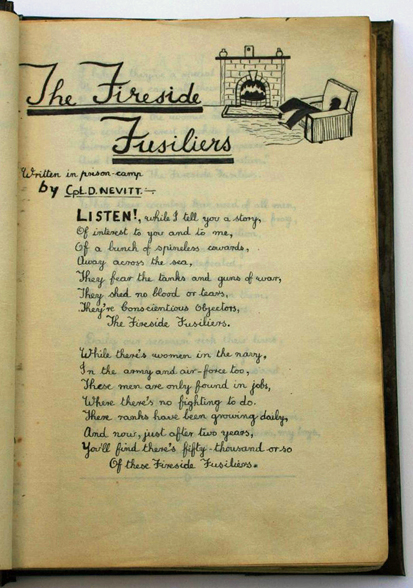
This poem is one of eight by Cpl. D. Nevitt recorded in Robert Dickinson’s diary, “Servigliano Calling.”

The Fireside Fusiliers

LISTEN!, while I tell you a story,
Of interest to you and to me,
Of a bunch of spineless cowards,
Away across the sea,
They fear the tanks and guns of war,
They shed no blood or tears,
They’re Conscientious Objectors,
The Fireside Fusiliers.

While there’s women in the navy,
In the army and air-force too,
These men are only found in jobs,
Where there’s no fighting to do
There ranks have been growing daily,
And now, just after two years,
You’ll find there’s fifty-thousand or so,
Of these Fireside Fusiliers.

I believe they’ve a special medal,
It’s one they can call their own,
Painted a bright gleaming yellow,
Designed by the women at home,
Its centre’s a crest of white feathers,
Surrounded by cold feet, it appears,
And their motto “Self-preservation,”
That’s the Fireside Fusiliers.

While their country has need of all men,
On “religious grounds”, keep from the fray,
And despite the serious position,
Enjoy home-comfort each day,
When Jerry has been defeated,
They’ll flourish their souvenirs,
Then tell you how they won them,
These Fireside Fusiliers.

Daily our seamen risk their lives,
To bring their rations through,
For remember there’s fifty-thousand,
Not just one or two,
But when this war is over,
You can regard these men with sneers,
For you’ve done your bit, and theirs, my boys,
The Fireside Fusiliers

“Servigliano Calling” Camp Poem #7


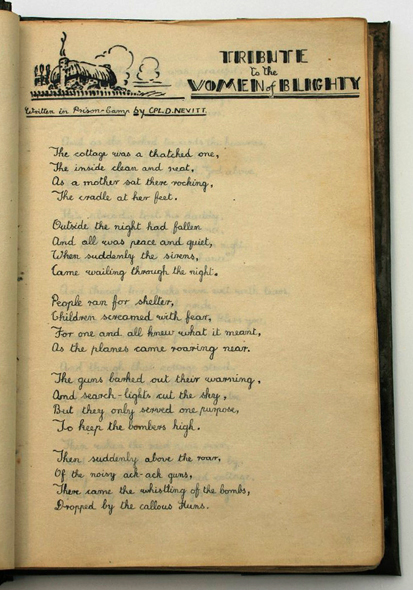
This touching poem by Cpl. D. Nevitt reflects on the bravery and sacrifice of the women of Blighty (England) through the story of one widow’s loving protection of her baby. The poem is from Robert Dickinson’s diary, “Servigliano Calling.”

Tribute to the Women of Blighty

The cottage was a thatched one,
The inside clean and neat,
As a mother sat there rocking,
The cradle at her feet.

Outside the night had fallen
And all was peace and quit,
When suddenly the sirens,
Came wailing through the night.

People ran for shelter,
Children screamed with fear,
For one and all knew what it meant,
As the planes came roaring near.

The guns barked out their warning,
And search-lights cut the sky,
But they only served one purpose,
To keep the bombers high.

Then suddenly above the roar,
Of the noisy ack-ack guns,
There came the whistling of the bombs,
Dropped by the callous Huns.

In the cottage all was peaceful,
And at the bottom of the stairs,
Knelt that mother with her baby,
As she softly said her prayers.

And as she looked towards the heavens,
Her eyes shone full of faith,
As she softly murmured, “God above,
Please keep my baby safe.

He’s already lost his daddy,
For he gave his life in France,
So if I should get killed this night,
Please give my child a chance.”

And though her cheeks were wet with tears,
Her voice was full of pride,
As she whispered may God Bless you,
And the bombs still fell outside.

And though that cottage stood,
Outside the town, alone,
A bomb crashed through the centre,
Of that peaceful little home.

Then when the raid was over,
And the bombers had passed by,
They searched that ruined cottage,
And they heard a baby’s cry.

They found her ’neath the ruins,
That poor young soldiers wife,
For her dead and battered body,
Had saved her baby’s life.

So when you go in action,
And you feel somewhat afraid,
Just think of what the women stand,
In any big air-raid.

“Servigliano Calling” Camp Poem #6


This clever poem, an ode to the Camp 59 dog, is one of six by C.A. Hollis recorded in Robert Dickinson’s diary, “Servigliano Calling.”

The Neutral

He’s not of any army, he has no need to kill,
His is the freedom of the prison, he comes and goes at will,
No cheering at advances, no worries of retreats;
It matters not, if he’s a coward, or performs heroic feats.

He’s the friend of captor and captive, of both he has no fear,
He just walks disdainfully, if either clip his ear.
No rations is he issued, his meals are bits and scraps,
And when he’s feeling tired, most anywhere, he knaps.

And when this war is over, his life will be the same,
He cares not who’s the victor, or who deserves the blame.
He’s a neutral in this conflict—this world engulfing bog,
He’s one of man’s greatest friends, just a homely dog.

This poem was inspired by Old Bob the camp dog.

The Christmas Ship

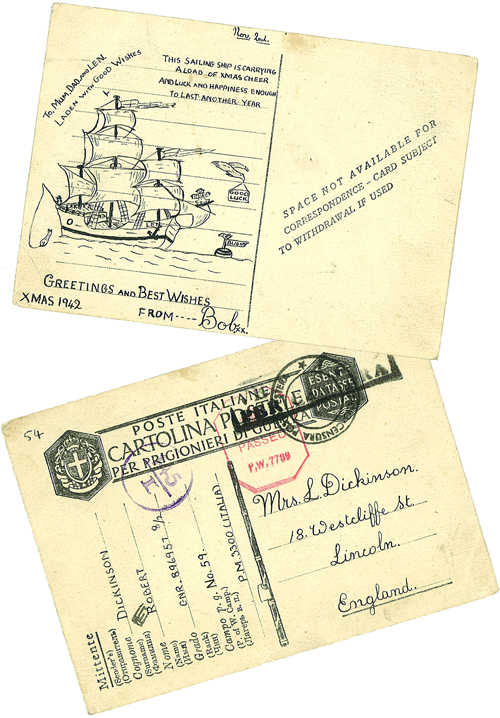
This Christmas postcard, sent from Camp 59 by Robert Dickinson to his parents and young brother Len, reads:

Nov. 2nd.

“To Mum, Dad, and Len.
Laden with Good Wishes

“This sailing ship is carrying
A load of Xmas cheer
And luck and happiness enough
To last another year

“Greetings and Best Wishes
From—Bob.xx.

“Xmas 1942”

Robert’s ocean scene is full of happy detail. Wind fills the sails of the ship, named Len, and sends it on it’s merry way toward “Blighty” (a nickname for Britain). A gull carries a sign that reads “Good Luck” as it sails on a breeze overhead. One sailer, playing an accordion, balances on the bowsprit. Another, with broad-brimmed hat, lands a fish at the back of the ship.

Continue reading

Combat and Capture—Armie’s 1976 Story

This account is from the first of two interviews with Armie regarding his experience during World War II. Armie’s son Dennis Hill taped this conversation on February 21, 1976 in Phelps, Wisconsin.

Dennis edited the transcript; Armie also made a few additions and corrections to the story.

This portrait of Armie was created by an artist in North Africa.

En Route to Invasion

“On August 31, 1942 the troops in my company left the States. Our first stop was Antrim County, Ireland. We were in Ireland for a few weeks. Then they sent us to England—to Liverpool. In England we had an idea that we would be sent someplace, but we didn’t know where we would be sent. We had been given extra training. We had spent time getting all our equipment ready. Everything had to be covered with oil and grease so that it would be waterproof, and then we covered it with canvas.

“One day we were told to be ready to load on the ships. They took us in barges out to the ships. And the ship that I was loaded on—I was a sergeant and a squad-leader at the time—wasn’t a passenger ship but an old, Russian ship that had been used to carry freight. It really wasn’t sea-worthy. All around ships were being loaded. It took us several days to load and assemble the convoy. Finally, we set off from Liverpool.

“We were given orders to stay below deck. When we were allowed on deck, we weren’t supposed to throw anything in the water that would give a clue as to the trail of the ships. When we did throw anything overboard—garbage or anything—it was always at night.

Continue reading

Combat and Capture—Armie’s 1987 Story

This account of Armie Hill’s early service experience, from induction and training through combat and capture, is based on the second of two tape-recorded interviews Armie made with his son Dennis.

This conversation was recorded on August 24–26, 1987 in Phelps, Wisconsin. Dennis edited the transcript and made a few additions and corrections that Armie requested.

Armie Hill at Fort Ord, California, 1941

First Year in Service

“I’ll start my story from the beginning, when I was first inducted into the service. I received my draft notice 1940 and signed up for selective service. Word came that December that I would be called, and I was inducted into the service in January 1941.

“This was the first draft and I was one of the first men drafted from Vilas County. There were about seven of us who were drafted from Vilas County, and I was the first one from the town of Phelps. We went to the courthouse in Eagle River and we were driven by bus—I think it was to the train station—and then we took a train to Chicago, and then from Chicago to Fort Sheridan, Illinois.

“At Fort Sheridan we were selected to go to Fort Ord in California. We went by train and it took us several days to get there.

“At that time, Fort Ord had been a tent camp—everyone had been living in tents. Before we arrived, new barracks had just been hastily put up and everything at the fort was still a mess. A lot of the work was still undone. The streets were sand. It was raining. We hadn’t had basic training, so we got all of our training there at Fort Ord.

“All was confusion there. I thought to myself, ‘If they’d just let me out, I’d walk home.’

Continue reading

An Unpaid Bill for Onions

This note reads:

“SEC. No 11. received from Canteen 30 KILOS of onions at 3 LIRE per kilo TOTAL LIRE = 90 Lire To be payed on the 16/9/43.

“8/IX/1943 [signed] Armie Hill Sec. Sergt.”

This scrap of paper, which was both a receipt for onions received and an I.O.U. for payment owed, was in Armie Hill’s pocket when he escaped from Camp 59 on September 14, 1943.

Armie was the Section 11 “section sergeant,” the serviceman who was put in charge of the 35 American servicemen who lived with him in Hut 4—Section 11.

The date of the receipt is written 8/IX/1943, seemingly a combination of Arabic and Roman numerals. If this is the case, then the transaction date was September 8, 1943—the day the Italian Armistice was signed.

And the due date for payment was September 16, 1943—two days after breakout from the camp.

It’s interesting to learn the price on onions from this slip (paid for in special Camp 59 POW money, of course), and to know that at least on one occasion purchase of food on credit was allowed.