Category Archives: Prisoners—Camp 59

Ralph Hoag—Escaped, then Recaptured

ralphhoag1942_g150

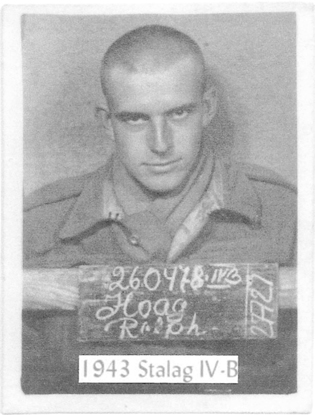
This 1943 Stalag 4B photo of Ralph Hoag was originally attached to his prison record. The prisoners took their own records from the office at Luckewalde after the Russians liberated the camp.

Many of the accounts on this site are of men who escaped from Camp 59 and made their way south to the Allied forces, or who were protected by the Italian farm families, the “contadini.”

Ralph Hoag, on the other hand, was free after the Camp 59 breakout for only nine days before being recaptured by German paratroopers.

He said of the escape:

“After the 59 breakout, eight of us were together—way too many to expect an Italian family to care for. We didn’t keep moving, but stayed in the woods and went to a farm for occasional food. I’m sure they reported our whereabouts to the Germans, because the Germans came right to us.

“We were returned to 59 along with most all of the others—half of which were British Tommies. I guess we were there two days. When it was time to move out there were two or three missing at roll call. The Germans threatened to shoot every tenth man until they were found.

“Finally, we were jammed into boxcars with crates of loot and bags of macaroni—so much so we couldn’t all lay down at once. That was a long 8–9 day trip. I think they let us out of the boxcars twice. We went through the Bremer Pass, into Germany—to Stalag IV-B.

“The German paratroopers respected the three for attempting to escape. They were hiding in the camp. The Germans knew no one had gotten out. They were treated fine and sent on to Germany, where they rejoined us a few days later.”

In addition to Camp 98 Sicily and Camp 59 Italy, Ralph was interned at:

Stalag 4B, Muhlberg Sachsen

Stalag 2B, Hammerstein, West Prussia

Stalag 3B, Furstenberg on the Oder, Brandenburg

Stalag 3A, Luckenwalde, Brandenburg

Read Ralph Hoag’s account of his POW experience at the combatvets.net site under “Bios/Memorials.”
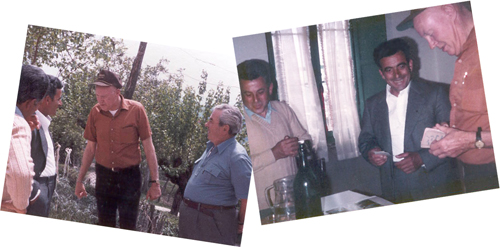
Luther’s Reunion with the Palmoni Family

famiglialuther3_r200

shields-reunion1983_r200

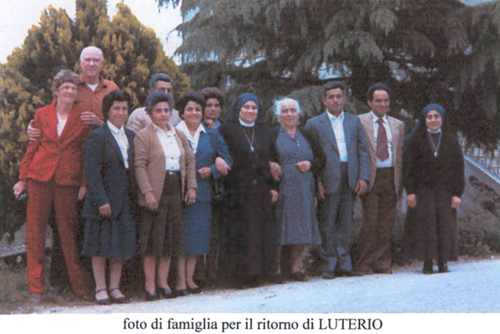
Luther Shields and his wife Jimmie visited with the Palmoni family in 1983. The Palmonis hid and fed Luther and fellow POW Louis VanSlooten after their escape from Camp 59.

At top: Luther and Jimmie (far left) with the Palmoni family. Iginia “Mama” Palmoni is the woman with white hair and gray dress.

Above left: Luther with Marino and his brother Gino. The man in blue is Primo Pilotti. Above right: Marino and Gino Palmoni with Luther indoors.

Continue reading

Luther’s Note of Thanks

luther-thanks-1983_r150

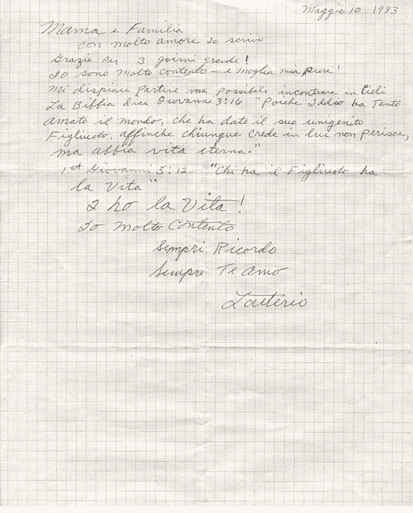
Following Luther and Jimmie Shield’s 1983 visit to the Palmoni family, Luther sent an affectionate thank you note to Iginia “Mama” Palmoni and her family. This letter was scanned by Antonello Palmoni (Marino Palmoni’s son), and sent to Luther’s daughter Cindy Jackson 25 years later, on December 29, 2008.

The text of the letter, both in Italian and translated into English, follows.

Continue reading

A Surprise Reunion

shields_article1_r200

News article—Part I

Forty years later: Reunion with Italian partisans—Local Cortez veteran man shares prison camp experiences

BY SUSAN SHIELDS
Cortez [Colorado] Journal, circa April 1983

(EDITOR’S NOTE: The following is the first part of a two-part account of the capture, internment in a prison camp, and ultimate escape of Luther Shields in a World War II battle which took him from north Africa to Italy during the height of intensive fighting.)

December 8, 1941: The United States declares war on the Axis countries. Private Luther Shields of Goodman Point had already been through training for the U.S. Army at Fort Bliss, and had written home to his parents, “I don’t think the army is so bad after all.”

On May 19, 1942, Private Shields would again be writing to the folks back home from Northern Ireland, where he and thousands of other American troops were engaged in serious training maneuvers, ostensibly, in preparation for thwarting the German Wehrmacht’s assault on Russia.

Continue reading

“Servigliano Calling” Camp Poem #10

dickinson_diary_angle_2001

“The Mirage” is one of eight poems by Cpl. D. Nevitt in Robert Dickinson’s Camp 59 journal, “Servigliano Calling.”

014_mirage_r150

The Mirage

T’was in a lonely desert outpost,
Where a sunburnt sentry lay,
Looking o’er towards the Jerries,
Not so very far away.

The flies for ever buzzing,
Converged upon that spot,
And the burning sun above him,
Made those yellow sands quite hot.

For hours he lay there watching,
But he didn’t mind that day.
For he’d just received a letter,
From a thousand miles away.

For thirteen weeks he’d waited,
Waited so patiently,
And now at last it had arrived,
That note from oversea.

Continue reading

Robert Dickinson’s Last Letter

rbtdickinson_150

Robert Dickinson at home.

This letter from Robert to his brother Jim and Jim’s wife Olive must have been sent after September 1944, as the breakout from Camp 59 was on September 14, 1943, and Robert writes that he has not been a POW for over a year.

Jim must have been glad to receive the letter, as he had not been in contact with Robert since he left camp.

Eve, who is mentioned, is Olive’s sister. Known in the family as Auntie Eve, she turned 90 in 2008.

Ida was Robert’s girlfriend. It is to Ida that he dedicated his journal, “Servigliano Calling.” Had Robert returned home, he and Ida would likely have married.

Continue reading

Dual Purpose Deck of Cards

cards1_r150
cards2_r1501 cards3_r150 cards4_r150 cards5_r150 cards6_r150 cards7_r150

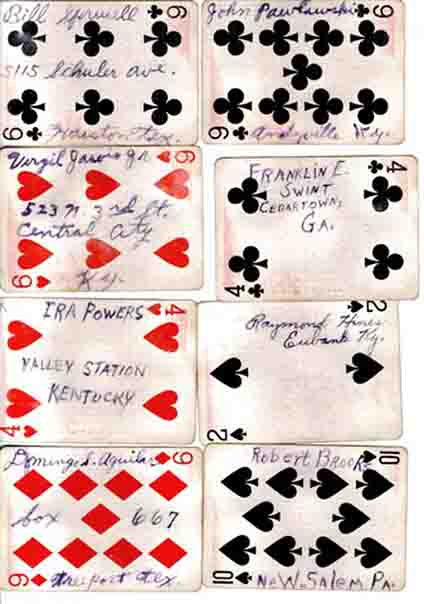
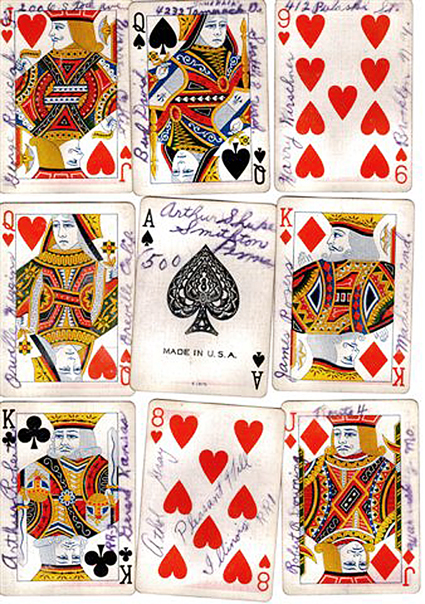
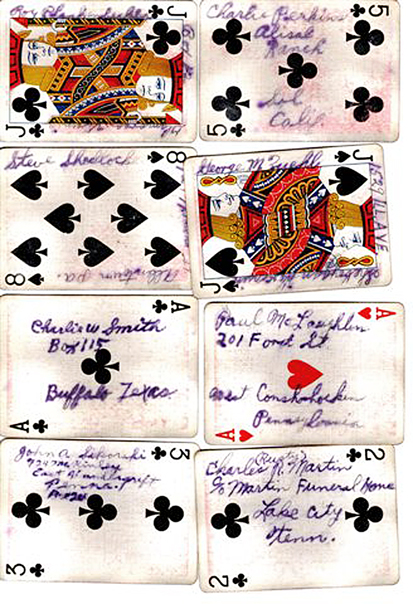
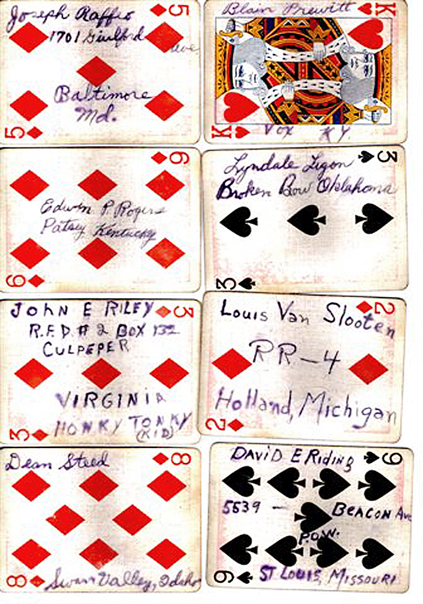
On this set of American Red Cross “Aviator” playing cards Luther Shields recorded the names and addresses of his friends in Camp 59. Most of them are likely from his camp section.

He carried this “address deck” with him when he escaped.

Note that a couple of the cards bear colorful descriptions: “Hill Billy Sheep Hearder” and “Honkey Tonk (Kid).”

There are 55 addresses in all. They are:

James L. Rogers
R.R. #1
Madison, Indiana

(U.S. National Archives on-line POW database indicates Pvt. James L. Rogers, Army Infantry, of Indiana was returned to military control, liberated or repatriated from CC 59 Ascoli Picenzo Italy 43-13.)

Gus Teel
507 S. Richardson
Roswell, New Mex.

(U.S. National Archives on-line POW database indicates Pvt. Guss O. Teel, Army Corps of Engineers, of New Mexico was returned to military control, liberated or repatriated from a POW camp, but no camp name is indicated.)

Paul Wakeland
601 Walnut Street
Dawson Springs, Ky.

(U.S. National Archives on-line POW database indicates Sgt. Paul I. Wakefield, Army Infantry, of Kentucky was returned to military control, liberated or repatriated from CC 59 Ascoli Picenzo Italy 43-1.)

Continue reading

Robert’s Calendars

dickinson_diary_angle_2001

calend_1941_r150

calend_1942_r150 calend_1943_r150 calend_1944_r150

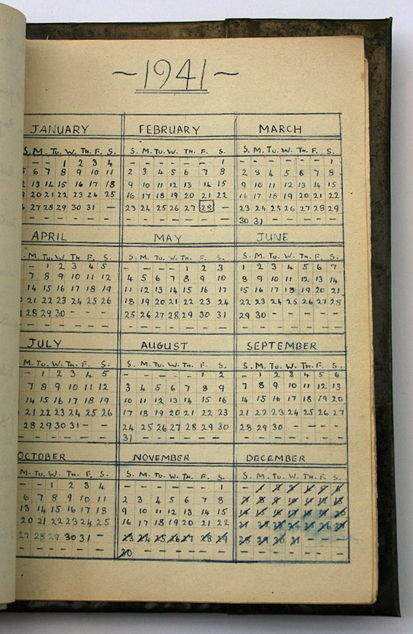
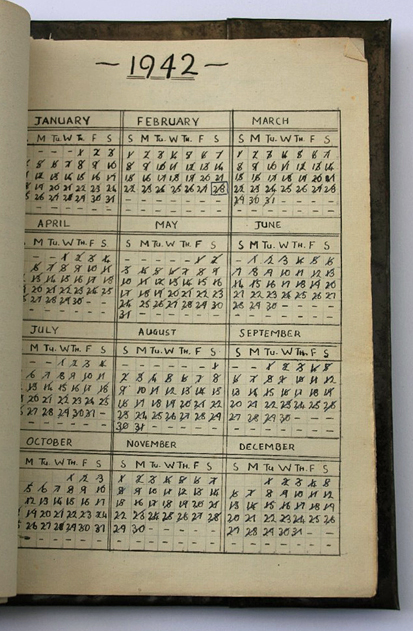
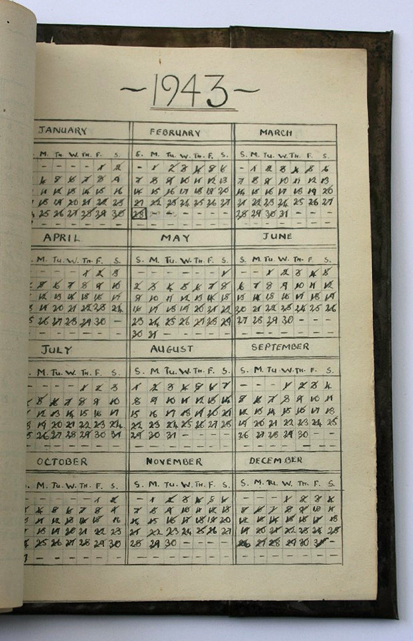
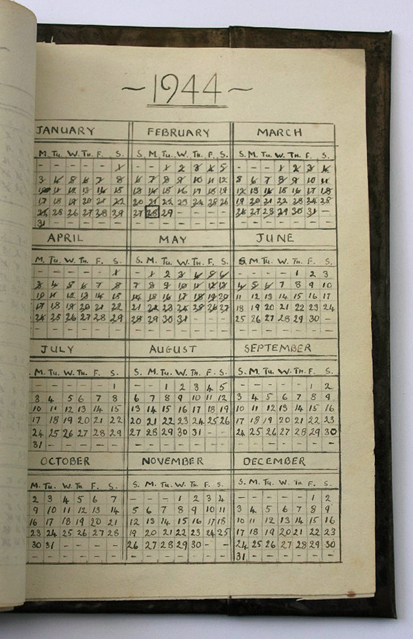
The last few pages of Robert Dickinson’s journal, “Servigliano Calling,” contain calendars for the years 1941–44. Each of these calendars is meticulously drawn and accurate; the 1944 calendar includes February 29th, as it was a leap year.

On each of the four calendars one date has a heavy outline, February 28—Robert’s sweetheart Ida’s birthday. Robert’s journal entry for February 28, 1944 reads:

“Feb 28th—Ida’s Birthday; Oh for a letter.”

The strikes-throughs marking each passing day begin on Sunday, November 23rd, the day Robert was captured by the Germans. The last strike was through June 6, 1944. But, curiously, Robert continued to record daily events in his journal through September 3, 1944. Why did he decide to stop marking out the days?

His entry for the last struck-though date is:

“Jun 6th—The invasion is on; news of big landings in France!!”

An Article on Luther Shields’ Escape

shields_bealiner_r200

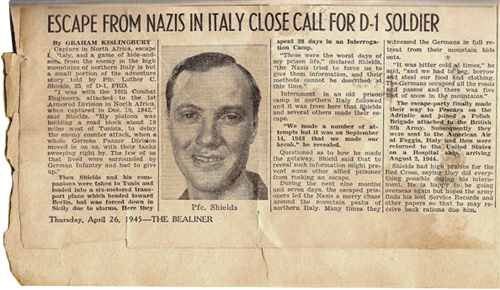
The following article by Graham Kislingbury, entitled “Escape from Nazis in Italy Close Call for D-1 Soldier,” appeared in the Thursday, April 26, 1945 edition of The Bealiner. The Bealiner is the newspaper of the Beal Air Force Base in Yuba County, California.

Capture in North Africa, escape from Italy, and a game of hide-and-seek from the enemy in the high mountains of northern Italy is but a small portion of the adventure story told by Pfc. Luther C. Shields, 25, of D-1, PRD.

I was with the 16th Combat Engineers, attached to the First Armored Division in North Africa, when captured in Dec. 10, 1942,” said Shields. “My platoon was building a road block about 18 miles west of Tunesia to delay the enemy counter attack, when a whole German Panzer Division moved in on us, with their tanks sweeping right by. The few of us that lived were surrounded by German Infantry and had to give up.”

Continue reading

Luther Shield’s Story

Prior to being drafted, I attended Garrett Ridge High School in the Cortez area of Colorado during my freshman and sophomore years. My mom and dad had no money to pay tuition for me to finish high school, so I went to Kuna, Idaho where I lived with my granddad and grandma Walker. I milked cows in Boise, Idaho. My granddad had an old radio in the barn that he played when milking cows. He swore the cows gave more milk when the radio was playing.

I was drafted in fall of 1941 to serve one year. Beginning in September 1941, I spent 13 weeks in basic training at Fort Knox in Kentucky, and I also trained at Fort Bliss in Texas.

Then Pearl Harbor was attacked in December 7, 1941 and World War II broke out.

World War II was everywhere. Yugoslavia and Greece had fallen to Nazi troops, Russia was being heavily attacked by powerful German artillery, American forces had whipped a Japanese fleet in the Coral Sea, and Mussolini was fighting for control over Italy in an alignment with Hitler. By November of 1942, most of the Allies’ concentration was on the European theater. Rommel masterminded a series of surprise advances in North Africa. On November 8th, our 16th Combat Engineers were attached to the First Armored Division of the U.S. Second Corps.

Continue reading