Category Archives: Prisoners—Camp 59

William George Wales

British serviceman William George Wales served in the Royal Sussex Regiment, 1st Buffs. He was captured in North Africa on December 15, 1941 and sent to the prison camp in Servigliano.

From Italy he was transferred to Germany, where he was interned at Stalag 7-A Moosburg, Stalag 11-A Altengrabow, Stalag 11-B Fallingbostel, and Commando 1011 Wolfenbüttel.

William was liberated on April 23, 1945.

Later in life he was consulted during the making of the film “Von Ryan’s Express.” He died in 1980.

Kane Brothers Recall the War—Article, Part II

Kane_Jacksonville_g150
This photo of Henry (at left) and Richard Kane was taken on the boardwalk in Jacksonville, FL while the brothers were on a pass during training. Henry’s son George commented, “Ironic that the photo depicts exactly what was to come several months later.” 

Memories of WW II Continue For Kane Brothers

December 23, 1986, The Sentinel, New Windsor, New York

Editors note: This is part two of a two-part feature. The first part appeared in the December 18 issue of The Sentinel.

by Linda Fehrs

Henry and Richard Kane are brothers who did many things together including joining the army in World War II. After fighting many battles, mostly in northern Africa they were captured together by the Axis powers and spent well over two years in prisoner of war camps in Europe.

After being transferred from camp to camp they had ended up in Palermo, staying there for about a year. They spent their time reading and playing games. The Red Cross sent them packages regularly, but life in the camp was not of the highest quality. The place was rampant with bedbugs and the men had body lice. The meals were sparse and the conditions less than pleasant to say the least.

One of the goals of captured soldiers in time of war is to escape. And this was what Henry and Richard Kane, along with other American soldiers, did. They managed to blow a hole in the wall of their camp and escape through some tunnels they had been digging.

Continue reading

Kane Brothers Recall the War—Article, Part I

HenryDick_1941_g72
Richard and Henry Kane, 1941

Brothers Recall Wartime Memories

December 18, 1986, The Sentinel, New Windsor, New York

Editors note: This is part one of a two-part feature. The second part will appear in our next issue.

by Linda Fehrs

It was while they were working on their family’s apple farm on Drury Lane that they decided to join the Civilian Conservation Corps. Henry and Richard Kane were just young boys then and eager to help their country.

Every eligible male it seemed back then wanted to help out and the CCC was a good place to start. They earned $30 a month and sent $20 of that home.

Henry worked at a Gypsy moth camp in Peekskill, 8 hours a day, and later transferred to Albany. Richard worked as a tree climber near West Point.

Continue reading

Potatoes for Prisoners

John Everett, Jr. e-mailed me last week that his sister, Sandra Everett Barnett, reminded him of another bit of information their father had shared with her, but that was not included in his written story:

“My Dad had said that food was scarce in the camp, and once more the Italian families came through for them. Apparently, a couple of near-by farmers would toss a few potatoes over the fences around the barracks at night for the soldiers. He said that it was about the only food they had sometimes.”

Armie’s Italian Angels

Armie_Address_r72

After escape from Camp 59 on September 14, 1943, Armie Hill and Ben Farley traveled south together and reached the British 8th Army, near Termoli, on October 15.

During this month-long journey the soldiers were assisted by a number of Italians.

In his two recorded accounts of the escape, Armie describes the help they received from the Bianchini family.

Two Bianchini addresses are recorded in his address book:

Bianchini Angela
Caserine N118
Roccafluvione
Ascoli Piceno

Bianchini Angelo
Porta Romana N18
Ascoli Piceno

Armie explained that the Bianchinis “…owned a place in the city, but this [the home in Roccafluvione] was out in the country—kind of like a hiding place or like a resort.” By contrast, Porta Romana is one of the six historical quarters of the city of Ascoli Piceno.

A woman who marries in Italy does not take her husband’s surname, but keeps her own family name. Therefore, Angelo Bianchini would likely have been Angela’s brother, cousin, or some other blood relative.

The addresses of two other Italian families are recorded in Armie’s address book.

Continue reading

The Survival Tale of John O. Everett

Lupi_family_r72
Nazareno Lupi and his wife, whose family hid John Everett and Willis Largent for over nine months. John received this picture after the war from the Lupi family.

JEverett_etal_r72
John Everett (with arms crossed) and two comrades.

Two weeks ago I received these photographs and the following story from John O. Everett, Jr.

He wrote, “Dad’s story is in the form of a submission he and I made to TNT years ago when they were focusing on soldiers’ stories one Memorial Day weekend. I had sat down with my Dad several times to obtain the timeline and other details for the story, and it was completed and submitted a year before he died. Although TNT did not include his story during the broadcast, I am so glad that I documented his experience so that I can provide the details to you.”

John O. Everett, Sr. passed away in 1995.

It’s a pleasure to share his story, and it’s my hope that the gratitude he wished to send to the Lupi family by way of the TNT broadcast will find it’s way to them somehow through this site.

John Everett and Willis Largent were both interned in Hut 4–Section 11—the section of men Armie Hill was assigned when he was transferred to the camp.

Here is John’s tale, which he named “The Unsung WWII Heroes of Italy: A POW’s Story.”

The Unsung WWII Heroes of Italy:
A POW’s Story

“What the hell part of the world are you from?”

I still remember this question asked of three scruffy American soldiers in June, 1944 by an officer in the South African Army near Foggia, Italy. The rags that served as our clothing were part U.S. Army issue, part Italian farmer, and our boots had more holes than leather. And yet we were happy, we were safe, and we owed our lives to an Italian family that hid four prisoners of war from the Germans for over nine months.

The history books tell us that Italy was our enemy during World War II. But you will never convince a number of POWs who owe their lives to the courage and generosity of several poor Italian families who shared when they had nothing to give.

World War II began for me when I was drafted in early 1942. I had originally volunteered for service in 1941, but was turned down due a problem with my legs. Like so many other health problems, mine was “reevaluated” when the fighting got hot and heavy in 1942.
Continue reading

Marino Palmoni on the Sheltering of the POWs

I nonni Iginia e Luigi_g150

Marino’s parents, Iginia and Luigi Palmoni (Marino genitori, Iginia e Luigi Palmoni)

This recollection of the experiences of Marino Palmoni during the long winter of 1943–44 was provided by his son Antonello Palmoni. Antonello interviewed his father for this story in May 2009.

marino_r100

Marino Palmoni

The story is presented here in Italian and translated into English.

First, the English translation (Tradotto in inglese):

In September 1943, my grandfather Luigi, my father Marino (10 years old), and my uncle Gino (5 years old) were plowing the field near the woods beneath the cliff, when out of the woods came a man. Although he did not speak Italian, we understood from his gestures that he was hungry.

Grandfather asked my father to return home and bring something to eat, so Marino did and returned with bread and cheese. Our family was poor and large; there were more of us at home.

Continue reading

Remembering Robert Dickinson

milan-steve_r150

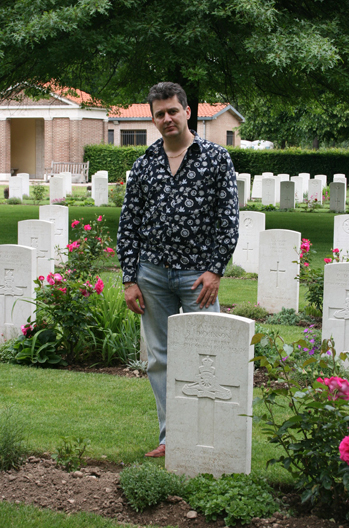
Steve Dickinson at the grave of his uncle, Robert Dickinson, in Milan War Cemetery. May 2009.

After escaping from prison camp, Robert Dickinson was sheltered by a family in Gassino (a small town near Turin in northern Italy).

Steve Dickinson, Robert’s nephew, believes he was hidden by a family with the surname of Bauducco at a farmhouse on Via Armando Diaz in Gassino. (A loose page in Robert’s diary, “Servigliano Calling,” bears the address of “Bauducco, Via A. Diaz, Gassino.”)

While in Gassino, Robert fought with the Italian Partisans against the German forces. He was killed in action on March 3, 1945. Initially, he was laid to rest by his Partisan comrades in Viali Cemetery in the town of Asti. After the war Robert’s body was moved to the Milan War Cemetery.

Steve Dickinson first visited Robert’s grave in August 1992. This month he made a return visit to the cemetery.

He also traveled to Gassino. In advance of his trip, Steve created “request for information” leaflets, translated by an Italian friend into Italian, for distribution in Gassino.

On returning to his home in the UK, Steve wrote:

“Spent some time in the village where Robert was hidden and left some of the fliers in various places. Several shops including the pharmacy said they would put them in their windows. Also left many in post boxes on Via Armando Diaz. Doubt I’ll get a reply but given the visit I had to try.

“Following this I visited Robert’s grave in Milan. I was greatly pleased to see that the cemetery was as well kept as when I had previously visited. In fact, probably better as the roses were in full bloom. As with my previous visit it was a moving experience. I probably spent an hour walking around the cemetery taking photos and reading/observing the graves. I found 5 graves buried all together, these being the crew of a plane shot down over Italy. Also found another grave of one of the Lincolnshire’s due to the Lincolnshire’s emblem (The Sphinx) on his gravestone.”

milan_064_r150

Robert Dickinson’s Address List

dickinson_diary_angle_2001

addresses_r300

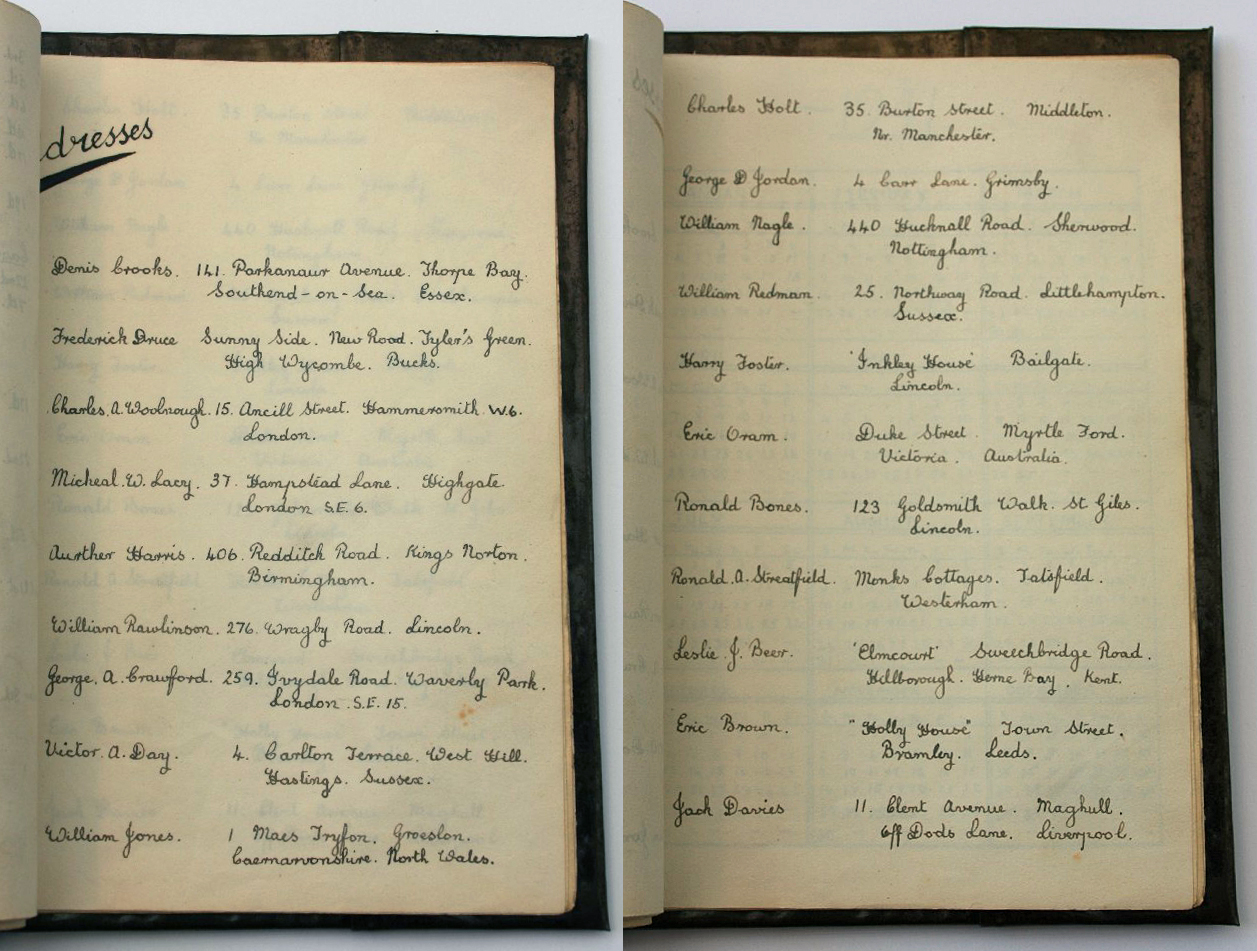
Two pages of Robert Dickinson’s journal, “Servigliano Calling,” contain names and addresses of 20 fellow prisoners. These are listed here:

Denis Crooks

141. Parkanaur Avenue. Thorpe Bay.

Southend-on-Sea. Essex.

Frederick Druce
Sunny Side. New Road. Tyler’s Green.
High Wycombe. Bucks.

Charles A. Woolnough
15. Ancill Street. Hammersmith. W.6.
London

Micheal W. Lacy
37. Hampstead Lane. Highgate.
London S.E.6.

Continue reading

The “Servigliano Calling” Poets

Robert Dickinson’s journal, “Servigliano Calling,” contains 34 poems. The ten identified poets whose works appear in the journal are: 

C.A. Hollis, J.R. Cromley, Corporal D. Nevitt, Denis Crooks, G.A. Crawford, C.G. Hooper-Rogers, Alec. Forman (A. Forman), Bombardier P.G. Whapples, Harry Stewart (H. Stewart), and F. Chiltern. 

One poem, The Alphabet, is simply attributed to “a South African.”

Only the addresses of two of the poets are recorded in the journal. They are:

Denis Crooks
141. Parkanaur Avenue. Thorpe Bay.
Southend-on-Sea. Essex.

George A. Crawford
259. Ivydale Road. Waverly Park.
London. S.E. 15.

Continue reading