Category Archives: Prisoners—Camp 59

A Salute to Dick Kane

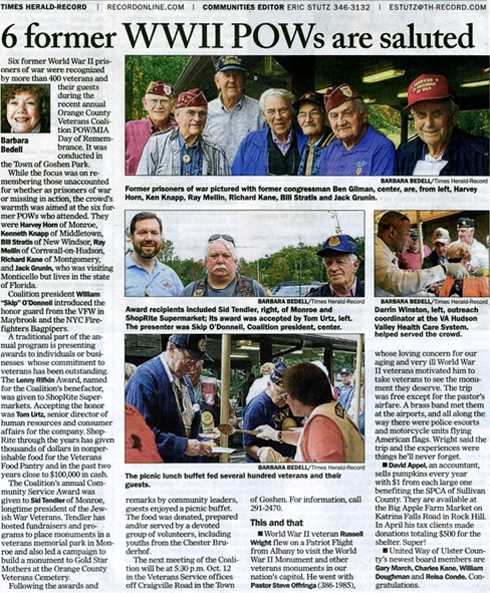
Caption for top image: “Former prisoners of war pictured with former congressman Ben Gilman, center, are, from left, Harvey Horn, Ken Knapp, Ray Mellin, Richard Kane, Bill Stratis, and Jack Grunin.”

Times Herald-Reporter (Middletown, New York)
October 1, 2010

Reporter Barbara Bedell covered this annual September veterans Day of Remembrance ceremony for the Times Herald-Record of Middletown, New York.

The article begins with a tribute to six former POWs:

“Six former World War II prisoner of war were recognized by more than 400 veterans and their guests during the recent annual Orange County Veterans Coalition POW/MIA Day of Remembrance. It was conducted in the Town of Goshen Park.

Continue reading

Postcards from Bob Smith


Here are two postcards Bob Smith sent while a prisoner at two camps in Italy.

Bob’s neice Carole Proctor explains, “I have 10 postcards written by him, the first 6 being from Campo 59 written to his sisters, one of whom was my mother who died in 2005. The first date on the postcards [from Campo 59] is 5.8.42 and the last is 23.12.42. The next postcard is dated 31.7.43 and the address is Lavoro Base No. 133/xvii. PM3100. He is still there on 4.7.43 but a card dated 15.8.43 he says he is in a new camp—No.133/iii.”

Continue reading

Clarence “Tom” Cronin

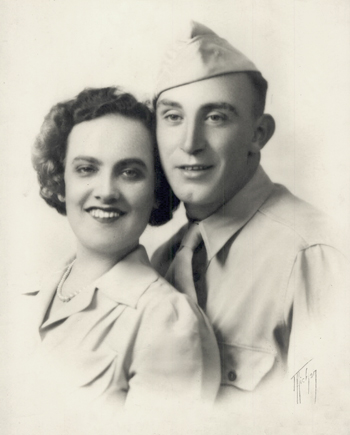
This photo of Clarence T. Cronin, sent to me by his son Ed, is of “my Dad and mother before he shipped out over seas.”

Clarence went by the name of Tom, which was his middle name. He sailed on the Queen Mary a few months after the wedding.

Tom was interned at Camp 59 and escaped in September 1943. “He was on the run for several months before he made it back to the lines.” Ed explains, “Like many in your stories, he was in an emaciated condition. My mother states he weighed 90 lbs. when he got home to the States.”

Tom passed away in 1996.

A Confident Dick Redman

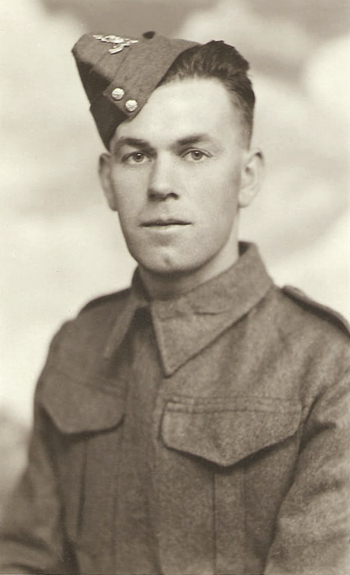
This dapper, confident fellow is William Redman—known to his family as Dick.

Dick was a British soldier from Littlehampton, Sussex. This photo is from his niece Jo Millard.

As Robert Dickinson included Dick’s address in his journal, “Servigliano Calling,” (see Robert Dickinson’s Address List) we can assume that Robert and Dick were pals.

Read Dick’s story on the post William Redman—Captivity, 1941–45.

In their Fathers’ Footsteps—Part 2

This post contains a second installment of news coverage in l’informatore of the Davison family’s visit to Vigevano, where escaped prison-of-war G. Norman Davison found shelter on the farm of Giovanni Bellazzi.

September 2, 2010
l’informatore

Caption for top photos: Some pictures of the day at Piazza Ducale and the Cararola house

Lower photo: Mariella Bellazzi, during the meeting on Sunday

War stories

Vigevano—A book, In the Prison of His Days, came to us unexpectedly, but thanks to this chance occurance we have uncovered an exciting story. This adventure, set against the backdrop of World War II, stars some of our fellow citizens who, risking their own lives, led English prisoners to safety in Switzerland. On Sunday, sons of the characters in this story met and together traced the courageous lives of their fathers.

The Englishman John Davison came to Vigevano to get to know the children of the brave men who saved his father 65 years ago

A meeting on the thread of memory

“In visiting these places we retrieved together the memory of our families”

A story of courage came to light through a book. The adventure of the British soldier Norman Davison saved with the help of a few courageous Vigevanesi.

A few days ago, children of the characters in this touching story met. John, the son of the English gunner, arrived last Sunday in Vigevano, where he was greeted by Mariella and Carlo Alberto, children of Giovanni Bellazzi, who in 1945 ran the Cararola farm, and Gigi Pistoia, friend of the Bellazzi family.

Continue reading

In their Fathers’ Footsteps—Part 1

In September, John Davison, accompanied by his wife Lesley and daughter Eleanor, traveled from their home in the UK to the town of Vigevano in northern Italy for an exciting, much-anticipated adventure.

They visited the places where John’s father, G. Norman Davison, had hidden following his escape from imprisonment, and they met descendants of the brave Italians who had sheltered and fed Norman and several other POWs until it became safe for them to cross the border into Switzerland.

Regarding the trip, John said, “The best thing of course was meeting Mariella, Giovanni’s daughter and her family, and also Mario who was 8 years old at the time—he remembered my father and the other soldiers who Giovanni helped.”

The local l’informatore newspaper covered the Davisons’ visit. Here, translated into English, is the first installment of that coverage.

For a story about John’s first contact with the people of Vigevano, read the May 29, 2010 post, L’informatore on the Davison Rescue.

August 30, 2010
l’informatore

Caption for top photo: Group photo at the Cararola farm: John Davison with his family (center) and Mariella Bellazzi, Gigi Pistoia

Caption for photos at center: Some pictures of the day. Above, left: Mariella Bellazzi shows the six lire that her father had given to Norman Davison. Right, John Davison presents a copy of his father’s book to Carlo Alberto Pistoia. Below left: an emotional, smiling John Davison. Below right: the son of the British soldier—whom the Vigevanesi at the Cararola home helped to escape—with assessors Andrea Ceffi and Giorgio Forni.

65 years later …
A story of courage and friendship

Yesterday afternoon, a thrilling encounter occurred between the children of wartime protagonists—a meeting between a British soldier and some brave Vigevanesi

VIGEVANO—We started to tell this story a few months ago. A story of courage and friendship that had bound British soldier Norman Davison to Giovanni Bellazzi, Gigi Pistoia, Teresina Andreanne, and Lidia Stoppino of Vigevano. The adventure—until recently only the personal memories of its players—was brought to light thanks to the children of those “heroes without medals.”

Continue reading

Bob Smith’s Adelboden Album

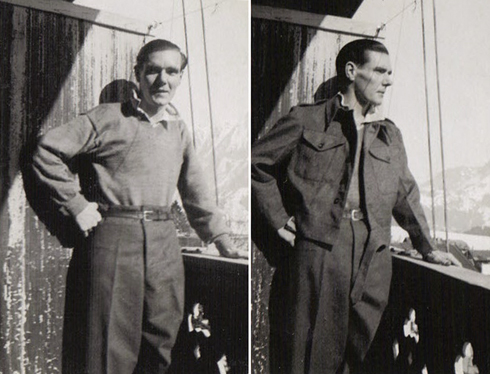
This set of photographs was taken in Adelboden, Switzerland, after Robert Smith’s escape from Italy.

The three photos above are all dated August 1944.

Because we know that G. Norman Davison was in Adelboden for a time (he arrived during the winter of 1943-44 and departed in October 1944), and that Patrick Cahill escaped to Switzerland and may have been in Adelboden, we have studied these photographs for servicemen bearing a resemblance to either man.

In the snapshot of the strolling men, we think the fellow in the middle might be Patrick Cahill. Of this image, Dean Cahill writes, “The man in the middle does bear a resemblance to my grandfather. We have some post-war photos in which he seems to walk with the same swagger.”

The other two photos were apparently taken on a patio of a hospital or hotel. In the center photo, Bob is at left—apparently smoking a cigarette. In the bottom image, he is on the right. We don’t know the identities of anyone else in these photos.

Continue reading

“Servigliano Calling” Poem #34

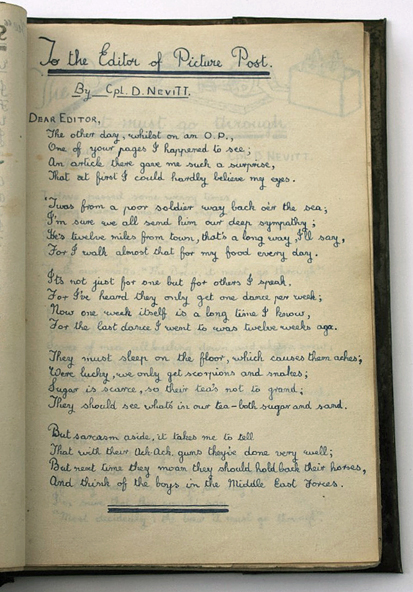
This poem by Cpl. D. Nevitt brings to a close the posts of prisoners’ poems recorded in Robert Dickinson’s “Servigliano Calling” prison camp diary. There are 34 poems in all in Robert’s journal.

In this poem, “To the Editor of Picture Post,” Corporal Nevitt expresses dismay at the complaints of soldiers at home over the deprivations they feel they are suffering.

Compare their situation to the lot of soldiers at war, Nevitt says, to realize where true hardship lies.

To the Editor of Picture Post

DEAR EDITOR,

The other day, whilst on an O.P.,
One of your pages I happened to see;
An article there gave me such a surprise,
That at first I could hardly believe my eyes.

“Twas from a poor soldier way back o’er the sea;
I’m sure we all send him our deep sympathy;
He’s twelve miles from town, that’s a long way, I’ll say,
For I walk almost that for my food every day.

It’s not just for one but for others I speak,
For I’ve heard they only get one dance per week;
Now one week itself is a long time I know,
For the last dance I went to was twelve weeks ago.

They must sleep on the floor, which causes them aches;
We’re lucky, we only get scorpions and snakes;
Sugar is scarce, so their tea’s not too grand;
They should see what’s in our tea—both sugar and sand.

But sarcasm aside, it takes me to tell
That with their ack-ack guns they’ve done very well;
But next time they moan they should hold back their horses,
And think of the boys in the Middle East Forces.

Note: O.P. is perhaps a military operating procedure. Ack-ack is slang for anti-aircraft fire.

“Servigliano Calling” Poem #33


This poem by H. Stewart is a rousing defense of the reputation of the British Army’s Seventh Armoured Division. The division was known as the “Desert Rats” and its mascot—a red jerboa—is displayed on its insignia.

“The ‘Seventh Armoured Div’” is one of three poems by Harry Stewart in Robert Dickinson’s journal, “Servigliano Calling.”

The “Seventh Armoured Div”

I once wrote a poem, which brought forth comments,
From different fellows in tank regiments,
Who said I was sadly deficient of sense,
Just because I stood up and put it to you,
That the Seventh Armoured Div. was out on the blue.

And one fellow, quite heated became,
And said ’cos you’re captured, you’ve no cause to blame,
This famous old Div., and subtly its name,
In vain I protested that all of us knew,
That the Seventh Armoured Div. was out of on the blue.

He said he was joy-making back at the base,
Persuaded a second we were holding this place,
Whilst we were retreating six different ways!
“You Machilé yes-men”, he said, “couldn’t do
Half that the Seventh Armoured Div. did out on the blue.”

He said “To point out the fact that he’s here,
Showed the Seventh’s life ain’t all skittles and beer”;
But he left his Mark 2 back at Agadabia!
The fact that he’s here is quite clearly true,
But the rest of the Div.’s still out on the blue.

However, we’re hearing queer stories again,
About loosing our tanks, and generals, and men,
But all good “prigioniere” are sifting the “gen”,
And if all the rumours are true—good enough,
At last the Seventh Armoured Div. is doing its stuff!

Note: The phase “all good ‘prigioniere’ are sifting the ‘gen'” seems to mean that the attentive prisoners are weighing incoming information about the war.

British Rifleman Robert Smith

Carole Procter—who lives in Berkshire, England—provided this information about her uncle Bob.

On the back of this photo are date and place: April 5, 1944. Adelboden. Gilback Ski-jump, Switzerland. Also recorded are the names Sera, Ginger, and Bill. Carole says her uncle Bob is the second one from the left with a cross over his head. Presumably Sera, Ginger, and Bill are (left to right) beneath the other three crosses. According to Carole, “‘Ginger’ was probably a nickname—people with red hair get called that over here!”

“My uncle, Rifleman 6142045 Robert Smith, was a prisoner in this camp. I have 10 postcards written by him, the first six being from Campo 59 written to his sisters, one of whom was my mother who died in 2005.

“Robert was always know as Bob.

“The first date on the postcards is August 5, 1942 and the last is December 23, 1942. The next postcard is dated July 31, 1943 and the address is Lavoro Base No. 133/xvii. PM3100. He is still there on July 4, 1943, but a card dated August 15, 1943 he says he is in a new camp–No.133/iii.

“I know that my uncle escaped from a camp and managed to get to Switzerland where he was in Adelboden—certainly in July and August 1944—and I have photos of him there with other soldiers. It was discovered that he had TB and was transferred to Laysin. I have photos of him there dated March 18, 1945.

“He eventually came home and sadly died in 1950 of TB. He was 30 years old. I was three when he died and have only very vague memories of him—he was also my godfather.

“Bob was born in South Shields, County Durham, in 1919 and his family moved to Surrey in the south of England in the early 1930s. I think he enlisted at the beginning of the war. I have photos of him in Egypt in 1940, but I don’t know where or when he was captured. He was in the King’s Royal Rifle Corps. He was the ‘baby’ of the family and very close to my mother, which is why she kept his letters and photos I think.

“I have also found a letter to my grandmother from a George William Beer dated July 23, 1943 saying he was with Bob in Campo 59 for two years but has now been moved and wants Bob to know he is OK. He is in a working camp getting double rations and Sundays off!”

Of this photo, Carole says, “On the back is my grandmother’s name and address and then Robert Smith. Rifleman 6142045. Campo PG No 59. PM 3300 Italia—all hand written in capital letters. I don’t know if this photo was taken in the camp or before he was captured, but it certainly looks as if it was sent from there.” Robert is on the left. We don’t know the identity of the other fellow.