Category Archives: Prisoners—Camp 59

Cesare Viozzi on Sheltering Robert A. Newton

Italian historian Filippo Ieranò conducted a number of interviews with Italians of the Marche region around 1999–2001.

They were published as Antigone nella Valle del Tenna, or “Antigone in the Tenna Valley” by the regional authority of the Marche (Consiglio Regionale delle Marche) in 2002. The title page refers to “The reception of fleeing Allied prisoners and Jews after 8th September 1943 in the valley of the River Tenna, as a form of civil disobedience against the Nazi-Fascists.”

The publication contains a July 2001 interview with Cesare Viozzi of Santa Vittoria in the Italian Marche.

Cesare Viozzi’s family sheltered American POWs Robert Alvey Newton (Logansport, Indiana) and Martin Majeski (Anderson, South Carolina) for nearly six months before the men were discovered by the Germans and executed on March 9, 1944.

Here is the story, in both the original Italian and translated into English by Anne Bewicke-Copley.

Avevano appiccato il fuoco (“They set it on fire”)

Eravamo 28 persone in casa in quel periodo. Abitavamo a metà strada tra Santa Vittoria in Matenano e Ponte Maglio, quattro famiglie insieme, tutti nella stessa abitazione. I prigionieri erano sparsi per le campagne, andavano a cercare aiuto un po’ di qua e un po’ di là. Allora i genitori decisero di prenderne due, si chiamavano Martin e Robert, due americani, e la famiglia aumentò arrivando a 30 persone.

We were 28 people in the house in this period. We lived halfway between Santa Vittoria in Mantenano and Ponte Maglio, four families together, all in the same house. The prisoners were spread out in the countryside, they came to ask help a bit here, a bit there. So my parents decided to take in two, called Martin and Robert, two Americans, and the family grew to 30 people.

Continue reading

In Search of Armie’s Italian Angels

Sergeant Armie S. Hill, circa 1943. I carried this photograph of my father with me to Roccafluvione and to the site of Camp 59, where he was a prisoner.

Strada Caserine winds up a mountainside westward from Roccafluvione. American servicemen Armie Hill and Ben Farley were led up this road by children to a farm where the family of Angela Bianchini offered them protection.

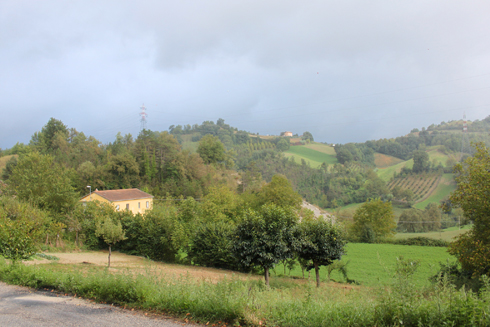
View into a rain-soaked valley from half way up Strada Caserine.

The story of how my father, Armie Hill, and Kentuckian Ben Farley were befriended in the town of Roccafluvione is recorded in an earlier post, “Armie’s Italian Angels.”

Take a moment to review Armie’s account, as it will help you appreciate the adventure described here—a September 2010 journey to Roccafluvione.

I had hoped to meet relatives of the Italians who had sheltered the two men. My friend Anne Bewicke-Copley said the way to get advance word out at Roccafluvione was to contact the town bars—the social hubs of the community.

In early August, I sent letters—translated into Italian—to the four bars in Roccafluvione. I also sent a letter to a city office—to the segreteria of the commune.

Continue reading

A Camp with a View

Before traveling to Italy, I thought I had a good sense of what Camp 59 was like—the layout of the camp, construction of the buildings, and the encompassing brick walls.

Of course, no former POW’s story of how things were in the camp—or even actual photographs I had been sent of Camp 59—could convey so complete a sense of the place as I experienced on walking though the camp for the first time in September.

From within the walls, I could look in all directions, touch the soil, feel the autumn Italian sun on my skin, hear birds and see them flying overhead.

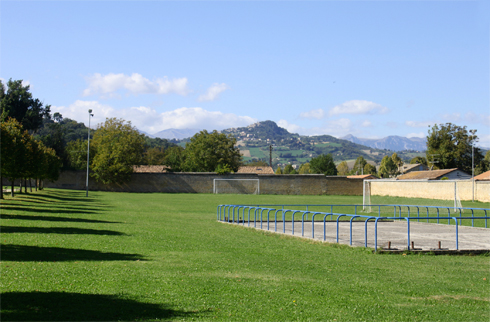
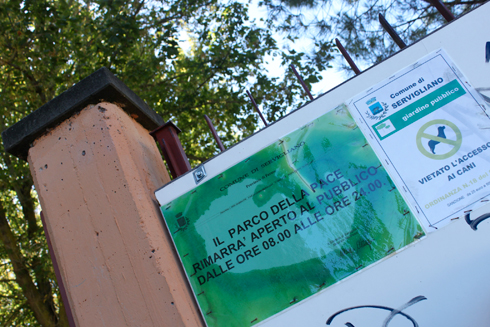
The camp today is a community park called Il Parco della Pace (the Park of Peace), with green lawns, shrubs, trees, and playing fields and courts for soccer, basketball, and other sports.

Continue reading

Robert Dickinson’s “Campo 59 Cookery”

During this time of year, as we devote time in our kitchens to preparation of holiday meals and mouthwatering pastries and desserts, consider for a moment how our imprisoned soldiers craved their favorite foods from home—probably more during this season than at any other time of year.

It is any surprise that the prisoners attempted to recreate some of these dishes, using their daily camp rations and items from the precious Red Cross parcels?

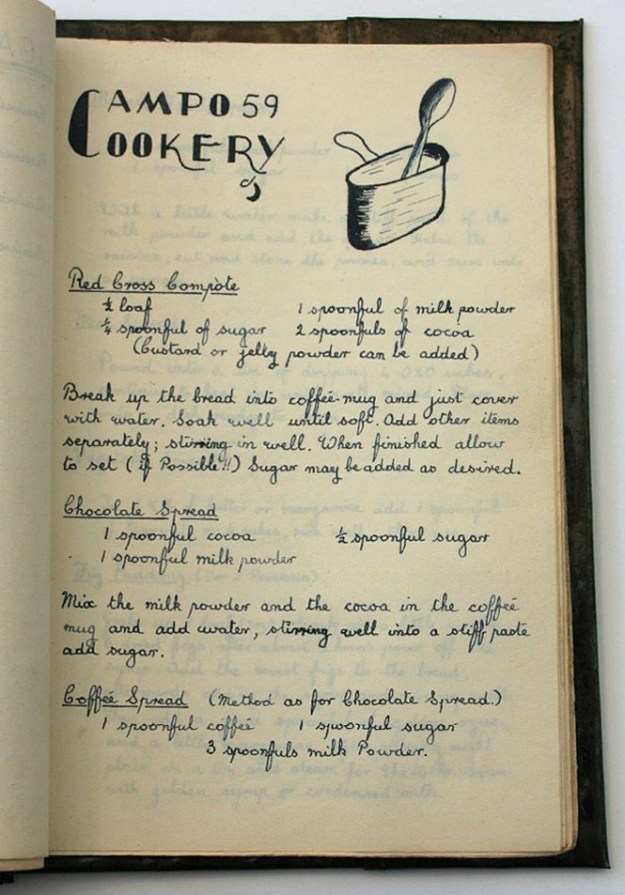
Three pages of Robert Dickinson’s journal, “Servigliano Calling,” are devoted to recipes, ranging from a compote and spreads to pies and fig pudding.

The situation called for some invention—fruit pie crust made of a paste of grated bread mixed with margarine for example.

Cooking was done handily on the camp cook stoves built by fellow prisoners from scraps of tin and shoelaces.

Although Robert titled this section of his journal “Campo 59 Cookery,” the last recipe, “Campo 53 Rarebit,” is evidence that the culinary experiments continued after his transfer to Camp 53 Sforzacosta in January 1943.

One of the poems in Robert’s journal, “Thoughts,” by C. G. Hooper-Rogers, contains a list of sorely missed foods from home. Of his yearnings, Hooper-Rogers writes:

“All I’ve got to do is think, / Of all I used to eat and drink, / And the phantom foods I used to like, / Haunt me all the blinking night.”

Red Cross Compòte

½ loaf
¼ spoonful of sugar
1 spoonful of milk powder
2 spoonfuls of cocoa
(Custard or jelly powder can be added)

Break up the bread into coffeé mug and just cover with water. Soak well until soft. Add other items separately; stirring in well. When finished allow to set (if possible!!) Sugar may be added as desired.

Chocolate Spread

1 spoonful cocoa
1 spoonful milk powder
½ spoonful sugar

Mix the milk powder and the cocoa in the coffeé mug and add water, stirring well into a stiff paste add sugar.

Coffeé Spread (Method as for Chocolate Spread.)

1 spoonful coffeé
1 spoonful sugar
3 spoonfuls milk powder

Continue reading

Il Resto del Carlino on the Camp Visit

Camp 59 and the blog dedicated to it

Coming upon their POW relatives on the web leads these two to Servigliano

Il Resto del Carlino
Tuesday, September 28, 2010

Caption: Englishman Steve Dickins[on] and American Dennis Hill in front of the wall through which their uncle and father managed an escape. [Note: Steve’s uncle Robert was transferred from Camp 59 before the September 1943 escape; however, around that same time Robert escaped from the camp where he was held.]

MEMORIES—The meeting between an American and an Englishman, the son and nephew of two interned soldiers

They wanted news about the Servigliano refugee camp, from which their relatives fled in 1943. In doing research on the Internet, the two discovered the blog “Cam[p] 59,” dedicated to the prisoner of war camp in this town. That’s how Englishman Steve Dickinson and American Dennis Hill began a “virtual” friendship, which brought them to Servigliano yesterday—to share their family stories.

Steve’s uncle Robert, a British soldier, was captured in Africa and interned at Servigliano. “I found his diary—a sort of copybook of the Red Cross—where my uncle recorded all his activities through the war and until his death. I read those pages and decided to retrace his steps. When he arrived at Servigliano, on 18 January 1942, he described the landscape as charming, though he explained that hunger did not allow him to enjoy the place.

“At Servigliano he found consolations—his first shower in 24 days, and clean sheets. He escaped through the hole in the wall and headed north, aided people of the area. He became a partisan and settled in Gassino Torinese, which is where he died. His body rests in the Milan war cemetery.”

Armie Hill’s story is different. Dennis’ father was an American soldier who was captured in Africa in 1943 and transferred to Servigliano. “My father escaped through the hole in the wall caused by the bombing,” Dennis said, “But he headed south—to meet the Allies—and he returned home. He recalls in his story [receiving help from] Don Giuseppe Ciabattoni, the rector at Roccafluvione.

Alessio Carassai

Continue reading

Celebrating Family Ties

A Dickinson family outing to the beach. At front are Robert, youngest brother Len on the lap of his mother, and his father. In back are brothers James and William.

On this occasion—the Thanksgiving weekend, when American families gather to feast, remember the past, and meditate on their blessings—I’ll pause for a moment to reflect on the universality of family ties.

Here are three families—British, American, and Italian—who have connections to prisoners from Camp 59. The stories of Robert Dickinson, Marino Palmoni, and Armie Hill are well-covered in a number of posts on this site.

In celebration of this holiday, here is an international family album.
Continue reading

“Servigliano Calling”—A Return to Camp 59

Robert Dickinson kept a diary, titled “Servigliano Calling,” from the date of his capture by the Germans until six months before his death (November 23, 1941 to September 3, 1944).

Robert arrived at Camp 59 on January 18, 1942, and a year later—on January 24, 1943—he was transferred to Camp 53 in Sforzacosta.

Robert’s log for his year in Servigliano is a fascinating, candid record of daily life and events in the camp.

I first learned about “Servigliano Calling” though e-mails from Robert’s nephew Steve Dickinson in April 2008.

Referring to Camp 59, Steve wrote:

“My uncle spent some time there during WW2, but was later transferred to another camp in Northern Italy. At the time of the armistice he walked out of that camp and fought with the Italian partisans until his death towards the end of the Italian Campaign.

“However, during his stay at Servigliano he kept a diary like many of the POW’s. This was found during renovations in a farmhouse [in Gassino, Italy] where the partisans had been hiding him some time after the war and returned to the family. It details the day to day events in Servigliano, football matches, escape attempts, cooking recipes, poetry, etc….”

Continue reading

A Season for Visits

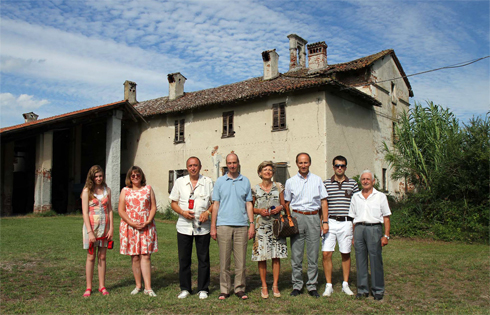
John Davison, his family, and new Italian friends explore the grounds of the old Cararola farm, where Norman Davison was at first assigned to work and where he later found shelter.

Steve Dickinson and Dennis Hill were among visitors to Camp 59, where Steve’s uncle Robert Dickinson and Dennis’ father Armie Hill were imprisoned. At center was the hole in the wall—since mortared shut—through which many prisoners escaped from the camp.

For three individuals who have an intimate family connection to the prisoner-of-war camp at Servigliano, this fall was a unique time for discovery.

John Davison this year made contact with descendants of Giovanni Bellazzi, the northern Italian farmer who sheltered his father, escaped prisoner G. Norman Davison. Giovanni and his friends helped to arrange for Norman’s safe passage to Switzerland.

Norman had been a prisoner at Camp 59 before he was transferred to camps farther north, where he was required to work on farms.

In early September, John and his family visited the town of Vigevano and experienced a thrilling welcome. (See posts In Their Fathers’ Footsteps, Part 1 and Part 2).

Then, at the end of September, Steve Dickinson and I were among visitors to Camp 59 in Servigliano, where Steve’s uncle Robert Dickinson and my father Armie Hill were interned.

Continue reading

A Kind Letter from the Past

This letter, from the town of Oleggio in northern Italy, dated May 5, 1947, was most likely sent to Bob Smith’s mother from the family whom he stayed with in Italy before his escape.

(The other two pages of the letter are at the bottom of this post.)

According to Bob’s niece, Carole Procter, “It was obviously a farm and I think it was probably the one he was allocated to from the POW camp, rather than the one he hid in when he first escaped, although that is only a feeling—no proof either way.

“The name at the end of the letter looks like J Roselli and on the Oleggio website it does say that Roselli is an old Oleggio name, with members of the family still living there.

Continue reading

Bob Smith—Convalescence at Leysin

Shown here are two of three pictures taken of Bob Smith on March 18, 1945 in Leysin, Switzerland.

Regarding these portraits, Bob’s niece, Carole Procter, says:

“I think these photos are really quite sad as they show very clearly how quickly Bob became ill. He looks to have lost a lot of weight in the 9 months since the last lot were taken and although he is smiling in two of them he looks quite gaunt.”

After escape from Axis-occupied northern Italy into Switzerland, Bob was sent to the Camp D’Internement Militaire at Bürglen in the canton of Thurgau.

In a letter from the camp, dated March 20, 1944, Bob explains, “I leave this week for a winter sports camp.”

Carol says, “I assume that’s Adelboden as the ski photo is April 44.” (See posts British Rifleman Robert Smith and Bob Smith’s Adelboden Album.)

Bob spent the spring and summer at Adelboden. Then, in October 1944, having been diagnosed with tuberculosis, he was transferred to a sanatorium in Leysin, Switzerland.

Continue reading