Author Archives: Dennis Hill

Roland Rakow’s Story

This narrative is by Staff Sgt. Roland V. Rakow, a crewmember of the 83rd Squadron, 12th Bomb Group of the United States Army Air Force. It describes the mission on September 1, 1942 when his plane was shot down.

The narrative also covers the events that followed—his capture, POW experience, escape from camp, and finally his return home.

In compiling this account, Sgt. Rakow drew on his personal experiences, as well as information from Capt. Croteau, as relayed in correspondence by the captain’s wife to Sgt. Rakow’s mother.

83rd Squadron, 12th Bomb Group (M), 9th United States Army Air Force
Attached to the British 8th Army—based at Ismailia, Egypt—El Alamein

The Crew

Pilot
Capt. Hubert P. Croteau—Prisoner of War in Germany
Army Serial No. 0-404012

Co-Pilot
2nd Lt. Irving Biers—Prisoner of War in Germany
Army Serial No. 0-659064

Navigator
2nd Lt. Robert J. McPartlin—Killed in Action—El Alamein
Army Serial No. 0-659067

Bombardier–Nose Gunner
2nd Lt. Thomas F. Archer—Killed in Action—El Alamein
Army Serial No. 0-850959

Top Turret Gunner
Staff Sgt. Leonard George Andersen—Killed in Action—El Alamein
Army Serial No. 57030832

Radio Operator–Lower Turret Gunner
Staff Sgt. Roland V. Rakow—Prisoner of War in Italy
Army Serial No. 16004997

The Mission

“On September 1, 1942, as our B-25 was returning from its second completed mission—dropping its bomb load on tanks, trucks and troops on the front line at El Alamein—it was struck by a German anti-aircraft 88 mm shell on the left side of the aircraft, adjacent to the top turret gun position. The shell made a gaping hole, which caused the aircraft to break open and go into a 30-or 40-degree dive.

[See further details of the crash on a later post, Roland Rakow’s Story—An Update.]

“After the aircraft was hit, I looked for a way of escape and found the gaping hole where the shell had hit. After some effort, since the aircraft was in a dive, I bailed out at the hole. Before exiting, I looked for Sergeant Andersen. He should have been adjacent to the hole, as this was the location of the top turret gun. I could only conjecture that he had been blown out of the aircraft when the shell hit.

“I bailed out and waited a few seconds, then felt for the ripcord—but I couldn’t find it. Frantically, I tried to locate it and finally found it, almost completely behind my back.

“With my last energy, I pulled the cord. The parachute opened with a jerk. My left arm became so entangled in the parachute’s lines I sustained a compound fracture of the left clavicle. I had no control of the chute before hitting the ground, my face down. There was a strong wind as I landed. The parachute ballooned and dragged me approximately 300 feet, until German soldiers came and stopped me from being dragged farther.

“Lt. Archer and Lt. McPartlin were unable to leave the aircraft and died in the crash. Capt. Croteau, Lt. Biers, and I parachuted to the ground. We landed in separate locations. Each of us sustained wounds and injuries.
Continue reading

Christmas Card of the 12th Bomb Group

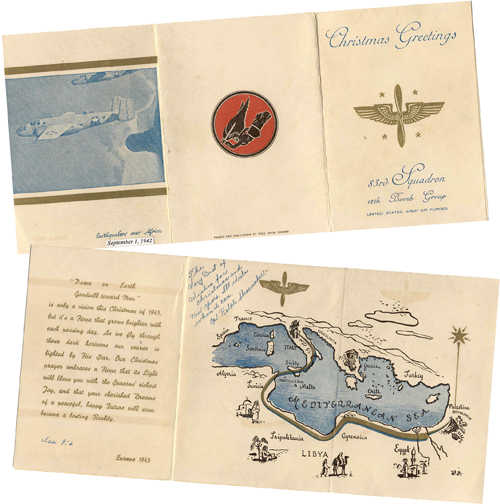
Roland Rakow received this Christmas card from his comrade Cpl. Ralph Shoemaker at Christmastime 1943. It had been a little over a year since Roland’s return to the States after his escape from captivity.

Cpl. Shoemaker, a member of the maintenance crew of the 83rd (Roland’s squadron), served with that unit until the end of the war. Roland kept in touch with him since the war, until Shoemaker passed away last year.

The front of the card reads: “Christmas Greetings, 83rd Squadron, 12th Bomb Group, United States Army Air Force”; in the center is a propeller with wings and four stars in gold.

The British Eighth Army, with essential support from the USAAF 12th Bombardment Group (known as the “Earthquakers”), had pushed Gen. Erwin Rommel’s Afrika Korps from North Africa and pursued them northward into Europe.

Continue reading

Roland Rakow Returns

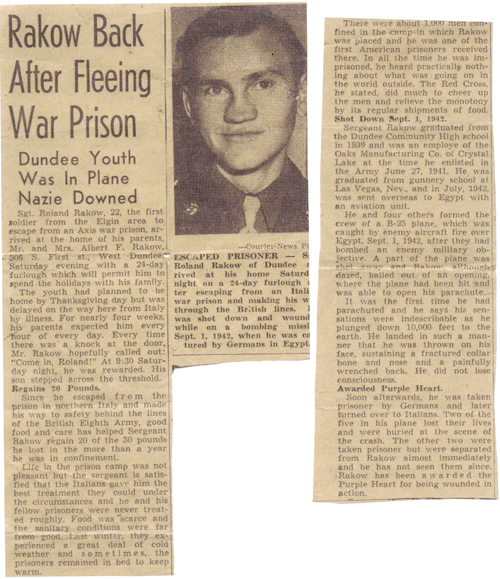
The following 1942 news item was clipped from the Chicago Tribune.

Rakow Back After Fleeing War Prison

Dundee Youth Was In Plane Nazie Downed

Sgt. Roland Rakow, 22, the first soldier from the Elgin area to escape from an Axis war prison, arrived at the home of his parents, Mr. and Mrs. Albert F. Rakow, 506 S. First st., West Dundee, Saturday evening with a 24-day furlough which will permit him to spend the holidays with his family.

The youth had planned to be home by Thanksgiving day but was delayed on the way here from Italy by illness. For nearly four weeks, his parents expected him every hour of every day. Every time there was a knock at the door, Mr. Rakow hopefully called out: “Come in, Roland!” At 9:30 Saturday night, he was rewarded. His son stepped across the threshold.

Regains 20 Pounds.

Since he escaped from the prison in northern Italy and made his way to safety behind the lines of the British Eighth Army, good food and care has helped Sergeant Rakow regain 20 of the 30 pounds he lost in the more than a year he was in confinement.

Continue reading

Roland Rakow, MIA

The following news clipping is likely from the Elgin Courier News, published in Elgin, Illinois, near Roland Rakow’s boyhood home of West Dundee.

The article would have appeared in the paper in September 1942.

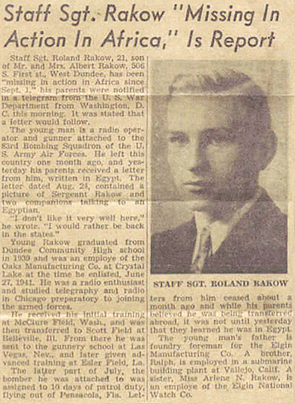
Staff Sgt. Rakow “Missing In Action In Africa”
Is Report

Staff Sgt. Roland Rakow, 21, son of Mr. and Mrs. Albert Rakow, 506 S. First st., West Dundee, has been “missing in action in Africa since Sept. 1.” his parents were notified in a telegram from the U.S. War Department from Washington, D.C. this morning. It was stated that a letter would follow.

The young man is a radio operator and gunner attached to the 83rd Bombing Squadron of the U.S. Army Air Forces. He left this country one month ago, and yesterday his parents received a letter from him, written in Egypt. The letter dated Aug. 24, contained a picture of Sergeant Rakow and two companions talking to an Egyptian.

I don’t like it very well here,” he wrote. “I would rather be back in the states.”

Young Rakow graduated from Dundee Community High school in 1939 and was an employee of the Oaks Manufacturing Co. at Crystal Lake at the time he enlisted, June 27, 1941. He was a radio enthusiast and studied telegraphy and radio in Chicago preparatory to joining the armed forces.

He received his initial training at McClure Field, Wash., and was then transferred to Scott Field at Belleville, Ill. From there he was sent to the gunnery school at Las Vegas, Nev., and later given advanced training at Esler Field, La.

The latter part of July, the bomber he was attached to was assigned to 10 days of patrol duty, flying out of Pensacola, Fla. Letters from him ceased about a month ago and while his parents believed he was being transferred abroad, it was not until yesterday that they learned he was in Egypt.

The young man’s father is foundry foreman for the Elgin Manufacturing Co. A brother, Ralph, is employed in a submarine building plant at Vallejo, Calif. A sister, Miss Arlene N. Rakow, is an employe of the Elgin National Watch Co.

“Servigliano Calling” Poem #4

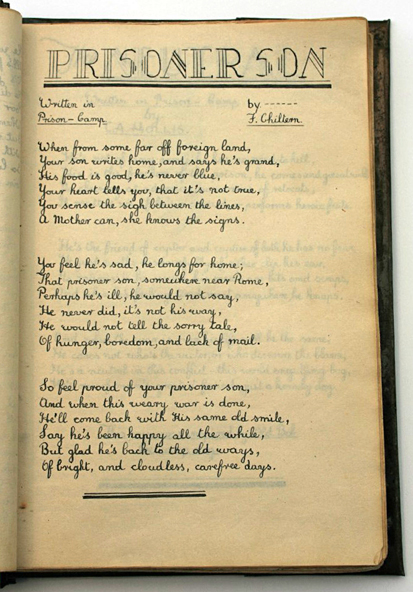
F. Chiltern is represented by this single poem in Robert Dickinson’s diary, “Servigliano Calling.”

Prisoner Son

When from some far off foreign land,
Your son writes home, and says he’s grand,
His food is good, he’s never blue,
Your heart tells you, that it’s not true,
You sense the sigh between the lines,
A mother can, she knows the signs.

You feel he’s sad, he longs for home;
That prisoner son, somewhere near Rome,
Perhaps he’s ill, he would not say,
He never did, it’s not his way,
He would not tell the sorry tale,
Of hunger, boredom, and lack of mail.

So feel proud of your prisoner son,
And when this weary war is done,
He’ll come back with his same old smile,
Say he’s been happy all the while,
But glad he’s back to the old ways,
Of bright, and cloudless, carefree days.

“Servigliano Calling” Camp Poem #3

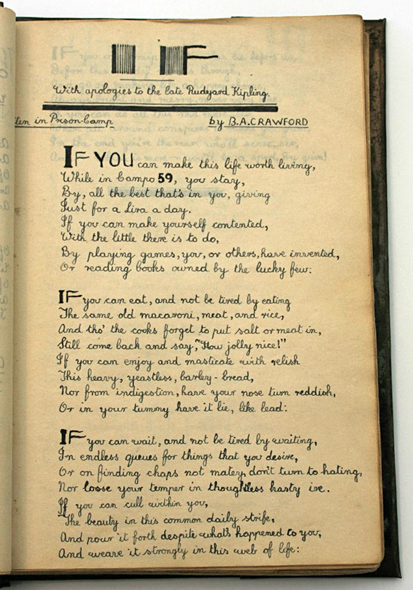
“If” is one of two poems by G. A. Crawford that are recorded in Robert Dickinson’s journal, “Servigliano Calling.”

IF

(With apologies to the late Rudyard Kipling)

IF YOU can make this life worth living,
While in Campo 59, you stay.
By, all the best that’s in you, giving,
Just for a Lira a day.
If you can make yourself contented,
With the little there is to do.
By playing games, you, or others have invented,
Or reading books owned by the lucky few.

IF you can eat, and not get tired by eating,
The same old macaroni, meat and rice.
And tho’ the cooks forget to put salt or meat in,
Still come back and say “How jolly nice”.
If you can enjoy and masticate with relish,
This heavy, yeastless, barley-bread.
Nor from indigestion, have your nose turn reddish,
Or in your tummy have it lie, like lead.

IF you can wait, and not be tired by waiting,
In endless queues for things that you desire.
Or on finding chaps not matey, don’t turn to hating,
Nor loose your temper in thoughtless hasty ire.
If you can cull within you,
The beauty in the common daily strife.
And pour it forth despite what’s happened to you
And weave it strongly in this web of life.

IF you can grasp what vistas lie before us,
Before the “ruddy” war is through.
And go on making life a happy chorus,
Always bright and merry, never very blue.
If you can do all this and more, sir,
When all around conspires to make you glum.
In the end you’re the man who’ll score, sir
And—which is more—you’ll be a sport, By gum!

“Servigliano Calling” Camp Poem #2

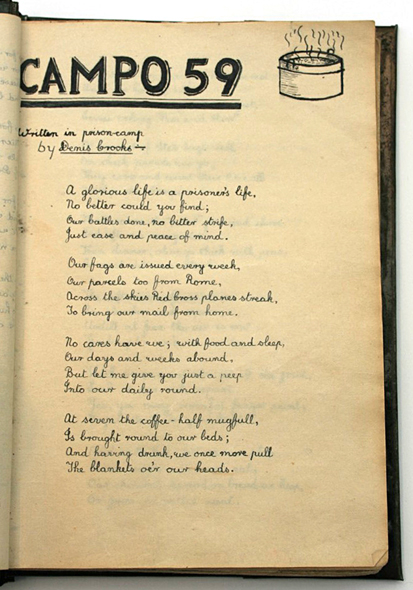
“Campo 59,” from Robert Dickinson’s diary, “Servigliano Calling,” is one of three poems by Robert’s friend Denis Crooks.

Campo 59

A glorious life is a prisoner’s life,
No better could you find.
Our battles done, no bitter strife,
Just ease and piece of mind

Our fags are issued every week,
Our parcels too from Rome.
Across the skies Red Cross planes streak,
To bring our mail from home.

No cares have we, with food and sleep
Our days and weeks abound.
But let me give you just a peep,
Into our daily round.

At seven the coffee, half mug full,
Is brought round to our beds.
And having drunk, we once more pull,
The blankets o’er our heads.

And there in peaceful bliss we rest,
Until the hour of nine.
When section sergeant as a jest,
Comes calling “rise and shine”.

At sound of Iti’s bugle call,
On check parade we go.
They come and count their P.G.’s all,
Within their Campio.

Continue reading

“Servigliano Calling” Camp Poem #1

Robert Dickinson’s amazing diary, “Servigliano Calling,” contains 34 poems written in camp by Robert’s fellow inmates during World War II. In the weeks ahead we will share all of these poems in individual posts.

This post contains one of the longer poems, “The Alphabet.”

The Alphabet

A is for “Aussi”, our “Comrades in Arms”
Who’ve left far behind them, their sheep and their farms.
Good fighters and jolly, the pick of fine men,
Who like their brave fathers are fighting again.

B that’s for British, now aren’t we all,
And to keep the flag flying soon answered the call.
We came in our millions to fight if we must,
For what we considered was true, right, and just.

C is for capture, a term that’s not nice,
But there’s always some who must pay the price,
We’ve all done our best and no ones to blame,
So don’t be downhearted, don’t think it a shame.

D reminds of Dunkirk, which all Germans say,
Was a farce, and that we ran away.
But twenty five Germans to each British three,
To my way of thinking, was our victory.

E is for eating, but sad to relate,
That term’s forgotten, we now masticate.
The meats is all gristly, the soups weak and thin,
And if we were at home, would go straight in the bin.

F is for freedom, so dear to our hearts,
But seems Oh! So distant in these foreign parts.
But freedom will come, have patience and smile,
Old Churchill himself said “its just for a while”.

Continue reading

Louis VanSlooten Honored

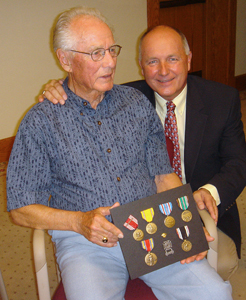
Louis VanSlooten of West Olive, Michigan, was one of nine former POWs of World War II and the Korean and Vietnam Wars to be honored today in Michigan.

The Holland (Michigan) Sentinel covered the event:

Long overdue

Veterans to receive medals in special ceremony today

By ROEL GARCIA
The Holland Sentinel

Louis VanSlooten was captured in Africa, taken to Sicily and finally northern Italy during World War II.

He calls it a time of starvation. Prisoners were given one bowl of water and a few pasta pieces once a day. He lost about 60 pounds while a prisoner.

VanSlooten and another man escaped on Sept. 14, 1943, after being prisoners since Dec. 10, 1942.

The friends spent nine months living off the land — eating acorns, chestnuts and dandelions — until they met up with the Allied armies in Italy.

“I lived on a daily basis,” said VanSlooten, 88, of West Olive of his life after the escape.

VanSlooten, serving in the Army as a member of the Combat Engineers with the 1st Armored Division, should have received the Prisoner of War Medal but he never got it.

On Monday, June 30, he and eight other veterans will get the opportunity to receive medals they earned.

U.S. Rep. Pete Hoekstra, R-Holland, will present the veterans their medals in a ceremony at 9:30 a.m. at Evergreen Commons, 480 S. State St.

“It’s been 66 years and I didn’t even know anything about the them,” VanSlooten said of the medals.

This ceremony is different, since there are veterans from World War II, Korea and Vietnam, where the focus was on World War II veterans before, Hoekstra said.

“We’ve got the full complement of people,” Hoekstra said.

While VanSlooten will receive eight medals, Navy veteran Donald Bouman will receive 11.

Bouman served in the Navy during World War II aboard the destroyer Collett.

Bouman has his own piece of history attached to his service during the war.

He was aboard the Collett when the Japanese surrendered.

“We were a short distance from the Missouri where the papers were signed. I watched it all with my binoculars,” said Bouman, 86, of Zeeland.

About the medals he will receive, Bouman said it’s important for his family more than himself.

“I’m anxious to find out about the medals. It’s not so much for myself but for my kids,” he said.

Louis VanSlooten is here shown with U.S. Representative Pete Hoekstra.

The medals Louis is holding are: Prisoner of War Medal, Good Conduct Medal, American Defense Service Medal, American Campaign Medal, European-African-Middle Eastern Campaign Medal, World War II Victory Medal, Honorable Service Lapel Button, Sharpshooter Badge with Rifle Bar.

“Servigliano Calling” Calendar of Events

Robert Dickinson kept a diary from November 23, 1941 to September 3, 1944—from the date of his capture by the Germans until six months before his death.

Robert titled his diary “Servigliano Calling.”

The diary chronicles Robert’s transfer from camp to camp, his escape, and his involvement with the Partisan resistance movement. In the diary, Robert details day to day activities and events at the Servigliano camp, including football matches, camp cooking recipes, mail and food parcels received, special holiday activities, and escape attempts. “Servigliano Calling” also includes drawings and poetry created by fellow prisoners.

Some time after the war, the diary was discovered during renovations to a farmhouse in Gassino, Italy—a house where the Partisans had hidden Robert—and it was returned to Robert’s family.

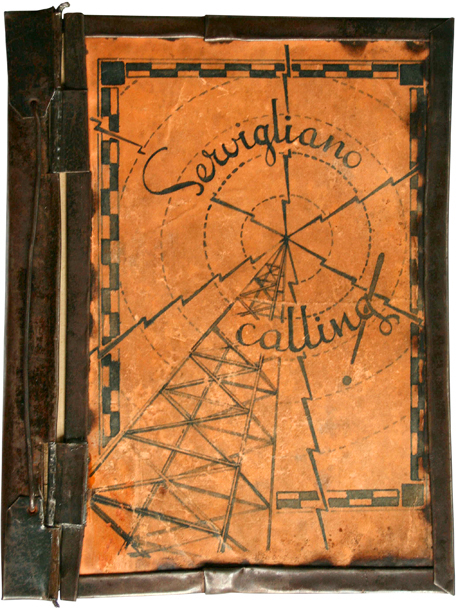
Parts of “Servigliano Calling” are shared here by Robert’s nephew, Steve Dickinson, who transcribed the calendar. The binding of the diary cover (shown above) is made from Cocoa tins. According to Steve, “Even to this day the diary has a slight aroma of Cocoa.”

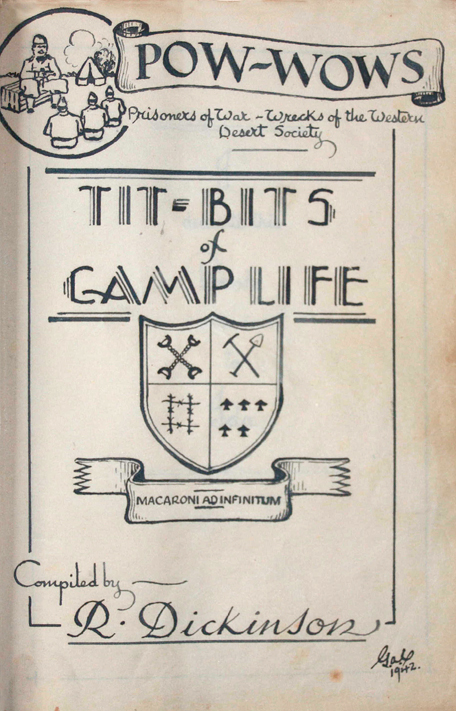
The page shown below is the diary’s title page.

This is a record of the main events which took place after my capture by the Germans near Gambut Aerodrome on Nov. 23rd 1941.

Nov 23rd
Captured by the Germans at 8:30 in the evening near Gambut Aerodrome about 12 miles south of Tobruk.

Nov 24th
Handed over to the Italians and joined up with approx 2,000 other prisoners, then transported to the ‘Pen’ a barbed wire enclosure about 50 miles from Tobruk, being bombed and shelled by our own forces on the way.

Nov 25th
Arrived Derna at 6 O’clock in the evening, still sleeping in the open without ground-sheet or blankets, rain and very cold.

Nov 26th
Arrived Benghazi prison camp at 5:30 in the evening feeling hellish hungry

Nov 27th
Letter card home and Red Cross

Nov 29th
Birthday, ½ mess tin of watery macaroni, ¼ tin of Bully (Iti) and 1½ rolls of bread

Nov 30th
Boarded a destroyer along with 100 officers and 150 men, split up from Pollard and most of the ‘Boys’, only 4 of us together now. Hellish night, believed to be chased by the ‘Navy’, everyone seasick.

Dec 3rd
Arrived Tripoli at 5 O’clock in the evening and taken in lorries to Tarhuna about 50 miles, arriving at midnight.

Dec 4th
Met 4 of the guys from the Battery and found they were captured 2 days before I.

Dec 5th
Hair cut right off!! and a shower bath, also blankets issued. Firsts nights sleep with any covering for a fortnight, but on a tiled floor no ground-sheet or mattress.

Dec 25th
Christmas Day, food just the same, bar for a lemon. Luckily I exchanged my cheap wallet for 20 cigs. Or else the boys and I would not have had a smoke.

Dec 26th
Forty of us taken to Castel Benito aerodrome and by plane at 2 O’clock in the afternoon and arrived at Trapani in Sicily at 5pm; from there taken to a new camp being erected; and found only one tent with 116 POW’s already in.

Dec 27th
Finished erecting the second tent and half of us move in, league of nations tent personel consists of Australians, New Zealanders, South Africans, 1 Indian (Sikh), 3 Polish, 2 Greeks, 2 Libyans and of course English; in all 72. Everyone talks in their own languages or dialects. What a row!!

Continue reading