Author Archives: Dennis Hill

Henry Kane’s Story

This narrative is based on personal notes and written accounts, personal interviews and several newspaper articles about Henry Kane and his brother Richard. George Kane, Henry’s son, helped to facilitate the interviews conducted between February and June of 2008 at the Hudson Valley Health Care System Veterans Hospital at Castle Point, New York. Eileen M. Fontanella, of Hopewell Junction, NY, collaborated with the Kanes to write and complete the project.

In June 2008 the narrative was submitted to the Veterans History Project of the American Folklife Center at the U.S. Library of Congress.

hanklittlebritian_g150

This picture of Henry Kane was probably taken in 1941, while he was on leave to visit his folks in Little Britain, a rural area between Goshen and Newburgh, in New York state.

Introduction

Mr. Henry Kane served in the United States Military from October 1940 until June 1945. During World War II, in December 1942, he was captured in North Africa. For more than two years he remained a prisoner of war. During that time he was moved around to different camps in Italy and Germany. He escaped from Campo 59 (Servigliano, Italy) for a brief period, but he was recaptured a few months later and sent to other camps including Stalag 7A, 2B and a small work camp west of Stalag 1A in Germany (Koningsberg, Germany, known today as Kaliningrad, Russia). He was liberated by the 7th Armor Division.

Henry’s Story

Henry Kane was born on December 18, 1920, in Middletown, New York. He was brought up in Orange County, New York, where he lived and worked on various dairy and apple farms, including the Bull Farm on Sara Wells Trail in Hamptonburg. In the late 1930’s, when they were just teenagers, Henry and his brother Richard joined the Civilian Conservation Corp. Richard quit school at 16 in order to join, and soon after their brothers Walt, Durwood and James joined. Henry says that it was the only thing to do. Service in the Corps allowed the boys to save a little money to help their family and provided an opportunity to help their country. They each earned $30.00 a month, of which they were allowed to keep $8.00 in coupons for their use at the C.C.C. The remaining $22.00 had to be sent home. With five boys away at camp, the Kane family received approximately $110.00 a month. Camp life was highly structured, and the reserve officers in charge maintained the same discipline as military training. Henry worked eight hours a day at a camp in Peekskill, New York, until he was later transferred to Albany.

Continue reading

A Joyful Family Reunion

henrydick1945_g300

This photo accompanied the following Newburgh News article. The caption reads:

Mrs. George [Lydia] Kane of 192 Washington St. is happily reunited with her two soldier sons, Henry (left) and Richard, who were recently liberated after having been held prisoners in Germany since December, 1942. Photo by [Ralph] Aiello.

1945_newburghnews_r150

Two Newburgh Brothers Home from Nazi Prison

By Norma Johnson
Newburgh News [Newburgh, New York; circa June 1945]

Pvts. Henry Kane and Richard Kane have truly been brothers—brothers in boyhood, playing tag, teasing, and playing cops and robbers; brothers in war, playing a harder game of trudging through mud, being captured, going hungry together, and hoping together—and now they are brothers at home again.

Sons of Mr. and Mrs. George Kane, 192 Washington St., [Newburgh, New York] both boys enlisted in October 24, 1940, and have been unseparated right up until now. They returned home last Saturday after spending two years and five months as prisoners of war. Having one son come home after being a prisoner of war means happiness for any mother, so you can imagine the happiness of Mrs. Kane when she saw two of her sons come home together.

Continue reading

“Servigliano Calling” Camp Poem #13

dickinson_diary_angle_2001

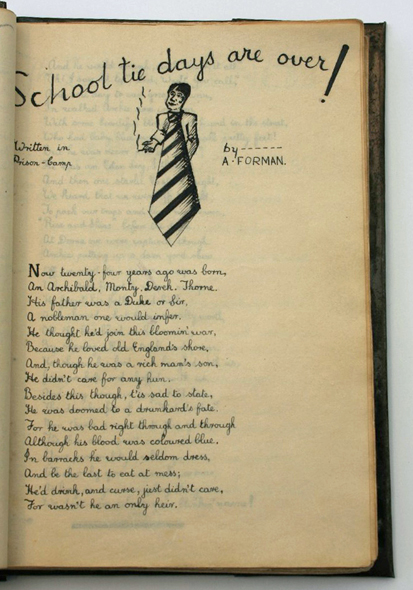
This clever poem pokes fun at early 1940s British class structure, but then reflects on how in time of crisis men are brothers and “personality’s what you are.” It is one of four poems by A. Forman in Robert Dickinson’s diary.

038_school_r150

School tie days are over!

Now twenty-four years ago was born,
An Archibald. Monty. Derek. Thorne.
His father was a Duke or Sir,
A nobleman one would infer,
He thought he’d join this bloomin’ war,
Because he loved old England’s shore.
And, though he was a rich man’s son,
He didn’t care for any hun.
Besides this though, t’is sad to state,
He was doomed to a drunkard’s fate.
For he was bad right through and through
Although his blood was coloured blue.
Continue reading

Letters from Loved Ones

dickinson_diary-ida_angle_200

Following the fancy title page of Robert Dickinson’s journal is a simple, full-page inscription, which reads: “I dedicate this Book with love to Ida.”

Farther into Robert’s journal is a six-page record of the 225 letters Robert received while he was in Servigliano Camp 59, Bonservizi Camp 53, Casanova Elvo Camp 106, and Gassino Camp 112.

Dates for receipt of the letters are March 30, 1942 to September 8, 1943. Letters from Robert’s sweetheart Ida (129 in all) account for the greatest number.

On the one Valentine’s Day within this 18 month period (February 14, 1943) Robert received a letter from Ida, which she had written on January 18. Some letters, delayed for unknown reasons (particularly at the latter two camps) arrived all in one day. Sometimes four, five, or six letters—usually from Ida—arrived all at once.

Robert and the other prisoners eagerly anticipated arrival of mail. Robert wrote in his diary on March 30, 1942, “At last the long awaited mail!!!”

There were 57 letters from home.

Continue reading

“Servigliano Calling” Poem #12

dickinson_diary_angle_2001

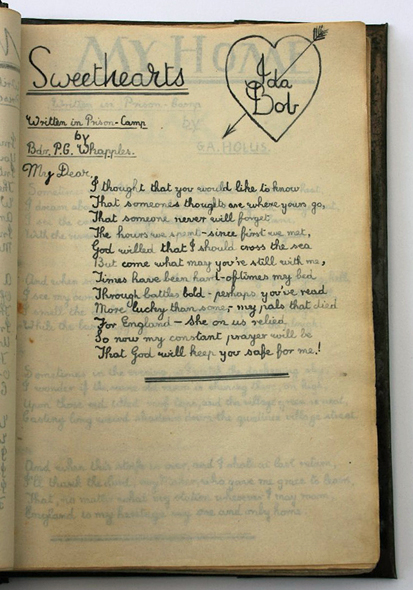
“Sweethearts,” is one of three poems by Bombardier G. P. Whapples in Robert Dickinson’s journal. This poignant poem speaks to the longing felt by many soldiers for their distant girlfriends or wives.

The pierced-heart icon on this page proclaims Robert’s love for Ida. Sadly, he did not return to her from the war.

sweethearts_047_r150

Sweethearts

My Dear,

I thought that you would like to know
That someone’s thoughts are where yours go,
That someone never will forget
The hours we spent—since first we met,
God willed that I should cross the sea
But come what may you’re still with me,
Times have been hard—of times my bed
Through battles bold—perhaps you’ve read
More lucky than some—my pals that died
For England—she on us relied
So now my constant prayer will be
That God will keep you safe for me!

“Servigliano Calling” Poem #11

dickinson_diary_angle_2001

“The Experiences of a Captive: In Verse—And Worse” is one of four poems by A. Forman in Robert Dickinson’s diary.

This poem spans five pages and is remarkably full of detail about the battle in which Forman was captured, his transfer from prison to prison, the prisoners’ illnesses, their mistreatment by the Germans and humane treatment by the Italians, and Forman’s impressions of the countryside as they were transported.

The tale begins in North Africa on April 7, 1941, with the ambush and capture, by a German patrol, of British generals Richard O’Connor and Philip Neame, and it concludes with the arrival of the prisoners at Camp 59 in February 1942.

040_experi_r150

The Experiences of a Captive:
In Verse—And Worse

We met the damned Hun, and started the fun,
On April the seventh at noon,
I think someone blundered; there were over six hundred
Whilst we were just a platoon.

In fact there were more; they had guns by the score
More likely two thousand or so,
Our job—rearguard action, to our small satisfaction,
Was ours, wherever, we’d go.

I ne’er really thought, that I’d ever be caught,
This—my wildest dreams did lack,
But to my satisfaction, I was captured in action
And was wounded so couldn’t fight back.

On a’drome was a fort, to which I was brought
Wounded in legs and in thigh,
And my heart was like lead, for I’d seen lying dead,
Three mates, only God knows why.

Continue reading

Ralph Hoag—Escaped, then Recaptured

ralphhoag1942_g150

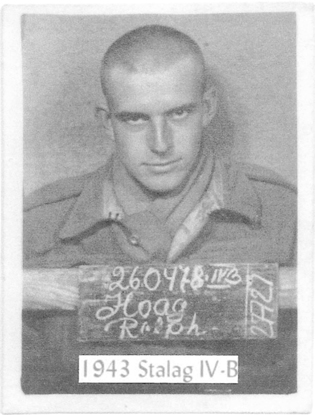
This 1943 Stalag 4B photo of Ralph Hoag was originally attached to his prison record. The prisoners took their own records from the office at Luckewalde after the Russians liberated the camp.

Many of the accounts on this site are of men who escaped from Camp 59 and made their way south to the Allied forces, or who were protected by the Italian farm families, the “contadini.”

Ralph Hoag, on the other hand, was free after the Camp 59 breakout for only nine days before being recaptured by German paratroopers.

He said of the escape:

“After the 59 breakout, eight of us were together—way too many to expect an Italian family to care for. We didn’t keep moving, but stayed in the woods and went to a farm for occasional food. I’m sure they reported our whereabouts to the Germans, because the Germans came right to us.

“We were returned to 59 along with most all of the others—half of which were British Tommies. I guess we were there two days. When it was time to move out there were two or three missing at roll call. The Germans threatened to shoot every tenth man until they were found.

“Finally, we were jammed into boxcars with crates of loot and bags of macaroni—so much so we couldn’t all lay down at once. That was a long 8–9 day trip. I think they let us out of the boxcars twice. We went through the Bremer Pass, into Germany—to Stalag IV-B.

“The German paratroopers respected the three for attempting to escape. They were hiding in the camp. The Germans knew no one had gotten out. They were treated fine and sent on to Germany, where they rejoined us a few days later.”

In addition to Camp 98 Sicily and Camp 59 Italy, Ralph was interned at:

Stalag 4B, Muhlberg Sachsen

Stalag 2B, Hammerstein, West Prussia

Stalag 3B, Furstenberg on the Oder, Brandenburg

Stalag 3A, Luckenwalde, Brandenburg

Read Ralph Hoag’s account of his POW experience at the combatvets.net site under “Bios/Memorials.”

Luther’s Reunion with the Palmoni Family

famiglialuther3_r200

shields-reunion1983_r200

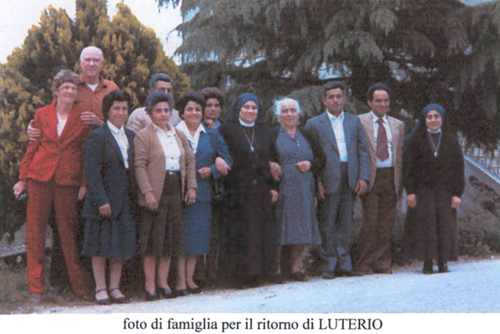
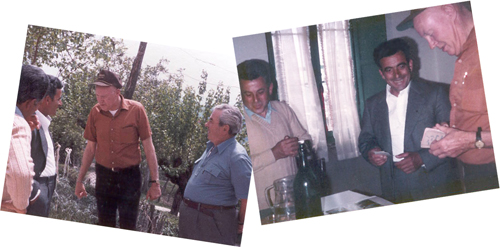
Luther Shields and his wife Jimmie visited with the Palmoni family in 1983. The Palmonis hid and fed Luther and fellow POW Louis VanSlooten after their escape from Camp 59.

At top: Luther and Jimmie (far left) with the Palmoni family. Iginia “Mama” Palmoni is the woman with white hair and gray dress.

Above left: Luther with Marino and his brother Gino. The man in blue is Primo Pilotti. Above right: Marino and Gino Palmoni with Luther indoors.

Continue reading

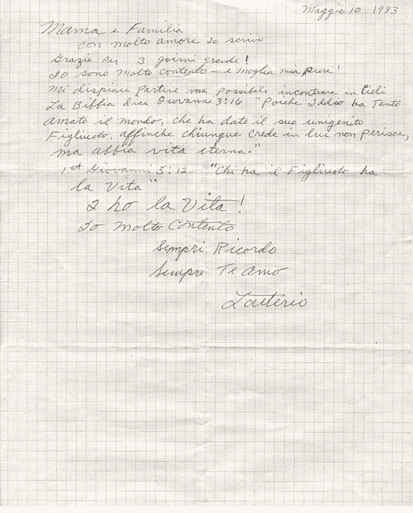
Luther’s Note of Thanks

luther-thanks-1983_r150

Following Luther and Jimmie Shield’s 1983 visit to the Palmoni family, Luther sent an affectionate thank you note to Iginia “Mama” Palmoni and her family. This letter was scanned by Antonello Palmoni (Marino Palmoni’s son), and sent to Luther’s daughter Cindy Jackson 25 years later, on December 29, 2008.

The text of the letter, both in Italian and translated into English, follows.

Continue reading

A Surprise Reunion

shields_article1_r200

News article—Part I

Forty years later: Reunion with Italian partisans—Local Cortez veteran man shares prison camp experiences

BY SUSAN SHIELDS
Cortez [Colorado] Journal, circa April 1983

(EDITOR’S NOTE: The following is the first part of a two-part account of the capture, internment in a prison camp, and ultimate escape of Luther Shields in a World War II battle which took him from north Africa to Italy during the height of intensive fighting.)

December 8, 1941: The United States declares war on the Axis countries. Private Luther Shields of Goodman Point had already been through training for the U.S. Army at Fort Bliss, and had written home to his parents, “I don’t think the army is so bad after all.”

On May 19, 1942, Private Shields would again be writing to the folks back home from Northern Ireland, where he and thousands of other American troops were engaged in serious training maneuvers, ostensibly, in preparation for thwarting the German Wehrmacht’s assault on Russia.

Continue reading