Author Archives: Dennis Hill

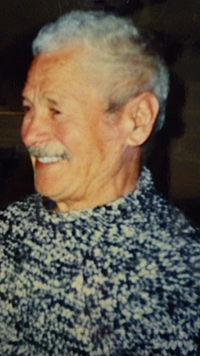
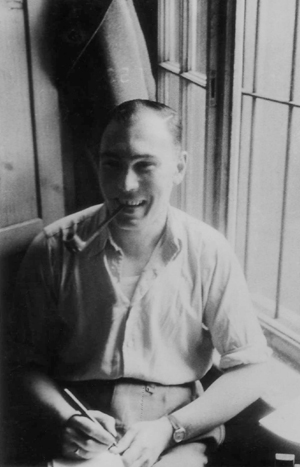
R. J. McMahon—Case for A Campaign Star

The three-page letter featured in this post was sent to me by R. J. McMahon’s daughter Linda Vaness. On receiving his WW II service medals, R. J. realized he qualified for one additional honor—an Italian Campaign Star.

This letter explains his justification for receiving the Star. As the text is written longhand in a single block, I’ve taken the liberty of dividing it into paragraphs for ease of reading.

I asked Linda if, in response to the letter, her father had received the campaign medal.

“Yes, Dad did get the Italian Star,” She replied. “We have had all of his medals set into a special jarrah (Western Australian hardwood) frame and his grandson has inherited them.”
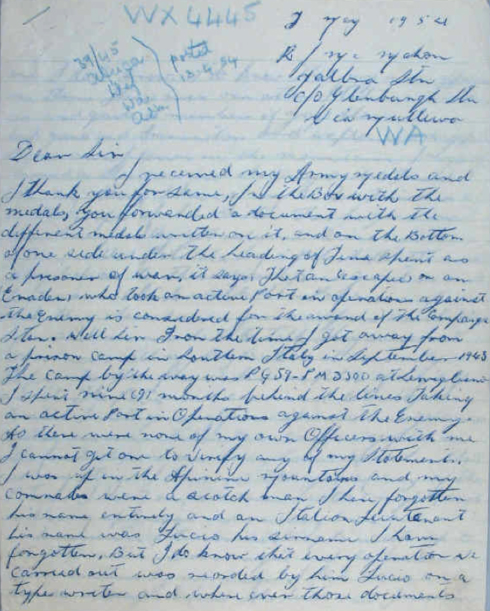
7 May 1954
R J McMahon
Yalbra Stn
C/O Glenburgh
Via Mullewa
WA

Dear Sir,

I received my Army medals and I thank you for same. In the box with the medals you forwarded a document with the different medals written on it and on the bottom of one side under the heading of time spent as a prisoner of war, it says, that an escapee or evader who took part in operations against the enemy is considered for the award of the Campaign Star.

Well, sir, from the time I got away from a prison camp in southern Italy in September 1943—the camp, by the way, was PG 59–PM 3300 at Servigliano—I spent nine (9) months behind the lines taking an active part in operations against the enemy. As there were none of my own officers with me I cannot get one to verify any of my statements.

Continue reading

R. J. McMahon, Part 2—Escape and Beyond

What follows is the second installment of R. J. McMahon’s autobiography, 1939–44. This post covers his experience in prison at Servigliano, escape, his involvement with the Partisans, and his eventual return to Australia.

Inside the prison walls were about 14 huts and each hut contained 50 prisoners. These huts were the most unstable constructions around and would shake with the slightest movement. When we were in bed they would shake us to sleep. The beds were two-tier bunks made with wooden slats about 6” apart. The mattresses we were issued with were a good kapok style, which were fairly comfortable and [we were issued] plenty of blankets. Having sheets on the bed was a big surprise, as we never had sheets in our own army. The last sheets we had enjoyed were prior to leaving Australia. At the end of the first week we had them taken off us and sent away to be cleaned, and we were issued with another set. Our sheet issue ran out at the end of the second week, when we mustered at the collection point waiting for another lot. The Italian in charge informed us there would be no more sheets as they had found out that the Australians did not give their prisoners sheets so they wouldn’t give them to us.

Six mates and I stayed in this prison camp for 12 months before succeeding in finding a way to get out. We tried digging our way out, emptying the soil down the sewage system and flushing it away. It was only sand and you had to take a chance on whether it fell in or not. There were a few blokes who did escape through a tunnel, but they were caught shortly after and brought back.

Continue reading

R. J. McMahon, Part 1—Battle and Captivity

Earlier this year, I heard from Linda Veness of Perth, Western Australia.

She wrote, “My father was a POW in Camp 59. He and four other Australians escaped together. My father was R. J. (Jim) McMahon WX4445, AIF [Australian Imperial Force]. His companions were Private Tom Alman from Kalgoorlie, Jack Allen from Kalgoorlie, Lance Corporal Les Worthington of Wiluna, and J. Feehan of Geraldton—all from Western Australia. There is an account of their escape in one of our newspapers.

“Also escaping with them was a Scot. He was a man named Tom Kelly (written on the back of a photograph) who was nicknamed “Jock”—how odd for a Scotsman! I have tried to figure out who he was, where he hailed from, and what happened to him, but with no luck.

“My father wrote an autobiography when he was about 70 years old—15 years before he died in 1999.

“I had grown up with stories about my Dad’s war experiences: never the grim bits, just tales of where he had been and the mates he had made along the way. When we lived in Geraldton, Western Australia, he would catch up every couple of years with all the chaps from the 2/28 Battalion when they had their reunions. It was a regular weekend, I can’t remember which month, but the weather was always pleasant. They had get-togethers for the adults and there was always a BBQ or picnic which their children could attend. I loved those days. The men were some of the ‘best blokes’ you could ever hope to meet. It seemed to be a part of my teenage years, waiting for that weekend.

Continue reading

Ken Fenton on New Zealanders

Early this year I was in search of information about any New Zealand POWs interned in Camp 59. Bill Rudd, a former Australian WWII POW and creator of the excellent web resource ANZAC POW Freemen in Europe, referred me to New Zealand WWII veteran and historian Ken Fenton.

Ken wrote to me:

“I served in Italy during WW2 in the 2nd NZ Division, but was never captured, although there were occasions when I might have come close when on recce [reconnaissance].

“In the last six years I have become interested in the fortunes of NZ [New Zealand] and Aust [Australian] POWs, as I was asked to write a book about those who were detained at Campo 57.

“Most of the NZ and Aust POWs were sent to PG 57 soon after arrival in Italy, following brief stays in transit type camps, but a few drifted in over a period of time as they left Italian hospitals or for other reasons.

Continue reading

“The Earthquake” Returns to San Benedetto

This clipping from a local San Benedetto Del Tronto (Marche, Italy) newspaper, commemorated the return, after two decades, of a favorite son—Nicola Lagalla, known to locals as “the earthquake.”

Nicola returned to San Benedetto when the hometown soccer team, Samb, was having a spectacular season.

Nicola’s daughter, Marida Parkes, in sending me the clipping, explained:

“When Samb climbed up the soccer ladder—because of their win—the town went berserk… they celebrated for weeks (as you do when you are Italian). Dad and mum flew to Italy for the festivities.

“Dad is fanatical about his soccer and Aussie Rules football. To this day he does not miss a match and will get up at all hours to watch.”

Sanbenedettese, the name for a person who is born in San Benedetto Del Tronto, is also the name of the soccer team—or Samb for short. Red and Blue are the Samb team colors.

Translation of the article:

NICOLA LAGALLA (earthquake)

“Today amongst us, we have chosen an enthusiastic, fanatical pureblooded Sanbenedettese who, from such a distance, has maintained his love not only for his soccer team, Samb, but also that of his hometown.

“He immigrated to Australia 20 years ago. With such distance between them, he missed his family and he has also missed his beloved team—Samb. The only comfort, as the newspaper reported on Tuesday, was that the Red & Blue team was promoted on the football ladder. Upon hearing this, he could not ignore the call to return to his roots and returned to San Benedetto Del Tronto for the festivities.

“He [Nicola] will remain here with us until the beginning of the next season/championship.”

Continue reading

Nicola Lagalla—After the Rescue

Marida describes the photo above: “This is of dad and myself—yes, with a ‘boy coif.’ I was two years old and dad would then have been 29 years old. It was taken at San Benedetto, opposite the port.”

Below right: Nicola Lagalla in recent years.

I asked Mariada Parkes this week if her father, Nicola Lagalla, and his brother Liberato ever returned to San Benedetto del Tronto after their transport of the British POWs down the Adriatic coast. (See “Nicola and Liberato Lagalla—Rescue by Sea” for the full story.)

She replied, “Papà tells me that after he and his brother delivered the POWs to safety, their boats were tied up alongside an American ship in Termoli for approximately one month.

“The boats used to assist the POWs were the San Nicola—built by my nonno [grandfather] and named after my dad—and the Luigi Primo. My nonno purchased the second boat, which had already been named.

“Dad and uncle had no money and no diesel for the boats.

“After a while, the Americans supplied them with diesel so that they could take the boats out fishing. They fished off the shores of Termoli, Molfetta, and Barletta. They sold the fish at the fish markets in these towns and then returned to the ship in Termoli.

“There was a curfew at the time—and so, dad and uncle returned to Termoli every day no later than 5 p.m.

“A little twist—in Barletta, dad met a man who had previously been a POW in Tobruk for two years. This fellow was allowed to help dad as a deck hand.

Continue reading

Nicola and Liberato Lagalla—Rescue by Sea

I was pleased to hear not long ago from Marida Parkes. Her father Nicola Lagalla and his brother Liberato were instrumental in transporting Captain J. H. Derek Millar and dozens of other escaped prisoners down Italy’s Adriatic coast from San Benedetto del Tronto to Termoli.

Marida had read Captain Millar’s autobiography and recognized her father’s role in his escape. Soon after, she interviewed her dad so that she could share the his story with Captain Millar’s son, Lenox.

Nicola now resides in Perth, Western Australia.

Here is his story:

“My brother and I knew nothing of the prisoners until we were approached by Commander Nebbia—my nautical professor—and Mr. Antonio Marchegiani.

“Prior to their approaching us, my brother and I had already decided that we were going to escape [from San Benedetto del Tronto] with our boats within two days. The boats belonged to my nonno [grandfather] Emidio Lagalla.

“They were the only two boats left on the wharf—and due to be sunk by the Germans.

Continue reading

Portraits of the Guys

These delightfully sensitive portraits of fellow prisoners are believed to have been taken in Camp 59 by Denis Crooks. Denis’ daughter, Maggie Clarke, found the photos among his papers after Denis passed away.

Unfortunately, we do not know the identities of these fellows, but their personalities shine brightly through these photographs.

Continue reading

Captain J. H. Derek Millar

J. H. Derek Millar grew up in Scotland. He qualified in 1937 from Edinburgh University and had been working in hospital medicine when the war broke out and he volunteered for service.

He was posted to go overseas in 1941. He served in North Africa and was captured in Egypt and was sent to Camp 59.

As one of two medical officers in the camp, he was confronted by primative hygienic conditions, poor nutrition and insufficient food in general, harsh climate, pests and parasites, and lack of medicine and tools for carrying out routine care.

On September 9th, the day the Italian Armistice was announced in the camp, Sergeant Major Hegerty, who had been commanding officer at Camp 59 for one year, relinquished his duties. Captain Millar volunteered to take over command of the camp.

It was in this commanding role that Captain Millar—just five days later—negotiated with the commandant, Colonel Bacci, for release of the prisoners.

Continue reading

Carnival Time

The photos in this post are from Maggie Clarke, daughter of Camp 59 British prisoner Denis Crooks.

Denis kept a suitcase—a veritable treasure trove—of letters, newspaper clipping, and photos related to his POW experience.

Maggie explains, “We didn’t find his suitcase full of these letters until after he died nine years ago. We also have some photos which he took of camp life, although as he said, he would have been shot if he had been caught! He must have got to a point where he didn’t care.”

She continues, that the photos “aren’t of brilliant quality as he somehow had them developed in camp! I seem to remember he mentioned bribing one of the guards! Mind you, by reading of some of the inventions he and Bob made, they probably made their own dark-room!”

Bob, of course, is Denis’ close friend and fellow prisoner Robert Dickinson.

Continue reading