Author Archives: Dennis Hill

Peter Grillo—Captive

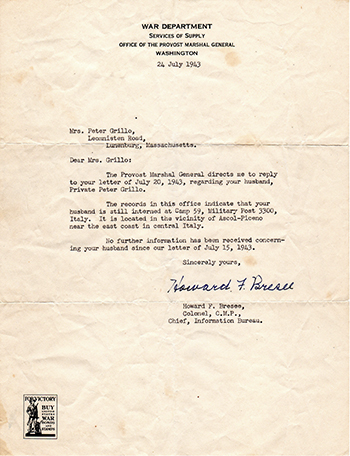
grillo_letter_r72

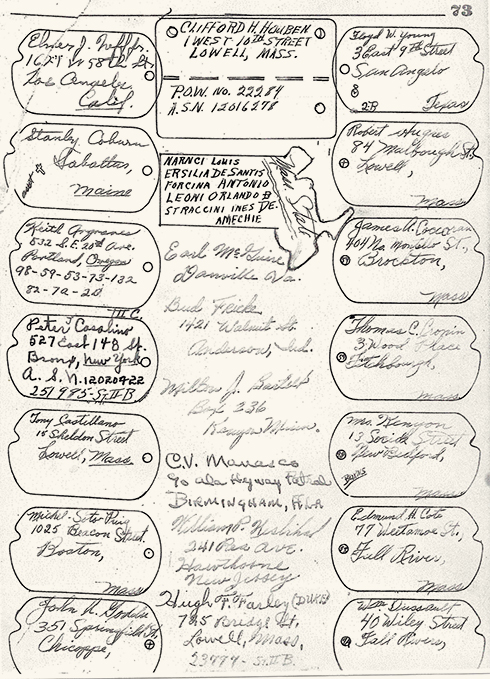
I received a note this morning from Roy Grillo, who, in conducting online research about his father, Peter Grillo, discovered his name on Clifford Houben’s Address List of POWs.

Peter’s name and address are also recorded in Charles Simmons’ address book.

Peter passed away in 2002.

Roy shared a letter with me that was sent by the U.S. War Department to his mother, Virginia E. Grillo, during Peter’s captivity.

Here is the text of that letter:

WAR DEPARTMENT
SERVICES OF SUPPLY
OFFICE OF THE PROVOST MARSHAL GENERAL
WASHINGTON

24 July 1943

Mrs. Peter Grillo,
Leomnister Road,
Lunenburg, Massachusetts.

Dear Mrs. Grillo:

The Provost Marshall General directs me to reply to your letter of July 20, 1943, regarding your husband, Private Peter Grillo.

The records in this office indicate that your husband is still interned at Camp 59, Military Post 3300, Italy. It is located in the vicinity of Ascol-Piceno [Ascoli Piceno] near the east coast in central Italy.

No further information has been received concerning your husband since our letter of July 15, 1943.

Sincerely yours,

Howard F. Bresee
Colonel, C.M.P.,
Bhief, Information Bureau.

“I remember my dad told me once that he and some of the other men ate rat and dog because of very small meals that were made available to them,” Roy said.

“I think the greatest gift my father left me was his talk about death and fear just before I left for Vietnam. It had a profound impact on me when our convoy came under attack (ambush), and it was his words that got me through those tough times.”

roy-grillo_neil_r72

“This photo is one my dad liked,” Roy said. “That is me, age 19, leaning on the machine gun and a very good friend, Neil Naffzinger, who drove this truck.”
Thomas Ager—Escapee from Italian Camp 82

TJ_Ager1_r72

T. J. Ager, after war and imprisonment, looking “rather the worse for wear”

On February 9, I received a note from Gillian Pink of Suffolk, England.

Her father, Thomas John Ager, who served in the Essex Regiment, was captured at Deir el Shein during the first battle of El Alamein. He was sent to Camp 82 at Laterina, Italy.

After the capitulation of Italy in September 1943, Tom and the other prisoners of the camp found themselves free of prison, but behind enemy lines.

“My father’s letters from Camp 82 stop in August of 1943,” Gill explained. “There is one dated July 1944 from the Red Cross to my mother saying he had been sent to a transit camp (Feldpost 31979), and another from the Red Cross dated August 1944 saying he was in Stalag VII-A. Shortly after, he was transferred to Stalag VIII-B, where they all seemed to end up.

“The first letter from Stalag VII-A is dated 16 July 1944. It says ‘The life that I am leading now is not quite so hectic as I have been used to for the last ten months. So I am having a little rest.’ I’m sure his time on the run is what he’s referring to, though my mother may not have known that. I can’t imagine an account of it would have been allowed past the censor.

Continue reading

Ray Kestner’s “Christmas Book”

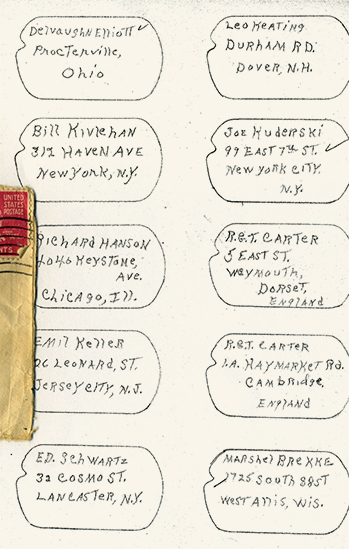
r-kestner_address-page_r72

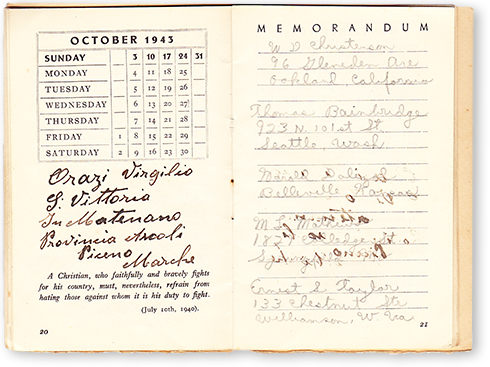
Ray Kestner’s granddaughter, Jessica Kestner McMahon, calls the little book that Ray brought home from prison camp the “Christmas book.”

Entitled Christmas 1942, the calendar booklets were a gift of Pope Pius XII to the Allied prisoners.

The booklets consist of 48 pages and a cover. They have calendar pages for January–December 1943, as well as a “memorandum” page for each month (pages 2–25); the rest (pages 26–48) is comprised of hymns and Christmas carols.

Camp 59 prisoner Charles Simmons also owned one of these booklets, described in “Charles Simmons’ Calendar and Address Book.”

Most of the addresses throughout Ray’s booklet are penciled in his own very legible handwriting. A few are written in other penmanship—presumably by the prisoners themselves.

Aside from the address of Italian Virgilio Orazi (above) and one Englishman—Bob Johnson of Leeds in West Yorkshire—the names and addresses are those of Americans.

Continue reading

Ray Kestner—Still Behind Enemy Lines

r_kestner-family_r72

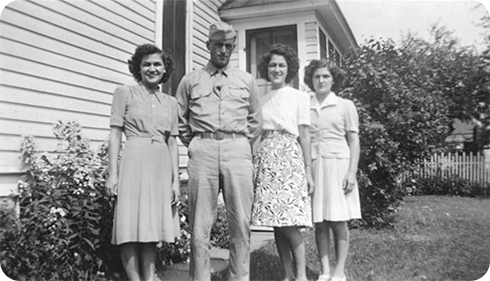
Raymond Kestner with family

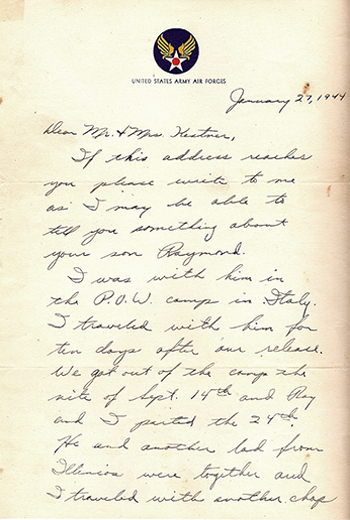
The letters in this post, saved by Ray Kestner’s sister, are posted here courtesy of Ray’s granddaughter Jessica Kestner McMahon.

In one of his letters, Marshall Wells makes reference to Ray’s wounded arm. Ray had been shot in the left arm before capture and was treated by the Italians.

The sensitive correspondence between strangers in this post calls to my mind the sharing of news concerning Albert Rosenblum’s capture described in “Kind Strangers—Relays from Radio Rome” and the news of Willman King recorded in “Heard over Shortwave.”

For more on Ray Kestner, see “Local News Articles—Raymond Kestner” and “Ray Kestner—Letters and Postcards.

Jan-27_44_1-M-Wells-r72

Continue reading

Willman King’s Addresses

w_king_2-r72 w_king_3-r72 w_king_4-r72 w_king_5-r72

w_king_1a-r72

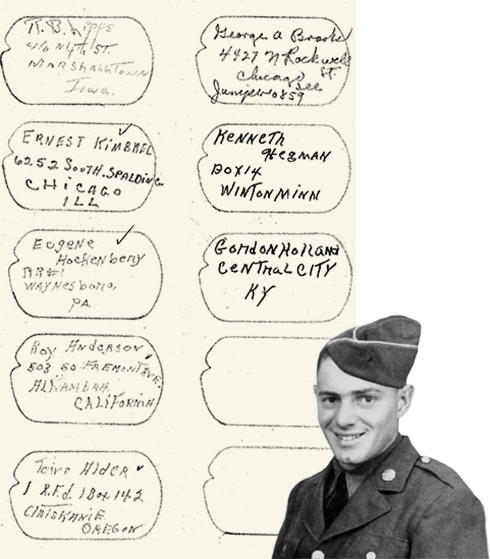
Above: American soldier Willman King superimposed against a page of his address list.

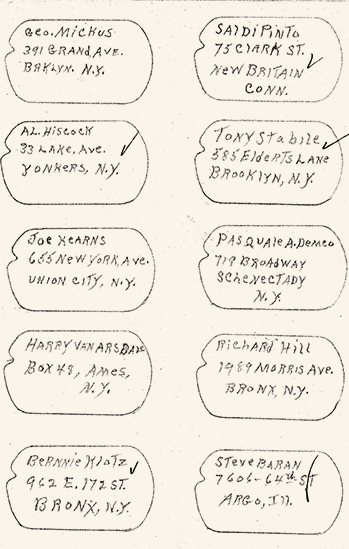
Like Clifford Houben, Charles Simmons, and many other POWs, Willman King kept a list of men he met while a prisoner.

Like Clifford Houben, Willman recorded his addresses on traced dog tags.

Because there are no notations in this list and because Willman was recaptured after escape from Camp 59 and sent to Germany, we can’t be sure which names and addresses were gathered in Camp 59 and which were collected later.

All the same, it’s good to have this document for future cross reference. Thanks to Willman’s son Joseph King for sharing this list.

R. B. Lipps
410 Ninth St. [street address is unclear]
Marshalltown
Iowa

Ernest Kimbrel
6252 South Spalding
Chicago
Illinois

Eugene Hockenbery
RR #1
Waynesboro
Pennsylvania

Continue reading

Clifford Houben’s Address List

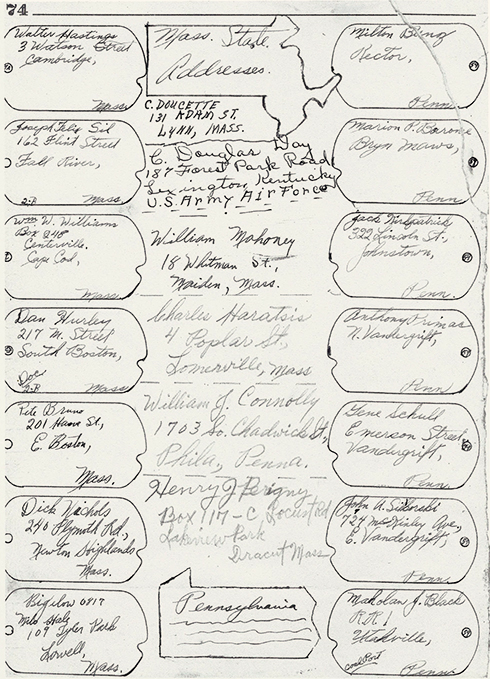
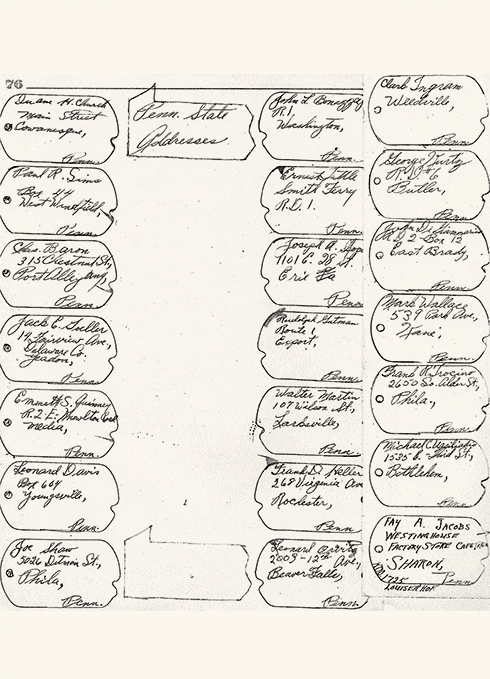
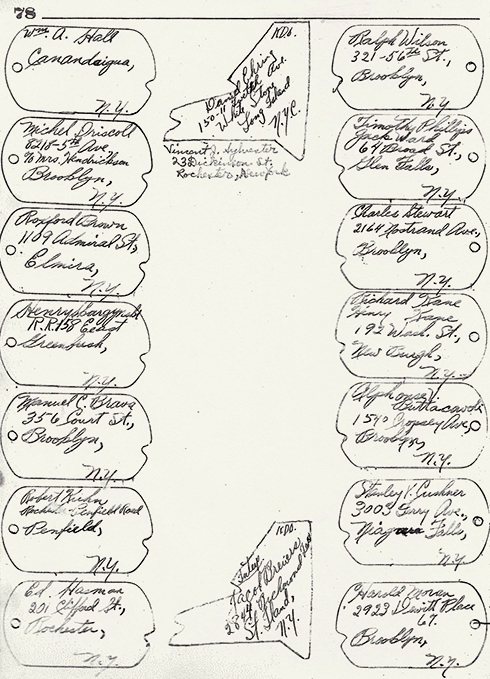
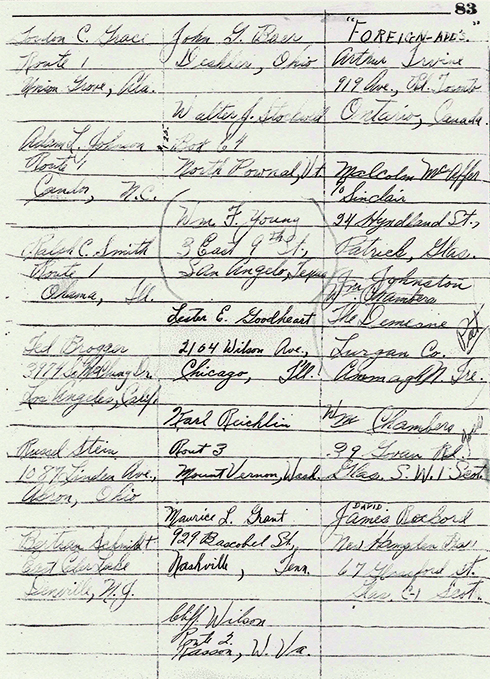
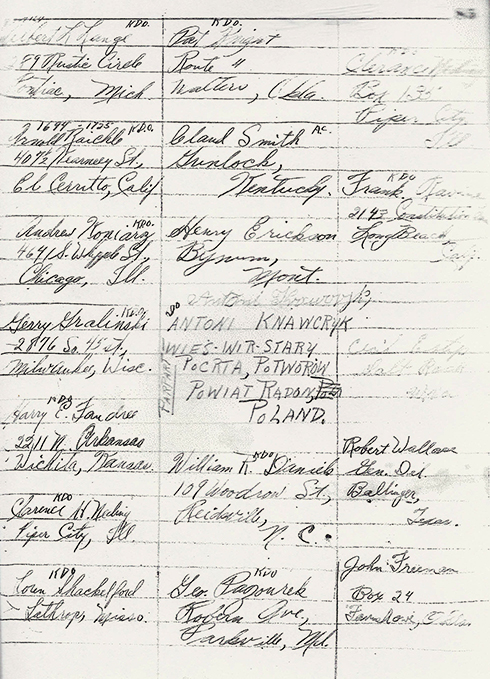
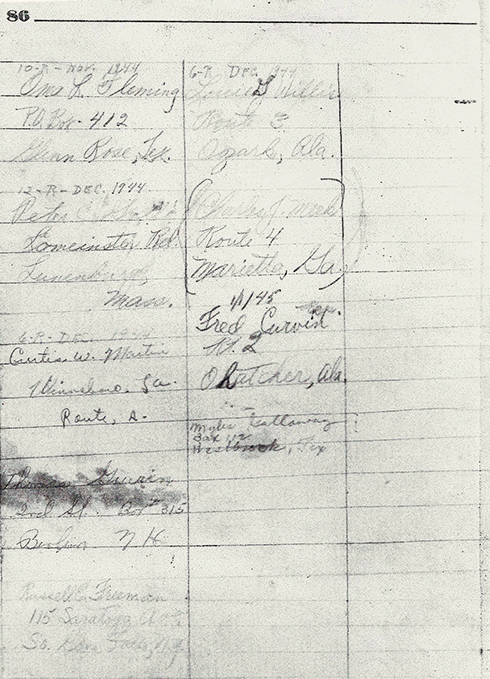
houben-74-r72 houben-76-r72 houben-77-r72 houben-78-r72 houben-83-r72 houben-84-r72 houben-85-r72 houben-86-r72

houben-73-r72

According to Wayne Houben (Clifford Houben’s son), Clifford escaped from Camp 59 and was given refuge by Italians; he was later recaptured and sent to Stalag 2B in Germany.

While in the Italian and German camps, Clifford accumulated a long address list of men he met. The list is comprised of nine full pages.

Roughly half of the addresses are written within the shapes of dog tags, and the traced holes of several of the tags cleverly contain camp numbers or crosses that likely indicate medical or pastoral affiliation.

Only the following 11 servicemen were noted as having been interned in Camp 59:

Keith Argraves, James A. Coccoran, Thomas C. Cronin, Edmund H. Cote, Milton Bunz, Marion P. Barone, Jack Kirkpatrick, Anthony Primac, Gene Schull, John A. Silborski, and Maholan J. Black

I checked many of the other names in the U.S. National Archives database of WW II POWS. Overwhelmingly, these other men were listed as having been freed from camps in Germany. How many were in Camp 59 and were recaptured after escaping—like Clifford Houben—I have no way of knowing. Some of the men, like Richard and Henry Kane, I know from other sources to have been in Camp 59.

I hope that relatives of any of the men listed below who read this post will contact me (hilld@indiana.edu) in order to help to resolve a bit of this puzzle.

Continue reading

Ray Kestner—Letters and Postcards

kestner-gate-r72

Ray Kestner

Jessica Kestner McMahon shared the following letters and postcards that her grandfather sent home while in the service. Ray Kestner was interned at Camp 59 in 1943 from March 1 to September 14.

On December 17, newspaper articles about Ray were posted to this site.

LETTER

[Fort Knox, Kentucky]

Dear Pappy, Mamy, and kids,

We finally arrived in Fort Knox at about 7:00 pm Fri. It took 39 hours to get here. While we were on the train we ate out of our mess kits. We had plenty to eat. The kitchen was in the baggage car.

It’s kool and cloudy here today. It sure rained hard last night. The ground is all red here except where there are trees. It’s kinda hilly around here and the buildings we are in are all new the same as at Snelling [Fort Snelling, Minnesota].

We have off from Sat. noon to Mon. morning, so I am just listening to the radio.

Yours with Love
Pvt. Raymond Kestner
Co. A, 10th Battalion
A.F.R.T.C., 4th Platoon
Fort Knox, Kentucky

Continue reading

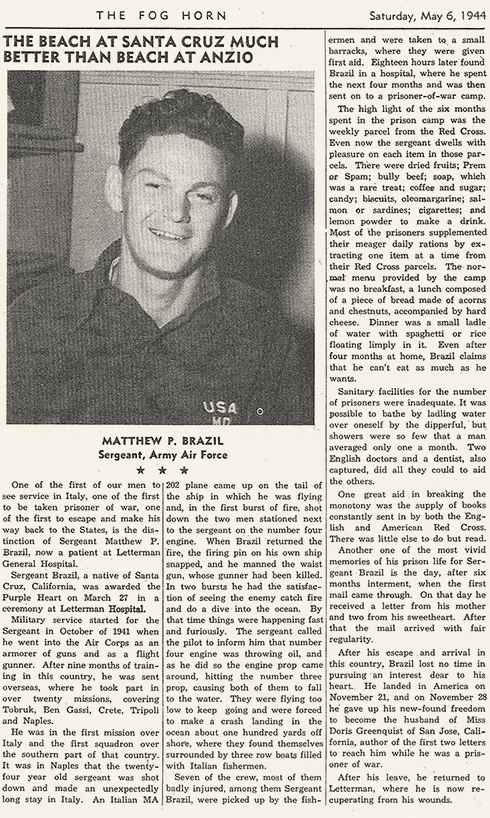
Matt Brazil Recuperating

Brazil-MPB-SF-5-6-44-r72

The U.S. National Archives database of WW II POWs lists Matt Brazil as having been a prisoner, but the record doesn’t include a camp name.

A couple of things mentioned in Laura Rawson’s article, “The Story of Sergeant Matt Brazil….,” and the Fog Horn article seem to reinforce that he was in Camp 59:

The article above mentions two British doctors. The two British doctors in Camp 59 were J. H. Derek Millar and Adrian Duff, both Scottish. The article also mentions a dentist—who was named Hogson, according to Giuseppe Millozzi.

Matt mentions getting mail regularly, which was not true in all camps.

Camp 59, though not in Ancona, is near to it. Matt’s estimate of their being around 1,300 prisoners (about 1,100 British and 200 Americans) in camp is close. The number in Camp 59 at the time of the escape is generally estimated at 2,000. Giuseppe Millozzi refers to Italian military authority records in giving the count of prisoners in March 1943—close to the time Matt would have arrived there—as 1,445 British and 464 Americans.

Continue reading

Freedom for Matt Brazil

Brazil-Santa-Cruz-12-43-r72

The Story of Sergeant Matt Brazil, Shot Down at Naples,
A Prisoner, Then Freedom

December 1943
By Laura Rawson

Sergeant Matthew Brazil, son of Mrs. Jennie Brazil of Santa Cruz, an aerial gunner who shot down [by] an enemy plane after it had disabled the Liberator on which he was a gunner over Naples December 11 of last year, and who escaped from an Italian prison camp less than three months ago, is bringing a happy ending to 1943 after all, for last Sunday he married Doris Greenquist of San Jose, to whom he became engaged before going overseas.

He will receive the purple heart and the air medal for his heroic efforts. His troubles are not entirely over yet, for he will undergo an operation to correct adhesions in the tendons of his injured leg soon. Sgt. Brazil is assigned to Hamilton Field when his 30-day furlough is over. He does not expect to be sent back to the European theatre but says, “I wouldn’t mind taking a look at the Japs.”

He says the most exciting moment was when he landed a short time ago on American soil in Newport News, Virginia. “I felt like getting down and kissing the ground,” Sgt. Brazil declared.

Continue reading