Author Archives: Dennis Hill

Christopher Facchina—of Hut 4, Section 11

christopher-columbus-facchina_r72

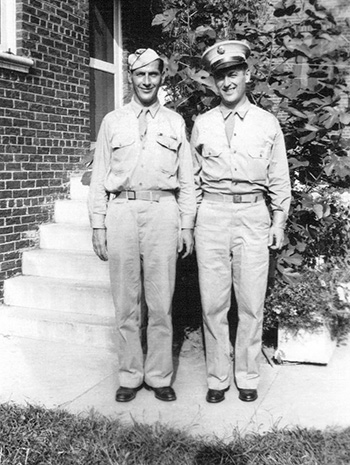
Christopher Facchina (left) and his twin brother Columbus were born October 12, 1912 (Columbus Day—the anniversary of Christopher Columbus’ arrival in the Americas).

I heard this week from Dennis Donehoo. He wrote, “My great uncle was Private Christopher Facchina.

“Christopher’s POW record states that he participated in Operation Torch, was captured at the Battle of Kasserine Pass in Tunisia, and was imprisoned at CC 59, Ascoli Piceno, Italy.”

Christopher Facchina was one of 35 men my father, Sgt. Armie Hill, was given charge of in the camp. See “Men of Hut 4—Section 11.”

“Your father mentions during his time as a POW he attended an ‘Italian class,” Dennis said. “Many pages of his journal read like an English-Italian Dictionary. [See “Armie Hill’s Camp Journal.”]

Continue reading

More Commonwealth Inmates of P.G. 59

The 30 men listed below were at one time interned in Camp 59. All were transferred to other camps before the September 1943 breakout. Dates of the men’s P.G. 59 internment are listed with their names.

Twenty-nine of the 30 soldiers are new to this site—Patrick Cahill is the one exception.

British researcher Brian Sims gleaned this information from his British National Archives data. I am most grateful to him for this generous contribution.

Unlike the 24 British soldiers listed in “British Escapees from Camp 59—New Names, who escaped to the Allied lines in the south, these 30 men found freedom via other routes. All returned home safely.

James Bough
Service Number—1086472
Gunner
102nd Regiment, Royal Artillery
Captured January 21, 1941—Sidi Rezegh, Libya
Camp 59 internment—January 23, 1942–January 24, 1943

Victor Boulter
Service Number—T/164744
Driver
Royal Army Service Corps
Captured April 8,1941—Fort Michelli
Camp 59 internment—March 1942–May 1943

R. C. R. Boulton
Service Number—5732581
Corporal
2nd Battalion, Parachute Regiment
Captured December 4, 1942—Tunis, Tunesia
Camp 59 internment—March 5, 1942–June 3, 1943

Continue reading

Tenna Valley Memorial Walks

trail_tenne_r72

Fording the River Tenna

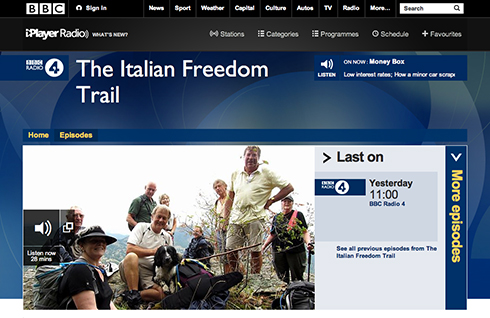
This post is an account by Anne Copley of the September 5–8 “memorial walks” based out of Camp 59 in Servigliano. The walks were arranged jointly by the Escape Lines Memorial Society (ELMS) and Monte San Martino Trust (MSMT).

Here is Anne’s story:

“A Syrian photojournalist, a very famous Italian photojournalist (being filmed for his own life story), a Canadian woman seeking information about her father, and the CEO of the UK Red Cross mingled with Italian students, retired soldiers, a Jack Russell dog and others with various connections to Italy at the start of three days of walking through the Southern Marche countryside.

“The reason? to commemorate the date on which Italians signed the Armistice and many of the fathers and grandfathers of those taking part escaped singly or en masse from prison camps across Italy.

Continue reading

Enduring friendship—A Virgili/Vacca Reunion

virgili-visit-pikes_r72

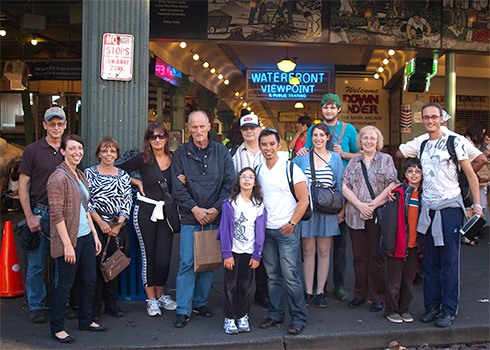
The Virgili and Vacca families at Pike’s Place Market in Seattle.

Left to right: Mario Vacca, Antoinette Perez (Tony’s daughter), Nancy Vacca (Mario’s wife), Maria Anna and Egisto Virgili, Tony Vacca, Joseph Perez (Antoinette’s husband), Cathie Vacca (Tony’s daughter), Christopher Howell (Cathie’s boyfriend), Brenda Vacca (Tony’s wife), Brendan Perez (Antoinette/Joseph’s son), and Alessandro Virgili, and in the very front is Alexis Perez (Antoinette/Joseph’s daughter).

Last March, I received a note from Mario Vacca, a son of Camp 59 escapee Felice “Phil” Vacca, announcing, “We’ve gotten news that some of the Virgili family are coming to Seattle this fall for a visit. They anticipate arriving on September 5 and staying five days.”

This was exciting news. Vacca brothers Mario, Tony, and Jim had kept in touch with the family who had sheltered their father since Tony made contact with the Virgilis in 1968. Egisto’s mother was Adele (Lelena) Virgili, who was a young woman when Phil lived with them.

Continue reading

War Crimes—Sorting through the Accounts

British researcher Brian Sims recently sent me an interesting affidavit from the British National Archives (file WO 311/1336), “In the matter of German war crimes and in the matter of the death of ‘George Godfrey’ in Italy about March, 1944.”

About a week later, Anne Copley mentioned to me that in the commume of Montelparo a British escapee variously called George or David was shot while running from the Germans/Fascists.

I began to wonder if this George or David might be George Godfrey or another fellow named George mentioned in the affidavit, as Montalto delle Marche is very near to Montelparo and Montalto is where the war crimes mentioned in the affidavit occurred.

Here is the full text of the affidavit, given by Forrester Hart:

In the matter of German war crimes and in the matter of the death
of ‘George Godfrey’ in Italy about March, 1944.

I, Forrester HART, with permanent home address in Barnsley Road, Dodworth, New Barnsley, Yorkshire, make oath and say as follows:

(1).
During the War I served with the R.A.S.C. [Royal Army Service Corps] and was serving with that Unit, attached to the Royal Artillery (Medium), in North Africa. My rank was Acting Lance Corporal and my regimental number T/230944. On the 21st June, 1942, I was taken prisoner by the Germans on the fall of Tobruk.

(2).
At the back end of July or the beginning of August, 1942, I, along with the other prisoners, was taken to a transit camp at TARANTO, via Derna and Bengazzi. About a fortnight later I was transferred to No.65 Camp, near Barri, where I was detained approximately 10 or 11 months. In June, 1943, I was taken to MACERATA Camp. About this time the Italians Capitulated.

Continue reading

A Chat with Neil Torssell

marche_165_r72

Neil Torssell passed over the rugged, beautiful terrain of Le Marche during his nine months “on the run” in 1943–44.

I first interviewed Neil Torssell in May 2008. An Interview with Neil Torssell covered his experience from the time of enlistment through the end of war.

Another interview, arranged though the Minnesota Historical Society’s Minnesota’s Greatest Generation Project, was recorded the year before.

On a follow-up phone visit with Neil on July 28, 2011, Neil shared more information with me about the time he was a fugitive in Italy.

My questions and comments below are in italic.

Neil, I have some additional questions I’d like to ask you.

You mentioned to me that when you escaped there were eight or nine of you together. You said there was somebody from New York who spoke Italian—Jimmy. You sent me the addresses of some of the guys you knew who were in the camp. I noticed there was a Jimmy Serrentino, and I was wondering if that was the Jimmy who was with you during the escape.

Yes, he was the one with us who spoke fluent Italian.

Continue reading

Stourton Escape Documentary on BBC

stourton-bbc_r72

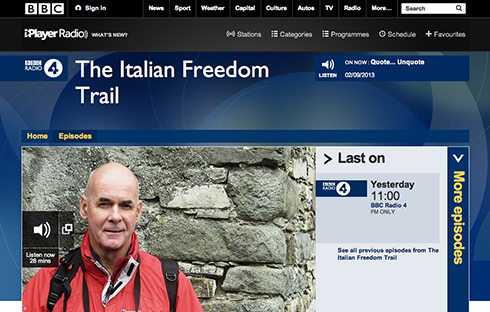
The BBC yesterday broadcast the first episode of a two-part documentary on the WW II breakout of Allied prisoners from Italian prison camps. The programs are the work of veteran journalist and author Edward Stourton.

This documentary was planned to commemorate the 70th anniversary of the September 1943 camp breakouts and the protection of the escapees by the Italian contadini.

Listen to Part 1 of “The Italian Freedom Trail” (www.bbc.co.uk/programmes/b038zcqh)

The far reach of the BBC ensures that this story will be heard not only in the UK, but around the world.

Stay tuned! Part 2 of Edward Stourton’s report is scheduled for broadcast next Friday, September 6.

Continue reading

Peter Grillo—Surgery “Sans Anesthetic”

grillo_article_r72

This article is from Peter Grillo’s son Roy.

He explained, “Digging through lots of papers, I found another item which is very interesting. This is the story my dad used to tell me as I grew up and was asking questions.”

We know that Peter was interned at Camp 59 in Servigliano through a letter from the War Department to Peter’s wife dated July 24, 1943 (See “Peter Grillo—Captive“).

The article suggests the surgery was done in an Italian POW camp. However, there only two British medical officers in the camp at that time, no German doctors. Perhaps at one point Peter was interned in another camp or hospital in Italy where the surgery was performed by the German doctor.

It seems even more likely the surgery was actually done after his transfer to Germany. According to the U.S. National Archives, Peter was last interned in Stalag 2B Hammerstein in Germany.

Continue reading

The Virgili Family

A few days ago Mario Vacca, one of Phil Vacca’s sons, sent me this information on the Virgili family during WW II.

The information, provided by Egisto Virgili, is below in both Italian and English.

Egisto and his family will be visiting Mario and his brother Tony here in the U.S. next month.

Con molto piacere cercherò di spiegarvi come era composta la famiglia Virgili. Mi pare di aver capito che le vostre conoscenze sono limitate a Elena, Sergio, Luigia ed alla loro mamma, Maria in quanto erano quelli presenti nel periodo in cui vostro padre, Felice, è stato loro ospite. In realtà i componenti erano otto (8). I genitori: Settimio e Maria con sei (6) figli: Nicola (1905), Erminia (1909), Elena (1910), Sergio (1914), Emilio (1916) e Luigia(1917).

With pleasure will I try to explain to you the makeup of the Virgili family. I think I understand that your knowledge is limited to Elena, Sergio, Luigia, and their mother, Mary, as they were the ones present at the time your father, Felice, was their guest. In reality there were eight in the family. Parents: Settimio and Maria with six children: Nicola (born 1905), Erminia (1909), Elena (1910), Sergio (1914), Emilio (1916), and Luigia (1917).

Continue reading